


02 Aug PM Modi Launches ‘Nasha Mukt Yuva’ Campaign for Drug-Free India 2026
✎ The 'Nasha Mukt Yuva for Viksit Bharat Sankalp Abhiyan' is a 100-week Jan Bhagidari campaign integrating youth-led activities, competitive arts, and digital pledges to combat substance abuse, culminating in the National Nasha…
Subject Relevance — Where This Topic Fits
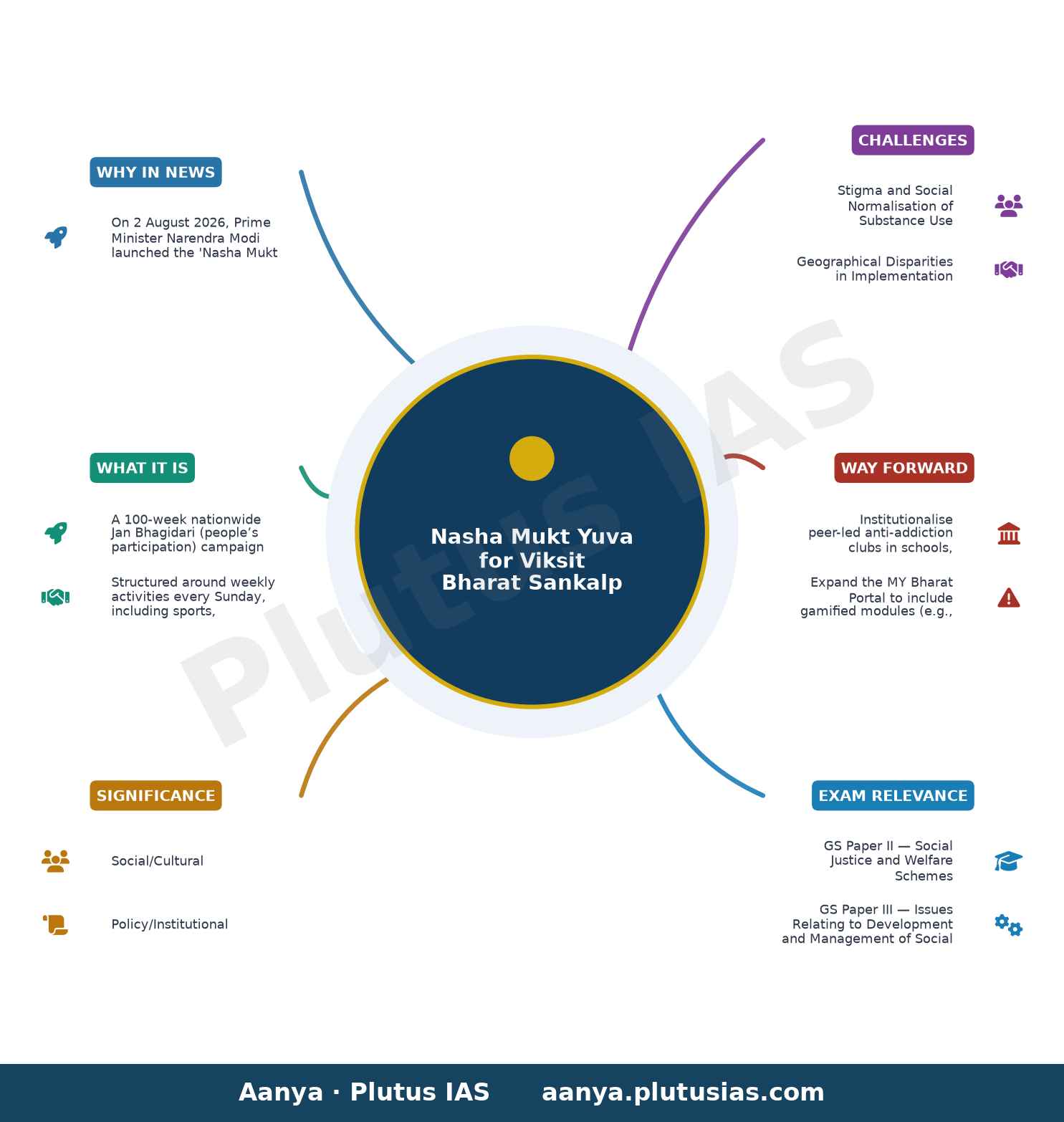
- GS Paper II — Social Justice and Welfare Schemes | GS Paper III — Issues Relating to Development and Management of Social Sector/Services relating to Health, Education, Human Resources | GS Paper IV — Ethics and Human Interface: Role of Family, Society and Educational Institutions in Inculcating Values
- Prelims: Substance abuse, Jan Bhagidari, MY Bharat Portal, Nasha Mukti Pledge, National Service Scheme (NSS), Viksit Bharat Sankalp Yatra, District-level competitions in folk arts, e-Pledge campaigns
- Essay: The Role of Youth in Nation-Building: Challenges and Opportunities, Balancing Development and Social Welfare: The Case for a Drug-Free India
Quick Revision: The ‘Nasha Mukt Yuva for Viksit Bharat Sankalp Abhiyan’ is a 100-week Jan Bhagidari campaign integrating youth-led activities, competitive arts, and digital pledges to combat substance abuse, culminating in the National Nasha Mukti Youth Conclave on 14 August 2026.
Why is this in the news?
On 2 August 2026, Prime Minister Narendra Modi launched the ‘Nasha Mukt Yuva for Viksit Bharat Sankalp Abhiyan’, a 100-week nationwide campaign aimed at combating substance abuse among youth through mass participation and community engagement. The initiative underscores the government’s commitment to integrating health, social justice, and youth empowerment in India’s developmental trajectory, aligning with the broader ‘Viksit Bharat’ vision.
Background
- Substance abuse among youth remains a critical public health challenge in India, with studies indicating rising trends in drug consumption, particularly among adolescents and young adults, driven by factors such as peer pressure, socio-economic disparities, and lack of awareness.
- The National Family Health Survey (NFHS-5) highlights that approximately 1.8% of men aged 15–29 in India report using drugs, with regional variations and underreporting likely skewing actual figures.
- The Government of India has historically implemented anti-drug policies such as the Narcotic Drugs and Psychotropic Substances (NDPS) Act, 1985, and the National Action Plan for Drug Demand Reduction (NAPDDR), but enforcement and prevention remain fragmented.
- The ‘Viksit Bharat Sankalp Yatra’ (2023–2024) served as a precursor to this campaign, emphasizing grassroots participation in developmental goals, including health and social welfare.
- The ‘MY Bharat’ platform, launched in 2023, is a digital ecosystem designed to engage youth in nation-building activities, including awareness campaigns and volunteerism.
- Global precedents, such as the United Nations’ ‘International Day Against Drug Abuse and Illicit Trafficking’ (26 June), and national models like Brazil’s ‘Crack, Crack is No Joke’ campaign, demonstrate the efficacy of community-led anti-drug movements.
What is the ‘Nasha Mukt Yuva for Viksit Bharat Sankalp Abhiyan’?
- A 100-week nationwide Jan Bhagidari (people’s participation) campaign launched on 2 August 2026, targeting youth engagement against substance abuse, culminating in the National Nasha Mukti Youth Conclave on 14 August 2026.
- Structured around weekly activities every Sunday, including sports, walkathons, meditation, cultural programs, nukkad nataks (street plays), and community discussions, to sustain momentum and awareness.
- Incorporates competitive elements at district, state, and national levels, with categories such as folk songs, mime acts, short films, painting, debate, and slogan writing, to encourage creative expression and peer learning.
- Aims to mobilize over 10 locations across India, involving MY Bharat Volunteers, NSS volunteers, educational institutions, NGOs, industry associations, and 125+ spiritual organizations in a unified anti-drug movement.
- Features the ‘Nasha Mukti Pledge’, a collective commitment by youth to abstain from substance abuse and inspire others, accessible via the MY Bharat Portal for digital participation.
- Seeks to strengthen the ‘Viksit Bharat’ vision by addressing the socio-economic costs of substance abuse, including reduced productivity, healthcare burdens, and intergenerational health risks.
Key Features
| Feature | Significance |
|---|---|
| 100-week Jan Bhagidari Campaign | Ensures sustained, long-term engagement of youth in anti-substance abuse activities, fostering habit formation and cultural shift. |
| Weekly Activities (Sports, Walkathons, Meditation) | Leverages mass participation to normalise healthy lifestyles and reduce social stigma around substance abuse. |
| District-State-National Competitions | Creates a structured, competitive platform for youth to express anti-addiction messaging through art, debate, and cultural forms. |
| Nasha Mukti Pledge via MY Bharat Portal | Digitally formalises individual commitment, enabling tracking and scalability of the movement across demographics. |
| Multi-Stakeholder Collaboration (Educational Institutions, NGOs, Spiritual Organisations) | Ensures convergence of formal and informal education systems to amplify reach and credibility of the campaign. |
Why it Matters
Social/Cultural
- Transforms youth from passive beneficiaries into active agents of social change, aligning with India’s demographic dividend and cultural ethos of collective responsibility.
- Promotes intergenerational dialogue by involving families, educational institutions, and communities in a shared anti-addiction narrative.
- Uses indigenous cultural forms (folk songs, nukkad natak) to embed the message in local traditions, enhancing relatability and penetration.
Policy/Institutional
- Demonstrates a whole-of-society approach, integrating youth affairs, health, education, and civil society into a unified anti-substance abuse strategy.
- Leverages the MY Bharat platform to institutionalise citizen engagement, aligning with the Digital India vision for participatory governance.
- Serves as a model for future Jan Bhagidari campaigns, potentially replicable for other public health challenges (e.g., mental health, nutrition).
Youth Development
- Addresses the critical intersection of youth empowerment and public health, positioning substance abuse prevention as a developmental priority.
- Encourages skill development (debate, art, leadership) through competitions, aligning with the National Youth Policy’s focus on holistic youth development.
- Fosters civic engagement by linking individual pledges to community-level action, reinforcing democratic participation among GenZ.
Challenges
1. Stigma and Social Normalisation of Substance Use
- Substance abuse remains socially normalised in certain peer groups, particularly in urban and semi-urban settings, complicating early intervention.
- Stigma associated with seeking help (e.g., rehabilitation) discourages youth from accessing available support systems.
UPSC Link: GS2: Social Justice—Issues relating to development and management of Social Sector/Services.
2. Geographical Disparities in Implementation
- Rural and tribal regions face higher vulnerability due to limited awareness, healthcare access, and law enforcement capacity.
- Urban slums and peri-urban areas often lack structured youth engagement platforms, necessitating targeted outreach strategies.
UPSC Link: GS1: Social Issues—Regional disparities in health outcomes and governance.
3. Sustainability of Community Engagement
- Maintaining momentum beyond the 100-week campaign requires institutionalisation of local anti-addiction initiatives (e.g., youth clubs, peer mentoring).
- Dependence on volunteerism risks attrition, necessitating formal partnerships with educational institutions and NGOs for continuity.
UPSC Link: GS2: Governance—Issues relating to development and management of Social Sector/Services.
4. Inter-Ministerial Coordination Gaps
- Effective implementation demands seamless coordination between Ministries of Youth Affairs, Health, Social Justice, and Education, which is often challenging.
- Delays in policy alignment (e.g., drug de-addiction centres, helplines) can undermine campaign impact.
UPSC Link: GS2: Governance—Role of Civil Services in Policy Implementation.
5. Digital Divide and MY Bharat Portal Accessibility
- Rural youth may face barriers in accessing the MY Bharat Portal due to limited internet penetration or digital literacy.
- Ensuring inclusivity requires offline modes (e.g., SMS-based pledges) and multilingual interfaces.
UPSC Link: GS3: Science & Technology—Digital Divide and Inclusive Growth.
Challenges — UPSC Perspective
| Issue | Concern |
|---|---|
| Peer Pressure | Normalisation of substance use in social circles, particularly among college students and working youth. |
| Lack of Awareness | Limited understanding of the legal, health, and socio-economic consequences of substance abuse among adolescents. |
| Law Enforcement Gaps | Inadequate policing of drug trafficking routes and weak implementation of the Narcotic Drugs and Psychotropic Substances (NDPS) Act in certain regions. |
| Rehabilitation Infrastructure | Shortage of de-addiction centres and trained counsellors, especially in Tier-2/3 cities and rural areas. |
| Cultural Relativism | Traditional practices (e.g., cannabis use in certain festivals) may inadvertently legitimise substance use. |
| Economic Vulnerability | Youth in informal sectors (e.g., gig workers, migrant labourers) face higher exposure to substance abuse due to stress and lack of structured support. |
Way Forward
- Institutionalise peer-led anti-addiction clubs in schools, colleges, and vocational training centres to sustain engagement post-campaign.
- Expand the MY Bharat Portal to include gamified modules (e.g., quizzes, challenges) to enhance digital participation and peer accountability.
- Strengthen district-level rehabilitation centres by integrating them with the campaign’s community networks for seamless referrals.
- Launch region-specific awareness drives in languages and cultural formats (e.g., Bhojpuri folk songs, tribal storytelling) to enhance relatability.
- Partner with industry bodies (e.g., NASSCOM, FICCI) to conduct workplace anti-substance abuse workshops for young professionals.
- Develop a national helpline with multilingual support, integrated with the campaign’s pledge system for real-time assistance.
- Conduct longitudinal studies to assess the campaign’s impact on youth behaviour, enabling data-driven policy refinements.
- Collaborate with state governments to align the campaign with existing schemes (e.g., Nasha Mukt Bharat Abhiyaan) for synergy.
UPSC Value Addition
Keywords for Mains Answer-Writing
Nasha Mukt Yuva Abhiyaan · Substance Abuse Prevention · Viksit Bharat Sankalp Abhiyan · Youth Empowerment · Community Participation · Jan Bhagidari Campaign · Nasha Mukti Pledge · MY Bharat Portal · Substance Abuse in India · Public Health Policy · National Service Scheme · Mental Health and Addiction · Drug-Free India · Youth Conclave
Concept Flow
Substance abuse among youth → Social and economic costs (healthcare, productivity loss) → National Youth Policy prioritises prevention → PM’s initiative leverages GenZ as change agents → 100-week campaign fosters habit formation → Community engagement normalises healthy lifestyles → Long-term reduction in addiction rates → Contributes to Viksit Bharat’s human capital development.
Prelims Practice Questions
Q1. Consider the following statements regarding the ‘Nasha Mukt Yuva for Viksit Bharat Sankalp Abhiyan’:
1. The campaign was launched on August 2, 2026, by the Prime Minister of India.
2. The initiative includes a 100-week nationwide Jan Bhagidari campaign against substance abuse.
3. The campaign culminates in a National Nasha Mukti Youth Conclave to be held in New Delhi on August 14, 2026.
4. The campaign is limited to urban youth and excludes rural participation.
How many of the above statements are correct?
- Only one
- Only two
- Only three
- All
Answer: Only three — Statements 1, 2, and 3 are correct as per the official launch details and campaign structure. Statement 4 is incorrect because the campaign explicitly includes participation from youth across over 10,000 locations, encompassing both urban and rural areas.
Q2. Assertion (A): The ‘Nasha Mukt Yuva for Viksit Bharat Sankalp Abhiyan’ aims to create a collective movement against substance abuse by involving educational institutions, youth organisations, and civil society groups.
Reason (R): The campaign seeks to leverage community participation to build a drug-free India, as articulated in the official press release.
- Both A and R are true, and R is the correct explanation of A.
- Both A and R are true, but R is NOT the correct explanation of A.
- A is true, but R is false.
- A is false, but R is true.
Answer: Both A and R are true, and R is the correct explanation of A. — Both the Assertion (A) and Reason (R) are true, and the Reason (R) correctly explains the Assertion (A). The campaign’s design explicitly includes multi-stakeholder engagement to achieve its objectives.
Q3. Which of the following activities is NOT explicitly mentioned as part of the weekly activities under the ‘Nasha Mukt Yuva for Viksit Bharat Sankalp Abhiyan’?
A. Sports events
B. Meditation sessions
C. Policy drafting workshops
D. Nukkad nataks
- A
- B
- C
- D
Answer: C — Policy drafting workshops are not listed among the weekly activities. The campaign includes sports events, meditation sessions, nukkad nataks, and other awareness-raising activities.
Mains Practice Question
✍ The Prime Minister’s launch of the ‘Nasha Mukt Yuva for Viksit Bharat Sankalp Abhiyan’ marks a significant step in India’s public health policy, particularly in addressing substance abuse among youth. Critically analyse the potential effectiveness of this campaign in achieving its stated objectives. Also, examine the role of community participation in ensuring the sustainability of such initiatives. (15 Marks)
Approach: MODEL-ANSWER SKELETON:
1. **Introduction (2 marks)**
– Briefly outline the objectives of the ‘Nasha Mukt Yuva for Viksit Bharat Sankalp Abhiyan’ as articulated by the PM and the Ministry of Youth Affairs and Sports.
– Highlight the significance of addressing substance abuse among youth in the context of India’s demographic dividend and public health priorities.
2. **Campaign Structure and Components (3 marks)**
– Discuss the 100-week Jan Bhagidari campaign, including its weekly activities (sports, meditation, nukkad nataks, art competitions, etc.) and district/state/national-level competitions.
– Explain the role of the Nasha Mukti Pledge and the MY Bharat Portal in mobilising youth participation.
– Mention the inclusion of over 125 spiritual organisations, educational institutions, and NGOs as partners.
3. **Potential Effectiveness (4 marks)**
– **Strengths**:
– Multi-stakeholder engagement (youth, educational institutions, civil society) can create a broad-based movement.
– Use of cultural and community-centric activities (nukkad nataks, folk songs) may enhance relatability and impact.
– The 100-week timeline allows for sustained awareness-building and habit formation.
– Integration with the MY Bharat Portal and e-Pledge campaign ensures digital reach and scalability.
– **Challenges**:
– Substance abuse is a complex issue with socio-economic and psychological underpinnings; a campaign alone may not address root causes.
– Rural-urban divide in reach and participation could limit inclusivity.
– Sustainability beyond the 100-week period is uncertain without institutionalised mechanisms.
– Behavioural change requires long-term reinforcement, which may not be guaranteed by short-term campaigns.
4. **Role of Community Participation (3 marks)**
– Define community participation in the context of public health (WHO’s Alma-Ata Declaration, 1978).
– Explain how community engagement can:
– Enhance local ownership and accountability.
– Bridge gaps in awareness and access to resources.
– Foster peer-led interventions and mentorship.
– Cite examples of successful community-based interventions in India (e.g., ‘Dare to Care’ in Punjab, ‘Sankalp Se Siddhi’ in tribal areas).
5. **Sustainability and Way Forward (3 marks)**
– Propose measures to ensure the campaign’s long-term impact:
– Institutionalising the movement through partnerships with schools, colleges, and local bodies.
– Integrating substance abuse prevention into school curricula (e.g., life skills education).
– Leveraging digital platforms for continuous engagement and monitoring.
– Strengthening law enforcement and rehabilitation infrastructure in parallel.
– Conclude with a balanced view: While the campaign is a commendable step, its success hinges on sustained political will, resource allocation, and community ownership.
Source: Mint
Generated by AanyaAi for educational purpose.

- मानसून सत्र: ओडिशा विधानसभा में विपक्ष का प्रमुख मुद्दा एमएमडीआर बिल - September 19, 2026
- Odisha Assembly Monsoon Session: MMDR Bill Withdrawal Key Demand - September 19, 2026
- मध्य प्रदेश में स्वास्थ्य सेवाओं का विस्तार: पीपीपी मॉडल और एमबीबीएस सीटों में वृद्धि - September 19, 2026

No Comments