


02 Aug Commercial Coal Mining: India’s Push for Energy Self-Reliance Explained for UPSC
✎ Commercial coal mining in India, launched in June 2020, operates on a revenue-sharing model linked to the National Coal Index, enabling private sector participation and market-driven coal allocation to enhance energy security and…
Subject Relevance — Where This Topic Fits
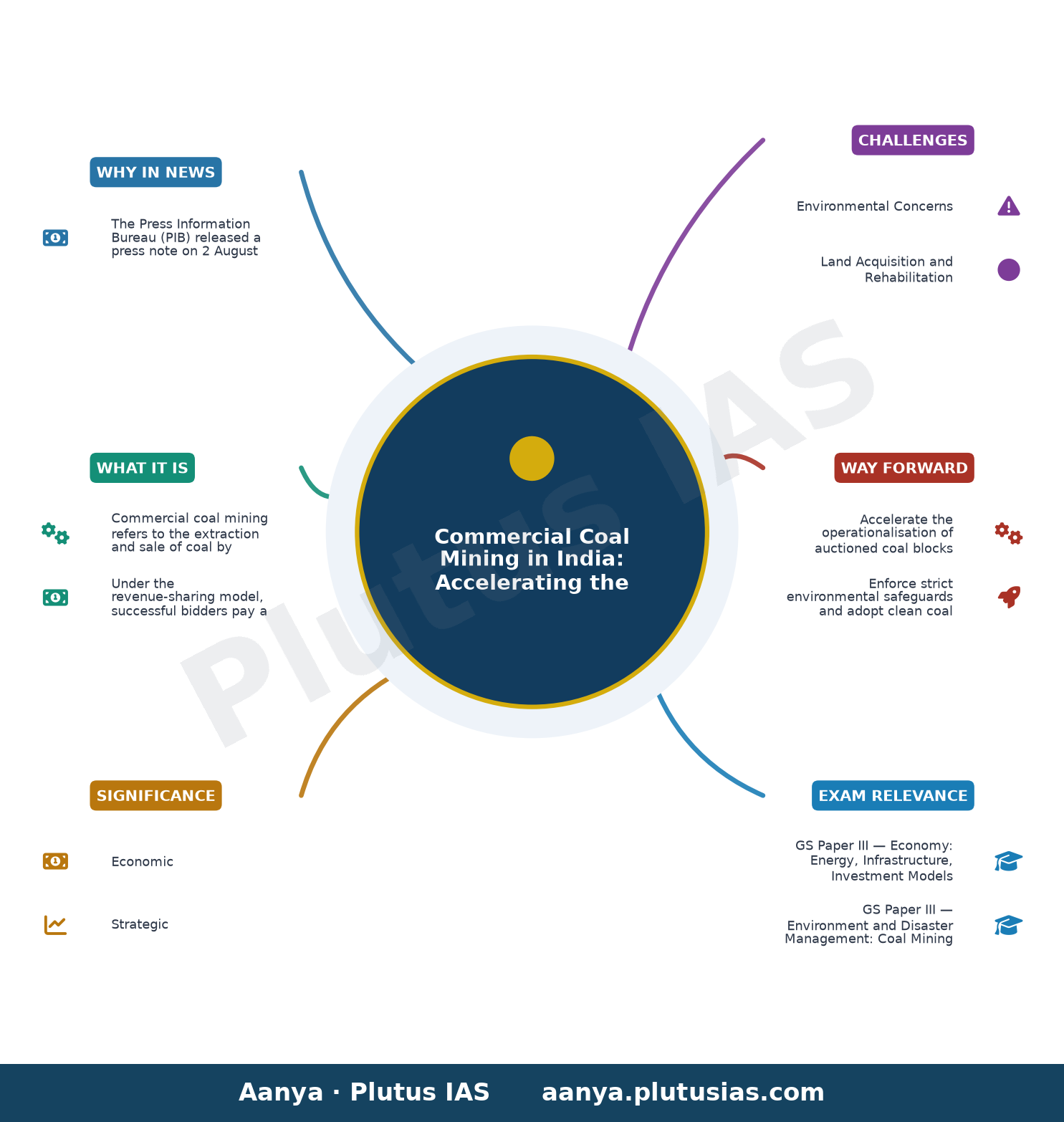
- GS Paper III — Economy: Energy, Infrastructure, Investment Models | GS Paper III — Environment and Disaster Management: Coal Mining and Environmental Concerns | GS Paper III — Science and Technology: Mining Technologies and Automation
- Prelims: Coal Mines (Special Provisions) Act, 2015, National Coal Index, Revenue Sharing Model, Commercial Coal Mining, Atmanirbhar Bharat Mission, Captive Coal Blocks, FDI in Coal Mining
- Essay: India’s Energy Security: Balancing Growth and Sustainability, Atmanirbhar Bharat: Self-Reliance in Critical Sectors
Quick Revision: Commercial coal mining in India, launched in June 2020, operates on a revenue-sharing model linked to the National Coal Index, enabling private sector participation and market-driven coal allocation to enhance energy security and fiscal benefits.
Why is this in the news?
The Press Information Bureau (PIB) released a press note on 2 August 2026 highlighting the progress of commercial coal mining in India, emphasizing its role in accelerating the nation’s journey towards self-reliance (Atmanirbhar Bharat). The note underscores the expansion of commercial coal mining through competitive bidding, the shift from captive to market-driven coal allocation, and the resultant economic and employment benefits for the country.
Background
- Coal constitutes approximately 55% of India’s primary energy requirements and over 70% of electricity generation, making it a critical input for the nation’s energy security.
- India holds the world’s fifth-largest coal reserves, estimated at 400,715 million tonnes, and is the second-largest producer and consumer of coal globally.
- Domestic coal production has consistently exceeded one billion tonnes annually since FY 2024-25, rising from 609.18 million tonnes in FY 2014-15 to 1,047.52 million tonnes in FY 2024-25.
- The Supreme Court’s 2014 judgment invalidated 204 out of 218 coal blocks allocated between 1993 and 2012 due to procedural inconsistencies, necessitating a transparent auction-based framework.
- The Coal Mines (Special Provisions) Act, 2015, provided a statutory basis for reallocation.
- The formal launch of commercial coal mining on 18 June 2020, under the Atmanirbhar Bharat Mission, marked a paradigm shift from captive to market-driven coal allocation, enabling private sector participation.
What is Commercial Coal Mining?
- Commercial coal mining refers to the extraction and sale of coal by private entities through competitive bidding processes, as opposed to captive mining where coal is solely used for end-use industries.
- Under the revenue-sharing model, successful bidders pay a fixed percentage of revenue to the government, linked to the National Coal Index, ensuring alignment with market prices.
- The eligibility criteria for participation have been significantly liberalized, allowing entities without prior mining experience, joint ventures, and 100% FDI via the automatic route to bid for coal blocks.
- Commercial coal mining enables the sale of coal to any consumer at market-determined prices, removing restrictions on end-use, thereby fostering a competitive and efficient coal market.
- Since June 2020, 141 coal mines have been auctioned across 14 phases, with a combined peak production capacity of 366.35 million tonnes per annum and an average revenue share of 24.17%.
- Commercial coal mining has generated significant employment, with an estimated 475,000 jobs expected upon full operationalization of auctioned blocks, alongside capital expenditure of ₹48,756 crore.
- The expansion of commercial coal mining aligns with India’s energy security goals, reducing import dependence and supporting the Atmanirbhar Bharat initiative.
Key Features
| Feature | Significance |
|---|---|
| Auction-based commercial coal mining (2020 onwards) | Replaced discretionary allocation with transparent, market-driven allocation, ensuring fair competition and optimal resource utilisation. |
| Revenue-sharing model | Links government receipts to actual coal prices via the National Coal Index, ensuring equitable fiscal benefits aligned with market dynamics. |
| Elimination of end-use restrictions | Permits successful bidders to sell coal to any consumer at market-determined prices, enhancing operational flexibility and economic efficiency. |
| Expansion of eligibility criteria | Removed prior mining experience requirements, allowed joint ventures, and permitted 100% FDI under automatic route, broadening participation. |
| Simplification of approvals | Reduced and streamlined clearances for operationalisation of coal blocks, accelerating project timelines and reducing bureaucratic delays. |
Why it Matters
Economic
- Boosts domestic coal production, reducing import dependency and improving trade balance, particularly for thermal power generation.
Strategic
- Enhances energy security by increasing indigenous coal supply, crucial for India’s industrial and power sector resilience.
Fiscal
- Generates substantial revenue for the exchequer through auction premiums and revenue-sharing, supporting public finances.
Employment
- Creates direct and indirect employment opportunities, estimated at 4,75,000, across mining and ancillary sectors.
Industrial Growth
- Supports downstream industries by ensuring reliable coal supply, fostering manufacturing and infrastructure development.
Challenges
1. Environmental Concerns
- Coal mining and combustion contribute to air pollution, greenhouse gas emissions, and ecological degradation, necessitating stringent compliance with environmental norms.
UPSC Link: GS3: Environmental Pollution
2. Land Acquisition and Rehabilitation
- Complexities in land acquisition, displacement of communities, and inadequate rehabilitation measures pose socio-economic challenges.
UPSC Link: GS2: Land Reforms
3. Operationalisation Delays
- Protracted approval processes, regulatory hurdles, and logistical bottlenecks delay the operationalisation of auctioned blocks, impacting production targets.
UPSC Link: GS3: Infrastructure
4. Market Volatility
- Fluctuations in global coal prices and domestic demand may impact the viability of commercial mining operations and revenue projections.
UPSC Link: GS3: Economic Sectors
5. Technological Gaps
- Limited adoption of advanced mining technologies and automation in domestic coal production affects efficiency and productivity.
UPSC Link: GS3: Science & Tech
Challenges — UPSC Perspective
| Issue | Concern |
|---|---|
| Environmental degradation | Non-compliance with environmental norms leading to pollution and ecological imbalance. |
| Land disputes | Protracted legal battles over land ownership and compensation, delaying project execution. |
| Regulatory bottlenecks | Multiple clearances required from central and state authorities, causing administrative delays. |
| Skilled labour shortage | Inadequate availability of trained mining professionals and technicians. |
| Infrastructure gaps | Poor connectivity and logistical constraints in coal-bearing regions. |
| Price volatility | Unpredictable coal prices affecting profitability and investment decisions. |
Way Forward
- Accelerate the operationalisation of auctioned coal blocks through streamlined approvals and monitoring mechanisms.
- Enforce strict environmental safeguards and adopt clean coal technologies to mitigate pollution and emissions.
- Strengthen land acquisition and rehabilitation frameworks with transparent compensation and grievance redressal systems.
- Promote research and development in mining technologies to enhance productivity and reduce operational costs.
- Diversify coal use through technological interventions like coal gasification and liquefaction for higher value addition.
- Encourage public-private partnerships to leverage expertise and investment in coal mining and logistics.
- Monitor market trends and adjust auction designs to ensure long-term viability and investor confidence.
UPSC Value Addition
Keywords for Mains Answer-Writing
Commercial coal mining liberalisation · Coal Mines (Special Provisions) Act, 2015 · Revenue-sharing model in coal auctions · Self-reliance in energy · Coal production in India · Direct Foreign Investment in mining · Coal allocation reforms · National Coal Index · Atmanirbhar Bharat Mission · Coal mine auctions · Coal sector employment · Coal auction revenue · Captive vs commercial coal blocks · Coal mine operational clearances · Energy security in India
Concept Flow
Coal scarcity and import dependency → Judicial intervention (Supreme Court, 2014) → Legislative response (Coal Mines Special Provisions Act, 2015) → Auction-based commercial mining (2020) → Increased domestic production and revenue → Economic growth and energy security → Environmental and socio-economic challenges → Policy reforms and technological adoption → Sustainable coal sector development
Prelims Practice Questions
Q1. Consider the following statements regarding the Coal Mines (Special Provisions) Act, 2015:
1. It was enacted to provide a statutory basis for the re-allocation of coal blocks.
2. The Act mandates that all coal blocks must be allocated through competitive bidding.
3. The Act allows for 100% Foreign Direct Investment (FDI) under the automatic route in coal mining.
4. The Act was passed in response to the Supreme Court’s cancellation of 204 coal block allocations in 2014.
How many of the above statements are correct?
- Only one
- Only two
- Only three
- All
Answer: All — Statements 1, 3, and 4 are correct. Statement 2 is incorrect because the Act does not mandate that all coal blocks must be allocated through competitive bidding; it provides a legal framework for re-allocation, including through auctions.
Q2. Assertion (A): The revenue-sharing model in coal mine auctions replaced the fixed fee per tonne system.
Reason (R): The revenue-sharing model ensures that the government’s earnings are linked to the actual value of coal, as determined by the National Coal Index.
Options:
A. Both A and R are true, and R is the correct explanation of A.
B. Both A and R are true, but R is not the correct explanation of A.
C. A is true, but R is false.
D. A is false, but R is true.
Answer: ? — Both Assertion (A) and Reason (R) are true, and Reason (R) correctly explains Assertion (A). The revenue-sharing model was introduced to align government revenue with the market value of coal, as reflected by the National Coal Index.
Q3. Match the following phases of coal mine auctions in India with their respective years of initiation:
Column I (Phase) Column II (Year of Initiation)
1. First phase of commercial coal mining A. 2014
2. Auction of coal mines under Coal Mines (Special Provisions) Act, 2015 B. 2020
3. Introduction of revenue-sharing model C. 2015
4. 100% FDI allowed under automatic route in coal mining D. 2018
Options:
1-B, 2-A, 3-D, 4-C
1-A, 2-C, 3-D, 4-B
1-C, 2-A, 3-B, 4-D
1-A, 2-B, 3-C, 4-D
- 1-B, 2-A, 3-D, 4-C
- 1-A, 2-C, 3-D, 4-B
- 1-C, 2-A, 3-B, 4-D
- 1-A, 2-B, 3-C, 4-D
Answer: 1-A, 2-C, 3-D, 4-B — The correct match is: 1-B (First phase of commercial coal mining initiated in 2020), 2-A (Auction of coal mines under Coal Mines (Special Provisions) Act, 2015 initiated in 2014), 3-D (Revenue-sharing model introduced in 2018), 4-C (100% FDI allowed under automatic route in 2015).
Mains Practice Question
✍ The liberalisation of commercial coal mining in India, initiated in June 2020, represents a paradigm shift from a state-dominated model to a market-driven, competitive framework. Critically examine the key reforms introduced under this liberalisation and evaluate their impact on India’s energy security and economic growth. (15 Marks)
Approach: MODEL-ANSWER SKELETON:
1. **Introduction (2 marks)**: Briefly state the context—India’s dependence on coal (55% of primary energy, 70% of electricity), historical issues (arbitrary allocations, Supreme Court’s 2014 judgment), and the need for reforms to achieve Atmanirbhar Bharat.
2. **Key Reforms Introduced (5 marks)**:
– **Auction-based allocation**: Transition from discretionary allocation to transparent, competitive bidding (Coal Mines (Special Provisions) Act, 2015).
– **Revenue-sharing model**: Replacement of fixed fee per tonne with a percentage of revenue linked to the National Coal Index, ensuring alignment with market prices.
– **Liberalisation of eligibility**: Removal of mining experience requirement, allowance for joint ventures, and 100% FDI under automatic route.
– **Operational ease**: Simplification of approvals and clearances for mine operations.
– **Expansion of commercial mining**: Permission for sale of coal to any consumer at market-determined prices, breaking the captive-consumer dichotomy.
3. **Impact on Energy Security (4 marks)**:
– **Increased production**: Domestic coal production crossed 1 billion tonnes (FY 2024-25: 1047.52 MT; FY 2025-26: 1040.08 MT), with commercial blocks contributing 210.46 MT in FY 2025-26 (up from 28.83 MT a decade ago).
– **Reduced import dependence**: Greater domestic production reduces reliance on coal imports, enhancing energy security.
– **Diversification of supply**: Participation of private players and foreign investors diversifies supply sources and reduces monopolistic practices.
– **Infrastructure development**: Revenue from auctions (₹5,553 crore in FY 2025-26 vs ₹461 crore in FY 2014-15) funds state development and infrastructure.
4. **Economic Growth and Employment (2 marks)**:
– **Revenue generation**: Auctioned blocks expected to generate ₹47,000 crore annually in revenue and ₹48,756 crore in capital expenditure.
– **Employment**: Creation of approximately 4,75,000 jobs, including direct and indirect employment in mining and allied sectors.
– **Private sector participation**: 123 mines auctioned to private companies, including 44 firms with no prior mining experience, fostering entrepreneurship.
5. **Challenges and Criticisms (2 marks)**:
– **Operational delays**: Ensuring timely commencement of production in auctioned mines remains a challenge.
– **Environmental concerns**: Coal mining’s ecological footprint and need for sustainable practices.
– **Market volatility**: Linking revenue to the National Coal Index exposes government earnings to market fluctuations.
– **Regional disparities**: Uneven distribution of benefits across coal-bearing states.
6. **Conclusion (2 marks)**: Summarise the transformative impact of reforms while acknowledging the need for continuous monitoring, environmental safeguards, and equitable distribution of benefits to fully realise the goals of Atmanirbharta in the energy sector.
Source: PIB (Press Information Bureau)
Generated by AanyaAi for educational purpose.

- महाराष्ट्र में त्योहार जुलूसों पर बॉम्बे हाईकोर्ट का बड़ा फैसला: पटाखे, लेजर और संगीत पर रोक - September 24, 2026
- Bombay HC Bans Firecrackers, Music in Maharashtra Processions: Key UPSC Analysis - September 24, 2026
- तमिलनाडु में महिला कर्मचारियों के लिए सवैतनिक माहवारी अवकाश नीति पर HC का आदेश - September 24, 2026

No Comments