


03 Aug CAG flags Samagra Shiksha failures in West Bengal: Dropouts, teacher crunch & fund gaps
✎ The Comptroller and Auditor General (CAG) of India’s performance audit for the period 2019–20 to 2023–24 has exposed critical systemic failures in the implementation of the Samagra Shiksha Abhiyan in West Bengal, including high…
Subject Relevance — Where This Topic Fits
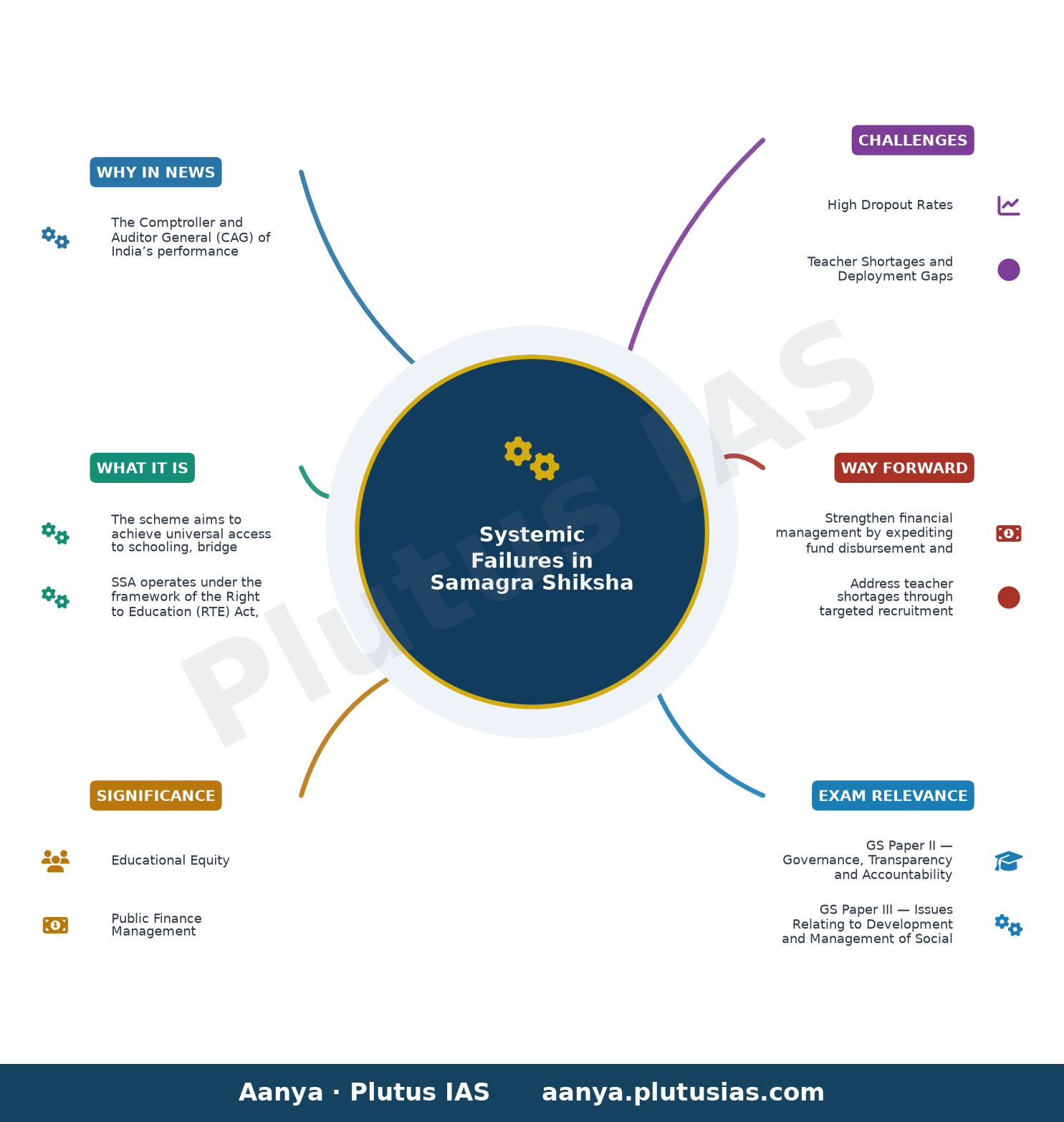
- GS Paper II — Governance, Transparency and Accountability | GS Paper III — Issues Relating to Development and Management of Social Sector/Services relating to Education
- Prelims: Samagra Shiksha Abhiyan, Comptroller and Auditor General (CAG), Pupil-Teacher Ratio (PTR), Right to Education (RTE) Act, Transition loss in education, Public Finance Management, School infrastructure gaps
- Essay: The role of audits in ensuring good governance and accountability in public service delivery, Challenges in achieving universal secondary education in India: A governance perspective
Why is this in the news?
The Comptroller and Auditor General (CAG) of India’s performance audit for the period 2019–20 to 2023–24 has exposed critical systemic failures in the implementation of the Samagra Shiksha Abhiyan in West Bengal, including high dropout rates, severe teacher shortages, and underutilisation of central funds. These findings are significant as they highlight governance deficits that undermine India’s commitment to achieving Sustainable Development Goal 4 (Quality Education) and the constitutional mandate under Article 21A (Right to Education). The audit underscores the need for urgent administrative and fiscal reforms to align state-level implementation with national educational objectives.
Background
- The scheme operates under the aegis of the Ministry of Education, Government of India, with a shared funding pattern between the Centre and States (90:10 for North-Eastern States and 60:40 for other States).
- West Bengal, with a Gross Enrolment Ratio (GER) of 98.7% at the primary level, faces significant challenges in transitioning students from upper primary (Classes VI–VIII) to higher secondary (Classes IX–XII), as evidenced by the CAG audit.
- The Right to Education (RTE) Act, 2009, mandates minimum Pupil-Teacher Ratios (PTR) of 30:1 for primary schools and 35:1 for upper primary schools, with provisions for teacher deployment and infrastructure development.
- The audit period (2019–20 to 2023–24) coincides with the COVID-19 pandemic, which exacerbated existing challenges in school education, including learning losses, dropouts, and resource constraints.
- The CAG’s findings align with broader concerns raised by the NITI Aayog’s School Education Quality Index (SEQI) and the Annual Status of Education Report (ASER), which highlight disparities in educational outcomes across states.
What is Samagra Shiksha Abhiyan (SSA)?
- The scheme aims to achieve universal access to schooling, bridge gender and social gaps in enrolment, and improve learning outcomes through targeted interventions such as teacher training, infrastructure development, and digital learning.
- SSA operates under the framework of the Right to Education (RTE) Act, 2009, and aligns with the Sustainable Development Goal 4 (SDG 4) of the United Nations, which seeks to ensure inclusive and equitable quality education for all.
- Key components of SSA include: (a) access and infrastructure development (e.g., school buildings, toilets, drinking water), (b) equity interventions (e.g., Kasturba Gandhi Balika Vidyalayas for marginalised girls), (c) inclusion of children with special needs, (d) teacher training and capacity building, and (e) digital initiatives such as DIKSHA and SWAYAM.
- The scheme follows a shared funding model between the Centre and States, with the Centre contributing 90% for North-Eastern States and 60% for other States, while the remaining is borne by the State governments.
- SSA is implemented through State Implementation Societies (SIS) and District Implementation Societies (DIS), with a focus on decentralised planning and monitoring to address localised challenges.
- The scheme also includes provisions for mid-day meals, uniforms, and textbooks to reduce economic barriers to education, particularly for children from disadvantaged backgrounds.
- Performance audits, such as those conducted by the CAG, are critical for assessing the effectiveness of SSA and identifying systemic gaps in implementation, resource utilisation, and governance.
Key Features
| Feature | Significance |
|---|---|
| Transition loss (28–42%) between upper primary and higher secondary | Indicates systemic failure in retaining students through secondary education, directly impacting the Right to Education’s goal of universal secondary education. |
| Teacher shortages (520 schools with zero teachers; 5,152 with one teacher) | Violates minimum Pupil-Teacher Ratio norms under RTE, leading to compromised teaching quality and student engagement. |
| Financial constraints cited by 53% of surveyed parents | Highlights poverty as a primary barrier to education, undermining the scheme’s equity objectives. |
| Underutilisation of funds (46–65% utilisation rate) | Reflects poor financial management, delaying infrastructure and educational interventions critical for student retention. |
| Administrative imbalances in teacher deployment (40,530 head teachers in schools with <150 students) | Demonstrates inefficient resource allocation, diverting managerial capacity from schools with greater needs. |
Why it Matters
Educational Equity
- Samagra Shiksha aims for universal access to quality education; West Bengal’s performance audit reveals systemic inequities in resource distribution and student retention.
- High dropout rates disproportionately affect marginalised communities, exacerbating socio-economic disparities.
- Failure to achieve minimum PTR norms undermines the constitutional guarantee of equitable education under Article 21A.
Public Finance Management
- Underutilisation of central funds (₹395 crore surrendered; ₹2,428 crore short-received) indicates fiscal indiscipline, weakening the scheme’s implementation.
- Delays in fund release by central and state governments disrupt targeted interventions, particularly in infrastructure and teacher recruitment.
- Poor fund utilisation reflects governance gaps, reducing the scheme’s potential to achieve its objectives.
Governance and Implementation
- Administrative imbalances in teacher deployment (e.g., head teachers in small schools) highlight inefficiencies in human resource management.
- Lack of coordination between central and state governments exacerbates delays in fund disbursement and project execution.
- Field surveys (581 out-of-school children) provide empirical evidence of systemic failures, enabling targeted policy responses.
Challenges
1. High Dropout Rates
- Transition losses of 28–42% between upper primary and higher secondary levels indicate systemic failure in retaining students.
- Key drivers include poverty (53%), early marriage (12%), migration for work (13%), and lack of interest (14%).
- Violates the Right to Education Act’s mandate for universal secondary education.
UPSC Link: GS2: Education, RTE Act
2. Teacher Shortages and Deployment Gaps
- 520 schools operate without any teachers; 5,152 schools have only one teacher, affecting 1,76,491 students.
- Deficit of 31,684 primary and 2,058 upper primary teachers; 79% of higher secondary schools exceed prescribed PTR limits.
- Administrative imbalances (40,530 head teachers in schools with <150 students) divert managerial resources from high-need schools.
UPSC Link: GS2: Education, RTE Act
3. Financial Constraints and Fund Underutilisation
- Poverty-driven dropouts (53%) highlight financial barriers to education, despite scheme provisions for scholarships and incentives.
- Fund utilisation rates of 46–65% over five years reflect poor financial management and delays in release of central and state funds.
- ₹395 crore surrendered due to non-execution of sanctioned civil works; ₹2,428 crore short-received due to execution inefficiencies.
UPSC Link: GS3: Public Finance, Budgetary Processes
4. Governance and Implementation Failures
- Lack of coordination between central and state governments delays fund disbursement and project execution, weakening scheme outcomes.
- Field surveys (581 out-of-school children) reveal systemic gaps, but their findings are not adequately addressed in policy responses.
- Administrative imbalances in teacher deployment indicate poor human resource management and planning.
UPSC Link: GS2: Governance, Public Administration
Challenges — UPSC Perspective
| Issue | Concern |
|---|---|
| Transition Loss (28–42%) | Systemic failure in retaining students from upper primary to higher secondary levels, violating RTE objectives. |
| Teacher Shortages (520 schools with zero teachers) | Compromises teaching quality and student engagement, violating minimum PTR norms under RTE. |
| Financial Constraints (53% of dropouts due to poverty) | Highlights poverty as a barrier to education, undermining the scheme’s equity objectives. |
| Fund Underutilisation (46–65% utilisation rate) | Reflects poor financial management, delaying critical interventions in infrastructure and teacher recruitment. |
| Administrative Imbalances (40,530 head teachers in small schools) | Demonstrates inefficient resource allocation, diverting managerial capacity from schools with greater needs. |
| Delays in Fund Release (₹2,428 crore short-received) | Disrupts targeted interventions, particularly in infrastructure and teacher recruitment, weakening scheme outcomes. |
Way Forward
- Strengthen financial management by expediting fund disbursement and reducing delays in release of central and state funds to schools.
- Address teacher shortages through targeted recruitment drives, particularly in schools with zero or single-teacher deployments.
- Implement targeted retention programmes for marginalised communities, focusing on poverty alleviation, early marriage prevention, and vocational training incentives.
- Conduct periodic audits of teacher deployment to ensure adherence to RTE norms on Pupil-Teacher Ratios across all school levels.
- Enhance coordination between central and state governments to streamline fund flow and project execution under Samagra Shiksha.
- Expand field surveys to identify root causes of dropouts in high-transition-loss districts, enabling data-driven policy responses.
- Promote community engagement programmes to raise awareness about the importance of secondary education and early marriage prevention.
- Leverage digital platforms for teacher training and student engagement to mitigate the impact of teacher shortages.
UPSC Value Addition
Keywords for Mains Answer-Writing
Samagra Shiksha Abhiyan · CAG performance audit · Right to Education Act 2009 · Pupil-Teacher Ratio norms · transition loss in education · teacher deployment norms · public finance management in education · out-of-school children · financial constraints in education · early marriage and education · migration and school dropout · RTE Act deployment norms · Comptroller and Auditor General · education policy implementation gaps
Constitutional & Policy Linkages
- Article 21A: Right to Education (mandates free and compulsory education for children aged 6–14).
- Article 45: Directive Principle of State Policy (aims to provide early childhood care and education for all children up to age 6).
Concept Flow
Poverty and socio-economic factors → Financial constraints for families → Early dropouts from school (53% cited poverty) → Transition loss (28–42%) between upper primary and higher secondary → Systemic failure in achieving RTE objectives → Underutilisation of Samagra Shiksha funds (46–65%) due to delays in fund release → Poor infrastructure and teacher shortages → Compromised teaching quality and student engagement → Reinforcement of poverty cycle → Persistent educational inequities.
Prelims Practice Questions
Q1. Consider the following statements regarding the Samagra Shiksha Abhiyan (SSA):
1. The scheme aims to provide universal access to quality education from pre-school to senior secondary levels.
2. The CAG report on West Bengal highlights a transition loss of 28 to 42% between upper primary and higher secondary levels.
3. The SSA mandates that all primary schools must have a minimum Pupil-Teacher Ratio (PTR) of 30:1.
4. The scheme is implemented under the aegis of the Ministry of Education, Government of India.
How many of the above statements are correct?
- Only one
- Only two
- Only three
- All four
Answer: All four — Statements 1, 2, and 4 are correct. Statement 3 is incorrect as the minimum PTR norm for primary schools under RTE is 30:1, but SSA may have variations based on state-specific norms.
Q2. Assertion (A): The Right to Education (RTE) Act, 2009 mandates that no child shall be subjected to physical punishment or mental harassment.
Reason (R): The RTE Act, 2009 prohibits corporal punishment and mental harassment to ensure a child-friendly learning environment.
Options:
A. Both A and R are true, and R is the correct explanation of A.
B. Both A and R are true, but R is not the correct explanation of A.
C. A is true, but R is false.
D. A is false, but R is true.
Answer: ? — Both the Assertion (A) and Reason (R) are true, and R correctly explains A as per Section 17 of the RTE Act, 2009.
Q3. Match the following columns related to education policies and their key features:
Column I (Policy/Scheme) | Column II (Key Feature)
—————————————|—————————————
A. Samagra Shiksha Abhiyan | 1. Mandates free and compulsory education for children aged 6-14
B. Right to Education Act, 2009 | 2. Aims to bridge social and gender gaps in school education
C. Mid-Day Meal Scheme | 3. Provides nutritious meals to enhance attendance and retention
D. Rashtriya Madhyamik Shiksha Abhiyan | 4. Focuses on universalisation of secondary education
Choose the correct match:
- A-2, B-1, C-3, D-4
- A-1, B-2, C-3, D-4
- A-4, B-1, C-2, D-3
- A-3, B-4, C-1, D-2
Answer: A-2, B-1, C-3, D-4 — The correct match is: A-2 (SSA aims to bridge social and gender gaps), B-1 (RTE mandates free and compulsory education), C-3 (Mid-Day Meal Scheme provides nutritious meals), D-4 (RMSA focuses on secondary education).
Mains Practice Question
✍ The Comptroller and Auditor General (CAG) report on the implementation of the Samagra Shiksha Abhiyan (SSA) in West Bengal highlights systemic gaps in teacher deployment, financial management, and student retention. Critically examine the structural and administrative challenges in the effective implementation of SSA, with reference to the Right to Education (RTE) Act, 2009 and relevant constitutional provisions. Also, assess the implications of these gaps on the achievement of Sustainable Development Goal (SDG) 4. (15 Marks)
Approach: MODEL-ANSWER SKELETON:
1. **Introduction (2 marks)**: Define SSA and its objectives under the Ministry of Education. Mention the constitutional mandate under Article 21A (Right to Education) and the RTE Act, 2009.
2. **Structural Challenges (5 marks)**:
– **Teacher Deployment**: Cite CAG findings on single-teacher schools (5,152 schools) and schools with no teachers (520 schools). Discuss violation of RTE norms on Pupil-Teacher Ratio (PTR) and deployment of head teachers in under-enrolled schools (40,530 head teachers in schools with <150 students).
– **Transition Loss**: Explain the 28-42% dropout between upper primary and higher secondary levels, citing financial constraints (53% of parents), early marriage (12%), and migration (13%).
– **Infrastructure Gaps**: Highlight surrender of ₹395 crore due to non-execution of sanctioned civil works and delays causing short receipt of ₹2,428 crore in central funds.
3. **Administrative and Financial Gaps (5 marks)**:
– **Fiscal Indiscipline**: Discuss delays in fund release by central and state governments and their impact on scheme outcomes.
– **Utilisation Deficits**: Note utilisation rates of 46-65% over five years, indicating poor public finance management.
– **RTE Compliance**: Evaluate compliance with RTE norms on PTR (31,684 primary and 2,058 upper primary teacher deficits) and deployment norms.
4. **Implications for SDG 4 (2 marks)**:
– Link challenges to SDG 4 (Quality Education) targets: inclusive and equitable education, retention, and learning outcomes. Discuss how systemic gaps undermine India’s commitment to SDG 4.
5. **Conclusion (1 mark)**: Summarise the need for structural reforms, timely fund release, and adherence to RTE norms to ensure equitable and quality education.
Source: The Hindu
Generated by AanyaAi for educational purpose.

- तमिलनाडु के लिए क्या है ‘एल नीनो’ और उत्तर-पूर्वी मानसून का खतरा? - September 23, 2026
- El Nino & Northeast Monsoon: Impact on Tamil Nadu for UPSC 2026 - September 23, 2026
- हिमाचल में डिजिटल भुगतान क्रांति: बिलासपुर अव्वल, महिलाओं की भागीदारी 93% तक पहुंची - September 23, 2026

No Comments