


03 Aug CAG Report Reveals Critical Gaps in West Bengal’s Samagra Shiksha Scheme
✎ Samagra Shiksha Abhiyan (SSA) is a Centrally Sponsored Scheme (CSS) that mandates adherence to Right to Education (RTE) norms, including minimum Pupil-Teacher Ratios (PTR) and prohibits single-teacher schools, yet West Bengal’s…
Subject Relevance — Where This Topic Fits
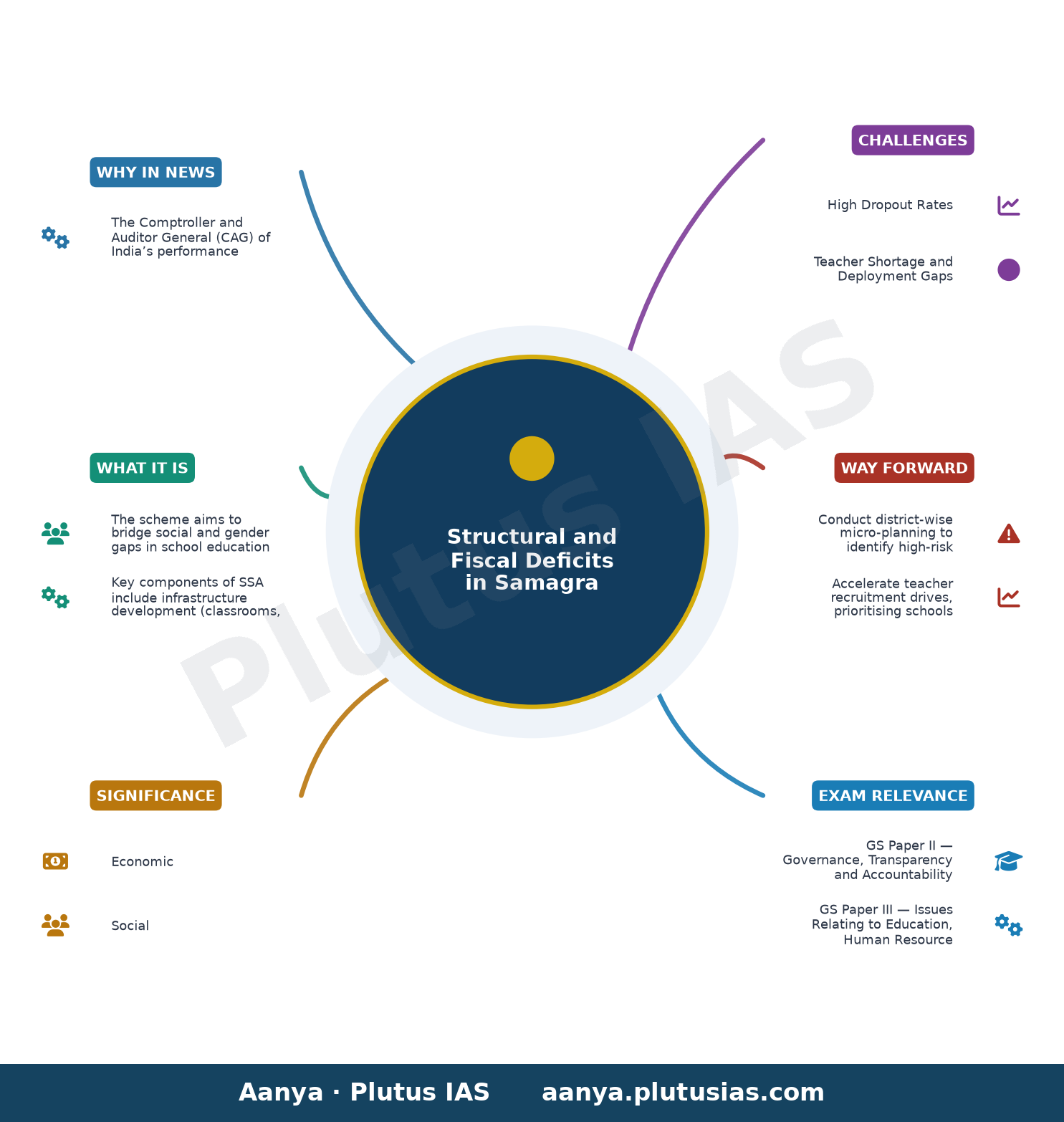
- GS Paper II — Governance, Transparency and Accountability | GS Paper III — Issues Relating to Education, Human Resource Development and Skill Development | GS Paper IV — Ethical Governance and Challenges in Public Service Delivery
- Prelims: Samagra Shiksha Abhiyan, Comptroller and Auditor General (CAG), Pupil-Teacher Ratio (PTR), Right to Education (RTE) Act, 2009, Transition loss in education, Fiscal federalism in centrally sponsored schemes, School infrastructure gaps, Teacher deployment norms
- Essay: The Role of Audits in Ensuring Good Governance: Lessons from CAG Reports, Education as a Public Good: Balancing Access, Equity, and Quality in India
Quick Revision: Samagra Shiksha Abhiyan (SSA) is a Centrally Sponsored Scheme (CSS) that mandates adherence to Right to Education (RTE) norms, including minimum Pupil-Teacher Ratios (PTR) and prohibits single-teacher schools, yet West Bengal’s CAG audit reveals systemic failures in teacher deployment, fund utilisation (46–65%), and high dropout rates (28–42% transition loss), highlighting governance gaps in public education delivery.
Why is this in the news?
The Comptroller and Auditor General (CAG) of India’s performance audit of West Bengal’s Samagra Shiksha Abhiyan (2019–20 to 2023–24) has exposed systemic failures in the scheme’s implementation, including high dropout rates (28–42% transition loss), severe teacher shortages (520 schools with no teachers, 5,152 with a single teacher), and poor utilisation of central funds (46–65%), leading to fiscal indiscipline and compromised educational outcomes. The audit underscores the need for structural reforms in teacher deployment, financial management, and governance to align with constitutional and statutory mandates such as the Right to Education (RTE) Act.
Background
- West Bengal is one of the largest states in India by population and has a significant proportion of marginalised communities, making the implementation of SSA critical for achieving Sustainable Development Goal 4 (Quality Education).
- The Right to Education (RTE) Act, 2009 mandates minimum Pupil-Teacher Ratios (PTR) and prohibits single-teacher schools, yet the CAG audit reveals widespread violations in West Bengal.
- Centrally Sponsored Schemes (CSS) like SSA are jointly funded by the Centre and States, with the Centre contributing up to 60% (for general category states) and the State bearing the remaining share, subject to utilisation certificates and timely releases.
- The CAG’s role as a constitutional authority is to audit the utilisation of public funds and assess the efficiency, economy, and effectiveness of government schemes, ensuring accountability in public expenditure.
- Prior to this audit, the Union Ministry of Education had flagged high secondary school dropout rates as a national concern, emphasising the need for state-specific interventions to address transition losses.
What is Samagra Shiksha Abhiyan (SSA)?
- The scheme aims to bridge social and gender gaps in school education by ensuring universal access, retention, and completion of schooling, with a focus on marginalised groups such as Scheduled Castes (SCs), Scheduled Tribes (STs), and girls.
- Key components of SSA include infrastructure development (classrooms, toilets, drinking water), teacher training and deployment, inclusive education for children with disabilities, digital initiatives, and vocational education.
- The scheme operates under the principle of fiscal federalism, with the Centre providing up to 60% of the funding (for general category states) and the State contributing the remaining 40%, subject to utilisation of funds and adherence to prescribed norms.
- SSA aligns with the Right to Education (RTE) Act, 2009, which mandates free and compulsory education for children aged 6–14, minimum PTRs, and prohibits single-teacher schools in classes beyond the primary stage.
- The scheme also incorporates provisions for the education of migrant children, children of construction workers, and those in difficult terrains, ensuring no child is left behind in the education system.
- Monitoring and evaluation of SSA are conducted through state-level and district-level structures, including School Management Committees (SMCs) and State Project Offices (SPOs), with periodic reviews by the Ministry of Education.
Key Features
| Feature | Significance |
|---|---|
| High dropout rates (28–42% transition loss) | Undermines the foundational goal of universal secondary education and exacerbates socio-economic disparities by limiting human capital formation. |
| Teacher shortage (5,152 single-teacher schools; 520 schools with no teachers) | Violates the Right to Education Act’s Pupil-Teacher Ratio norms, directly impeding instructional quality and student engagement. |
| Poor fund utilisation (46–65% utilisation rate) | Indicates systemic inefficiencies in public finance management, leading to underutilisation of central grants and delayed infrastructure development. |
| Financial hardship as primary dropout driver (53% of surveyed parents) | Highlights the intersection of education policy with poverty alleviation, necessitating multi-sectoral interventions beyond the education sector. |
| Administrative imbalances in teacher deployment (40,530 head teachers in schools with <150 students) | Demonstrates misallocation of human resources, diverting administrative capacity from schools with critical needs to those with surplus staffing. |
Why it Matters
Economic
- Prolonged school dropout reduces future earnings potential, constraining West Bengal’s demographic dividend and long-term economic growth.
- Poor utilisation of central funds (₹395 crore surrendered; ₹2,428 crore short receipt) reflects suboptimal allocation of public resources, distorting fiscal federalism.
Social
- High dropout rates, particularly among girls due to early marriage (12%), perpetuate intergenerational cycles of poverty and gender inequality.
- Teacher shortages disproportionately affect marginalised communities, exacerbating educational inequities in tribal and rural districts.
Administrative
- Delays in fund release by central and state governments indicate systemic governance failures in scheme implementation.
- Non-execution of sanctioned civil works (₹395 crore) suggests poor project management and monitoring within the Samagra Shiksha framework.
Legal
- Violation of RTE Act’s PTR norms (29% primary, 30% upper primary schools) exposes the state to legal challenges under Article 21A and the RTE Act, 2009.
- Administrative imbalances in teacher deployment may contravene service rules and recruitment policies, warranting disciplinary action.
Challenges
1. High Dropout Rates
- Financial constraints (53% of surveyed parents) force students into early labour or marriage, undermining universal education goals.
- Migration for work (13%) and early marriage (12%) reflect socio-economic pressures that education policy alone cannot address.
- Transition loss of 28–42% between upper primary and higher secondary levels indicates systemic failure in retaining students post-primary education.
UPSC Link: GS2: Issues relating to development and management of Social Sector/Services relating to Education
2. Teacher Shortage and Deployment Gaps
- 5,152 schools with single teachers and 520 schools with no teachers violate RTE norms, compromising educational quality.
- Deficit of 31,684 primary and 2,058 upper primary teachers (29% and 30% of schools, respectively) exacerbates PTR violations.
- Administrative imbalances (40,530 head teachers in schools with <150 students) reflect misallocation of human resources, diverting talent from critical needs.
UPSC Link: GS2: Issues relating to development and management of Social Sector/Services relating to Education
3. Fiscal Indiscipline and Fund Utilisation Gaps
- Utilisation rate of 46–65% over five years indicates poor planning and execution, leading to underutilisation of central grants.
- Surrender of ₹395 crore for unexecuted civil works and short receipt of ₹2,428 crore in central funding highlight delays and inefficiencies in fund management.
- Delays in fund release by central and state governments reflect governance failures, distorting fiscal federalism and scheme outcomes.
UPSC Link: GS3: Government Budgeting and Resource Mobilisation
4. Structural Inequities in Education Delivery
- Teacher shortages and high dropout rates disproportionately affect marginalised groups, including tribal and rural communities.
- Administrative imbalances in teacher deployment exacerbate inequities, as head teachers are posted in schools with surplus staffing rather than critical needs.
UPSC Link: GS2: Welfare schemes for vulnerable sections of the population by the Centre and States and the performance of these schemes
5. Governance and Implementation Gaps
- Non-execution of sanctioned civil works and delays in targeted interventions indicate poor project management and monitoring within Samagra Shiksha.
- Field surveys (581 out-of-school children across 21 schools) reveal systemic failures in identifying and addressing dropout causes at the grassroots level.
UPSC Link: GS4: Ethics and Human Interface: Strengthening of ethical and moral values in governance
Challenges — UPSC Perspective
| Issue | Concern |
|---|---|
| High dropout rates (28–42%) | Undermines universal secondary education and exacerbates socio-economic disparities. |
| Teacher shortage (5,152 single-teacher schools; 520 schools with no teachers) | Violates RTE norms, compromising instructional quality and student engagement. |
| Poor fund utilisation (46–65%) | Indicates systemic inefficiencies in public finance management, leading to underutilisation of central grants. |
| Financial hardship as primary dropout driver (53%) | Highlights the intersection of education policy with poverty alleviation, necessitating multi-sectoral interventions. |
| Administrative imbalances in teacher deployment (40,530 head teachers in schools with <150 students) | Demonstrates misallocation of human resources, diverting administrative capacity from critical needs. |
| Delays in fund release by central and state governments | Reflects governance failures, distorting fiscal federalism and scheme outcomes. |
Government Initiatives — Must-Memorise for Prelims
- Samagra Shiksha Abhiyan (SSA) – Centrally Sponsored Scheme for school education from pre-school to Class 12
- Right to Education (RTE) Act, 2009 – Mandates free and compulsory education for children aged 6–14 years
Way Forward
- Conduct district-wise micro-planning to identify high-risk schools and students, with targeted interventions for retention (e.g., stipends, mid-day meals, and vocational training).
- Accelerate teacher recruitment drives, prioritising schools with critical shortages, and enforce RTE-compliant Pupil-Teacher Ratios through strict monitoring.
- Streamline fund disbursement mechanisms to ensure timely release of central and state funds, with real-time tracking of utilisation and penalties for delays.
- Strengthen multi-sectoral coordination with the Department of Women and Child Development to address early marriage and financial hardship as dropout drivers.
- Implement a robust grievance redressal system for teachers and students, with regular audits of school infrastructure and human resource deployment.
- Enhance teacher training programmes to improve pedagogical skills, particularly in schools with single-teacher deployments, to mitigate instructional quality gaps.
- Leverage technology for attendance monitoring and dropout tracking, using AI-driven analytics to predict and prevent student attrition.
- Establish a state-level task force with representatives from education, finance, and social welfare departments to oversee scheme implementation and address systemic bottlenecks.
UPSC Value Addition
Keywords for Mains Answer-Writing
Samagra Shiksha Abhiyan · CAG performance audit · Right to Education (RTE) Act, 2009 · Pupil-Teacher Ratio (PTR) · School dropout rates · Teacher deployment norms · Public finance management in education · Financial constraints in education · Early marriage and child labour · Central sector schemes · State-funded education initiatives · Education infrastructure gaps
Constitutional & Policy Linkages
- Article 21A – Right to Education as a Fundamental Right
- Article 45 – Directive Principle of State Policy on early childhood care and education
Concept Flow
Poverty and socio-economic pressures → High dropout rates (28–42%) → Reduced human capital formation → Perpetuation of intergenerational poverty → Teacher shortages and administrative imbalances → Violation of RTE norms → Compromised instructional quality → Reduced student engagement → Delays in fund release → Poor fund utilisation (46–65%) → Underutilisation of central grants → Delayed infrastructure development → Non-execution of sanctioned civil works → Surrender of ₹395 crore → Short receipt of ₹2,428 crore → Fiscal indiscipline and governance failures → Administrative imbalances in teacher deployment → Misallocation of human resources → Exacerbation of educational inequities → Marginalisation of vulnerable groups
Prelims Practice Questions
Q1. Consider the following statements regarding the Samagra Shiksha Abhiyan in West Bengal as per the CAG report (2019-20 to 2023-24):
1. The scheme experienced a transition loss of 28 to 42% between upper primary and higher secondary levels.
2. Over 500 schools were functional without a single teacher.
3. The non-execution of sanctioned civil works led to the surrender of ₹395 crore meant for school infrastructure.
4. The scheme achieved 90% utilisation of central funds in the state.
How many of the above statements are correct?
- Only one
- Only two
- Only three
- All four
Answer: Only three — Statements 1, 2, and 3 are correct as per the CAG report. Statement 4 is incorrect because the utilisation of central funds ranged between 46% and 65%, not 90%.
Q2. Assertion (A): The Right to Education (RTE) Act, 2009 mandates a minimum Pupil-Teacher Ratio (PTR) for schools to ensure quality education.
Reason (R): A higher PTR is associated with better learning outcomes and reduced teacher workload.
In the context of the above two statements, which one of the following is correct?
- Both A and R are true, and R is the correct explanation of A
- Both A and R are true, but R is NOT the correct explanation of A
- A is true, but R is false
- A is false, but R is true
Answer: Both A and R are true, but R is NOT the correct explanation of A — The RTE Act, 2009 does mandate a minimum PTR (e.g., 30:1 for primary and 35:1 for upper primary). A higher PTR is generally linked to poorer learning outcomes due to increased teacher workload, making R a correct explanation of A.
Q3. Match the following reasons cited by parents for school dropouts in West Bengal (as per the CAG report) with their respective percentages:
Column I (Reason) | Column II (Percentage)
——————————————-|———————–
A. Financial distress | 1. 14%
B. Early marriage | 2. 13%
C. Migration for work | 3. 12%
D. Unwillingness to continue studies | 4. 53%
- A-4, B-3, C-2, D-1
- A-1, B-2, C-3, D-4
- A-4, B-2, C-3, D-1
- A-3, B-4, C-1, D-2
Answer: A-4, B-3, C-2, D-1 — The CAG report states that 53% of parents cited financial distress, 12% cited early marriage, 13% cited migration for work, and 14% cited unwillingness to continue studies.
Mains Practice Question
✍ The implementation of the Samagra Shiksha Abhiyan in West Bengal has been severely constrained by structural, administrative, and financial challenges, as highlighted by the CAG performance audit. Critically examine the causes of high dropout rates, teacher shortages, and underutilisation of funds in the state’s education system. Also, suggest measures to address these issues in line with the objectives of the Right to Education (RTE) Act, 2009. (15 Marks)
Approach: MODEL-ANSWER SKELETON:
1. **Introduction (2 marks)**:
– Define Samagra Shiksha Abhiyan (SSA) as a centrally sponsored scheme integrating pre-primary to Class XII education.
– Mention the CAG audit findings (2019-20 to 2023-24) on West Bengal’s implementation gaps.
2. **Causes of High Dropout Rates (4 marks)**:
– **Socio-economic factors**: Financial distress (53% of surveyed parents), early marriage (12%), migration for work (13%), and unwillingness to study (14%).
– **Structural gaps**: Transition loss of 28–42% between upper primary and higher secondary levels.
– **Administrative failures**: Violation of RTE norms (e.g., 8% of schools with single teachers affecting 1,76,491 students).
3. **Teacher Shortages and Deployment Issues (4 marks)**:
– **Deficit in teacher numbers**: Shortage of 31,684 primary and 2,058 upper primary teachers; 520 schools with no teachers.
– **Administrative imbalances**: 40,530 head teachers posted in schools with fewer than 150 students, violating RTE norms.
– **Pupil-Teacher Ratio (PTR) violations**: 79% of higher secondary schools exceeded prescribed PTR limits.
4. **Underutilisation of Funds (3 marks)**:
– **Fiscal indiscipline**: Fund utilisation ranged between 46% and 65% due to delays in release and execution.
– **Infrastructure gaps**: Surrender of ₹395 crore for unexecuted civil works; short receipt of ₹2,428 crore in central funding.
5. **Measures to Address Challenges (2 marks)**:
– **Policy interventions**: Strengthen RTE implementation by ensuring teacher deployment norms (e.g., 30:1 for primary, 35:1 for upper primary).
– **Financial reforms**: Timely release and utilisation of funds; prioritise infrastructure development to reduce transition losses.
– **Community engagement**: Address socio-economic barriers through scholarships, awareness campaigns on early marriage, and vocational training to reduce migration.
6. **Conclusion (2 marks)**:
– Emphasise the need for a multi-dimensional approach combining policy, administrative, and community-level interventions to achieve universal education goals.
Source: The Hindu
Generated by AanyaAi for educational purpose.

- महाराष्ट्र में त्योहार जुलूसों पर बॉम्बे हाईकोर्ट का बड़ा फैसला: पटाखे, लेजर और संगीत पर रोक - September 24, 2026
- Bombay HC Bans Firecrackers, Music in Maharashtra Processions: Key UPSC Analysis - September 24, 2026
- तमिलनाडु में महिला कर्मचारियों के लिए सवैतनिक माहवारी अवकाश नीति पर HC का आदेश - September 24, 2026

No Comments