


03 Aug India’s AI Literacy Gap: Why UPSC & PCS Aspirants Must Focus on AI in Education
✎ AI literacy in education must integrate technical proficiency with ethical reasoning and equitable access to prepare learners for an AI-driven future, as mandated by NEP 2020 and evidenced by rising AI adoption in schools.
Subject Relevance — Where This Topic Fits
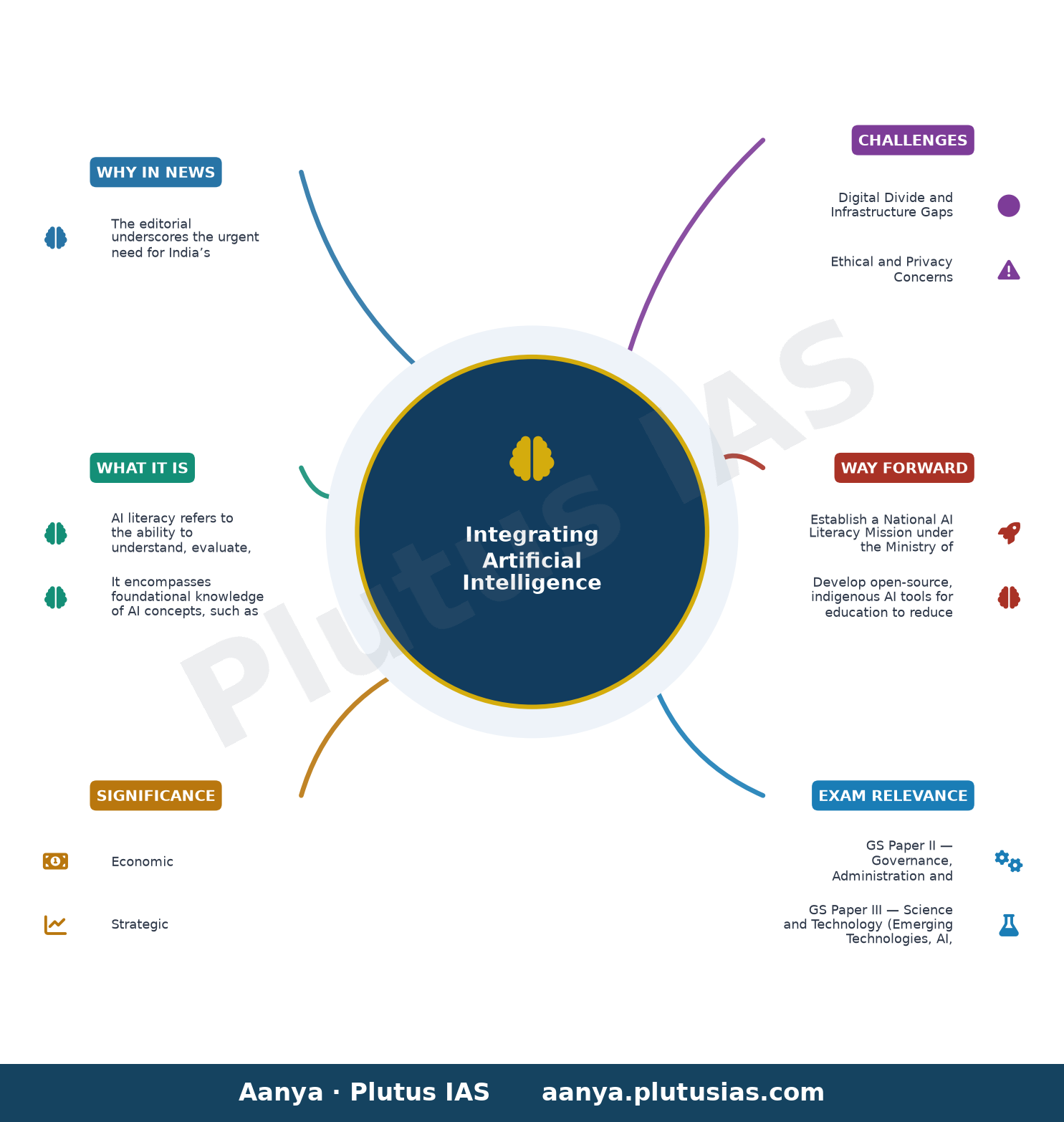
- GS Paper II — Governance, Administration and Challenges (Digital Governance, Skill Development) | GS Paper III — Science and Technology (Emerging Technologies, AI, Ethical Considerations) | GS Paper IV — Ethics, Integrity and Aptitude (Ethical Implications of AI, Responsible Innovation)
- Prelims: NEP 2020, AI literacy, NITI Aayog, CBSE AI curriculum, NCERT AI integration, generative AI, computational thinking, AI Appreciation Day, digital divide in education, personalised learning
- Essay: The Role of Artificial Intelligence in Bridging Educational Inequities in India, Ethical Governance of Emerging Technologies: A Framework for Responsible AI Integration
Quick Revision: AI literacy in education must integrate technical proficiency with ethical reasoning and equitable access to prepare learners for an AI-driven future, as mandated by NEP 2020 and evidenced by rising AI adoption in schools.
Why is this in the news?
The editorial underscores the urgent need for India’s education system to prioritise Artificial Intelligence (AI) literacy, highlighting the rapid integration of AI tools in schools, the exponential growth in AI course enrolments, and the transformative potential of AI in addressing educational disparities. It argues that AI literacy must transcend technical skills to include ethical reasoning, critical thinking, and equitable access, aligning with the National Education Policy (NEP) 2020’s vision for future-ready learning.
Background
- The National Education Policy (NEP) 2020 explicitly mandates the inclusion of coding and computational thinking in school curricula, laying the foundation for AI literacy.
- According to NITI Aayog’s 2025 report, over 60% of Indian schools now utilise AI-powered learning tools, reflecting a rapid adoption of AI in education.
- The Coursera Global Skills Report 2025 indicates a 107% year-on-year increase in India’s enrolments for generative AI courses, totalling 2.6 million— the highest globally.
- The Ministry of Education, through CBSE and NCERT, has initiated AI integration into school curricula starting from Grade 9, signalling a systemic shift in educational priorities.
- AI-driven educational platforms are increasingly bridging the digital divide by providing personalised learning pathways for students in rural and remote areas.
- The celebration of AI Appreciation Day in 2026 underscores the growing societal and institutional recognition of AI’s transformative role in daily life and education.
What is AI Literacy in the Context of Education?
- AI literacy refers to the ability to understand, evaluate, and utilise Artificial Intelligence technologies responsibly and ethically in personal, professional, and societal contexts.
- It encompasses foundational knowledge of AI concepts, such as machine learning, natural language processing, and neural networks, alongside practical skills in using AI tools for problem-solving.
- Ethical AI literacy involves recognising biases in AI systems, understanding data privacy implications, and promoting fairness and transparency in AI applications.
- Critical thinking is integral to AI literacy, enabling learners to question AI-generated outputs, assess their reliability, and mitigate misinformation or algorithmic bias.
- AI literacy also includes computational thinking, which involves breaking down complex problems into algorithmic steps—a skill emphasised in the NEP 2020.
- In education, AI literacy enables personalised learning by adapting content to individual learner needs, thereby enhancing engagement and academic outcomes.
- For educators, AI literacy entails training in AI tools to design adaptive learning experiences and to integrate AI responsibly into pedagogical practices.
- Equitable AI literacy ensures that all students, regardless of socio-economic background or geographic location, have access to AI education and resources.
Key Features
| Feature | Significance |
|---|---|
| Integration of AI in school curricula (Grades 9-12) | Formalises computational thinking and prepares students for AI-driven economies, aligning with NEP 2020’s emphasis on future-ready competencies. |
| AI-powered personalised learning tools | Enables adaptive learning pathways, addressing individual student needs and reducing disparities in educational outcomes across socio-economic divides. |
| Generative AI course enrolments (2.6 million in 2025) | Demonstrates rapid upskilling demand, reflecting India’s potential to lead in AI talent development if structured educational pathways are established. |
| AI-driven educational platforms for rural access | Bridges the digital divide by providing equitable access to high-quality resources, particularly in underserved regions where teacher shortages persist. |
| NITI Aayog 2025 report on AI in schools | Provides empirical basis for policy prioritisation, highlighting the scalability of AI tools in India’s diverse educational landscape. |
Why it Matters
Economic
- AI literacy enhances workforce readiness, positioning India to capitalise on the global AI market, projected to reach $15.7 trillion by 2030 (PwC).
- Reduces brain drain by creating high-skilled employment opportunities within India, particularly in emerging AI sectors such as healthcare diagnostics and agritech.
Strategic
- Strengthens India’s self-reliance in critical technologies, reducing dependence on foreign AI systems for educational and administrative applications.
- Supports India’s leadership in global AI governance debates, particularly in ethical frameworks and data sovereignty, as outlined in the Global Partnership on AI (GPAI).
Social
- Democratises education by providing personalised learning to students with disabilities, linguistic minorities, and those in remote areas.
- Fosters critical thinking by teaching students to evaluate AI outputs, mitigating risks of misinformation and algorithmic bias.
Educational
- Aligns with NEP 2020’s vision of multidisciplinary learning, integrating AI with STEM, humanities, and vocational education.
- Prepares teachers for AI-assisted pedagogy, ensuring that digital tools enhance rather than replace human instruction.
Challenges
1. Digital Divide and Infrastructure Gaps
- Unequal access to devices and high-speed internet excludes rural and economically weaker sections from AI literacy initiatives.
- Teacher shortages in government schools limit the effective implementation of AI tools, exacerbating existing inequalities.
UPSC Link: GS2: Digital Divide and Education
2. Ethical and Privacy Concerns
- Risk of data exploitation by AI platforms, particularly in the absence of a comprehensive data protection framework (Digital Personal Data Protection Act, 2023).
- Algorithmic bias in AI-driven assessments may reinforce socio-economic or caste-based disparities in educational outcomes.
UPSC Link: GS2: Data Privacy and Ethics
3. Curriculum and Teacher Training Deficits
- Lack of standardised AI curricula for K-12, leading to uneven quality across states and school boards.
- Inadequate teacher training in AI pedagogy, with only 12% of Indian teachers reporting confidence in using AI tools (UNESCO, 2025).
UPSC Link: GS2: Teacher Training and Curriculum Design
4. Economic and Geopolitical Dependencies
- Over-reliance on foreign AI platforms (e.g., proprietary generative AI tools) may undermine India’s strategic autonomy in education technology.
- High costs of AI integration may divert resources from foundational literacy and numeracy, particularly in government schools.
UPSC Link: GS3: Technology and National Security
5. Assessment and Evaluation Challenges
- Difficulty in measuring AI literacy outcomes within traditional examination systems, which prioritise rote learning over critical analysis.
- Risk of AI tools being used to game assessments, leading to inflated performance metrics without genuine learning.
UPSC Link: GS2: Examination Reforms
Challenges — UPSC Perspective
| Issue | Concern |
|---|---|
| Lack of standardised AI curricula | Inconsistent quality of AI education across states, leading to unequal preparedness for AI-driven economies. |
| Data privacy risks in AI platforms | Exploitation of student data by third-party vendors, violating the Digital Personal Data Protection Act, 2023. |
| Teacher unpreparedness for AI pedagogy | Only 12% of teachers report confidence in using AI tools, hindering effective classroom integration. |
| Digital divide in rural areas | Exclusion of 60% of rural students from AI literacy due to lack of devices and internet connectivity. |
| Algorithmic bias in AI assessments | Reinforcement of socio-economic disparities in educational outcomes through biased AI-driven evaluations. |
Way Forward
- Establish a National AI Literacy Mission under the Ministry of Education to standardise curricula, teacher training, and resource allocation across states.
- Develop open-source, indigenous AI tools for education to reduce dependence on foreign platforms and ensure data sovereignty.
- Integrate AI ethics and critical thinking modules into school curricula, with case studies on bias, privacy, and misinformation.
- Launch a Digital Public Infrastructure (DPI) initiative for AI in education, providing low-cost devices and high-speed internet to rural schools.
- Create a National Teacher Training Programme for AI Pedagogy, in collaboration with NCERT, IITs, and EdTech startups.
- Pilot AI literacy programmes in aspirational districts to test scalability and address ground-level challenges before nationwide rollout.
- Strengthen the Digital Personal Data Protection Act, 2023, with specific provisions for student data protection in AI-driven platforms.
- Foster public-private partnerships to develop low-cost AI tools tailored for Indian languages and regional curricula.
UPSC Value Addition
Keywords for Mains Answer-Writing
Artificial Intelligence literacy · National Education Policy 2020 · AI in school curriculum · Ethics in AI education · Digital divide in education · Personalised learning · Teacher training for AI integration · Generative AI skills · AI-driven educational platforms · NITI Aayog AI report 2025 · CBSE AI curriculum · Equitable access to AI education
Concept Flow
Rapid AI adoption in global education → Recognition of AI literacy as essential for future readiness → NEP 2020’s inclusion of computational thinking → Integration of AI in school curricula → Emergence of AI-driven personalised learning tools → Expansion of AI education to rural and underserved regions → Identification of challenges (digital divide, ethics, teacher training) → Need for structured policy interventions → Development of AI literacy frameworks → Implementation and scalability across states.
Prelims Practice Questions
Q1. Consider the following statements regarding the integration of Artificial Intelligence (AI) in the Indian education system:
1. The National Education Policy (NEP) 2020 explicitly calls for the inclusion of coding and computational thinking in school curricula.
2. According to a 2025 NITI Aayog report, more than 60% of Indian schools now use AI-powered learning tools.
3. The CBSE has integrated AI into the curriculum starting from grade 7 as part of the NEP’s vision.
How many of the above statements are correct?
- Only one
- Only two
- All three
- None
Answer: Only two — Statement 1 is correct as NEP 2020 mandates coding and computational thinking. Statement 2 is correct based on the 2025 NITI Aayog report. Statement 3 is incorrect as AI integration in CBSE starts from grade 9, not grade 7.
Q2. Assertion (A): India has recorded a 107% year-on-year increase in enrolments for generative AI courses, the highest globally.
Reason (R): The Coursera Global Skills Report 2025 attributes this surge to the National Education Policy 2020’s emphasis on AI literacy.
- Both A and R are true, and R is the correct explanation of A
- Both A and R are true, but R is not the correct explanation of A
- A is true, but R is false
- A is false, but R is true
Answer: A is true, but R is false — Assertion (A) is true as per the Coursera Global Skills Report 2025. Reason (R) is false because the surge in AI course enrolments is not explicitly attributed to NEP 2020 in the report; it reflects broader global demand for AI skills.
Q3. Match the following initiatives with their respective implementing agencies:
Column I (Initiative) | Column II (Implementing Agency)
— | —
1. Integration of AI into school curricula | A. NITI Aayog
2. Generative AI course enrolments data | B. CBSE
3. AI-powered learning tools adoption report | C. Coursera
Select the correct match:
- 1-A, 2-B, 3-C
- 1-B, 2-C, 3-A
- 1-C, 2-A, 3-B
- 1-B, 2-A, 3-C
Answer: 1-B, 2-C, 3-A — 1. AI integration into school curricula is implemented by CBSE (Column I-1 matches Column II-B). 2. Generative AI course enrolments data is reported by Coursera (Column I-2 matches Column II-C). 3. The AI-powered learning tools adoption report is published by NITI Aayog (Column I-3 matches Column II-A).
Mains Practice Question
✍ Critically examine the necessity of integrating Artificial Intelligence (AI) literacy into the Indian education system in the context of the National Education Policy (NEP) 2020. Substantiate your arguments with reference to ethical considerations, equitable access, and teacher capacity building. (15 Marks)
Approach: MODEL-ANSWER SKELETON:
1. **Introduction (2 marks)**: Define AI literacy and its relevance in the 21st century, citing NEP 2020’s emphasis on future-ready learning.
2. **NEP 2020’s Vision for AI Literacy (3 marks)**:
– Explicit provisions for coding, computational thinking, and AI integration in school curricula (Grade 9 onwards).
– Alignment with the policy’s goals of equitable quality education and digital empowerment.
3. **Ethical Considerations (3 marks)**:
– Address biases in AI algorithms, data privacy, and the need for ethical frameworks in AI education.
– Reference the requirement for AI ethics as a core component in curriculum design.
4. **Equitable Access and Digital Divide (3 marks)**:
– Highlight the role of AI-driven platforms in bridging rural-urban divides (e.g., personalised learning pathways).
– Cite NITI Aayog’s 2025 report on AI adoption in schools and its implications for inclusivity.
5. **Teacher Capacity Building (2 marks)**:
– Discuss the need for upskilling teachers in AI tools and pedagogy (e.g., NCERT’s initiatives).
– Reference the Coursera Global Skills Report 2025 on generative AI enrolments as a demand signal.
6. **Conclusion (2 marks)**:
– Summarise the transformative potential of AI literacy while cautioning against over-reliance without safeguards.
– Emphasise the need for a balanced, ethics-first approach to AI integration.
Source: Hindustan Times
Generated by AanyaAi for educational purpose.

- NIRF रैंकिंग 2026: नए बदलाव और क्यों है ये महत्वपूर्ण? - September 23, 2026
- NIRF Rankings 2026: Key Changes & Their Impact on UPSC Aspirants - September 23, 2026
- मुस्लिम महिलाओं को विरासत में समान अधिकार: सुप्रीम कोर्ट ने केंद्र से पूछा जवाब - September 23, 2026

No Comments