


03 Aug Kisan Credit Card Scheme: ₹1 Investment Yields ₹2.30 in Agri GDP Growth
✎ The Kisan Credit Card scheme, supported by the Revised Interest Subsidy Scheme, ensures affordable institutional credit for farmers, reduces interest burden, and enhances agricultural productivity through crop diversification and…
Subject Relevance — Where This Topic Fits
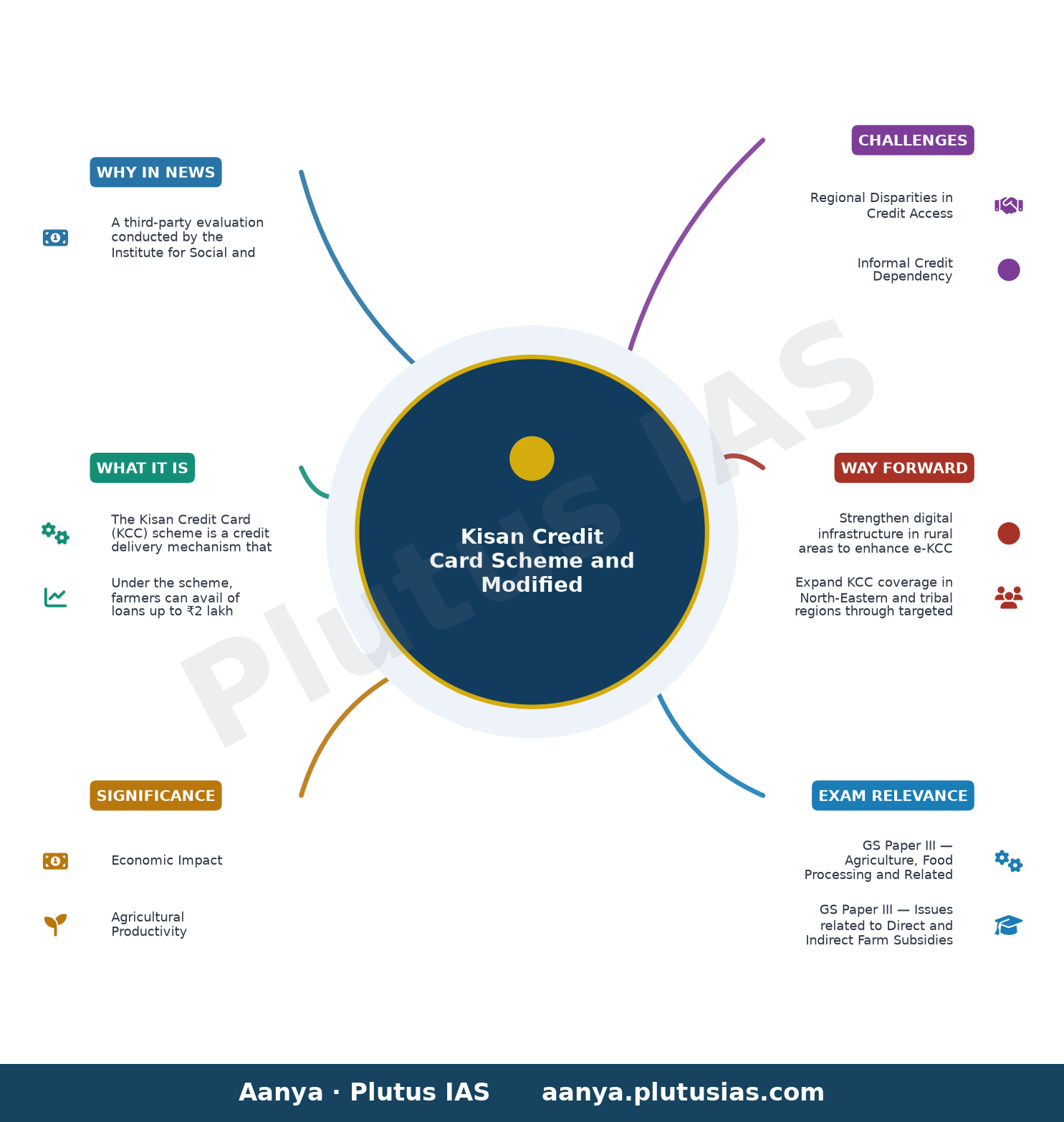
- GS Paper III — Agriculture, Food Processing and Related Issues | GS Paper III — Issues related to Direct and Indirect Farm Subsidies and Minimum Support Prices
- Prelims: Kisan Credit Card (KCC), Modified Interest Subvention Scheme (MISS), Priority Sector Lending (PSL), NABARD, Agricultural Credit Targets, Farm Productivity, Crop Intensification, Working Capital Requirements, Fisheries and Animal Husbandry Integration
- Essay: Agricultural Credit and Rural Prosperity: The Role of Institutional Support, Digital Transformation in Indian Agriculture: Opportunities and Challenges
Quick Revision: The Kisan Credit Card scheme, supported by the Revised Interest Subsidy Scheme, ensures affordable institutional credit for farmers, reduces interest burden, and enhances agricultural productivity through crop diversification and multi-seasonal farming, with every ₹1 invested yielding ₹2.30 in net value addition.
Why is this in the news?
A third-party evaluation conducted by the Institute for Social and Economic Change (ISEC), Bengaluru, has quantified the economic impact of the Kisan Credit Card (KCC) scheme under the Revised Interest Subsidy Scheme, revealing that every ₹1 invested yields ₹2.30 in net value addition to agriculture and allied sectors. This assessment, released by the Ministry of Finance, underscores the scheme’s role in reducing farmers’ interest burden, enhancing crop intensity, and promoting multi-seasonal farming, thereby contributing to income diversification and rural economic resilience.
Background
- The Kisan Credit Card (KCC) scheme was introduced in 1998 to provide timely and adequate credit to farmers through institutional sources, addressing the limitations of informal credit markets.
- The scheme has been progressively expanded, with the Government of India’s estimated subsidy amount from its inception to 2024-25 being ₹1.87 lakh crore, ensuring affordable credit access for millions of small and marginal farmers.
- The evaluation by ISEC highlights the scheme’s alignment with broader agricultural policy objectives, including the promotion of crop diversification, sustainable irrigation practices, and integration of allied activities such as dairy, fisheries, and animal husbandry.
- Technological interventions like the Kisan Credit Card Portal, Jan Samarth Portal, e-KCC, and Krishika have been introduced to streamline credit delivery, reduce transaction costs, and enhance transparency in agricultural credit distribution.
- The scheme operates within the framework of Priority Sector Lending (PSL) guidelines, which mandate banks to allocate a specified proportion of their credit to agriculture and allied sectors.
What is the Kisan Credit Card (KCC) Scheme and Revised Interest Subsidy Scheme?
- The Kisan Credit Card (KCC) scheme is a credit delivery mechanism that provides farmers with timely and hassle-free access to short-term agricultural credit through institutional sources such as commercial banks, regional rural banks, and cooperative banks.
- Under the scheme, farmers can avail of loans up to ₹2 lakh without collateral for loans up to ₹1.6 lakh (increased to ₹2 lakh from 1 January 2025), with flexible repayment terms aligned to the crop cycle.
- The Revised Interest Subsidy Scheme complements the KCC by providing interest subvention on short-term crop loans and term loans for allied activities, reducing the effective interest rate for farmers.
- The scheme covers a wide range of agricultural and allied activities, including crop production, post-harvest expenses, marketing loans, and investments in farm machinery, irrigation, and allied sectors such as dairy, poultry, fisheries, and animal husbandry.
- The Revised Interest Subsidy Scheme operates on a ‘subvention’ model, where the Government of India reimburses the interest subvention directly to the lending institutions, thereby ensuring that farmers benefit from lower interest rates without administrative delays.
- The scheme promotes crop intensification and multi-seasonal farming by enabling farmers to access working capital for diverse cropping patterns, thereby enhancing farm productivity and income stability.
- The evaluation by ISEC confirms that the scheme’s design and implementation have contributed to a multiplier effect in agricultural value addition, with every ₹1 of investment generating ₹2.30 in net value addition.
- The scheme also incentivizes timely repayment through the Prompt Repayment Incentive (PRI), which rewards farmers with additional subvention benefits, thereby improving credit discipline and reducing default risks for banks.
Key Features
| Feature | Significance |
|---|---|
| Revised Interest Subsidy Scheme under KCC | Provides subsidised credit to farmers, reducing interest burden and enhancing access to institutional finance. |
| 1:2.30 Leverage Ratio in Net Value Addition | Demonstrates high economic efficiency; every ₹1 invested yields ₹2.30 in net value addition in agriculture and allied sectors. |
| Crop Intensification and Multi-Season Farming | Encourages higher cropping intensity and diversification across seasons, improving farm productivity and resilience. |
| Working Capital Access via KCC | Ensures timely availability of inputs through enhanced working capital, reducing seasonal dependency and improving repayment discipline. |
| Digital Integration (Kisan Credit Card Portal, e-KCC, Jan Samarth, Krishika) | Streamlines loan disbursement, reduces transaction costs, and expands digital reach to small and marginal farmers. |
| Interest Subsidy Outlay (₹1.87 lakh crore, 2024-25) | Significant fiscal support to sustain agricultural credit flow and incentivise early repayment, boosting bank confidence. |
| Expansion of Collateral-Free KCC Limit (₹1.6 lakh to ₹2 lakh) | Enhances credit access for small farmers without risk of asset loss, effective from 01.01.2025. |
| Income Diversification Incentives (Dairy, Fisheries, Animal Husbandry) | Promotes allied activities, reducing over-reliance on seasonal crops and stabilising farm incomes. |
Why it Matters
Economic Impact
- Enhances agricultural productivity and output through improved credit access and input utilisation.
- Stimulates rural economy via higher farm incomes and diversified livelihoods.
- Demonstrates high fiscal efficiency with a 1:2.30 multiplier effect in net value addition.
- Reduces credit risk for banks by incentivising timely repayment through PRI schemes.
Agricultural Productivity
- Increases crop intensity and multi-season farming, optimising land use and resource allocation.
- Supports allied sectors (dairy, fisheries, animal husbandry) for income diversification and resilience.
- Facilitates adoption of modern agricultural practices through timely and affordable credit.
Financial Inclusion
- Expands institutional credit access to small and marginal farmers via digital platforms.
- Reduces dependency on informal credit sources, lowering interest costs for farmers.
- Strengthens repayment culture and financial discipline among borrowers.
Policy and Governance
- Demonstrates evidence-based policy evaluation through third-party assessments (e.g., ISEC).
- Showcases inter-ministerial coordination (Finance, Agriculture, NABARD) for scheme implementation.
- Highlights the role of digital governance in agricultural credit delivery and monitoring.
Challenges
1. Regional Disparities in Credit Access
- Uneven distribution of KCC coverage across states, with lower penetration in North-Eastern and tribal regions.
- Inadequate awareness and digital literacy in remote areas hinder scheme utilisation.
UPSC Link: GS-III: Agricultural Credit and Rural Development
2. Informal Credit Dependency
- Persistence of informal credit sources (moneylenders) due to delays in institutional credit disbursement.
- Lack of collateral in some regions limits access to formal credit despite KCC expansion.
UPSC Link: GS-III: Financial Inclusion and Rural Economy
3. Climate Vulnerability and Risk Mitigation
- Increased exposure to climate risks (droughts, floods) due to higher crop intensity and multi-season farming.
- Limited insurance coverage for allied activities (dairy, fisheries) under KCC framework.
UPSC Link: GS-III: Climate Change and Agriculture
4. Bureaucratic and Operational Delays
- Lag in updating land records and digitisation of farmer databases delays KCC approvals.
- Inconsistent implementation of PRI incentives across banks and regions.
UPSC Link: GS-II: Governance and Public Service Delivery
5. Debt Sustainability Concerns
- Rising farm debt levels despite subsidies, raising questions about long-term fiscal sustainability.
- Over-reliance on credit without corresponding investment in productivity-enhancing technologies.
UPSC Link: GS-III: Agricultural Finance and Subsidies
6. Technology Adoption Barriers
- Low digital literacy among small farmers limits utilisation of e-KCC and online portals.
- Inadequate infrastructure (internet connectivity, mobile access) in rural areas.
UPSC Link: GS-III: Digital Divide and Rural Development
Challenges — UPSC Perspective
| Issue | Concern |
|---|---|
| Uneven KCC Coverage | Lower penetration in North-East and tribal regions due to logistical and awareness gaps. |
| Informal Credit Dependency | Moneylenders remain dominant in areas with delayed institutional credit disbursement. |
| Climate Risk Exposure | Higher crop intensity increases vulnerability to extreme weather events. |
| Bureaucratic Delays | Land record digitisation and database updates lag behind KCC expansion. |
| Debt Burden | Subsidised credit may lead to over-indebtedness without productivity gains. |
| Digital Literacy Gaps | Small farmers struggle to utilise e-KCC and online portals effectively. |
Government Initiatives — Must-Memorise for Prelims
- Kisan Credit Card (KCC) Scheme
- Kisan Credit Card Portal (for digital loan applications)
- Jan Samarth Portal (for credit facilitation)
- e-Kisan Credit Card (digital KCC issuance)
- Priority Sector Lending (PSL) Targets for Agriculture (RBI guidelines)
Way Forward
- Strengthen digital infrastructure in rural areas to enhance e-KCC and portal accessibility.
- Expand KCC coverage in North-Eastern and tribal regions through targeted awareness campaigns.
- Integrate climate-resilient agricultural practices with KCC loans to mitigate climate risks.
- Accelerate land record digitisation and farmer database updates to reduce approval delays.
- Enhance insurance coverage for allied activities (dairy, fisheries) under KCC framework.
- Promote financial literacy programmes to improve digital adoption and repayment discipline.
- Monitor and evaluate PRI incentives to ensure uniform implementation across banks.
- Encourage convergence with PM-KISAN and other welfare schemes for holistic farmer support.
UPSC Value Addition
Keywords for Mains Answer-Writing
Kisan Credit Card (KCC) Scheme · Modified Interest Subvention Scheme (MISS) · Agricultural credit · Net Value Addition (NVA) in agriculture · Crop intensification · Multi-season farming · Priority Sector Lending (PSL) · Digital lending platforms · Farm income diversification · Working capital requirements (WCR) in inland fisheries · Priority Sector Lending (PSL) targets for agriculture · Electronic Kisan Credit Card (e-KCC) · Jan Samarth Portal · Kisan Rin Portal · Karshika platform · Interest subvention for farmers · Small and marginal farmers · Agricultural credit disbursement · Fisheries and livestock integration · North-East region diversification
Concept Flow
Insufficient institutional credit → High interest burden on farmers → Revised Interest Subsidy Scheme under KCC introduced → KCC provides collateral-free credit access → Enhanced working capital for farmers → Improved input utilisation and crop intensity → Subsidised interest rates → Reduced debt burden → Higher repayment discipline (PRI incentives) → Increased bank confidence → Digital integration (e-KCC, Jan Samarth) → Streamlined loan disbursement → Expanded reach to small farmers → Higher crop intensity and multi-season farming → Increased agricultural output → Diversification into allied sectors (dairy, fisheries) → Third-party evaluation (ISEC) → Evidence of 1:2.30 leverage ratio → Policy refinement and scalability of KCC → Regional disparities and climate risks → Need for targeted interventions → Way forward for inclusive and resilient agriculture
Prelims Practice Questions
Q1. Consider the following statements regarding the Kisan Credit Card (KCC) Scheme:
1. The KCC scheme was launched to provide timely and adequate credit to farmers.
2. The Modified Interest Subvention Scheme (MISS) under KCC reduces the interest burden on farmers.
3. The KCC scheme covers only crop loans and excludes allied activities like dairy and fisheries.
4. The KCC scheme has been digitized through platforms like e-KCC and Karshika.
How many of the above statements are correct?
- Only one
- Only two
- Only three
- All four
Answer: All four — Statements 1, 2, and 4 are correct. Statement 3 is incorrect as the KCC scheme covers allied activities like dairy and fisheries under its ambit.
Q2. Assertion (A): The Modified Interest Subvention Scheme (MISS) under the Kisan Credit Card (KCC) scheme has significantly reduced the interest burden on farmers.
Reason (R): The MISS provides a 2% interest subvention to farmers, which is further enhanced by an additional 3% for prompt repayment, making the effective interest rate 4% per annum.
(a) Both A and R are true, and R is the correct explanation of A
(b) Both A and R are true, but R is NOT the correct explanation of A
(c) A is true, but R is false
(d) A is false, but R is true
Answer: ? — Both the assertion and reason are correct. The MISS under KCC provides a 2% interest subvention, and an additional 3% for prompt repayment, making the effective interest rate 4% per annum, which significantly reduces the interest burden on farmers.
Q3. Match the following initiatives launched to streamline agricultural credit disbursement under the Kisan Credit Card (KCC) scheme with their respective purposes:
Column I (Initiative) | Column II (Purpose)
———————————————–|————————————————
A. Kisan Rin Portal | 1. Digital platform for seamless KCC application
B. Jan Samarth Portal | 2. Centralized portal for credit-linked subsidies
C. e-Kisan Credit Card (e-KCC) | 3. Digital issuance and management of KCC
D. Karshika platform | 4. State-level coordination for agricultural credit
Choose the correct match:
- A-3, B-2, C-1, D-4
- A-2, B-3, C-1, D-4
- A-1, B-2, C-3, D-4
- A-4, B-1, C-2, D-3
Answer: A-3, B-2, C-1, D-4 — A-3: Kisan Rin Portal is a digital platform for seamless KCC application and management. B-2: Jan Samarth Portal is a centralized portal for credit-linked subsidies. C-1: e-Kisan Credit Card (e-KCC) is a digital platform for KCC issuance and management. D-4: Karshika platform is used for state-level coordination for agricultural credit.
Mains Practice Question
✍ Critically examine the role of the Modified Interest Subvention Scheme (MISS) under the Kisan Credit Card (KCC) framework in enhancing agricultural productivity and farm income diversification. Also, analyse the technological interventions that have supported the implementation of the KCC scheme. (15 Marks)
Approach: MODEL-ANSWER SKELETON:
1. **Introduction (2 marks)**
– Brief context: Kisan Credit Card (KCC) scheme and its evolution into the Modified Interest Subvention Scheme (MISS).
– Objective of MISS: Reduce interest burden on farmers and enhance agricultural productivity.
2. **Role of MISS in Enhancing Agricultural Productivity (5 marks)**
– **Interest Subvention Mechanism**: Explain the 2% subvention + 3% prompt repayment incentive, reducing effective interest rate to 4%.
– **Impact on Crop Intensification and Multi-Season Farming**: Cite the third-party evaluation (2.30x NVA per ₹1 invested) and how it has enabled farmers to cultivate larger areas and adopt diverse cropping patterns.
– **Farm Income Diversification**: Highlight expansion into allied sectors like dairy, fisheries, and livestock, reducing dependence on seasonal agriculture.
– **Working Capital Requirements (WCR) in Inland Fisheries**: Emphasize support for North-East region diversification.
3. **Technological Interventions Supporting KCC Implementation (5 marks)**
– **Digital Platforms**:
– e-Kisan Credit Card (e-KCC): Digital issuance and management of KCC.
– Kisan Rin Portal: Seamless application and tracking of KCC.
– Jan Samarth Portal: Centralized portal for credit-linked subsidies.
– Karshika Platform: State-level coordination for agricultural credit.
– **Impact of Technology**: Discuss how these platforms have streamlined credit disbursement, improved transparency, and reduced transaction costs.
4. **Challenges and Limitations (2 marks)**
– **Digital Divide**: Address disparities in access to digital platforms, particularly for small and marginal farmers.
– **Awareness Gaps**: Highlight the need for continued IEC (Information, Education, and Communication) campaigns to ensure wider coverage.
5. **Conclusion (1 mark)**
– Summarize the transformative impact of MISS and technological interventions on agricultural productivity and farm income diversification.
– Emphasize the need for scaling up digital infrastructure and awareness campaigns to maximize benefits.
Source: PIB (Press Information Bureau)
Generated by AanyaAi for educational purpose.

- Kerala PSC Chairperson Removal: Governor’s Recommendation Explained for UPSC - October 25, 2026
- लोकसभा स्पीकर बिरला और रूस के ड्यूमा स्पीकर वोलोडिन ने संसदीय सहयोग बढ़ाने पर बातचीत की - October 25, 2026
- UP’s New Age Verification Rules to Curb POCSO Act Misuse - October 25, 2026

No Comments