


03 Aug Kisan Credit Card Scheme: ₹1 Investment Yields ₹2.30 in Agri GDP – PIB Report
✎ The Modified Interest Subsidy Scheme under KCC ensures a 7% interest rate on loans up to ₹3 lakh, with an additional 3% subvention for prompt repayment, thereby reducing the effective interest burden on farmers and enhancing…
Subject Relevance — Where This Topic Fits
- GS Paper III — Agriculture, Food Processing and Related Sectors | GS Paper III — Issues related to Direct and Indirect Farm Subsidies and Minimum Support Prices | GS Paper III — Technology Missions and Digital Infrastructure in Agriculture
- Prelims: Kisan Credit Card (KCC), Priority Sector Lending (PSL), Interest Subvention Scheme for Short-Term Crop Loans, NABARD, RBI guidelines on agricultural credit, Crop Intensification, Working Capital Requirements (WCR) in inland fisheries, E-KCC, Jan Samarth Portal, Kisan Credit Card saturation campaigns
- Essay: Agricultural credit as a catalyst for rural transformation, Digital public infrastructure and its role in inclusive growth
Quick Revision: The Modified Interest Subsidy Scheme under KCC ensures a 7% interest rate on loans up to ₹3 lakh, with an additional 3% subvention for prompt repayment, thereby reducing the effective interest burden on farmers and enhancing agricultural productivity.
Why is this in the news?
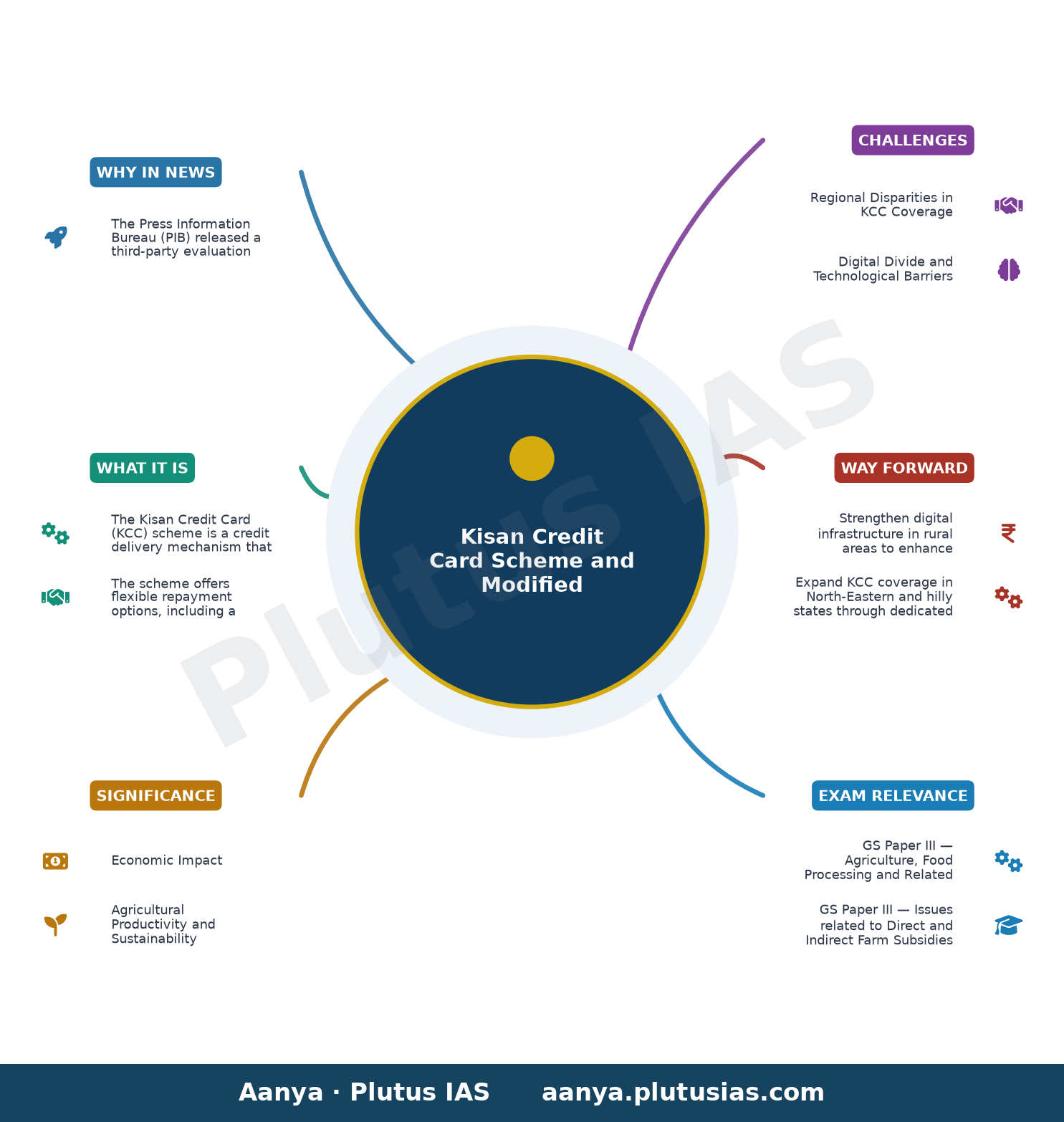
The Press Information Bureau (PIB) released a third-party evaluation report by the Institute for Social and Economic Change (ISEC), Bengaluru, highlighting the economic multiplier effect of the Modified Interest Subsidy Scheme under the Kisan Credit Card (KCC) initiative. The report quantifies the net value addition in agriculture and allied sectors at ₹2.30 for every ₹1 invested, underscoring the scheme’s role in enhancing farm productivity, crop diversification, and rural income sustainability. This development is significant in the context of India’s ongoing efforts to strengthen institutional credit access for farmers and align agricultural financing with the goals of the National Mission for Sustainable Agriculture (NMSA).
Background
- The Kisan Credit Card (KCC) scheme was launched in 1998 by the Government of India in collaboration with NABARD to provide short-term credit to farmers for agricultural and allied activities, including post-harvest expenses.
- The Modified Interest Subsidy Scheme for KCC was introduced to reduce the interest burden on farmers, particularly small and marginal ones, by providing interest subvention on short-term crop loans up to ₹3 lakh at 7% per annum.
- The scheme’s coverage was expanded to include allied activities such as dairy, poultry, fisheries, and animal husbandry, aligning with the government’s push for integrated farming systems.
- The total subvention disbursed under the scheme from its inception to 2024-25 is estimated at ₹1.87 lakh crore, reflecting its scale and fiscal commitment.
- The scheme operates under the aegis of the Department of Agriculture and Farmers’ Welfare, Ministry of Agriculture and Farmers’ Welfare, with NABARD as the nodal agency for implementation and monitoring.
- The evaluation by ISEC, Bengaluru, was conducted to assess the scheme’s impact across diverse agro-climatic zones in India, using a robust third-party methodology.
What is the Kisan Credit Card Scheme and the Modified Interest Subsidy Scheme?
- The Kisan Credit Card (KCC) scheme is a credit delivery mechanism that provides farmers with timely and adequate short-term credit for agricultural and allied activities through a simplified process.
- The scheme offers flexible repayment options, including a revolving cash credit facility, and covers expenses such as crop production, post-harvest activities, and consumption needs.
- The Modified Interest Subsidy Scheme reduces the effective interest rate on KCC loans to 7% per annum for loans up to ₹3 lakh, with an additional 3% subvention for prompt repayment under the ‘Prompt Repayment Incentive’ (PRI) scheme.
- The scheme’s eligibility extends to small and marginal farmers, tenant farmers, sharecroppers, and other cultivators engaged in agricultural activities or allied sectors like dairy, poultry, fisheries, and animal husbandry.
- The KCC scheme is implemented through commercial banks, regional rural banks (RRBs), and cooperative banks, with NABARD facilitating the flow of credit and monitoring the scheme’s implementation.
- The scheme’s digital transformation includes initiatives like the Kisan Credit Card Portal, Jan Samarth Portal, E-KCC, and KRIShiKA, which streamline loan disbursement, application processing, and monitoring.
- The KCC scheme also supports the government’s priority sector lending (PSL) targets, ensuring that at least 18% of net bank credit is directed toward agriculture and allied activities.
Key Features
| Feature | Significance |
|---|---|
| Modified Interest Subsidy Scheme under KCC | Reduces interest burden on farmers, enhancing affordability of institutional credit and promoting investment in agriculture and allied sectors. |
| Net Value Addition (NVA) Multiplier of 2.30 | Demonstrates high economic efficiency where ₹1 invested yields ₹2.30 in net value addition, validating the scheme’s fiscal prudence and scalability. |
| Enhanced Crop Intensity and Multi-Season Farming | Facilitates diversification of cropping patterns, reduces seasonal dependency, and improves farm productivity through timely access to working capital. |
| Digital Integration (Kisan Credit Card Portal, e-KCC, Krishika, Jan Samarth Portal) | Streamlines loan disbursement, reduces transaction costs, and ensures last-mile delivery of credit, particularly benefiting small and marginal farmers. |
| Increased Loan Limit (₹1.6 lakh to ₹2 lakh) | Expands credit accessibility for farmers without collateral, fostering financial inclusion and risk mitigation in agricultural operations. |
Why it Matters
Economic Impact
- Demonstrates a high return on investment (ROI) of 230% in agriculture and allied sectors, validating the scheme’s role in enhancing farm profitability and rural economic growth.
- Reduces interest burden on farmers by ₹1.87 lakh crore (2024-25 estimate), freeing up capital for reinvestment in productivity-enhancing inputs.
- Promotes income diversification through integration of livestock, fisheries, and allied activities, reducing seasonal income volatility.
- Supports the expansion of dairy and animal husbandry, aligning with national goals of doubling farmer income and achieving nutritional security.
Agricultural Productivity and Sustainability
- Increases crop intensity and multi-season farming, optimizing land use and reducing fallow periods.
- Enhances access to reliable irrigation and timely inputs, improving crop yields and resilience to climate variability.
- Encourages adoption of modern agricultural practices and technology through improved credit availability.
- Supports inland fisheries (particularly in North-East India) by addressing working capital requirements, fostering aquaculture diversification.
Financial Inclusion and Institutional Credit
- Strengthens institutional credit delivery, reducing dependence on informal and high-interest debt sources.
- Improves loan repayment discipline through early repayment incentives, enhancing banks’ confidence in agricultural lending.
- Expands KCC coverage to small and marginal farmers, ensuring equitable access to formal credit infrastructure.
- Facilitates seamless integration with digital payment systems, reducing transaction frictions and leakages.
Policy and Governance
- Serves as a model for evidence-based policy formulation, with third-party evaluation (ISEC) providing credible impact assessment.
- Demonstrates the efficacy of targeted subsidies in achieving socio-economic objectives without distorting market mechanisms.
- Highlights the role of inter-ministerial coordination (Finance, Agriculture, and Rural Development) in implementing welfare schemes.
Challenges
1. Regional Disparities in KCC Coverage
- Uneven penetration of KCC scheme across states, with lower coverage in North-Eastern and hilly regions due to logistical and infrastructural constraints.
- Need for targeted interventions to ensure equitable credit access in tribal and remote areas.
UPSC Link: GS3: Agricultural Finance
2. Digital Divide and Technological Barriers
- Limited digital literacy among small and marginal farmers, hindering adoption of e-KCC and online portals.
- Reliance on intermediaries for digital transactions increases vulnerability to fraud and misinformation.
UPSC Link: GS3: Digital Divide
3. Climate Change and Agricultural Risk
- Increased frequency of extreme weather events threatens repayment capacity of farmers, despite subsidy support.
- Need for integration of climate-resilient agricultural practices and crop insurance mechanisms with KCC scheme.
UPSC Link: GS3: Climate Change
4. Sustainability of Subsidy Burden
- Long-term fiscal sustainability of interest subsidies requires periodic review and rationalization to prevent fiscal strain.
- Exploration of alternative financing models, such as risk-sharing mechanisms with private sector, to reduce government burden.
UPSC Link: GS3: Fiscal Policy
5. Monitoring and Evaluation Gaps
- Need for real-time data integration to track loan utilisation and impact, beyond periodic third-party evaluations.
- Strengthening of grievance redressal mechanisms to address farmer grievances related to loan disbursement and repayment.
UPSC Link: GS2: Governance
Challenges — UPSC Perspective
| Issue | Concern |
|---|---|
| Regional Disparities | Uneven KCC coverage across states, particularly in North-East and hilly regions, leading to exclusion of marginalised farmers. |
| Digital Literacy | Low adoption of e-KCC and online portals due to limited digital skills among small and marginal farmers. |
| Climate Vulnerability | Increased agricultural risks from climate change threaten repayment capacity and long-term viability of KCC beneficiaries. |
| Fiscal Sustainability | High subsidy outlay (₹1.87 lakh crore) raises concerns about long-term fiscal sustainability and need for cost-efficient alternatives. |
| Data Gaps | Lack of real-time monitoring systems to assess loan utilisation, impact, and grievance redressal efficiency. |
Government Initiatives — Must-Memorise for Prelims
- Modified Interest Subsidy Scheme under Kisan Credit Card (KCC)
- Kisan Credit Card (KCC) Scheme
- Jan Samarth Portal
- Kisan Loan Portal
- e-Kisan Credit Card (e-KCC)
- Krishika Platform
Way Forward
- Strengthen digital infrastructure in rural areas to enhance adoption of e-KCC and online loan portals, with targeted training programs for farmers.
- Expand KCC coverage in North-Eastern and hilly states through dedicated outreach programs and simplification of application processes.
- Integrate climate-resilient agricultural practices and crop insurance schemes with KCC to mitigate climate-related risks.
- Rationalize subsidy outlays through performance-based disbursement and explore risk-sharing models with private sector lenders.
- Enhance real-time monitoring of loan utilisation and impact through digitised MIS platforms, with periodic third-party audits.
- Promote convergence with other agricultural schemes (e.g., PM-KISAN, PM-FME) to create a holistic credit and welfare ecosystem.
- Strengthen grievance redressal mechanisms through dedicated helplines and district-level committees for farmer support.
- Conduct periodic impact assessments to identify gaps and refine scheme parameters for optimal outcomes.
UPSC Value Addition
Keywords for Mains Answer-Writing
Kisan Credit Card (KCC) · Modified Interest Subvention Scheme (MISS) · Agricultural credit · Net Value Addition (NVA) · Crop intensification · Multi-seasonal farming · Institutional credit delivery · Net Present Value (NPV) of subsidies · Priority sector lending · Digital KCC initiatives · Farm income diversification · Livestock and fisheries integration · Third-party evaluation · Institute for Social and Economic Change (ISEC) · RBI guidelines on KCC
Concept Flow
Farmers face high interest burden → Government introduces Modified Interest Subsidy Scheme under KCC → Reduces cost of institutional credit → Increases affordability of agricultural inputs → Enhances crop intensity and multi-season farming → Boosts Net Value Addition (NVA) in agriculture and allied sectors → Demonstrates high ROI (2.30x) → Validates scheme’s economic efficiency → Encourages income diversification and rural economic growth → Strengthens financial inclusion and institutional credit delivery → Facilitates digital integration and streamlined loan disbursement → Supports climate-resilient and sustainable agriculture.
Prelims Practice Questions
Q1. Consider the following statements regarding the Kisan Credit Card (KCC) scheme:
1. The KCC scheme provides interest subvention to farmers for short-term crop loans.
2. The revised interest subvention scheme covers loans up to ₹2 lakh without collateral.
3. The scheme is implemented by the Ministry of Agriculture and Farmers’ Welfare.
4. The KCC scheme does not include loans for allied agricultural activities such as dairy and fisheries.
How many of the above statements are correct?
- Only one
- Only two
- Only three
- All four
Answer: Only three — Statements 1, 2, and 3 are correct. Statement 4 is incorrect as the KCC scheme includes loans for allied agricultural activities such as dairy and fisheries.
Q2. Assertion (A): The Modified Interest Subvention Scheme (MISS) under KCC has contributed ₹2.30 to the Net Value Addition (NVA) in agriculture for every ₹1 invested.
Reason (R): The scheme has reduced the interest burden on farmers, thereby improving their credit discipline and enabling timely repayment.
- Both A and R are true, and R is the correct explanation of A
- Both A and R are true, but R is not the correct explanation of A
- A is true, but R is false
- A is false, but R is true
Answer: Both A and R are true, but R is not the correct explanation of A — Both the assertion and reason are true. The reduction in interest burden (Reason) is a key mechanism through which the scheme enhances agricultural productivity and NVA (Assertion).
Q3. Which of the following initiatives has been launched to streamline the agricultural credit delivery process under the Kisan Credit Card scheme?
1. Kisan Rin Portal
2. Jan Samarth Portal
3. e-KCC
4. KRIBHCO
Select the correct answer using the code below:
- 1, 2, and 3 only
- 1, 2, and 4 only
- 2, 3, and 4 only
- 1, 2, 3, and 4
Answer: 1, 2, and 3 only — The initiatives launched to streamline agricultural credit delivery under KCC are the Kisan Rin Portal, Jan Samarth Portal, and e-KCC. KRIBHCO is not part of these initiatives.
Mains Practice Question
✍ Critically examine the role of the Modified Interest Subvention Scheme (MISS) under the Kisan Credit Card (KCC) framework in enhancing agricultural productivity and farm income diversification. Also, analyse the challenges in its implementation and suggest measures for further improvement. (15 Marks)
Approach: MODEL-ANSWER SKELETON:
1. **Introduction (2 marks)**
– Briefly define the KCC scheme and the MISS.
– State the objective of MISS: reducing interest burden, enhancing credit access, and promoting agricultural productivity.
2. **Role in Enhancing Agricultural Productivity (5 marks)**
– **Crop Intensification and Multi-seasonal Farming**: Explain how the scheme has enabled farmers to cultivate larger areas and adopt multi-seasonal cropping patterns (supported by the ISEC evaluation).
– **Timely Input Availability**: Discuss the role of timely credit in ensuring timely procurement of inputs (seeds, fertilizers, pesticides).
– **Interest Subvention and Early Repayment Incentives (PRI)**: Highlight the impact of reduced interest burden and PRI on loan repayment discipline and bank confidence.
– **Net Value Addition (NVA)**: Emphasize the 2.30:1 return on investment in NVA as per the ISEC report.
3. **Farm Income Diversification (4 marks)**
– **Allied Activities**: Discuss the integration of livestock, dairy, fisheries, and horticulture with crop production.
– **Regional Impact**: Highlight the scheme’s role in promoting diversification in the North-Eastern region, particularly for inland fisheries.
– **Income Stability**: Explain how multi-seasonal farming and allied activities reduce dependency on seasonal agriculture.
4. **Challenges in Implementation (2 marks)**
– **Regional Disparities**: Discuss uneven access to KCC across states, particularly in remote and tribal areas.
– **Awareness Gaps**: Highlight the need for greater awareness campaigns among small and marginal farmers.
– **Digital Divide**: Mention the challenges posed by digital literacy and access to technology.
5. **Suggestions for Improvement (2 marks)**
– **Expansion of KCC Coverage**: Propose measures to include more small and marginal farmers, particularly in tribal and hilly regions.
– **Strengthening Digital Initiatives**: Recommend scaling up platforms like e-KCC, Kisan Rin Portal, and Jan Samarth Portal with user-friendly interfaces.
– **Targeted Subsidies**: Suggest linking subsidies to specific crops or activities to maximize impact.
– **Monitoring and Evaluation**: Emphasize the need for continuous third-party evaluations to assess the scheme’s effectiveness.
**Balanced View**: Present both the successes (e.g., improved NVA, crop intensification) and limitations (e.g., regional disparities, digital divide) to provide a critical analysis.
Source: PIB (Press Information Bureau)
Generated by AanyaAi for educational purpose.

- Jal Arpan: 1850+ Gram Panchayats Join Hands for Rural Water Supply - October 3, 2026
- भारत ने किया 5.56 किमी मुक्त अंतरिक्ष क्वांटम की वितरण लिंक का सफल परीक्षण - October 3, 2026
- Great Indian Bustard Reintroduction: 10-Year Effort Bears Fruit in Rajasthan - October 3, 2026

No Comments