


04 Aug IIT Hyderabad Launches India’s First Nuclear Tech Programme for UPSC & PCS
✎ ANUGYAN is India’s first industry-academia nuclear technology programme, designed to address the critical shortage of skilled professionals in the civil nuclear sector and support the country’s target of scaling nuclear power to…
 Nuclear Technology ProgrammeIndustry-Academia CollaborationSkilled Workforce DevelopmentCivil Nuclear SectorClean Energy Transition
Subject Relevance — Where This Topic Fits
- GS Paper II — International Relations (Energy Diplomacy and Nuclear Cooperation) | GS Paper III — Science and Technology (Nuclear Energy, Indigenous Technologies, and Human Resource Development) | GS Paper III — Environment (Clean Energy Transition and Climate Mitigation)
- Prelims: Atomic Energy Regulatory Board (AERB), Small Modular Reactors (SMRs), Nuclear Power Corporation of India Limited (NPCIL), Civil Nuclear Liability Act, 2010, India’s NDCs under Paris Agreement (500 GW non-fossil by 2030), Bharat Innovate 2026, Centre of Design Excellence in Nuclear Engineering (CODENE), Dassault Systèmes
- Essay: India’s Energy Transition: Balancing Nuclear Power and Renewables in the Path to Net-Zero, The Role of Public-Private Partnerships in Advancing Indigenous Nuclear Technologies
Quick Revision: ANUGYAN is India’s first industry-academia nuclear technology programme, designed to address the critical shortage of skilled professionals in the civil nuclear sector and support the country’s target of scaling nuclear power to 100 GWe by 2047.
Why is this in the news?
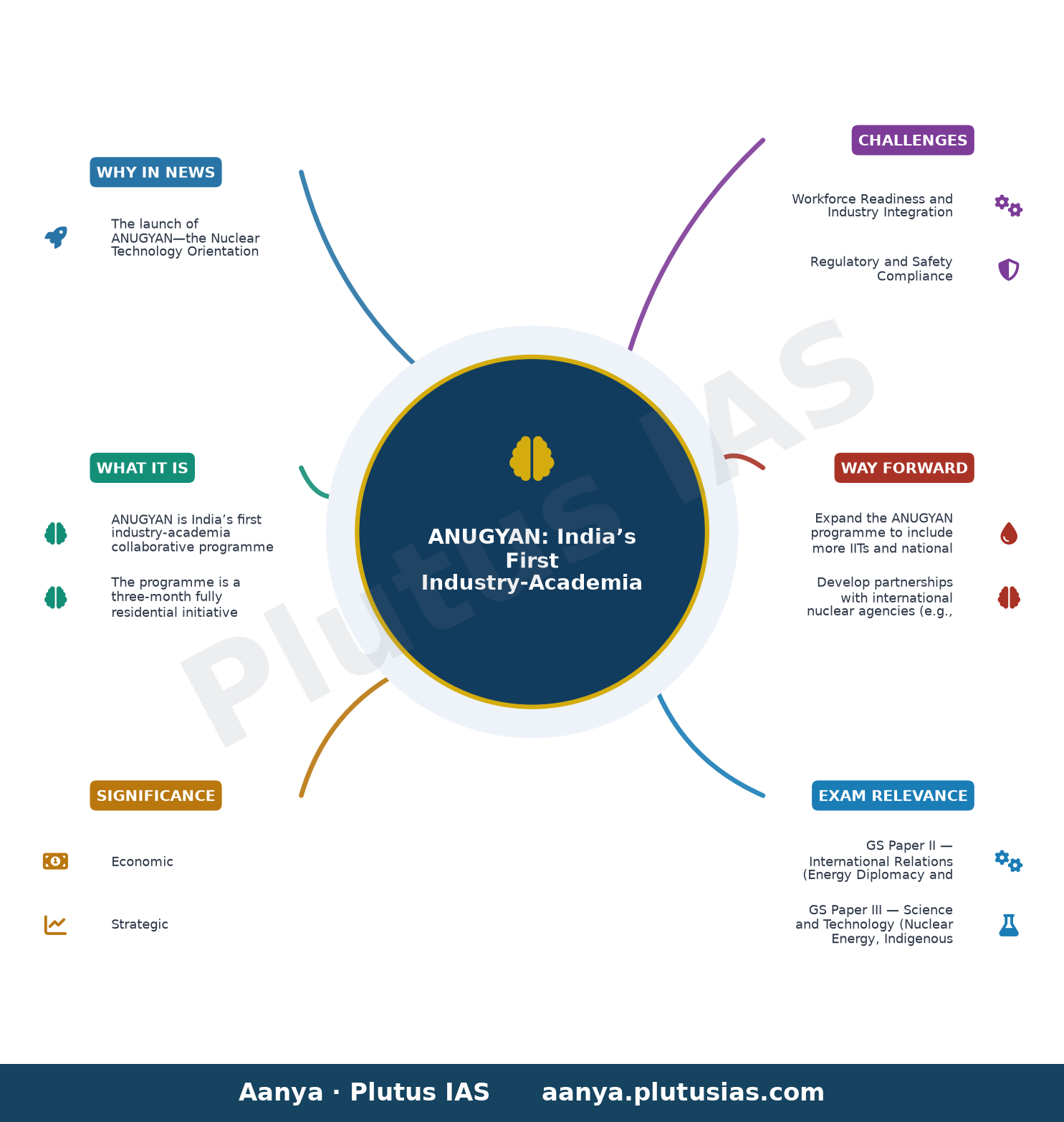
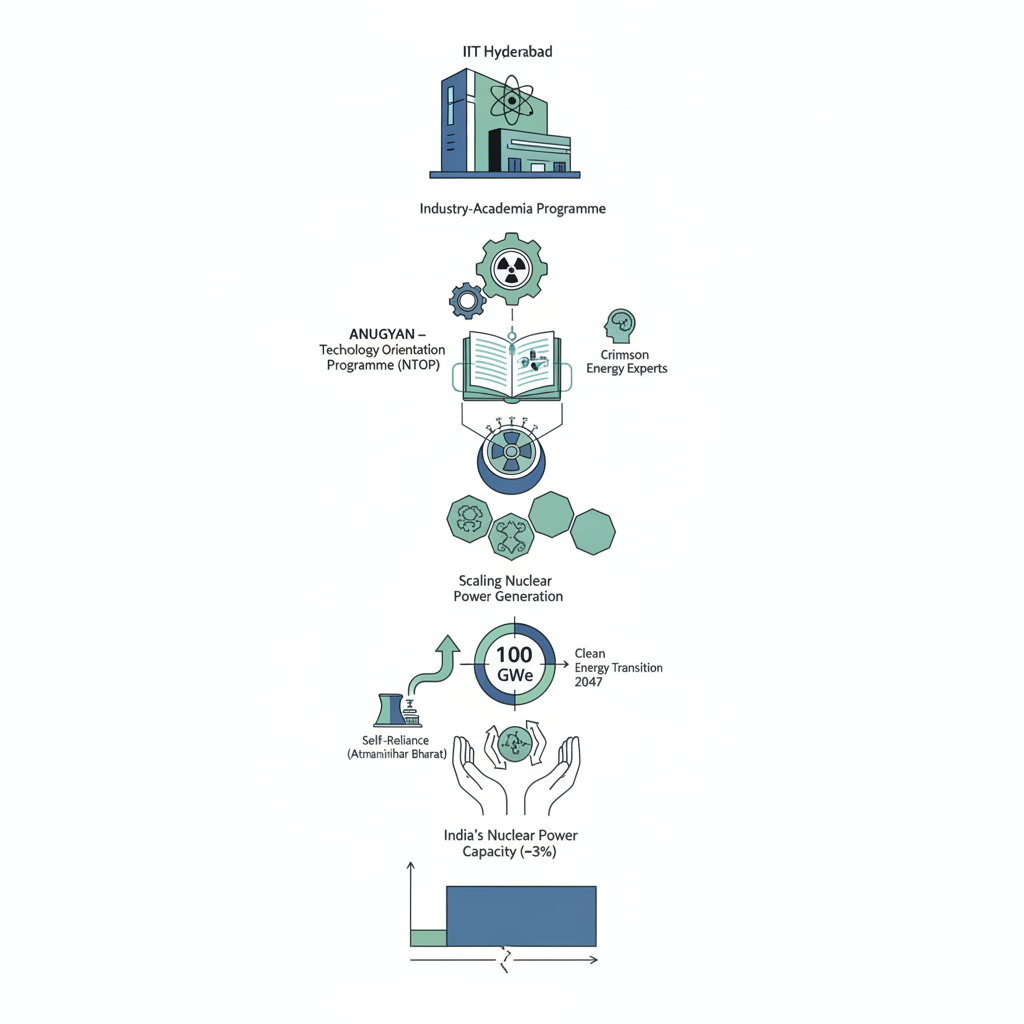
The launch of ANUGYAN—the Nuclear Technology Orientation Programme (NTOP)—by IIT Hyderabad in collaboration with Crimson Energy Experts marks a watershed moment in India’s nuclear energy ecosystem. This initiative directly addresses the acute shortage of skilled professionals in the civil nuclear sector, which is critical to achieving India’s ambitious target of scaling nuclear power generation from 8.8 GWe to 100 GWe by 2047. By integrating academic rigour with industrial expertise, ANUGYAN exemplifies a paradigm shift in India’s approach to nuclear engineering education, aligning with the government’s push for self-reliance (Atmanirbhar Bharat) and clean energy transition.
Background
- India’s nuclear power capacity stands at approximately 8.8 GWe, contributing ~3% to the national electricity mix, far below its potential given the country’s vast thorium reserves and uranium resources.
- The Atomic Energy Regulatory Board (AERB) plays a pivotal role in ensuring safety and compliance in nuclear operations, with stringent regulations governing reactor design, waste management, and radiation safety.
- Public-Private Partnerships (PPPs) in nuclear technology are emerging as a strategic tool to bridge the gap between academic research and industrial application, particularly in high-technology sectors like nuclear engineering.
- The Civil Nuclear Liability Act, 2010, governs liability in case of nuclear accidents, balancing industry incentives with public safety concerns.
- The MoU for the ANUGYAN programme was signed during the Bharat Innovate 2026 platform, underscoring India’s focus on fostering innovation in nuclear technology through international collaborations.
What is ANUGYAN — Nuclear Technology Orientation Programme (NTOP)?
- ANUGYAN is India’s first industry-academia collaborative programme in nuclear technology, jointly developed by IIT Hyderabad and Crimson Energy Experts Pvt. Ltd., with support from Dassault Systèmes.
- The programme is a three-month fully residential initiative designed to equip engineers, industry professionals, and PSU executives with advanced competencies in nuclear engineering and clean energy technologies.
- Core curriculum components include reactor physics, thermal hydraulics, radiation safety, Small Modular Reactors (SMRs), engineering design, quality assurance, AERB regulatory compliance, and simulator-based training.
- The programme integrates theoretical learning with hands-on industrial exposure, ensuring participants gain practical insights into nuclear plant operations, regulatory frameworks, and emerging technologies like SMRs.
- Eligible participants include engineering graduates, working professionals, PSU executives, EPC contractors, and industrial equipment manufacturers, with a focus on building a skilled workforce for India’s expanding nuclear supply chain.
- Upon completion, participants receive a joint certification from IIT Hyderabad and Crimson Energy Experts, enhancing their employability in the nuclear sector and allied industries.
- The programme is aligned with the Centre of Design Excellence in Nuclear Engineering (CODENE), established under the MoU signed at Bharat Innovate 2026, to advance nuclear engineering design and digital simulation.
- ANUGYAN’s launch reflects a broader shift towards indigenous capacity-building in nuclear technology, reducing dependence on foreign expertise and accelerating India’s clean energy transition.
Key Features
| Feature | Significance |
|---|---|
| Fully residential three-month programme | Ensures immersive learning and industry exposure, fostering skill development in a structured environment. |
| Joint certification by IIT Hyderabad and Crimson Energy Experts | Enhances credibility and industry recognition of the programme, aligning academic rigour with practical expertise. |
| Curriculum covering reactor physics, thermal hydraulics, and radiation safety | Addresses core competencies required for nuclear engineering, ensuring comprehensive theoretical and practical training. |
| Inclusion of Small Modular Reactors (SMRs) and AERB regulatory compliance | Aligns with India’s nuclear energy expansion goals and regulatory frameworks, preparing professionals for modern and compliant nuclear projects. |
| Simulator-based training | Provides hands-on experience in nuclear operations, enhancing operational readiness and reducing on-the-job risks. |
Why it Matters
Economic
- Addresses the critical shortage of skilled nuclear engineers in India’s expanding civil nuclear sector, projected to grow from 8.8 GWe to 100 GWe by 2047.
- Enhances India’s self-reliance in nuclear engineering education, reducing dependence on foreign expertise and technologies.
- Creates a skilled workforce for the nuclear supply chain, including PSUs, EPC contractors, and industrial equipment manufacturers, boosting job creation and industrial capacity.
Strategic
- Supports India’s clean energy transition by providing trained professionals for nuclear power generation, a key component of the energy mix.
- Strengthens domestic nuclear engineering capabilities, reducing vulnerability to geopolitical constraints in technology transfers.
- Facilitates the development of advanced nuclear technologies such as SMRs, aligning with global trends and India’s long-term energy security goals.
Educational
- Bridges the gap between academia and industry by integrating academic rigour with real-world industrial exposure.
- Provides a model for industry-academia collaboration in niche sectors like nuclear technology, setting a precedent for other engineering disciplines.
- Offers a structured pathway for engineering graduates and professionals to upskill in a high-technology domain.
Technological
- Advances India’s capabilities in nuclear engineering design and digital simulation through the proposed Centre of Design Excellence in Nuclear Engineering (CODENE).
- Incorporates modern training tools such as simulators, ensuring professionals are adept at operating advanced nuclear systems.
- Promotes the adoption of SMRs, which are scalable, safer, and suitable for India’s diverse energy needs.
Challenges
1. Workforce Readiness and Industry Integration
- Ensuring the programme’s graduates meet industry standards and are immediately employable in a highly regulated sector.
- Bridging the gap between academic training and real-world industrial requirements in nuclear technology.
- Addressing the reluctance of industry to invest in training programmes due to perceived risks in nuclear sector employment.
UPSC Link: GS3: Science and Technology – Human Resource Development
2. Regulatory and Safety Compliance
- Aligning the programme with the Atomic Energy Regulatory Board (AERB) standards to ensure graduates are compliant with national regulations.
- Managing the challenges of simulator-based training, which requires high-fidelity replication of nuclear plant operations.
- Ensuring the programme adheres to international nuclear safety protocols while catering to domestic needs.
UPSC Link: GS3: Science and Technology – Nuclear Energy and Safety
3. Scalability and Accessibility
- Expanding the programme’s reach to a wider pool of candidates, including those from rural or underrepresented regions.
- Balancing the cost of a fully residential programme to ensure affordability for aspiring professionals.
- Ensuring the programme remains relevant amid rapid advancements in nuclear technology and regulatory changes.
UPSC Link: GS2: Governance – Inclusive Development
4. Public Perception and Acceptance
- Addressing societal concerns about nuclear energy, which may influence the willingness of professionals to join the sector.
- Promoting the programme as a career opportunity in a sector often perceived as high-risk or politically sensitive.
- Ensuring transparency and trust in the programme’s curriculum and industry partnerships.
UPSC Link: GS3: Science and Technology – Public Awareness
5. Collaboration and MoU Implementation
- Ensuring the successful implementation of the MoU between IIT Hyderabad, Dassault Systèmes, and Crimson Energy Experts for CODENE.
- Managing the logistics of international collaborations, including technology transfer and joint research initiatives.
- Sustaining long-term partnerships to keep the programme updated with global nuclear advancements.
UPSC Link: GS2: Governance – International Cooperation
Challenges — UPSC Perspective
| Issue | Concern |
|---|---|
| Industry-Academia Gap | Ensuring the curriculum aligns with real-world industrial needs and regulatory standards. |
| Regulatory Compliance | Meeting AERB and international nuclear safety protocols in training and certification. |
| Public Perception | Overcoming societal scepticism about nuclear energy to attract talent to the sector. |
| Scalability | Expanding the programme’s reach while maintaining quality and affordability. |
| Technology Transfer | Managing international collaborations for advanced nuclear technologies like SMRs. |
| Workforce Retention | Ensuring trained professionals remain in the nuclear sector amid competing career options. |
Way Forward
- Expand the ANUGYAN programme to include more IITs and national laboratories to scale up training capacity.
- Develop partnerships with international nuclear agencies (e.g., IAEA) to enhance curriculum standards and global recognition.
- Introduce scholarships and financial aid for deserving candidates to improve accessibility and diversity.
- Establish a dedicated placement cell to connect graduates with nuclear PSUs, EPC contractors, and research institutions.
- Incorporate modular and online learning components to cater to working professionals and remote learners.
- Strengthen simulator infrastructure with advanced digital twin technologies for realistic training scenarios.
- Launch awareness campaigns to highlight career opportunities and dispel myths about the nuclear energy sector.
- Encourage research collaborations under CODENE to drive innovation in nuclear engineering design and safety.
UPSC Value Addition
Keywords for Mains Answer-Writing
Nuclear energy in India · Self-reliance in nuclear technology · Small Modular Reactors (SMRs) · Atomic Energy Regulatory Board (AERB) · Civil nuclear energy sector · Industry-academia collaboration · Centre of Design Excellence in Nuclear Engineering (CODENE) · Nuclear power capacity expansion · Reactor physics and thermal hydraulics · Radiation safety and regulatory compliance · Simulator-based training in nuclear engineering · Joint certification in nuclear technology · Public Sector Undertakings (PSUs) in nuclear sector · Engineering, Procurement, and Construction (EPC) contractors · Clean energy technologies
Concept Flow
India’s nuclear energy expansion (8.8 GWe to 100 GWe by 2047) → Demand for skilled nuclear professionals → Launch of ANUGYAN programme by IIT Hyderabad and Crimson Energy Experts → Industry-academia collaboration → Joint certification and immersive training → Skilled workforce for nuclear supply chain → Contribution to clean energy goals and self-reliance.
Prelims Practice Questions
Q1. Consider the following statements regarding the ANUGYAN programme launched by IIT Hyderabad:
1. ANUGYAN is India’s first industry-academia programme in nuclear technology.
2. The programme is a six-month fully residential course.
3. The curriculum includes Small Modular Reactors (SMRs), reactor physics, and radiation safety.
4. Participants receive a joint certification from IIT Hyderabad and Dassault Systèmes.
How many of the above statements are correct?
- Only one
- Only two
- Only three
- All
Answer: Only three — Statements 1 and 3 are correct. Statement 2 is incorrect as the programme is a three-month fully residential course. Statement 4 is incorrect as the certification is provided by IIT Hyderabad and Crimson Energy Experts, not Dassault Systèmes.
Q2. Assertion (A): The ANUGYAN programme aims to cater to the growing demand for trained professionals in India’s nuclear energy sector.
Reason (R): India plans to increase its nuclear power generation capacity from 8.8 GWe to 100 GWe by 2047.
Options:
A. Both A and R are true, and R is the correct explanation of A.
B. Both A and R are true, but R is not the correct explanation of A.
C. A is true, but R is false.
D. A is false, but R is true.
Answer: ? — Both Assertion (A) and Reason (R) are true. The programme is designed to address the demand for skilled professionals in the nuclear sector, and India’s target of increasing nuclear power capacity to 100 GWe by 2047 underscores the need for such initiatives.
Q3. Match the following components of the ANUGYAN programme with their respective descriptions:
Column I
1. Small Modular Reactors (SMRs)
2. Radiation safety
3. AERB regulatory compliance
4. Simulator-based training
Column II
A. Ensuring adherence to safety standards prescribed by the Atomic Energy Regulatory Board
B. Practical training using nuclear reactor simulators to enhance operational skills
C. Advanced nuclear reactors designed for modular deployment and enhanced safety
D. Measures to protect workers and the public from ionizing radiation exposure
Options:
A. 1-C, 2-D, 3-A, 4-B
B. 1-A, 2-B, 3-C, 4-D
C. 1-D, 2-C, 3-B, 4-A
D. 1-B, 2-A, 3-D, 4-C
- A
- B
- C
- D
Answer: A — The correct matches are: 1-C (SMRs are advanced modular reactors), 2-D (Radiation safety involves protecting against radiation exposure), 3-A (AERB regulatory compliance ensures adherence to safety standards), and 4-B (Simulator-based training uses nuclear reactor simulators for practical learning).
Mains Practice Question
✍ Critically analyse the significance of industry-academia collaborations in advancing India’s nuclear energy sector. Substantiate your arguments with reference to the ANUGYAN programme launched by IIT Hyderabad and its potential implications for achieving self-reliance in nuclear technology. (15 Marks)
Approach: MODEL-ANSWER SKELETON:
1. **Introduction (2 Marks)**: Define industry-academia collaborations and their relevance in the context of nuclear energy. Highlight India’s nuclear energy targets (e.g., increasing capacity from 8.8 GWe to 100 GWe by 2047) and the need for skilled professionals.
2. **Significance of Industry-Academia Collaborations (5 Marks)**:
– Bridging the gap between theoretical knowledge and practical industrial requirements.
– Leveraging the expertise of senior nuclear professionals (e.g., from Crimson Energy Experts) to provide real-world exposure.
– Enhancing curriculum relevance through joint design and certification (e.g., ANUGYAN’s collaboration with IIT Hyderabad and Crimson Energy Experts).
– Facilitating research and innovation, as seen in the proposed Centre of Design Excellence in Nuclear Engineering (CODENE) with Dassault Systèmes.
– Addressing workforce shortages in the civil nuclear energy sector by training engineers, PSU executives, and EPC contractors.
3. **ANUGYAN Programme as a Case Study (5 Marks)**:
– Structure: Three-month fully residential programme covering reactor physics, thermal hydraulics, radiation safety, SMRs, and AERB compliance.
– Outcomes: Joint certification, simulator-based training, and exposure to modern nuclear engineering practices.
– Alignment with national goals: Supports India’s push for self-reliance in nuclear technology and clean energy technologies.
4. **Challenges and Limitations (3 Marks)**:
– Ensuring sustained industry participation and funding for long-term programmes.
– Addressing regulatory and safety concerns in nuclear technology training.
– Balancing academic rigour with industry-specific skill development.
– Scaling the programme to meet the demand for 100 GWe capacity by 2047.
5. **Conclusion (2 Marks)**: Summarise the transformative potential of such collaborations in achieving India’s nuclear energy ambitions while acknowledging the need for continuous improvement and policy support.
Source: The Indian Express
Generated by AanyaAi for educational purpose.

- औषध विभाग ने ई-कचरे के वैज्ञानिक प्रबंधन के लिए शुरू किया विशेष अभियान 6 - October 2, 2026
- Tamil Nadu Launches Vettri Payanam Scheme: Free Bus Travel for Women - October 2, 2026
- गुजरात निर्मित उपग्रह TAPAS-1: अंतरिक्ष में भारत की नई उपलब्धि, जानिए कैसे करेगा मदद - October 2, 2026

No Comments