


04 Aug GI Tag Boosts Traditional Indian Art & Culture for UPSC Exams
✎ GI tags are a TRIPS-compliant intellectual property tool that certify the geographical origin and unique attributes of a product, thereby protecting traditional knowledge, enhancing market access, and driving rural economic…
Subject Relevance — Where This Topic Fits
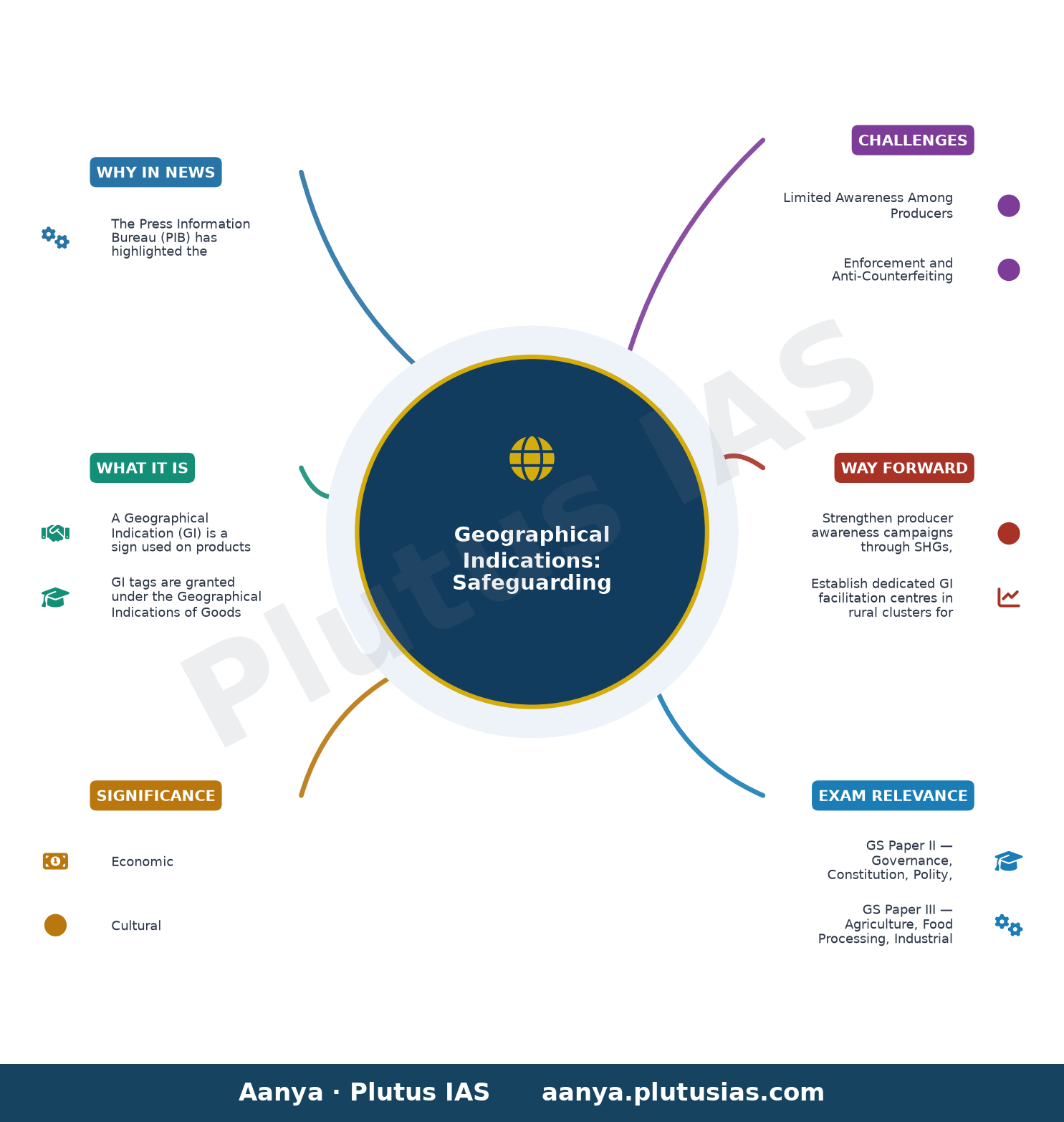
- GS Paper II — Governance, Constitution, Polity, Social Justice and International Relations (Intellectual Property Rights) | GS Paper III — Agriculture, Food Processing, Industrial Policy, and Economic Development
- Prelims: Geographical Indication (GI), TRIPS Agreement, Paris Convention, WTO, Intellectual Property Rights, Traditional Knowledge, GI Act 1999, Darjeeling Tea, Basmati Rice, Banarasi Saree, Channapatna Toys, Muzaffarnagar Jaggery, Paris Convention for the Protection of Industrial Property, TRIPS Agreement (Article 22-24), WTO Doha Round, TRIPS Council, GI Registry (Chennai), IPAB (Intellectual Property Appellate Board), Market Access, Rural Livelihoods, Premium Pricing, Export Promotion, Cultural Heritage, Artisan Welfare, Traditional Crafts
- Essay: The interplay between cultural preservation and economic empowerment: The role of Geographical Indications in India, Intellectual property as a tool for sustainable development: Balancing tradition and innovation
Quick Revision: GI tags are a TRIPS-compliant intellectual property tool that certify the geographical origin and unique attributes of a product, thereby protecting traditional knowledge, enhancing market access, and driving rural economic development.
Why is this in the news?
The Press Information Bureau (PIB) has highlighted the expanding role of Geographical Indications (GI) in India as a mechanism to protect traditional heritage, prevent misuse of indigenous products, and enhance economic opportunities for local artisans, weavers, farmers, and producer groups. The PIB backgrounder underscores how GI tags are transforming India’s cultural and economic landscape by ensuring authenticity, fostering premium market access, and driving rural development, with specific examples such as Banarasi sarees, Channapatna toys, and Muzaffarnagar jaggery.
Background
- The Geographical Indications (Registration and Protection) Act, 1999, was enacted to comply with India’s obligations under the TRIPS Agreement and to protect goods originating from a specific geographical region with unique qualities or reputation.
- India is a signatory to the Paris Convention for the Protection of Industrial Property (1883) and the TRIPS Agreement (1995), which mandate protection for geographical indications as a form of intellectual property.
- The World Intellectual Property Organization (WIPO) administers the Lisbon Agreement for the Protection of Appellations of Origin and their International Registration, though India is not a party to it.
- The Geographical Indications Registry, headquartered in Chennai, is the nodal authority for registering and administering GI tags in India.
- The GI ecosystem in India has witnessed exponential growth over the past decade, with over 400 GI tags registered as of 2026, spanning agricultural, handicraft, and textile products.
What is a Geographical Indication (GI)?
- A Geographical Indication (GI) is a sign used on products that have a specific geographical origin and possess qualities or a reputation that are essentially attributable to that origin.
- GI tags are granted under the Geographical Indications of Goods (Registration and Protection) Act, 1999, and are governed by the Controller General of Patents, Designs, and Trademarks (CGPDTM).
- GI protection is a form of intellectual property right (IPR) that prevents unauthorized use of the name or origin of a product, thereby safeguarding the interests of local producers and artisans.
- GI tags are not limited to agricultural products; they also cover handicrafts, textiles, manufactured goods, and foodstuffs, provided they meet the criteria of uniqueness and origin-linked attributes.
- The TRIPS Agreement under the WTO mandates member countries to provide legal protection for geographical indications, particularly for wines and spirits, though India extends this protection to all categories of goods.
- GI tags enhance the market value of products by certifying their authenticity, quality, and cultural heritage, thereby enabling producers to command premium prices in domestic and international markets.
- The registration process for a GI tag involves an application to the GI Registry, followed by a public notice period, examination by the Registrar, and potential opposition proceedings before final registration.
- GI tags contribute to the preservation of traditional knowledge systems, indigenous craftsmanship, and rural livelihoods by creating sustainable economic incentives for their continued practice.
Key Features
| Feature | Significance |
|---|---|
| Legal Protection | Prevents unauthorised use and commercial exploitation of traditional products, ensuring exclusive rights to producers in the designated geographical area. |
| Market Differentiation | Distinguishes authentic products from imitations, enhancing consumer trust and premium pricing in both domestic and international markets. |
| Cultural Preservation | Safeguards indigenous knowledge systems, artisanal techniques, and regional craftsmanship from erosion due to globalisation. |
| Economic Empowerment | Increases income for artisans, weavers, and farmers by 20-30% through enhanced market access and premium pricing. |
| Export Facilitation | Enables compliance with international trade standards, thereby boosting export potential of GI-tagged products like Banarasi silk and Muzzafarnagar jaggery. |
| Tourism Integration | Attracts cultural tourism by promoting GI-tagged products as heritage symbols, creating ancillary livelihood opportunities in rural areas. |
Why it Matters
Economic
- Enhances income security for rural artisans and farmers by linking products to premium markets, reducing distress migration.
- Facilitates export-led growth for niche agricultural and handicraft sectors, exemplified by Muzzafarnagar jaggery exports to Bangladesh.
- Strengthens backward and forward linkages in rural value chains, fostering agro-industrial and artisanal clusters.
Cultural
- Acts as a custodian of India’s intangible cultural heritage by legally protecting traditional knowledge and craftsmanship.
- Promotes intergenerational transmission of artisanal skills, ensuring continuity of heritage practices like Banarasi weaving.
- Enhances global visibility of India’s cultural diversity, positioning GI-tagged products as ambassadors of indigenous traditions.
Strategic
- Reduces vulnerability to trade disputes by providing legal recourse against misappropriation of traditional products in foreign markets.
- Supports India’s ‘Vocal for Local’ initiative by aligning with global demand for authentic, ethically sourced products.
- Contributes to achieving Sustainable Development Goals (SDGs) 1 (No Poverty), 8 (Decent Work), and 12 (Responsible Consumption).
Legal-Institutional
- Operationalises India’s obligations under the WTO TRIPS Agreement, particularly Article 22-24 on Geographical Indications.
- Strengthens the Geographical Indications of Goods (Registration and Protection) Act, 1999, by providing a robust enforcement mechanism.
- Encourages state-level initiatives for GI registration, exemplified by Uttar Pradesh’s focus on Banarasi silk and Karnataka’s Channapatna toys.
Challenges
1. Limited Awareness Among Producers
- Many artisans and farmers lack knowledge about the GI registration process and its benefits, leading to underutilisation of the scheme.
- Low participation from marginalised communities, particularly women artisans, due to socio-economic barriers and lack of access to information.
UPSC Link: GS3: Rural Development
2. Enforcement and Anti-Counterfeiting
- Inadequate monitoring mechanisms result in widespread counterfeiting, especially for high-value products like Banarasi silk.
- Cross-border smuggling of imitation products undermines the economic benefits of GI certification in international markets.
UPSC Link: GS3: IPR and Innovation
3. Infrastructure and Market Access
- Poor storage, transportation, and certification facilities in rural areas hinder the supply chain efficiency of GI products.
- Limited access to e-commerce platforms and export promotion bodies restricts market reach for small-scale producers.
UPSC Link: GS3: Agriculture and Food Processing
4. Sustainability of Artisanal Practices
- Rapid mechanisation and synthetic alternatives threaten the viability of traditional craftsmanship, even with GI protection.
- Lack of formal training and skill upgradation programmes for artisans to adapt to evolving consumer preferences.
UPSC Link: GS1: Indian Society
5. Inter-State and Inter-Sectoral Coordination
- Fragmented implementation across states leads to duplication of efforts and inefficiencies in GI promotion.
- Absence of a unified national database for GI products complicates monitoring and policy formulation.
UPSC Link: GS2: Centre-State Relations
Challenges — UPSC Perspective
| Issue | Concern |
|---|---|
| Low Producer Awareness | Underutilisation of GI scheme due to lack of information among artisans and farmers. |
| Counterfeiting and Smuggling | Proliferation of imitation products reduces market share and earnings for genuine producers. |
| Infrastructure Gaps | Inadequate storage, certification, and transport facilities hinder supply chain efficiency. |
| Skill Erosion | Traditional craftsmanship faces decline due to mechanisation and lack of skill upgradation. |
| Policy Fragmentation | Inconsistent implementation across states and sectors leads to inefficiencies. |
| Export Barriers | Limited access to international markets and trade networks restricts growth potential. |
Government Initiatives — Must-Memorise for Prelims
- Geographical Indications of Goods (Registration and Protection) Act, 1999
Way Forward
- Strengthen producer awareness campaigns through SHGs, cooperatives, and digital platforms to enhance GI adoption.
- Establish dedicated GI facilitation centres in rural clusters for registration, certification, and market linkage support.
- Invest in cold chain infrastructure and certification labs to ensure quality control and reduce post-harvest losses.
- Promote GI products through e-commerce portals like ‘Bharat Craft’ and international trade fairs to expand market reach.
- Integrate GI promotion with tourism circuits to create rural livelihoods through cultural and heritage tourism.
- Encourage public-private partnerships for skill upgradation programmes to sustain traditional craftsmanship.
- Develop a national GI database with real-time monitoring to track production, exports, and enforcement challenges.
- Simplify export procedures for GI-tagged products by aligning with international standards and trade agreements.
UPSC Value Addition
Keywords for Mains Answer-Writing
Geographical Indications (GI) Tags · Intellectual Property Rights (IPR) · Traditional Knowledge Protection · Rural Artisans and Weavers · Cultural Heritage Preservation · Premium Market Access · Export Promotion · Sustainable Livelihoods · Consumer Trust and Authentication · Banarasi Sarees · Channapatna Toys · Muzaffarnagar Jaggery · Rural Development · Craftsmanship and Skill Preservation
Concept Flow
Traditional knowledge and craftsmanship → Geographical Indication (GI) registration → Legal protection and market differentiation → GI certification → Enhanced consumer trust and premium pricing → Increased income for artisans and farmers → Premium pricing → Export opportunities and rural development → Sustainable livelihoods → Sustainable livelihoods → Preservation of cultural heritage → Intergenerational transmission of skills → Cultural preservation → Global recognition of India’s intangible heritage → Strengthening of national identity → National identity → Policy support and institutional frameworks → Expansion of GI ecosystem
Prelims Practice Questions
Q1. Consider the following statements about Geographical Indications (GI) Tags in India:
1. A GI tag is granted under the Geographical Indications of Goods (Registration and Protection) Act, 1999.
2. The Controller General of Patents, Designs and Trade Marks (CGPDTM) is the authority responsible for GI registration in India.
3. A GI tag can be granted to agricultural, natural, or manufactured goods.
4. The term of a GI tag is renewable every 10 years.
How many of the above statements are correct?
- Only one
- Only two
- Only three
- All
Answer: All — Statements 1, 2, and 3 are correct. Statement 4 is incorrect as the term of a GI tag is not explicitly defined in the Act; it is valid indefinitely unless cancelled or surrendered.
Q2. Assertion (A): The Geographical Indications (GI) Tags primarily aim to protect the intellectual property of individual artisans.
Reason (R): GI tags ensure that only products originating from a specific geographical region can use the tag, thereby preventing misuse and enhancing market value.
Options:
A. Both A and R are true, and R is the correct explanation of A.
B. Both A and R are true, but R is not the correct explanation of A.
C. A is true, but R is false.
D. A is false, but R is true.
Answer: ? — Assertion (A) is partially correct as GI tags protect the collective intellectual property of a community or region rather than an individual. Reason (R) is correct and explains the mechanism by which GI tags achieve their objective.
Q3. Match the following GI-tagged products with their respective states:
Column I (GI-tagged Product) | Column II (State)
—————————–|——————
1. Banarasi Sarees | A. Karnataka
2. Channapatna Toys | B. Uttar Pradesh
3. Muzaffarnagar Jaggery | C. Tamil Nadu
4. Kancheepuram Silk | D. Uttar Pradesh
Options:
A. 1-A, 2-B, 3-C, 4-D
B. 1-D, 2-A, 3-B, 4-C
C. 1-B, 2-A, 3-D, 4-C
D. 1-C, 2-D, 3-A, 4-B
Answer: ? — 1. Banarasi Sarees are associated with Varanasi (Banaras) in Uttar Pradesh.
2. Channapatna Toys are from Karnataka.
3. Muzaffarnagar Jaggery is from Uttar Pradesh.
4. Kancheepuram Silk is from Tamil Nadu.
Mains Practice Question
✍ The Geographical Indications (GI) Tags have emerged as a powerful tool for protecting traditional knowledge, enhancing market access, and promoting rural livelihoods in India. Critically examine the role of GI tags in preserving cultural heritage while simultaneously fostering economic opportunities for artisans and weavers. Also, assess the challenges in ensuring the effective implementation of GI tags in India. (15 Marks)
Approach: MODEL-ANSWER SKELETON:
1. **Introduction (2 Marks)**
– Define Geographical Indications (GI) and their legal framework (Geographical Indications of Goods (Registration and Protection) Act, 1999).
– Mention the objective: protection of traditional knowledge, prevention of misuse, and promotion of rural livelihoods.
2. **Role of GI Tags in Preserving Cultural Heritage (4 Marks)**
– **Authenticity and Tradition**: GI tags certify the origin and traditional methods of production (e.g., Banarasi sarees, Kancheepuram silk).
– **Prevention of Misuse**: Protects against counterfeit products that dilute the cultural and economic value (e.g., Channapatna toys).
– **Cultural Identity**: Reinforces regional identity and pride (e.g., Darjeeling tea, Mysore silk).
– **Legal Protection**: Provides a legal recourse under IPR laws to combat infringement.
3. **Economic Opportunities for Artisans and Weavers (4 Marks)**
– **Market Access**: Enables artisans to access premium markets domestically and internationally (e.g., export of Muzaffarnagar jaggery to Bangladesh).
– **Increased Income**: Studies show a 20-30% rise in income for GI-tagged products due to higher market value and reduced intermediaries.
– **Sustainable Livelihoods**: Creates long-term employment opportunities in rural areas, reducing migration.
– **Bargaining Power**: Strengthens the negotiating position of artisans against middlemen and large corporations.
4. **Challenges in Implementation (3 Marks)**
– **Awareness Gap**: Lack of awareness among artisans about the benefits and process of GI registration.
– **Legal and Administrative Hurdles**: Complex registration process, delays, and high costs.
– **Enforcement Issues**: Difficulty in monitoring and preventing counterfeit products, especially in unorganised sectors.
– **Market Competition**: GI-tagged products face competition from cheaper, mass-produced alternatives.
– **Exploitation by Middlemen**: Artisans often do not receive the full benefits due to exploitation by intermediaries.
5. **Way Forward (2 Marks)**
– **Awareness Campaigns**: Government and NGOs should conduct awareness programs to educate artisans.
– **Simplification of Processes**: Streamline registration and renewal processes to reduce bureaucratic delays.
– **Strengthening Enforcement**: Strengthen legal mechanisms to combat counterfeiting and misuse.
– **Market Linkages**: Develop platforms for direct market access (e.g., e-commerce, export promotion councils).
– **Capacity Building**: Provide training in modern marketing, quality control, and financial management to artisans.
**Balanced View**: Highlight both the successes (e.g., Banarasi sarees, Darjeeling tea) and limitations (e.g., low awareness, enforcement challenges) to present a nuanced perspective.
Source: PIB (Press Information Bureau)
Generated by AanyaAi for educational purpose.

- एनसीएल द्वारा शुरू हुआ ‘विशेष अभियान 6.0’: स्वच्छता और ई-कचरा प्रबंधन पर जोर - September 19, 2026
- NCERT & NCL Launch ‘Special Campaign 6.0’ for Clean Governance: Key Details for UPSC - September 19, 2026
- ‘नशा मुक्त युवा अभियान’: 100 सप्ताह के राष्ट्रव्यापी अभियान का शुभारंभ, जानिए प्रमुख तथ्य - September 19, 2026

No Comments