


04 Aug Mysuru’s Bid for Global Tourism Mission: Centre’s Nod Sought
✎ The National Mission for 50 Globally Competitive Tourist Destinations is a flagship initiative under the Union Budget 2025-26, designed to transform India’s tourism sector by integrating heritage conservation, infrastructure…
Subject Relevance — Where This Topic Fits
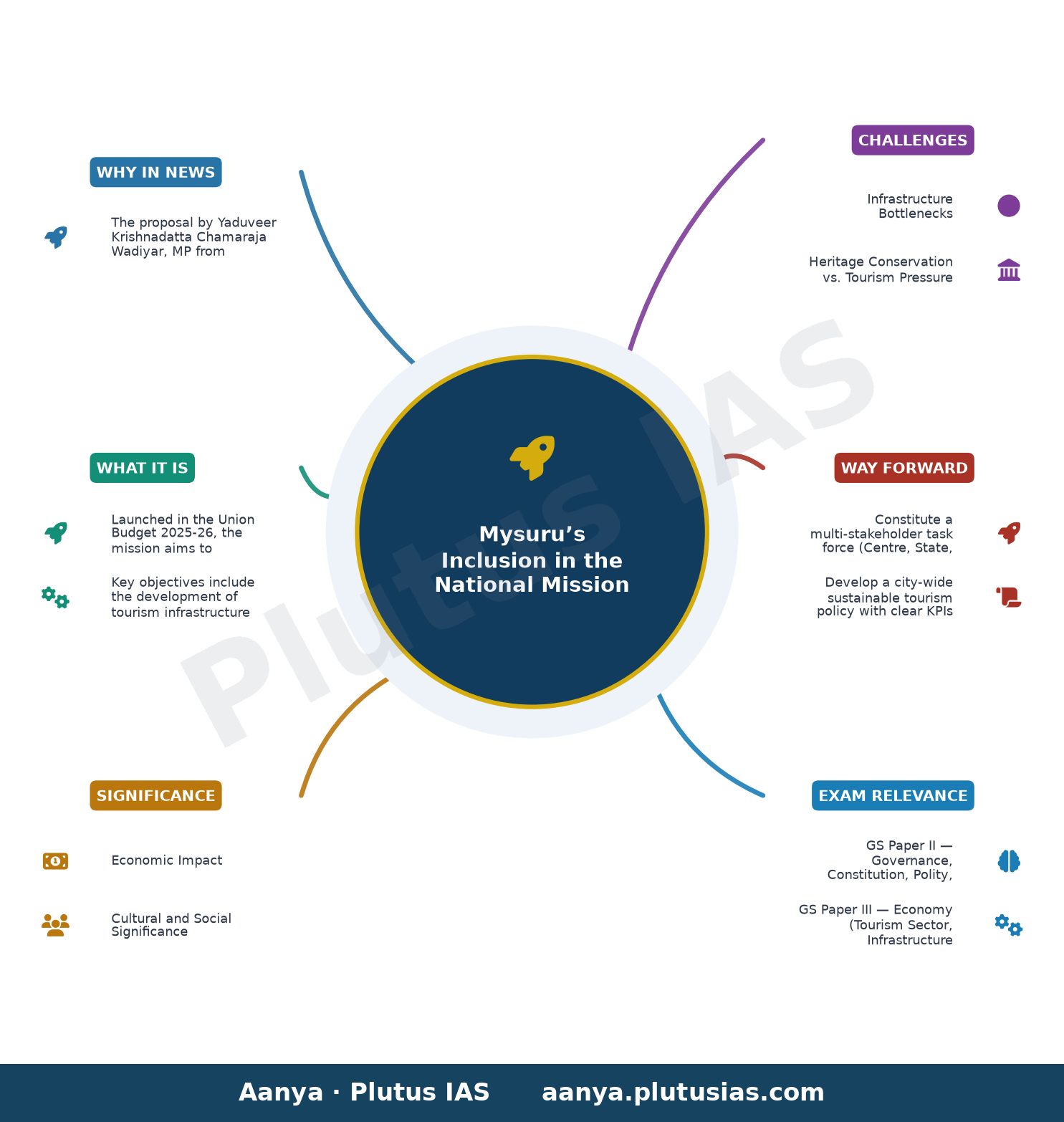
- GS Paper II — Governance, Constitution, Polity, Social Justice and International Relations (Role of Parliament, Centre-State Relations, Tourism Policy, UNESCO Recognition) | GS Paper III — Economy (Tourism Sector, Infrastructure Development, Employment Generation, Public-Private Partnerships)
- Prelims: National Mission for the Development of 50 Globally Competitive Tourist Destinations, Viksit Bharat 2047, UNESCO Intangible Cultural Heritage, Cultural Heritage Conservation, Tourism Infrastructure Development, Centre-State Cooperative Federalism
- Essay: The Role of Heritage Conservation in National Development: A Case Study of Mysuru, Sustainable Tourism as a Catalyst for Inclusive Growth
Quick Revision: The National Mission for 50 Globally Competitive Tourist Destinations is a flagship initiative under the Union Budget 2025-26, designed to transform India’s tourism sector by integrating heritage conservation, infrastructure development, and sustainable growth, with Mysuru emerging as a prime candidate due to its cultural and historical significance.
Why is this in the news?
The proposal by Yaduveer Krishnadatta Chamaraja Wadiyar, MP from Mysuru-Kodagu, to include Mysuru in the Union Government’s National Mission for the Development of 50 Globally Competitive Tourist Destinations has brought renewed focus on the strategic importance of heritage-led tourism development in India. The meeting with the Union Tourism Minister underscores the need for policy convergence between cultural preservation and economic growth, particularly in the context of India’s Viksit Bharat 2047 vision. This development is significant as it highlights the intersection of heritage conservation, economic diplomacy, and sustainable tourism in shaping India’s global image.
Background
- The Union Budget 2025-26 announced the National Mission for the Development of 50 Globally Competitive Tourist Destinations, aiming to position India as a premier global tourism hub by leveraging its cultural, historical, and natural assets.
- Mysuru, historically known as the cultural capital of Karnataka, has been a focal point of India’s heritage tourism due to its royal legacy, architectural marvels, and UNESCO-recognised traditions such as the Mysuru Dasara festival.
- The mission aligns with the broader national vision of Viksit Bharat 2047, which seeks to transform India into a developed nation by 2047 through inclusive and sustainable growth strategies.
- Karnataka’s tourism sector contributes significantly to the state’s economy, with Mysuru serving as a major attraction, drawing lakhs of domestic and international tourists annually.
- The proposal comes at a time when global tourism is increasingly prioritising sustainable and experiential travel, making heritage-rich destinations like Mysuru strategically important for India’s soft power diplomacy.
- Centre-State coordination in tourism policy is critical, as heritage conservation and infrastructure development often require joint efforts between the Union Government and state administrations.
What is the National Mission for the Development of 50 Globally Competitive Tourist Destinations?
- Launched in the Union Budget 2025-26, the mission aims to identify, develop, and promote 50 globally competitive tourist destinations across India to enhance the country’s tourism appeal and economic contribution.
- Key objectives include the development of tourism infrastructure (transport, accommodation, visitor amenities), conservation of heritage sites, promotion of sustainable tourism practices, and creation of employment opportunities.
- The mission is expected to foster public-private partnerships (PPPs) to accelerate investment in tourism-related projects, including hotels, resorts, cultural centres, and eco-tourism initiatives.
- Destinations under the mission will be selected based on their unique selling propositions (USPs), such as historical significance, natural beauty, cultural festivals, or adventure tourism potential.
- The mission will also focus on digital transformation of tourism services, including e-tourism portals, virtual reality experiences, and AI-driven personalised travel recommendations.
- Monitoring and evaluation mechanisms will be established to assess the progress of selected destinations, with periodic reviews to ensure alignment with global tourism standards.
Key Features
| Feature | Significance |
|---|---|
| Mysore Palace | One of India’s most visited heritage monuments, symbolising royal legacy and architectural grandeur; a key tourist magnet requiring conservation and visitor management. |
| Mysuru Dasara Festival | UNESCO-recognised cultural event; showcases Karnataka’s traditions, art, and heritage; potential for global tourism branding and cultural diplomacy. |
| Yoga and Wellness Centre | Mysuru’s established reputation as a hub for yoga and wellness tourism; aligns with global health and sustainable tourism trends. |
| Traditional Handicrafts and Art | Handlooms, sandalwood carvings, and silk sarees; supports local artisans and promotes cultural tourism; requires skill preservation and market linkages. |
| Connectivity Infrastructure | Strong road, rail, and air connectivity (Mysuru Airport, NH-275, Bengaluru-Mysuru Expressway); critical for mass tourism and last-mile connectivity. |
| Heritage Conservation | Need for restoration and adaptive reuse of colonial and royal-era structures; aligns with national missions like HRIDAY and Swadesh Darshan. |
Why it Matters
Economic Impact
- Direct revenue generation from tourism (domestic and international visitors) boosts local GDP and state exchequer through taxes and levies.
- Multiplier effect on hospitality, transport, handicrafts, and food sectors; creates ancillary employment in informal and formal economies.
- Attracts private investment in hotels, resorts, and tourism infrastructure; enhances Karnataka’s share in India’s tourism sector (~20% of domestic tourist visits in 2023-24).
- Promotes entrepreneurship among local artisans, guides, and small businesses; reduces migration pressure from rural areas.
Cultural and Social Significance
- Preserves and promotes Karnataka’s intangible cultural heritage (Dasara, Yakshagana, Mysore silk) through global visibility.
- Enhances social cohesion by integrating local communities into tourism value chains; empowers women artisans in handicraft clusters.
- Strengthens India’s soft power through globally recognised cultural events and heritage sites; aligns with ‘Viksit Bharat 2047’ cultural diplomacy goals.
Strategic and Policy Relevance
- Inclusion under the National Mission for 50 Globally Competitive Tourist Destinations leverages central funding and technical expertise for infrastructure upgradation.
- Aligns with national priorities: ‘Dekho Apna Desh’, ‘Swadesh Darshan 2.0’, and ‘PRASAD’ schemes for thematic and pilgrimage circuit development.
- Supports Karnataka’s tourism policy (2023-28) to position Mysuru as a ‘heritage tourism hub’ and diversify from Bengaluru-centric tourism.
Sustainability Imperatives
- Promotes eco-friendly tourism practices (waste management, energy efficiency) in heritage sites to mitigate overtourism impacts.
- Encourages community-based tourism models to balance economic gains with environmental and socio-cultural preservation.
- Leverages yoga and wellness tourism for health-focused, low-impact travel; aligns with SDG 8 (Decent Work) and SDG 12 (Responsible Consumption).
Challenges
1. Infrastructure Bottlenecks
- Inadequate last-mile connectivity to peripheral tourist sites (e.g., Shivanasamudra Falls, Srirangapatna) despite strong inter-city links.
- Limited parking facilities and traffic congestion around Mysore Palace during peak seasons (Dasara, weekends).
- Over-reliance on road transport; need for multi-modal integration (metro, cycle rickshaws, e-vehicles) for intra-city mobility.
UPSC Link: Infrastructure: Urban transport, Heritage conservation
2. Heritage Conservation vs. Tourism Pressure
- Structural degradation of heritage sites due to high footfall and environmental factors (pollution, humidity).
- Lack of adaptive reuse policies for colonial-era buildings; risks of commercialisation eroding historical authenticity.
- Need for heritage impact assessments and regulated visitor caps to prevent irreversible damage.
UPSC Link: Cultural Heritage: Conservation policies
3. Skill Gaps and Informal Labour
- Low formalisation of tourism-related jobs (guides, artisans, hospitality staff) leading to exploitation and skill shortages.
- Absence of standardised training programmes for local artisans in product diversification and digital marketing.
- Seasonal unemployment in tourism-dependent communities; need for upskilling in allied sectors (IT, hospitality management).
UPSC Link: Human Resource Development: Skill gaps
4. Sustainable Tourism Management
- Unregulated homestays and commercial establishments threatening the city’s heritage character and carrying capacity.
- Lack of waste management systems in tourist hotspots; pollution in Cauvery riverfront areas.
- Need for a city-wide sustainable tourism policy with measurable KPIs for waste reduction, energy use, and water conservation.
UPSC Link: Environment: Sustainable tourism
5. Policy Coordination Gaps
- Divergent priorities between Centre (National Mission) and State (Karnataka Tourism Policy) in fund utilisation and project execution.
- Delays in approvals for heritage conservation projects due to multi-departmental clearances (ASI, State Archaeology, Urban Local Bodies).
- Lack of a unified data repository for tourist inflow, revenue, and impact assessment to guide policy.
UPSC Link: Governance: Inter-governmental coordination
Challenges — UPSC Perspective
| Issue | Concern |
|---|---|
| Over-tourism | Risk of degradation of heritage sites and dilution of cultural authenticity due to unregulated visitor influx. |
| Seasonality | Peak-season congestion (Dasara) followed by low-season unemployment; need for year-round tourism products. |
| Digital Divide | Limited e-ticketing, multilingual apps, and online promotion for international tourists; hampers accessibility. |
| Climate Vulnerability | Extreme weather events (floods, heatwaves) impacting heritage structures and tourist comfort. |
| Branding Challenges | Competition with other heritage cities (Jaipur, Varanasi) for global visibility; need for unique positioning. |
| Funding Constraints | Dependence on central schemes; state budgetary allocations insufficient for large-scale infrastructure projects. |
Government Initiatives — Must-Memorise for Prelims
- National Mission for the Development of 50 Globally Competitive Tourist Destinations (Union Budget 2025-26)
- Swadesh Darshan 2.0 (Ministry of Tourism)
- PRASAD Scheme (Pilgrimage Rejuvenation and Spiritual Augmentation Drive)
- HRIDAY Scheme (Heritage City Development and Augmentation Yojana)
- Karnataka Tourism Policy 2023-28
Way Forward
- Constitute a multi-stakeholder task force (Centre, State, ULBs, private sector) to draft a 5-year strategic plan for Mysuru’s tourism development under the National Mission.
- Develop a city-wide sustainable tourism policy with clear KPIs for waste management, energy efficiency, and water conservation in heritage sites.
- Upgrade urban mobility through dedicated bus lanes, pedestrian zones, and e-vehicle adoption in the core heritage area.
- Launch a ‘Mysuru Heritage Pass’ for tourists, integrating entry fees, guided tours, and artisan experiences with revenue earmarked for conservation.
- Establish a ‘Centre of Excellence for Heritage Conservation’ in collaboration with IITs/IIMs for technical and managerial expertise.
- Promote year-round tourism by diversifying offerings (culinary tourism, literary festivals, adventure trails) to reduce seasonality.
- Digitise heritage assets with AR/VR experiences and multilingual e-ticketing to enhance accessibility and global appeal.
- Strengthen skill development programmes for local artisans, guides, and hospitality staff through partnerships with NGOs and industry bodies.
UPSC Value Addition
Keywords for Mains Answer-Writing
National Mission for the Development of 50 Globally Competitive Tourist Destinations · Mysuru Dasara festival UNESCO recognition · Viksit Bharat 2047 · cultural tourism infrastructure · heritage conservation · sustainable tourism · tourism-led employment generation · public-private partnership in tourism
Concept Flow
Proposal for Mysuru’s inclusion under National Mission → Centre-State coordination → Strategic planning and funding allocation → Infrastructure upgradation and heritage conservation → Enhanced tourist inflow and revenue generation → Employment creation and skill development → Community empowerment and cultural preservation → Sustainable tourism practices → Global recognition as a heritage tourism destination → Alignment with ‘Viksit Bharat 2047’ vision
Prelims Practice Questions
Q1. Consider the following statements regarding the National Mission for the Development of 50 Globally Competitive Tourist Destinations in India:
1. The mission was announced in the Union Budget 2025-26.
2. The mission aims to develop 50 globally competitive tourist destinations in India.
3. The mission includes a focus on sustainable tourism practices.
4. The mission is solely funded by the Central Government with no private sector participation.
How many of the above statements are correct?
- Only one
- Only two
- Only three
- All four
Answer: Only three — Statements 1, 2, and 3 are correct as per the Union Budget 2025-26 announcement, the mission’s stated objectives, and its emphasis on sustainability. Statement 4 is incorrect because the mission encourages public-private partnerships for funding and implementation.
Q2. Assertion (A): The Mysuru Dasara festival has received UNESCO recognition for its cultural significance.
Reason (R): The festival is a 10-day celebration featuring cultural performances, processions, and religious ceremonies.
Options:
A. Both A and R are true, and R is the correct explanation of A.
B. Both A and R are true, but R is not the correct explanation of A.
C. A is true, but R is false.
D. A is false, but R is true.
Answer: ? — Assertion (A) is true as the Mysuru Dasara festival has been recognized by UNESCO for its cultural significance. Reason (R) correctly describes the festival’s features, but it does not explain why UNESCO recognized it, making R a true but non-explanatory statement.
Q3. Match the following pairs related to tourism in India:
Column I (Tourist Destination) | Column II (Unique Feature)
1. Mysuru | A. UNESCO-recognized cultural festival
2. Varanasi | B. Spiritual and wellness tourism hub
3. Rishikesh | C. Heritage city with royal legacy
4. Jaipur | D. Ancient city with religious significance
Options:
A. 1-A, 2-D, 3-B, 4-C
B. 1-C, 2-D, 3-B, 4-A
C. 1-B, 2-A, 3-D, 4-C
D. 1-D, 2-B, 3-A, 4-C
Answer: ? — 1-C (Mysuru is renowned for its royal legacy and heritage), 2-D (Varanasi is an ancient city with deep religious significance), 3-B (Rishikesh is a spiritual and wellness tourism hub), 4-A (Jaipur hosts the UNESCO-recognized Jaipur Literature Festival, but the closest match here is Mysuru’s Dasara festival for Column I).
Mains Practice Question
✍ The inclusion of Mysuru under the National Mission for the Development of 50 Globally Competitive Tourist Destinations is a strategic step towards realizing the vision of ‘Viksit Bharat 2047’. Critically examine the potential benefits and challenges associated with this initiative, with reference to the principles of sustainable tourism and heritage conservation. (15 Marks)
Approach: MODEL-ANSWER SKELETON:
1. **Context and Vision Alignment** (2 Marks):
– Briefly explain the National Mission for the Development of 50 Globally Competitive Tourist Destinations (announced in Union Budget 2025-26) and its alignment with ‘Viksit Bharat 2047’.
– Mention Mysuru’s unique attributes: Mysore Palace, UNESCO-recognized Dasara festival, yoga and wellness hub, traditional handicrafts, and connectivity.
2. **Potential Benefits** (5 Marks):
– **Economic Growth**: Tourism-led employment generation, boost to local artisans, small businesses, and hospitality sector.
– **Infrastructure Development**: Upgradation of roads, railways, and air connectivity; improved visitor amenities.
– **Heritage Conservation**: Focus on preserving heritage sites like Mysore Palace and promoting sustainable tourism.
– **Cultural Promotion**: Leveraging the Dasara festival and local art forms to attract global tourists.
– **Public-Private Partnerships (PPP)**: Encouraging investment in tourism infrastructure and services.
3. **Challenges and Mitigation** (5 Marks):
– **Over-Tourism**: Risk of straining heritage sites and local resources; propose carrying capacity planning and visitor management strategies.
– **Sustainability Concerns**: Balancing tourism growth with environmental protection (e.g., waste management, carbon footprint).
– **Community Involvement**: Ensuring local stakeholders (artisans, small businesses) benefit equitably; avoid displacement or exploitation.
– **Funding and Implementation**: Ensuring timely release of funds and efficient project execution; avoid bureaucratic delays.
– **Cultural Authenticity**: Preventing commercialization from diluting the cultural essence of Mysuru’s heritage.
4. **Conclusion** (3 Marks):
– Summarize the transformative potential of the initiative for Mysuru and India’s tourism sector.
– Emphasize the need for a balanced approach that integrates economic, social, and environmental sustainability.
– Reference global best practices (e.g., Bhutan’s high-value, low-impact tourism model) for inspiration.
Source: The Hindu
Generated by AanyaAi for educational purpose.

- महाराष्ट्र में त्योहार जुलूसों पर बॉम्बे हाईकोर्ट का बड़ा फैसला: पटाखे, लेजर और संगीत पर रोक - September 24, 2026
- Bombay HC Bans Firecrackers, Music in Maharashtra Processions: Key UPSC Analysis - September 24, 2026
- तमिलनाडु में महिला कर्मचारियों के लिए सवैतनिक माहवारी अवकाश नीति पर HC का आदेश - September 24, 2026

No Comments