


04 Aug Panchayat Development Index (PDI 2.0): Key Features & UPSC Relevance
✎ The Panchayat Advancement Index (PAI) 2.0 is a data-driven framework for assessing the localisation of Sustainable Development Goals (SDGs) in Gram Panchayats, enabling targeted interventions and evidence-based governance to…
Subject Relevance — Where This Topic Fits
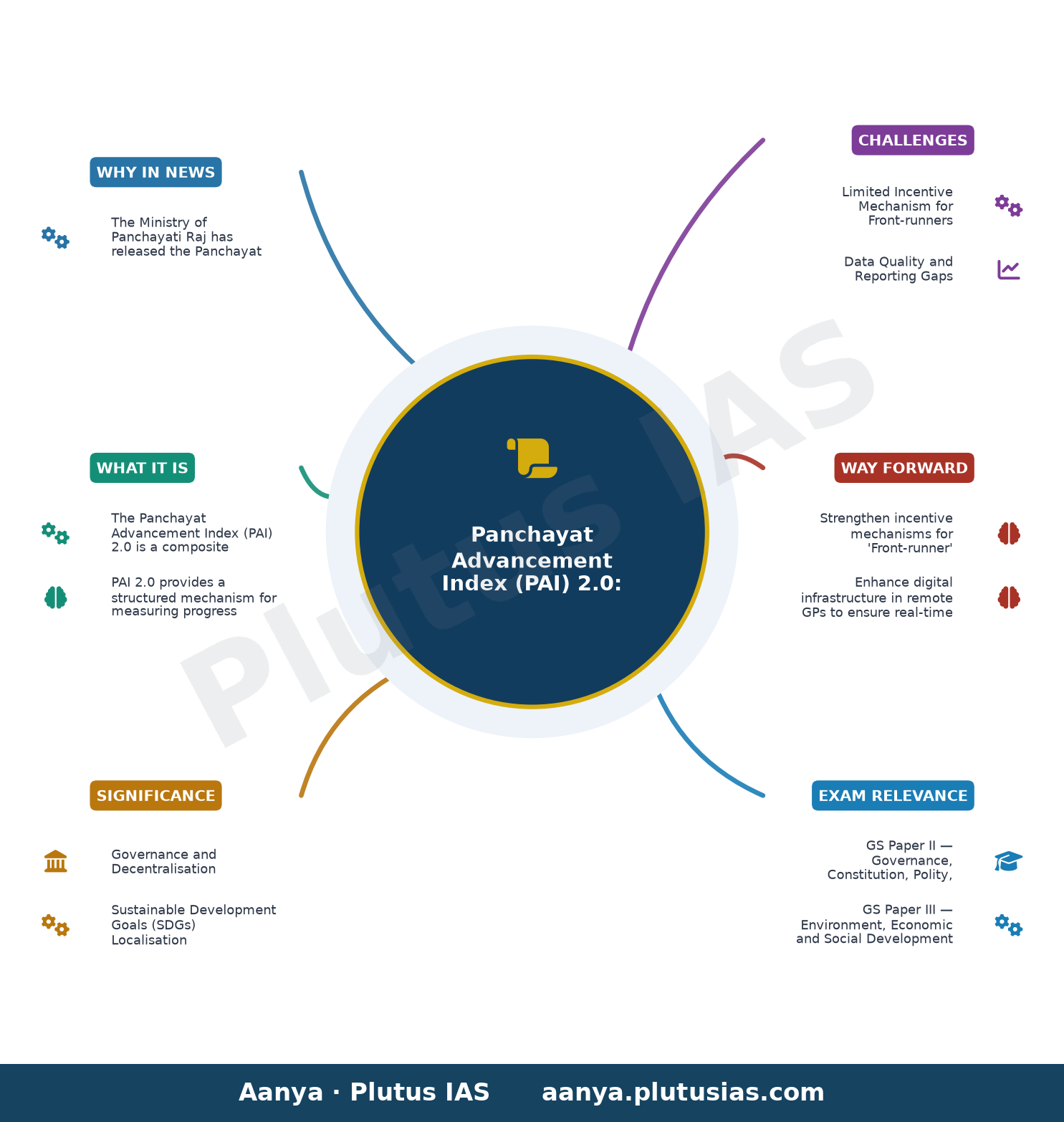
- GS Paper II — Governance, Constitution, Polity, Social Justice and International Relations | GS Paper III — Environment, Economic and Social Development
- Prelims: Panchayat Advancement Index (PAI), Localisation of SDGs, Panchayat Development Plan (GPDP), Rashtriya Gram Swaraj Abhiyan (RGSA), Capacity Building and Training (CB&T), Sustainable Development Goals (SDGs), Gram Panchayat, Union Territory-wise PAI scores
- Essay: Decentralisation and grassroots governance: The role of Panchayati Raj Institutions in achieving sustainable development, Inclusive rural development: Balancing economic growth with environmental sustainability through local governance
Quick Revision: The Panchayat Advancement Index (PAI) 2.0 is a data-driven framework for assessing the localisation of Sustainable Development Goals (SDGs) in Gram Panchayats, enabling targeted interventions and evidence-based governance to achieve inclusive and sustainable rural development.
Why is this in the news?
The Ministry of Panchayati Raj has released the Panchayat Advancement Index (PAI) 2.0, a comprehensive assessment framework designed to measure the progressive performance of Gram Panchayats and equivalent entities in localising the Sustainable Development Goals (SDGs). This initiative, previously known as the Panchayat Development Index (PDI), provides granular, theme-wise and overall scores through a scorecard and dashboard, enabling the identification of performance gaps, strengths, and priority areas for targeted intervention. The release underscores the government’s commitment to strengthening rural governance through data-driven decision-making and capacity enhancement, aligning with the broader agenda of achieving inclusive and sustainable development at the grassroots level.
Background
- The Panchayati Raj system in India, enshrined in the 73rd Constitutional Amendment Act, 1992, mandates decentralised governance through three-tiered Panchayati Raj Institutions (PRIs) to ensure participatory and inclusive rural development.
- The Sustainable Development Goals (SDGs), adopted by the United Nations in 2015, provide a universal framework for achieving sustainable and inclusive development by 2030, with 17 goals and 169 targets.
- The localisation of SDGs refers to the adaptation and implementation of global development agendas at the local level, ensuring relevance and effectiveness in diverse socio-economic and ecological contexts.
- The Panchayati Raj Ministry has been progressively aligning PRIs with SDG localisation through targeted schemes, capacity-building initiatives, and institutional frameworks to enhance rural governance and service delivery.
- The Panchayat Advancement Index (PAI) is an evolution of earlier indices like the Panchayat Development Index (PDI), reflecting a shift towards a more holistic and outcome-oriented assessment of rural governance.
What is the Panchayat Advancement Index (PAI) 2.0?
- The Panchayat Advancement Index (PAI) 2.0 is a composite assessment framework developed by the Ministry of Panchayati Raj to evaluate the performance of Gram Panchayats and equivalent entities in localising the Sustainable Development Goals (SDGs).
- PAI 2.0 provides a structured mechanism for measuring progress across nine thematic areas aligned with the SDGs, enabling comparative analysis and targeted interventions at the grassroots level.
- The framework includes a scorecard and dashboard that offer both theme-wise and overall scores, facilitating the identification of performance gaps, relative strengths, and priority areas for improvement in rural governance.
- PAI 2.0 assesses a total of 2.59 lakh Gram Panchayats and equivalent entities across 33 States and Union Territories for the financial year 2023-24, providing a comprehensive snapshot of rural development progress.
- The index is designed to support evidence-based policymaking, enabling the Ministry to allocate resources, design interventions, and monitor the impact of schemes such as the Rashtriya Gram Swaraj Abhiyan (RGSA) and capacity-building initiatives.
- PAI 2.0 incorporates the localisation of SDGs into Gram Panchayat Development Plans (GPDPs), ensuring that rural development strategies are aligned with global development agendas while addressing local priorities.
- The framework emphasises the role of elected representatives, officials, and stakeholders in driving sustainable rural development through participatory governance and capacity enhancement.
- PAI 2.0 serves as a tool for benchmarking performance across States and Union Territories, fostering healthy competition and knowledge-sharing among PRIs to enhance governance outcomes.
Key Features
| Feature | Significance |
|---|---|
| Panchayat Advancement Index (PAI) 2.0 | A composite assessment framework measuring the progressive performance of Gram Panchayats (GPs) against Sustainable Development Goals (SDGs) localised at the local level, enabling evidence-based governance and targeted interventions. |
| Subject-wise and Aggregate Scoring | Provides granular insights into performance gaps, relative strengths, and priority areas for improvement across nine SDG themes, facilitating data-driven decision-making in rural development. |
| Front-runner Panchayats Recognition | Identifies high-performing GPs under themes such as ‘Child-friendly Village’ and ‘Water-sufficient Panchayat’, though no special incentive fund is earmarked for FY 2026-27. |
| Capacity Building through RGSA | Enhances leadership and governance skills of elected representatives and officials via structured training programmes, including thematic and refresher courses, aligned with SDG localisation. |
| Gram Panchayat Development Plan (GPDP) Integration | Mandates GPs to identify and prioritise ‘Sankalp’ areas (core development themes) in GPDP preparation, ensuring alignment with SDG themes such as efficient water management and climate-resilient agriculture. |
Why it Matters
Governance and Decentralisation
- Strengthens the 73rd Constitutional Amendment by institutionalising performance measurement and accountability in rural local bodies (RLBs).
- Enhances participatory governance by enabling GPs to self-assess and address developmental deficits through targeted planning.
Sustainable Development Goals (SDGs) Localisation
- Translates global SDG targets into actionable local priorities, ensuring relevance and feasibility in rural contexts.
- Facilitates convergence of national and sub-national development agendas, particularly in themes like water sufficiency and climate-resilient agriculture.
Data-Driven Policy Implementation
- Provides a robust monitoring mechanism for tracking progress in rural development through PAI 2.0 dashboards and scorecards.
- Enables evidence-based resource allocation and policy formulation by identifying underperforming and high-potential GPs.
Human Capital Development in Rural India
- Augments the capacity of elected representatives and officials through RGSA’s structured training programmes, improving governance quality.
- Promotes skill development in thematic areas such as water management, sustainable agriculture, and climate adaptation.
Challenges
1. Limited Incentive Mechanism for Front-runners
- Absence of a dedicated fund for ‘Front-runner’ Panchayats in FY 2026-27 may dilute motivation for sustained performance improvement.
- Risk of complacency among high-performing GPs without tangible rewards or recognition.
UPSC Link: GS-II: Rural Development
2. Data Quality and Reporting Gaps
- Dependence on self-reported data from GPs may introduce biases or inaccuracies in PAI scoring.
- Inadequate digital infrastructure in remote GPs could hinder real-time data collection and analysis.
UPSC Link: GS-II: Governance
3. Implementation Bottlenecks in RGSA
- Uneven capacity across states may lead to disparities in the effectiveness of RGSA’s training programmes.
- Limited outreach to marginalised sections (e.g., women, SC/ST representatives) in training initiatives.
UPSC Link: GS-II: Schemes for Vulnerable Sections
4. Inter-sectoral Coordination Deficits
- Fragmented implementation of SDG themes (e.g., water management, agriculture) across departments may reduce the impact of PAI 2.0.
- Lack of convergence between Gram Panchayats and line departments (e.g., agriculture, water resources) for integrated planning.
UPSC Link: GS-II: Cooperative Federalism
5. Climate Resilience Integration Gaps
- Insufficient emphasis on climate adaptation strategies in GPDPs despite themes like ‘Water-sufficient Panchayat’ and ‘Clean and Green Panchayat’.
- Limited awareness among GPs about climate-resilient agricultural practices and their integration into local plans.
UPSC Link: GS-III: Environment and Climate Change
Challenges — UPSC Perspective
| Issue | Concern |
|---|---|
| Incentive Mechanism | Absence of a dedicated fund for high-performing GPs may reduce motivation for sustained improvement. |
| Data Reliability | Self-reported data from GPs may introduce biases, affecting the accuracy of PAI 2.0 assessments. |
| Capacity Asymmetry | Uneven training infrastructure across states may lead to disparities in governance quality. |
| Inter-departmental Coordination | Fragmented implementation of SDG themes may reduce the holistic impact of PAI 2.0. |
| Climate Resilience Focus | Limited integration of climate adaptation strategies in GPDPs despite thematic relevance. |
| Marginalised Representation | Inadequate outreach to women and SC/ST representatives in RGSA training programmes. |
Government Initiatives — Must-Memorise for Prelims
- Revised National Gram Swaraj Abhiyan (RGSA)
- Panchayat Advancement Index (PAI) 2.0
Way Forward
- Strengthen incentive mechanisms for ‘Front-runner’ Panchayats through performance-linked grants or recognition awards to sustain motivation.
- Enhance digital infrastructure in remote GPs to ensure real-time data collection, validation, and reporting for PAI 2.0.
- Expand RGSA’s training programmes to include climate-resilient agriculture, water management, and gender-sensitive governance with a focus on marginalised sections.
- Establish a multi-departmental coordination mechanism at the district level to align Gram Panchayat Development Plans (GPDPs) with line department schemes.
- Promote convergence between PAI 2.0, RGSA, and other rural development schemes (e.g., MGNREGS, PM-KISAN) for integrated impact assessment.
- Develop a standardised framework for climate adaptation integration in GPDPs, with technical support from agricultural universities and research institutions.
- Increase participation of women and SC/ST representatives in RGSA training by leveraging local NGOs and self-help groups for outreach.
- Conduct periodic third-party audits of PAI 2.0 data to ensure accuracy and reduce reporting biases.
UPSC Value Addition
Keywords for Mains Answer-Writing
Panchayati Raj Institutions (PRIs) · Panchayat Development Index (PDI) · Panchayat Advancement Index (PAI) · Sustainable Development Goals (SDGs) localisation · Localisation of SDGs (LSDG) · Gram Panchayat Development Plan (GPDP) · National Gram Swaraj Abhiyan (NGSA) · Capacity Building and Training (CB&T) · Front-runner Panchayats · SDG themes in rural governance
Constitutional & Policy Linkages
- 73rd Constitutional Amendment Act, 1992 (Part IX) – Empowerment of Panchayati Raj Institutions (PRIs) for local governance and development.
Concept Flow
Constitutional Mandate (73rd Amendment) → Decentralisation of Governance → Empowerment of PRIs → Need for Performance Measurement → Development of PAI 2.0 Framework → Localisation of SDGs → GPDP Preparation → Capacity Building via RGSA → Implementation and Monitoring → Data-Driven Governance → Sustainable Rural Development
Prelims Practice Questions
Q1. Consider the following statements regarding the Panchayat Advancement Index (PAI) 2.0:
1. It is an assessment framework developed by the Ministry of Panchayati Raj to measure the performance of Gram Panchayats.
2. PAI 2.0 includes a scorecard and dashboard for subject-wise and composite scoring.
3. The index is exclusively used to identify underperforming Panchayats for administrative action.
4. It aligns with the localisation of Sustainable Development Goals (SDGs) at the grassroots level.
How many of the above statements are correct?
- Only one
- Only two
- Only three
- All four
Answer: Only three — Statements 1, 2, and 4 are correct. Statement 3 is incorrect because PAI 2.0 identifies both underperforming and high-performing Panchayats (e.g., ‘Front-runner’ Panchayats) to guide targeted interventions and capacity-building efforts.
Q2. Assertion (A): The National Gram Swaraj Abhiyan (NGSA) aims to enhance the leadership and governance skills of elected representatives in Panchayati Raj Institutions.
Reason (R): The scheme provides capacity-building and training (CB&T) support to Panchayat officials and stakeholders under its revised framework since 2022-23.
Options:
A. Both A and R are true, and R is the correct explanation of A.
B. Both A and R are true, but R is NOT the correct explanation of A.
C. A is true, but R is false.
D. A is false, but R is true.
Answer: ? — Both Assertion (A) and Reason (R) are true, and Reason (R) correctly explains Assertion (A). The NGSA’s primary objective is indeed to strengthen leadership and governance in PRIs through targeted CB&T initiatives.
Q3. Match the following SDG themes under the Panchayat Advancement Index (PAI) with their corresponding focus areas:
Column I (SDG Theme) | Column II (Focus Area)
1. Subject 3: Child-friendly Village | A. Efficient water management and watershed development
2. Subject 4: Water-sufficient Panchayat | B. Climate-resilient agriculture and sustainable farming practices
3. Subject 5: Clean and Green Panchayat | C. Inclusive education and child welfare initiatives
4. Subject 6: Climate-resilient Agriculture | D. Sustainable sanitation and environmental conservation
Options:
A. 1-C, 2-A, 3-D, 4-B
B. 1-D, 2-A, 3-C, 4-B
C. 1-B, 2-D, 3-A, 4-C
D. 1-A, 2-C, 3-B, 4-D
Answer: ? — The correct matches are: 1-C (Child-friendly Village focuses on inclusive education and child welfare), 2-A (Water-sufficient Panchayat emphasizes efficient water management), 3-D (Clean and Green Panchayat targets sustainable sanitation and environmental conservation), and 4-B (Climate-resilient Agriculture includes climate-resilient farming practices).
Mains Practice Question
✍ The Panchayat Advancement Index (PAI) 2.0 represents a paradigm shift in rural governance by integrating Sustainable Development Goals (SDGs) localisation into the assessment of Gram Panchayats. Critically examine the significance of PAI 2.0 in enhancing grassroots democracy and service delivery, with particular reference to its alignment with SDG themes and the role of the National Gram Swaraj Abhiyan (NGSA). Also, discuss the challenges in its implementation and suggest measures for its effective operationalisation. (15 Marks)
Approach: MODEL-ANSWER SKELETON:
1. **Introduction (2 marks)**
– Define PAI 2.0 and its evolution from the Panchayat Development Index (PDI).
– Highlight its objective: measuring performance of 2.59 lakh Gram Panchayats across 33 states/UTs using a composite framework.
– Emphasise its alignment with SDG localisation (LSDG) and the nine thematic areas (e.g., Child-friendly Village, Water-sufficient Panchayat).
2. **Significance of PAI 2.0 (5 marks)**
– **Enhancing Grassroots Democracy:**
– Empowers Panchayats through data-driven governance (scorecards, dashboards).
– Identifies ‘Front-runner’ Panchayats for replication of best practices.
– Facilitates participatory planning via Gram Panchayat Development Plans (GPDPs).
– **Service Delivery:**
– Targets gaps in critical sectors (water, sanitation, education) through thematic focus (e.g., SDG 4, 6).
– Promotes climate-resilient agriculture (SDG 13) and sustainable practices.
– **Accountability and Transparency:**
– Enables comparative analysis across states/UTs and within districts.
– Supports evidence-based policymaking by the Ministry of Panchayati Raj.
3. **Role of NGSA (3 marks)**
– NGSA’s revised framework (2022-23 onwards) focuses on capacity-building (CB&T) for elected representatives and officials.
– Training modules aligned with PAI themes (e.g., SDG localisation, GPDP preparation).
– Data: 36.82 lakh stakeholders trained (2022-27), including thematic training on LSDG themes.
– Synergy between PAI 2.0 and NGSA: NGSA’s training ensures Panchayats can utilise PAI data for targeted interventions.
4. **Challenges in Implementation (3 marks)**
– **Data Quality and Coverage:**
– Ensuring real-time, accurate data from 2.59 lakh Panchayats is resource-intensive.
– Disparities in administrative capacity across states/UTs.
– **Institutional Capacity:**
– Limited technical expertise at the Panchayat level to interpret PAI data and draft GPDPs.
– Resistance to change in traditional governance structures.
– **Funding and Incentives:**
– Lack of dedicated funds for ‘Front-runner’ Panchayats (as per the PIB release).
– Need for performance-linked grants to incentivise high performers.
– **Inter-departmental Coordination:**
– PAI 2.0 requires convergence with line ministries (e.g., Jal Shakti, Agriculture) for thematic integration.
5. **Measures for Effective Operationalisation (2 marks)**
– **Strengthening Data Systems:**
– Leveraging technology (GIS, AI) for real-time monitoring and predictive analytics.
– Capacity-building for Panchayat functionaries on data utilisation.
– **Incentivising Performance:**
– Introducing performance-linked grants for ‘Front-runner’ Panchayats.
– Recognising top performers through awards (e.g., ‘Swaraj Awards’).
– **Enhancing Convergence:**
– Mandating inter-departmental committees for thematic planning (e.g., water, sanitation).
– Aligning NGSA training with PAI themes for practical application.
– **Community Participation:**
– Involving SHGs, youth, and marginalised groups in GPDP preparation to ensure inclusivity.
6. **Conclusion (2 marks)**
– PAI 2.0 is a transformative tool for decentralised governance, but its success hinges on addressing implementation challenges.
– A multi-stakeholder approach—combining technology, capacity-building, and incentives—can ensure its efficacy in achieving SDG localisation at the grassroots level.
Source: PIB (Press Information Bureau)
Generated by AanyaAi for educational purpose.


No Comments