


04 Aug Supreme Court Directs RBI to Frame SOP for Mule Accounts in Cyber Fraud Cases
✎ On 4 August 2026, the Supreme Court of India, in a suo motu case titled *In Re: Victims of Digital Arrest Related to Forged Documents*, issued a series of binding directives to the Reserve Bank of India (RBI), state governments…
Subject Relevance — Where This Topic Fits
- GS Paper III — Science and Technology (Cyber Security, Digital Payments), GS Paper III — Environment and Disaster Management (Data Security), GS Paper II — Governance (Financial Regulation, Cyber Crimes)
- Prelims: Mule Accounts, Digital Financial Fraud, Standard Operating Procedure (SOP), Section 66C of IT Act, RBI Circulars on KYC/AML, Cyber Appellate Tribunal, Fintech Regulation
- Essay: The Role of Judiciary in Safeguarding Digital Sovereignty: A Case Study of Cyber Fraud Mitigation
Why is this in the news?
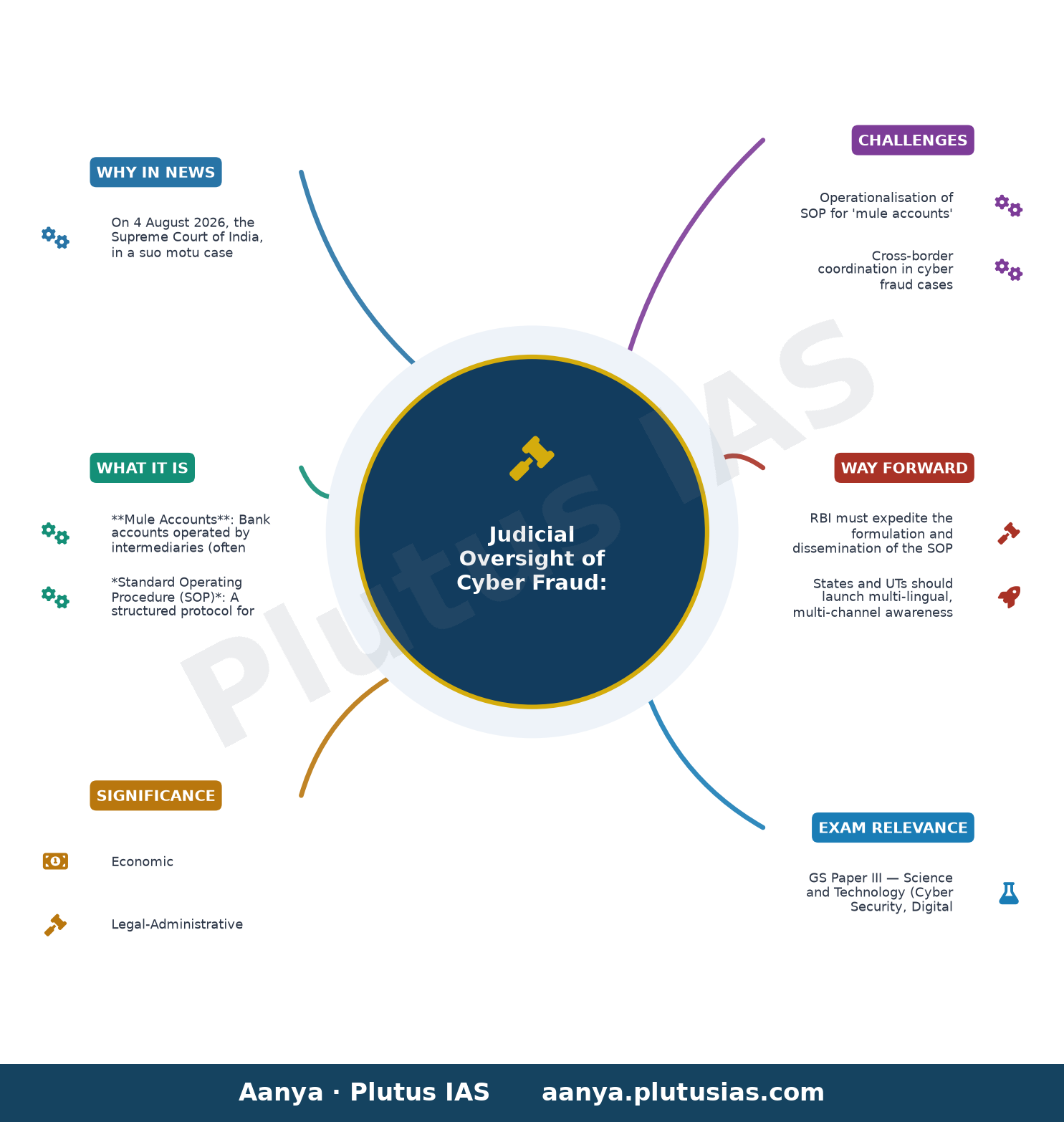
On 4 August 2026, the Supreme Court of India, in a suo motu case titled *In Re: Victims of Digital Arrest Related to Forged Documents*, issued a series of binding directives to the Reserve Bank of India (RBI), state governments, and law enforcement agencies to curb cyber fraud, particularly involving ‘mule accounts’. The Court mandated the formulation of a Standard Operating Procedure (SOP) for the identification, freezing, and restitution of fraudulent accounts, alongside measures for victim redressal and public awareness. This judicial intervention underscores the escalating threat of digital financial crimes and the need for systemic accountability in financial governance.
Background
- Cyber fraud in India has surged with the rapid digitisation of financial services, with reported cases of digital arrest, phishing, and identity theft increasing by over 200% between 2020 and 2025 (NCRB data).
- Mule accounts—bank accounts used by fraudsters to launder illicit funds—have emerged as a critical vector in cyber financial crimes, often linked to organised syndicates operating across jurisdictions.
- The RBI, under the *Payment and Settlement Systems Act, 2007*, and *Prevention of Money Laundering Act, 2002*, has issued multiple circulars on KYC/AML compliance, but enforcement gaps persist due to lack of standardised protocols.
- The *Information Technology Act, 2000*, read with *Section 66C* (punishment for identity theft), and *Section 66D* (punishment for cheating by impersonation), provides legal recourse, but procedural delays hinder victim restitution.
- State police forces and cyber cells often lack specialised training or inter-agency coordination to trace and freeze mule accounts, leading to prolonged victim distress.
What are ‘Mule Accounts’ and the Supreme Court’s Directives on Cyber Fraud Mitigation?
- **Mule Accounts**: Bank accounts operated by intermediaries (often unknowingly) to facilitate the transfer of illicit funds derived from cyber fraud, including digital arrest scams, phishing, and identity theft. These accounts are critical to the fraud ecosystem due to their ability to obfuscate the origin of funds.
- *Standard Operating Procedure (SOP)*: A structured protocol for financial institutions, law enforcement, and judicial authorities to identify, freeze, and restitute funds from mule accounts. The SOP is expected to include timelines for action, inter-agency coordination mechanisms, and victim compensation frameworks.
- *Digital Arrest Scams*: A modus operandi where fraudsters impersonate law enforcement or tax authorities to coerce victims into transferring funds under threat of legal action. Such scams often involve forged documents and psychological manipulation.
- *Public Awareness Campaigns*: Mandated by the Court, these campaigns must target vulnerable demographics (e.g., elderly, rural populations) through vernacular mediums, highlighting red flags such as unsolicited calls, urgency tactics, and requests for OTPs or personal data.
- *Judicial Oversight*: The Supreme Court has directed High Courts to monitor compliance with the SOP through periodic reports from subordinate courts, ensuring accountability in restitution timelines and prosecution rates.
Key Features
| Feature | Significance |
|---|---|
| Supreme Court’s suo motu intervention in cyber fraud cases | Demonstrates judicial activism in addressing systemic gaps in digital financial fraud prevention and redressal mechanisms. |
| Mandate for RBI to frame SOP for ‘mule accounts’ | Standardises procedures for identifying, freezing, and investigating fraudulent accounts used in cyber fraud. |
| State-wise and bank-wise accountability reporting | Ensures transparency and traceability in the handling of cyber fraud complaints across jurisdictions and financial institutions. |
| Mandate for High Courts to disseminate SOP to subordinate courts | Facilitates timely legal recourse for victims by ensuring awareness of redressal mechanisms at the grassroots level. |
| Directives for awareness campaigns by states/UTs | Aims to reduce victimisation by educating the public on cyber fraud risks and reporting mechanisms. |
Why it Matters
Economic
- Reduces financial losses to individuals and the banking system by curbing the misuse of ‘mule accounts’ in cyber fraud.
- Enhances trust in digital financial transactions by strengthening fraud prevention and redressal frameworks.
- Aligns with RBI’s mandate to maintain financial stability and consumer protection in the digital economy.
Legal-Administrative
- Establishes a coordinated multi-stakeholder approach involving judiciary, law enforcement, banks, and regulatory bodies.
- Ensures uniformity in the handling of cyber fraud cases across states and union territories.
- Promotes judicial oversight over administrative lapses in fraud prevention and victim relief.
Social
- Provides structured relief mechanisms for victims of digital financial fraud, reducing psychological and financial distress.
- Empowers citizens through awareness campaigns to recognise and report fraudulent activities promptly.
Challenges
1. Operationalisation of SOP for ‘mule accounts’
- Identification of ‘mule accounts’ requires advanced AI/ML tools and inter-bank data sharing, which may face implementation delays.
- Risk of false positives in account freezing, leading to legitimate users facing undue hardship.
- Coordination challenges among banks, RBI, and law enforcement agencies due to decentralised financial systems.
UPSC Link: GS3: Cyber Security, Financial Inclusion
2. Cross-border coordination in cyber fraud cases
- Cyber fraud often involves international jurisdictions, complicating investigation and asset recovery.
- Lack of standardised global protocols for freezing and repatriating funds from foreign accounts.
- Delays in mutual legal assistance treaties (MLATs) hinder timely action against fraudsters.
UPSC Link: GS2: International Relations, Cyber Diplomacy
3. Public awareness and behavioural resistance
- Low digital literacy in rural and semi-urban areas limits the effectiveness of awareness campaigns.
- Victims may hesitate to report fraud due to stigma, fear of data misuse, or lack of trust in authorities.
- Rapid evolution of fraud techniques outpaces public and institutional adaptability.
UPSC Link: GS3: Digital Divide, Financial Literacy
4. Legal and regulatory gaps in victim redressal
- Inconsistent interpretation of fraud laws across states may lead to delayed or denied compensation.
- Limited legal recourse for victims of ‘digital arrest’ scams, where fraudsters impersonate law enforcement.
- Banks may prioritise operational efficiency over victim relief, delaying fund recovery.
UPSC Link: GS2: Fundamental Rights, Directive Principles
5. Technological and infrastructural constraints
- Legacy banking systems lack real-time fraud detection capabilities, increasing vulnerability.
- Inadequate cybersecurity infrastructure in smaller banks and cooperative societies.
- Absence of a centralised national cyber fraud database hampers inter-agency coordination.
UPSC Link: GS3: Science & Technology, IT Act
Challenges — UPSC Perspective
| Issue | Concern |
|---|---|
| False positives in account freezing | Risk of legitimate users facing undue financial restrictions due to flawed fraud detection algorithms. |
| Cross-border fraud complexity | Jurisdictional challenges in investigating and prosecuting fraudsters operating from foreign jurisdictions. |
| Low digital literacy in target demographics | Limited reach and effectiveness of awareness campaigns among vulnerable populations. |
| Inconsistent state-level legal frameworks | Variations in fraud laws and compensation mechanisms across states hinder uniform redressal. |
| Banks’ operational priorities vs. victim relief | Potential delays in fund recovery due to banks’ focus on compliance and risk management. |
Way Forward
- RBI must expedite the formulation and dissemination of the SOP for ‘mule accounts’, incorporating inputs from banks, law enforcement, and cybersecurity experts.
- States and UTs should launch multi-lingual, multi-channel awareness campaigns targeting rural, semi-urban, and digitally illiterate populations.
- High Courts must integrate the SOP into their subordinate court proceedings and ensure periodic training for judicial officers on cyber fraud redressal.
- A national cyber fraud database should be established under RBI’s purview to enable real-time tracking of fraudulent accounts and patterns.
- Strengthen inter-agency coordination by formalising protocols for mutual legal assistance, asset recovery, and joint investigations with international counterparts.
- Enhance digital literacy programmes through partnerships with NGOs, educational institutions, and fintech firms to build a fraud-aware citizenry.
- Introduce a graded compensation framework for victims, with faster disbursement for clear-cut cases of fraud, to restore confidence in digital transactions.
UPSC Value Addition
Keywords for Mains Answer-Writing
Cyber fraud · Mule accounts · RBI SOP · Digital financial fraud · Supreme Court directives · Money restoration mechanism · Banking fraud prevention · Cybercrime investigation · Standard Operating Procedure · Financial inclusion risks · Digital arrest fraud · Victim relief mechanisms · Cybersecurity governance · Financial intermediaries accountability · Supreme Court suo motu jurisdiction
Constitutional & Policy Linkages
- {‘Article 21’: ‘Right to Life and Personal Liberty (includes financial security and protection from fraud)’}
- {‘Article 38’: ‘Directive Principle of State Policy (promotion of welfare and reduction of inequalities)’}
- {‘Article 39A’: ‘Equal justice and free legal aid (ensuring access to redressal mechanisms)’}
Concept Flow
Rise in cyber fraud cases → Victims face financial and psychological distress → Judicial intervention via suo motu cognisance → Supreme Court directs RBI to frame SOP for ‘mule accounts’ → SOP mandates standardised procedures for identification, freezing, and investigation → States/UTs directed to implement complaint redressal and awareness campaigns → High Courts disseminate SOP to subordinate courts → Enhanced accountability and transparency in fraud prevention and victim relief.
Prelims Practice Questions
Q1. Consider the following statements regarding ‘mule accounts’ in the context of cyber fraud:
1. Mule accounts are typically opened by individuals with no criminal intent but are later misused for fraudulent transactions.
2. The Prevention of Money-laundering Act, 2002 (PMLA) mandates banks to freeze mule accounts immediately upon suspicion.
3. The Reserve Bank of India (RBI) has the statutory authority to formulate Standard Operating Procedures (SOPs) for handling mule accounts under the Banking Regulation Act, 1949.
How many of the above statements are correct?
- Only one
- Only two
- All three
- None
Answer: All three — Statement 1 is correct: Mule accounts are often opened by unsuspecting individuals who are later coerced or tricked into facilitating fraudulent transactions. Statement 2 is incorrect: While PMLA mandates reporting suspicious transactions, immediate freezing is not automatic and requires due process. Statement 3 is correct: RBI derives its authority to issue SOPs for banks from the Banking Regulation Act, 1949.
Q2. Assertion (A): The Supreme Court of India can issue suo motu directions to the Reserve Bank of India (RBI) to frame Standard Operating Procedures (SOPs) for handling cyber fraud-related bank accounts.
Reason (R): The Supreme Court’s power of judicial review under Article 32 of the Constitution empowers it to issue directions to ensure the enforcement of fundamental rights, including the right to life and personal liberty (Article 21) in the context of cyber fraud victims.
Options:
A. Both A and R are true, and R is the correct explanation of A.
B. Both A and R are true, but R is not the correct explanation of A.
C. A is true but R is false.
D. A is false but R is true.
Answer: ? — Assertion (A) is true: The Supreme Court has the constitutional authority to issue suo motu directions, as seen in the instant case. Reason (R) is also true and correctly explains the legal basis for the Supreme Court’s intervention, as cyber fraud victims’ rights to life and personal liberty under Article 21 necessitate protective measures.
Mains Practice Question
✍ The Supreme Court of India has recently directed the Reserve Bank of India (RBI) to formulate a Standard Operating Procedure (SOP) for handling ‘mule accounts’ and other bank accounts linked to cyber fraud. Critically examine the efficacy of such SOPs in mitigating digital financial fraud in India, with reference to the existing legal and institutional framework. Also, analyse the potential challenges in their implementation. (15 Marks)
Approach: MODEL-ANSWER SKELETON:
1. **Context and Directive**:
– Briefly explain the Supreme Court’s suo motu directive to RBI to frame an SOP for mule accounts and cyber fraud-related bank accounts.
– Highlight the objectives: victim relief, accountability, and prevention of digital financial fraud.
2. **Existing Legal and Institutional Framework**:
– **Statutory Basis**:
– RBI’s powers under the Banking Regulation Act, 1949, and the Payment and Settlement Systems Act, 2007.
– Provisions under the Information Technology Act, 2000 (IT Act) and the Indian Penal Code, 1860 (IPC) for cybercrime.
– PMLA, 2002, for reporting and freezing of suspicious accounts.
– **Institutional Mechanisms**:
– Role of the Cyber Crime Investigation Cell (CCIC), Financial Intelligence Unit (FIU-IND), and State Cyber Cells.
– RBI’s existing guidelines on customer protection and fraud reporting (e.g., RBI Circulars on ‘Customer Protection – Limiting Liability of Customers in Unauthorised Electronic Banking Transactions’).
3. **Efficacy of SOPs in Mitigating Digital Financial Fraud**:
– **Strengths**:
– Standardisation of procedures for banks and law enforcement agencies.
– Enhanced accountability and transparency in handling fraud cases.
– Faster resolution for victims through structured grievance redressal and money restoration mechanisms.
– Deterrence effect on fraudsters due to stricter monitoring and penalties.
– **Limitations**:
– SOPs may not address the root causes of cyber fraud, such as lack of digital literacy or weak cybersecurity infrastructure.
– Over-reliance on SOPs without addressing systemic gaps in enforcement and inter-agency coordination.
– Potential for bureaucratic delays in implementation and oversight.
4. **Challenges in Implementation**:
– **Technological Challenges**:
– Rapid evolution of cyber fraud techniques outpacing regulatory updates.
– Need for real-time monitoring and AI-driven fraud detection systems.
– **Institutional Challenges**:
– Coordination gaps between RBI, banks, law enforcement, and judicial authorities.
– Lack of specialised training for bank staff and law enforcement in handling cyber fraud cases.
– Jurisdictional ambiguities between state and central agencies.
– **Societal Challenges**:
– Low awareness among the public about cyber fraud risks and redressal mechanisms.
– Resistance from banks due to operational costs and liability concerns.
5. **Way Forward**:
– Strengthening inter-agency coordination through dedicated cyber fraud task forces.
– Mandating digital literacy programmes and public awareness campaigns.
– Leveraging technology (e.g., blockchain, AI) for fraud detection and prevention.
– Periodic reviews and updates of SOPs to align with emerging threats.
6. **Conclusion**:
– SOPs are a necessary but insufficient step; a multi-pronged approach combining legal, technological, and institutional reforms is essential to effectively mitigate digital financial fraud.
Source: amarujala.com
Generated by AanyaAi for educational purpose.

- महाराष्ट्र में त्योहार जुलूसों पर बॉम्बे हाईकोर्ट का बड़ा फैसला: पटाखे, लेजर और संगीत पर रोक - September 24, 2026
- Bombay HC Bans Firecrackers, Music in Maharashtra Processions: Key UPSC Analysis - September 24, 2026
- तमिलनाडु में महिला कर्मचारियों के लिए सवैतनिक माहवारी अवकाश नीति पर HC का आदेश - September 24, 2026

No Comments