


05 Aug Forest Rights Act Implementation: Key Data & Challenges for UPSC 2026
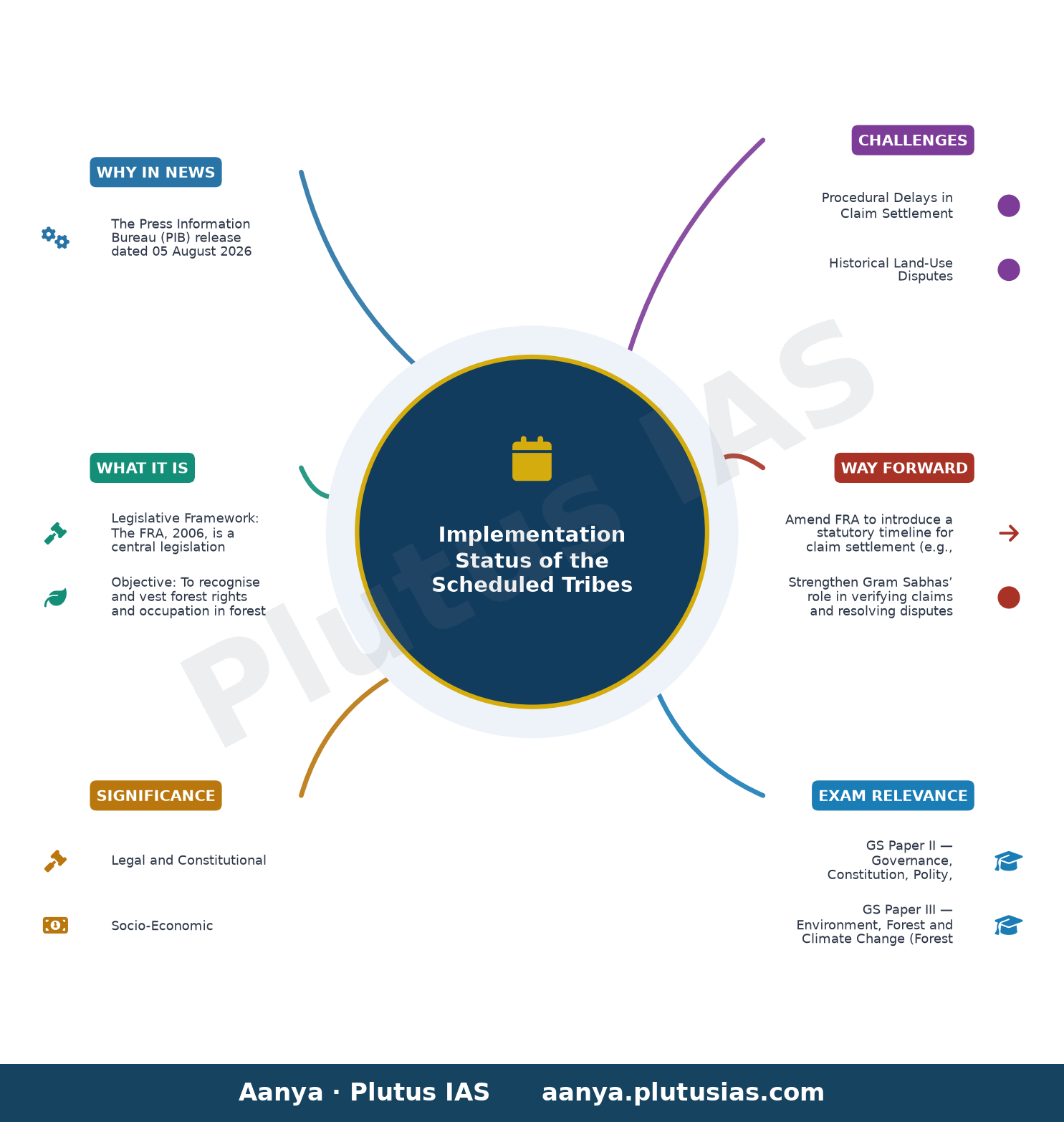
✎ The Forest Rights Act, 2006, is a constitutional instrument for tribal empowerment, recognising Individual and Community Forest Rights through Gram Sabha-led processes, with no statutory timeframe for claim settlement…
Subject Relevance — Where This Topic Fits
- GS Paper II — Governance, Constitution, Polity, Social Justice and International Relations (Tribal Welfare Policies) | GS Paper III — Environment, Forest and Climate Change (Forest Rights and Conservation) | GS Paper II — Functions and Responsibilities of the Union and the States (Cooperative Federalism in Tribal Affairs)
- Prelims: Forest Rights Act 2006, Scheduled Tribes and Other Traditional Forest Dwellers (Recognition of Forest Rights) Act, Community Forest Rights, Individual Forest Rights, Gram Sabha, Title Deeds (Patta), Monthly Progress Report (MPR), Tribal Cooperative Marketing Development Federation of India (TRIFED), Van Adhikar Sangharsh Samiti, Constitutional Provisions for Scheduled Tribes (Articles 341, 342, 339)
- Essay: Tribal rights and environmental justice: Balancing conservation with livelihood security, Federalism in action: The role of states in implementing central welfare legislations
Quick Revision: The Forest Rights Act, 2006, is a constitutional instrument for tribal empowerment, recognising Individual and Community Forest Rights through Gram Sabha-led processes, with no statutory timeframe for claim settlement, necessitating vigilance against procedural delays and evidence gaps.
Why is this in the news?
The Press Information Bureau (PIB) release dated 05 August 2026 highlights the implementation status of the Forest Rights Act (FRA), 2006, as reported by the Union Minister of State for Tribal Affairs in the Rajya Sabha. It provides granular data on claims filed, approved, and rejected under the Act between FY 2023-24 and FY 2025-26, alongside the procedural and administrative challenges in its execution. This development is critical for UPSC aspirants as it intersects with constitutional provisions, environmental governance, and the socio-legal empowerment of forest-dwelling communities, which are recurrent themes in both prelims and mains examinations.
Background
- The Forest Rights Act (FRA), 2006, was enacted to address historical injustices faced by Scheduled Tribes (STs) and Other Traditional Forest Dwellers (OTFDs) by recognising their rights to forest land and resources, thereby aligning with constitutional directives under Articles 46 and 275(1).
- The Act was a legislative response to the displacement and marginalisation of forest-dependent communities due to colonial-era forest policies and subsequent conservation measures that restricted access to forest resources.
- The FRA is a landmark legislation that empowers Gram Sabhas (village assemblies) to initiate and process claims, ensuring decentralised governance and participatory rights recognition.
- The Act mandates the issuance of title deeds (patta) to eligible claimants, thereby conferring legal ownership over forest land for cultivation and habitation, subject to conservation norms.
- Implementation of the FRA has been a subject of debate, with concerns raised about delays, procedural ambiguities, and conflicts with forest conservation objectives, particularly under the Forest Conservation Act, 1980.
- The Tribal Cooperative Marketing Development Federation of India (TRIFED) and state-level Tribal Welfare Departments play a pivotal role in facilitating the implementation of the FRA through capacity-building and monitoring mechanisms.
What is the Forest Rights Act (FRA), 2006?
- Legislative Framework: The FRA, 2006, is a central legislation enacted under Entry 17 (Forest) and Entry 18 (Land) of the Concurrent List (List III) of the Seventh Schedule of the Constitution, empowering both Parliament and State Legislatures to legislate on the subject.
- Objective: To recognise and vest forest rights and occupation in forest land in forest-dwelling Scheduled Tribes and Other Traditional Forest Dwellers who have been residing in such forests for generations but whose rights could not be recorded.
- Rights Recognised: The Act recognises two primary categories of rights — Individual Forest Rights (IFR) and Community Forest Rights (CFR). IFR includes rights to cultivate and reside on forest land, while CFR includes rights to protect, regenerate, conserve, or manage any community forest resource.
- Procedural Safeguards: Claims are processed through a multi-stage process involving Gram Sabha verification, district-level committees, and state-level monitoring. Title deeds are issued only after due diligence and public scrutiny.
- Role of Gram Sabha: The Gram Sabha is the nodal authority for initiating, verifying, and recommending claims, ensuring grassroots participation and transparency in the process.
- Constitutional Safeguards: The FRA operationalises the Directive Principles of State Policy (Article 46) and the Fifth and Sixth Schedules of the Constitution, which provide for the protection and welfare of Scheduled Tribes.
Key Features
| Feature | Significance |
|---|---|
| Implementation responsibility of State Governments and UTs | Ensures decentralised governance of forest rights, aligning with the federal structure of the Constitution (Article 246 and Seventh Schedule). |
| Monthly Progress Reports (MPRs) by Tribal Affairs Ministry | Facilitates centralised monitoring of FRA implementation, though no statutory timeline exists for claim settlement. |
| Total claims filed (8,56,159) vs. titles distributed (2,34,352) | Highlights the procedural lag in FRA implementation, with only 27.37% of claims approved over three fiscal years. |
| Rejection criteria (pre-2005 occupation, multiple claims, non-forest land, lack of evidence) | Demonstrates the stringent evidentiary standards under FRA, which often exclude genuine forest-dwelling communities due to historical land-use patterns. |
| State-wise data availability on FRA portal | Promotes transparency and accountability, enabling civil society and beneficiaries to track progress and grievances. |
Why it Matters
Legal and Constitutional
- The Forest Rights Act (FRA), 2006, is a statutory recognition of the rights of Scheduled Tribes (STs) and Other Traditional Forest Dwellers (OTFDs) under the Fifth Schedule and PESA (Panchayats (Extension to Scheduled Areas) Act, 1996).
- It operationalises the constitutional mandate of Article 244(1) and the Fifth Schedule, which empowers tribal self-governance in Scheduled Areas.
- FRA is a critical tool for addressing historical injustices against forest-dependent communities, particularly in the context of the colonial-era forest laws (e.g., Indian Forest Act, 1927).
Socio-Economic
- FRA empowers forest-dwelling communities to access land titles, which can enhance livelihood security, food sovereignty, and resilience against displacement.
- Legal recognition of rights enables communities to participate in forest management, biodiversity conservation, and climate mitigation efforts (e.g., REDD+ initiatives).
- Reduces vulnerability to exploitation by non-tribal entities, including illegal land grabs and resource extraction industries.
Administrative and Policy
- FRA is a flagship legislation under the Ministry of Tribal Affairs, reflecting the government’s commitment to tribal welfare and constitutional obligations.
- The absence of a statutory timeline for claim settlement underscores the need for procedural reforms to expedite rights recognition.
- State-wise variation in implementation highlights the role of local governance structures (e.g., Gram Sabhas) in ensuring effective FRA enforcement.
Challenges
1. Procedural Delays in Claim Settlement
- No statutory timeline for claim disposal under FRA leads to prolonged uncertainty for claimants.
- High rejection rates (1.69% of total claims) indicate systemic inefficiencies in documentation and evidence collection.
UPSC Link: GS-II: Governance, GS-III: Environment
2. Historical Land-Use Disputes
- Pre-2005 occupation requirement excludes many forest dwellers who were displaced or relocated post-independence.
- Colonial-era land records often lack clarity, leading to conflicts between forest departments and tribal communities.
UPSC Link: GS-II: Governance, GS-III: Environment
3. Multiple Claims and Non-Forest Land Issues
- Overlapping claims on the same land parcel create administrative bottlenecks and legal ambiguities.
- Claims filed on non-forest land (e.g., revenue land) are rejected, highlighting the need for better land-use classification under FRA.
UPSC Link: GS-II: Governance
4. Evidentiary Burden on Claimants
- Lack of formal land records or historical evidence disproportionately affects marginalised communities.
- Dependence on oral testimonies and community memory increases vulnerability to rejection.
UPSC Link: GS-II: Governance, GS-III: Environment
5. State-Level Implementation Gaps
- Variation in FRA implementation across states reflects disparities in administrative capacity and political will.
- Some states lack dedicated FRA cells or trained personnel, leading to poor claim processing.
UPSC Link: GS-II: Governance
Challenges — UPSC Perspective
| Issue | Concern |
|---|---|
| No statutory timeline for claim settlement | Prolonged uncertainty for claimants; lack of accountability in administrative processes. |
| Pre-2005 occupation requirement | Excludes many genuine forest dwellers due to historical displacement or lack of records. |
| Multiple claims on same land | Creates legal ambiguities and administrative bottlenecks in claim processing. |
| Rejection due to lack of evidence | Disproportionately affects marginalised communities with limited access to formal documentation. |
| State-level implementation disparities | Reflects administrative capacity gaps and varying political commitment to FRA. |
| Non-forest land claims | Indicates confusion in land classification and need for better inter-departmental coordination. |
Way Forward
- Amend FRA to introduce a statutory timeline for claim settlement (e.g., 90 days for disposal), with provisions for interim relief pending resolution.
- Strengthen Gram Sabhas’ role in verifying claims and resolving disputes at the grassroots level to reduce administrative delays.
- Digitise land records and historical evidence (e.g., revenue records, forest department maps) to facilitate easier verification of claims.
- Conduct periodic capacity-building programmes for state officials and forest department staff on FRA provisions and procedural requirements.
- Establish a grievance redressal mechanism at the district level to address rejections and expedite appeals.
- Promote community-led mapping of forest resources to pre-empt conflicts and improve transparency in land-use claims.
- Integrate FRA implementation with other welfare schemes (e.g., MGNREGA, PM-KISAN) to enhance livelihood security for titled beneficiaries.
- Mandate annual state-level reviews of FRA progress, with public disclosure of rejection reasons and corrective measures.
UPSC Value Addition
Keywords for Mains Answer-Writing
Forest Rights Act 2006 · Scheduled Tribes and Other Traditional Forest Dwellers · Forest land claims · Individual and Community Forest Rights · Forest Rights Recognition Rules · State-level implementation of FRA · Monthly Progress Reports (MPR) · Land entitlement under FRA · Rejection criteria for forest rights claims · Tribal Sub-Plan (TSP) and FRA convergence · Van Adhikar Abhiyan · Constitutional provisions for tribal rights · Forest bureaucracy and tribal autonomy · Historical injustice redressal mechanisms
Constitutional & Policy Linkages
- {‘link’: ‘Article 244(1) – Administration of Scheduled Areas’, ‘note’: ‘Empowers tribal self-governance’}
- {‘link’: ‘Fifth Schedule – Tribal Areas’, ‘note’: ‘Provides constitutional framework for tribal rights’}
- {‘link’: ‘Article 246 – Seventh Schedule’, ‘note’: ‘Distributes legislative powers between Centre and States’}
- {‘link’: ‘PESA Act, 1996’, ‘note’: ‘Extends Panchayati Raj to Scheduled Areas’}
Concept Flow
Colonial-era forest laws (e.g., Indian Forest Act, 1927) → Displacement of forest-dwelling communities → Post-independence land-use conflicts → FRA, 2006 enacted to recognise forest rights → Implementation gaps (e.g., pre-2005 occupation requirement) → High rejection rates and procedural delays → State-level disparities in enforcement → Need for procedural reforms and capacity-building → Strengthened Gram Sabhas and digitised records → Enhanced livelihood security and conservation outcomes
Prelims Practice Questions
Q1. Consider the following statements regarding the Forest Rights Act (FRA), 2006:
1. The FRA recognises both individual and community forest rights.
2. The Act mandates a time-bound process for the settlement of forest rights claims.
3. The implementation of FRA is the responsibility of the Union Ministry of Tribal Affairs.
4. Claims under FRA can be made for both forest and non-forest lands.
How many of the above statements are correct?
- Only one
- Only two
- Only three
- All four
Answer: Only three — Statements 1 and 4 are correct. Statement 2 is incorrect as the FRA does not prescribe any time-bound process for claim settlement. Statement 3 is incorrect as the implementation responsibility lies with state governments and Union Territories, not the Union Ministry of Tribal Affairs.
Q2. Assertion (A): The Forest Rights Act, 2006, empowers tribal communities to claim rights over forest land and resources.
Reason (R): The Act was enacted to address historical injustices faced by Scheduled Tribes and other traditional forest dwellers.
Options:
A. Both A and R are true, and R is the correct explanation of A.
B. Both A and R are true, but R is NOT the correct explanation of A.
C. A is true, but R is false.
D. A is false, but R is true.
Answer: ? — Both A and R are true, and R correctly explains A. The FRA was enacted to correct historical injustices by recognising the rights of forest-dwelling communities over forest land and resources.
Q3. Match the following provisions of the Forest Rights Act (FRA), 2006, with their correct descriptions:
Column I (Provision) | Column II (Description)
———————————————–|———————————————–
1. Individual Forest Rights | A. Rights over non-timber forest products
2. Community Forest Rights | B. Rights over land cultivated prior to 13.12.2005
3. Habitat Rights | C. Rights over common property resources
4. Minor Forest Produce Rights | D. Rights over areas traditionally used by a community
Options:
A. 1-B, 2-C, 3-D, 4-A
B. 1-A, 2-B, 3-C, 4-D
C. 1-D, 2-C, 3-B, 4-A
D. 1-B, 2-D, 3-C, 4-A
Answer: ? — 1-B: Individual Forest Rights pertain to land cultivated prior to 13.12.2005. 2-C: Community Forest Rights pertain to common property resources. 3-D: Habitat Rights pertain to areas traditionally used by a community. 4-A: Minor Forest Produce Rights pertain to rights over non-timber forest products.
Mains Practice Question
✍ The Forest Rights Act (FRA), 2006, represents a significant legislative effort to address historical injustices faced by Scheduled Tribes and other traditional forest dwellers. Critically examine the implementation challenges of the FRA, with particular reference to the rejection of forest rights claims. Also, assess the role of state governments in ensuring the effective realisation of these rights. (15 Marks)
Approach: MODEL-ANSWER SKELETON:
1. **Introduction (2 marks)**
– Brief background of the FRA, 2006: enacted to correct historical injustices faced by forest-dwelling communities.
– Objective: recognise and vest forest rights in Scheduled Tribes and other traditional forest dwellers.
– Key provisions: Individual Forest Rights (IFR), Community Forest Rights (CFR), Habitat Rights, and Minor Forest Produce Rights.
2. **Implementation Challenges (6 marks)**
– **Rejection of Claims**: Analyse the primary reasons for rejection as cited in the PIB release (e.g., lack of occupancy prior to 13.12.2005, multiple claims on the same land, claims on non-forest land, lack of evidence).
– **Procedural Delays**: Absence of time-bound processes for claim settlement under the FRA and reliance on state-level mechanisms.
– **Bureaucratic Hurdles**: Role of forest bureaucracy in obstructing the recognition of rights; lack of convergence with other schemes like the Tribal Sub-Plan (TSP).
– **Awareness and Capacity**: Limited awareness among forest-dwelling communities about their rights under the FRA.
– **Data and Monitoring**: Reliance on Monthly Progress Reports (MPR) without centralised monitoring or accountability mechanisms.
3. **Role of State Governments (4 marks)**
– **Legal Responsibility**: FRA explicitly assigns implementation responsibility to state governments and Union Territories.
– **State-Level Mechanisms**: Role of State Level Monitoring Committees, District Level Committees, and Sub-District Level Committees in processing claims.
– **Policy Initiatives**: Examples of states with progressive implementation (e.g., Odisha, Maharashtra) and states lagging behind (e.g., Uttar Pradesh, Bihar).
– **Convergence with Development Schemes**: Integration of FRA with schemes like MGNREGA, PM-KISAN, and Van Mitra Yojana to enhance livelihood security.
4. **Way Forward (3 marks)**
– **Strengthening Institutional Mechanisms**: Need for time-bound processes, dedicated grievance redressal mechanisms, and capacity-building for officials and communities.
– **Data Transparency**: Centralised and real-time monitoring of claim settlement progress.
– **Judicial Safeguards**: Role of the judiciary in ensuring compliance with FRA provisions (e.g., Supreme Court orders in forest rights cases).
– **Community Participation**: Involvement of gram sabhas in claim verification and dispute resolution.
**Conclusion**: Summarise the need for a multi-stakeholder approach involving state governments, civil society, and communities to ensure the FRA achieves its intended objectives.
Source: PIB (Press Information Bureau)
Generated by AanyaAi for educational purpose.

- सुप्रीम कोर्ट ने दवाओं की ऊंची कीमतों को ‘लूट’ बताया, सरकार से पूछा- क्या है कानून? - September 23, 2026
- Supreme Court slams ‘extortion’ in drug pricing; calls for Jan Aushadhi expansion - September 23, 2026
- संयुक्त राष्ट्र की विफलता पर तुर्की राष्ट्रपति ने उठाया बड़ा सवाल, जानिए पूरा मामला - September 23, 2026

No Comments