


05 Aug 7 Years of Article 370 Abrogation: A Milestone for J&K & Ladakh Development
✎ The abrogation of Article 370 and Article 35A in 2019 integrated Jammu & Kashmir fully into India’s constitutional framework, enabling uniform governance, developmental parity, and the empowerment of marginalised communities…
Subject Relevance — Where This Topic Fits
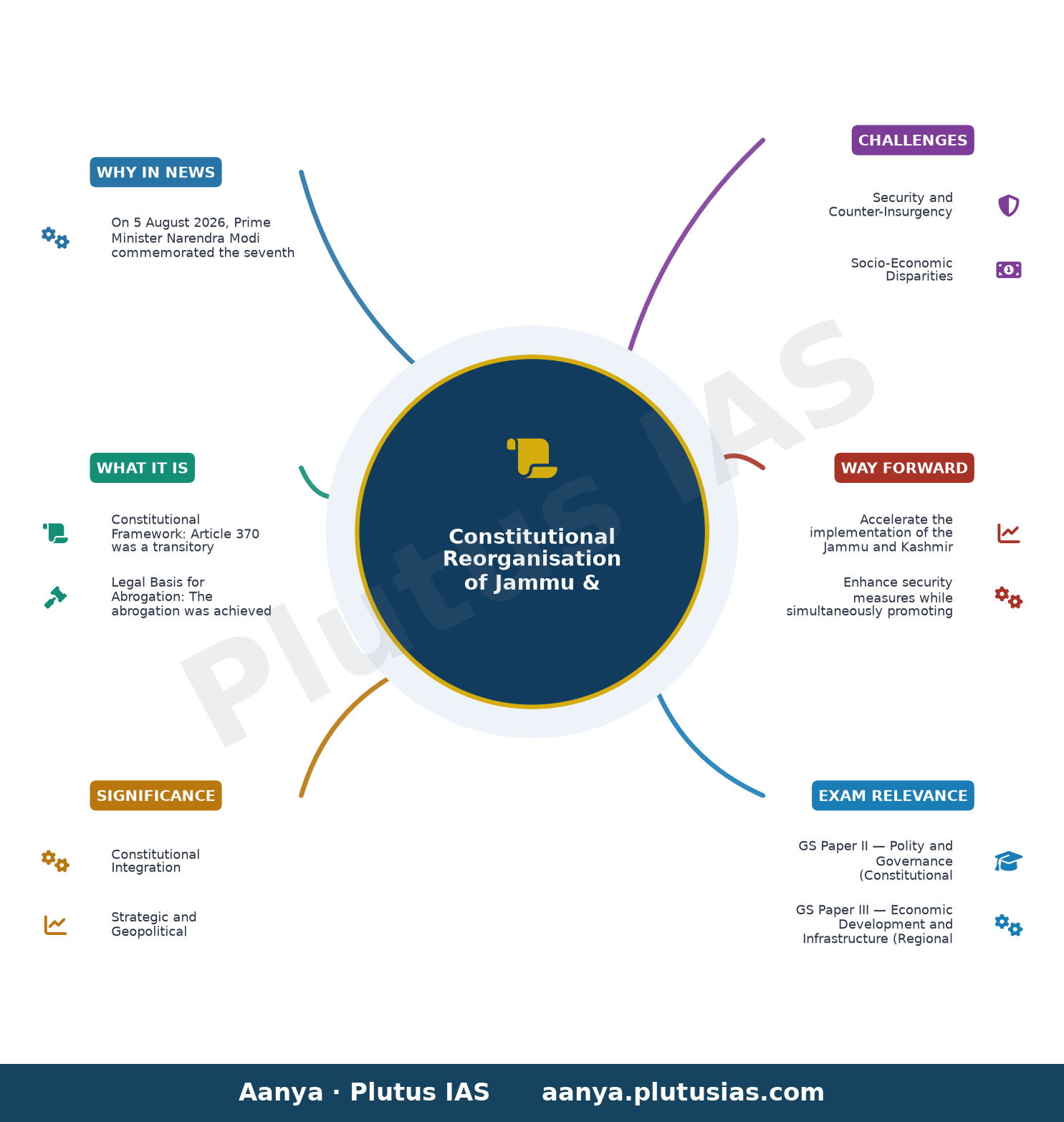
- GS Paper II — Polity and Governance (Constitutional Amendments, Federalism, Fundamental Rights) | GS Paper III — Economic Development and Infrastructure (Regional Development, Social Sector Schemes)
- Prelims: Article 370, Article 35A, Jammu & Kashmir Reorganisation Act 2019, Ladakh Union Territory, Dr. Shyama Prasad Mookerjee, Fundamental Rights in J&K, Article 371, Concurrent List, Directive Principles of State Policy
- Essay: The Role of Constitutional Reforms in National Integration: A Case Study of Jammu & Kashmir, Development as a Catalyst for Social Justice: Lessons from Post-Article 370 J&K
Quick Revision: The abrogation of Article 370 and Article 35A in 2019 integrated Jammu & Kashmir fully into India’s constitutional framework, enabling uniform governance, developmental parity, and the empowerment of marginalised communities through the uniform application of fundamental rights and welfare schemes.
Why is this in the news?
On 5 August 2026, Prime Minister Narendra Modi commemorated the seventh anniversary of the abrogation of Article 370 and Article 35A, highlighting its enduring significance in reshaping the constitutional, developmental, and socio-economic trajectory of Jammu & Kashmir and Ladakh. The event underscored the government’s commitment to inclusive growth, constitutional empowerment, and the realisation of Dr. Shyama Prasad Mookerjee’s vision of national unity.
Background
- Article 370 of the Indian Constitution, inserted in 1949, granted Jammu & Kashmir a special status, limiting Parliament’s legislative authority over the state and exempting it from the full application of the Constitution except through presidential orders.
- Article 35A, introduced in 1954, empowered the Jammu & Kashmir legislature to define ‘permanent residents’ and grant them exclusive rights, effectively restricting property ownership and employment opportunities for non-residents.
- The decision was rooted in the argument that Article 370 was a temporary provision that had outlived its purpose, creating legal ambiguities and impeding socio-economic integration with the rest of India.
- The move was accompanied by a series of developmental initiatives, including infrastructure expansion, education reforms, and targeted welfare schemes to address historical disparities.
- Dr. Shyama Prasad Mookerjee, founder of the Bharatiya Jana Sangh, had long advocated for the integration of Jammu & Kashmir with India, famously stating, ‘Ek desh mein do vidhan, do pradhan, do nishan nahi chalenge’ (One country cannot have two constitutions, two heads, or two flags).
What is the abrogation of Article 370 and Article 35A?
- Constitutional Framework: Article 370 was a transitory provision under Part XXI of the Constitution, allowing Jammu & Kashmir to have its own Constitution and flag, while Article 35A was a legislative addition that defined ‘permanent residents’ and restricted certain rights.
- Legal Basis for Abrogation: The abrogation was achieved through a presidential order under Article 370(3), which required the concurrence of the Jammu & Kashmir Constituent Assembly. The subsequent bifurcation of the state into two Union Territories was enacted via the Jammu & Kashmir Reorganisation Act, 2019.
- Impact on Governance: The removal of Article 370 extended the full scope of the Indian Constitution to Jammu & Kashmir, including fundamental rights, Directive Principles of State Policy, and the Concurrent List, thereby aligning its legal framework with the rest of India.
- Developmental Transformation: Post-abrogation, significant investments were made in infrastructure (e.g., roads, bridges, airports), education (e.g., establishment of new universities, skill development programs), healthcare (e.g., Ayushman Bharat expansion), and entrepreneurship (e.g., startup policies, industrial corridors).
- Empowerment of Marginalised Groups: The abrogation ensured the uniform application of constitutional safeguards, including reservations for Scheduled Castes, Scheduled Tribes, and Other Backward Classes, as well as rights for women and economically weaker sections, which were previously diluted under state-specific laws.
- Ladakh’s Integration: Ladakh, carved out as a separate Union Territory, benefited from direct central funding and policy interventions, including the promotion of tourism, renewable energy projects, and the preservation of its unique cultural heritage.
- Challenges and Criticisms: Critics argue that the abrogation undermined the autonomy of Jammu & Kashmir, while others highlight the lack of political representation in the immediate aftermath. However, the government has pointed to long-term developmental gains and constitutional uniformity as justifications for the decision.
- Dr. Mookerjee’s Legacy: The abrogation is often linked to Dr. Shyama Prasad Mookerjee’s vision of a united India, where all citizens are subject to the same constitutional framework, irrespective of region.
Key Features
| Feature | Significance |
|---|---|
| Infrastructure Expansion | Systematic development of roads, bridges, power, and digital connectivity in Jammu-Kashmir and Ladakh, reducing logistical bottlenecks and fostering economic integration with mainland India. |
| Constitutional Rights Realisation | Full implementation of the Indian Constitution in Jammu-Kashmir, ensuring equal rights for women, Scheduled Castes, Scheduled Tribes, and other marginalised communities. |
| Educational Reforms | Increased access to quality education, establishment of new institutions, and alignment with national curricula, enhancing human capital formation. |
| Healthcare Integration | Expansion of healthcare infrastructure, including primary and tertiary care facilities, and integration with national health schemes for universal coverage. |
| Economic Opportunities | Facilitation of entrepreneurship, industrialisation, and tourism through policy reforms, thereby diversifying the local economy beyond traditional sectors. |
Why it Matters
Constitutional Integration
- Abolition of Article 370 and Article 35A removed the legal and administrative barriers that had historically insulated Jammu-Kashmir from the full application of the Indian Constitution, ensuring uniform governance and rights across all states.
- Integration facilitated the application of Directive Principles of State Policy, particularly Articles 38, 39, and 41, which mandate social justice, economic welfare, and public health for all citizens.
- Empowerment of women and marginalised groups through the enforcement of constitutional provisions such as Article 14 (Right to Equality), Article 15 (Prohibition of Discrimination), and Article 21 (Right to Life and Personal Liberty).
Strategic and Geopolitical
- Enhanced territorial integration of Jammu-Kashmir and Ladakh with the Union of India, strengthening national security and reducing external vulnerabilities.
- Facilitated the implementation of national security frameworks, including the Unlawful Activities (Prevention) Act (UAPA) and the National Investigation Agency (NIA), without constitutional ambiguity.
- Enabled the deployment of national infrastructure projects, such as the Chenab Bridge and the Zojila Tunnel, critical for connectivity and strategic mobility in the region.
Economic Development
- Integration with national markets and schemes, such as the Goods and Services Tax (GST) and the PM-KISAN scheme, has improved economic parity and reduced dependency on state-specific policies.
- Attracted investment in sectors like tourism, hydropower, and agriculture, leveraging the region’s natural resources and strategic location.
- Enabled the utilisation of centrally sponsored schemes, such as the Pradhan Mantri Gram Sadak Yojana (PMGSY) and the National Rural Health Mission (NRHM), for inclusive growth.
Social Justice and Inclusion
- Removal of discriminatory provisions, such as Article 35A, which had historically restricted property rights and employment opportunities for non-permanent residents, particularly women.
- Ensured the application of reservation policies under Articles 15(4) and 16(4) for Scheduled Castes, Scheduled Tribes, and Other Backward Classes, promoting social equity.
- Facilitated the participation of women in political and economic spheres, exemplified by increased representation in local governance and entrepreneurship.
Historical and Ideological
- Realisation of Dr. Shyama Prasad Mookerjee’s vision of ‘Ek Bharat, Shreshtha Bharat,’ which advocated for the integration of Jammu-Kashmir into the Indian Union without special privileges.
- Symbolised the culmination of a decades-long debate on the constitutional status of Jammu-Kashmir, aligning it with the democratic and secular ethos of the Indian Republic.
- Demonstrated the state’s commitment to the principles of federalism, while ensuring the supremacy of the Constitution over regional autonomy.
Challenges
1. Security and Counter-Insurgency
- Persistent threats from cross-border terrorism and local insurgent groups, necessitating sustained deployment of security forces and intelligence operations.
- Risk of radicalisation in pockets of the region, requiring de-radicalisation programs and community engagement initiatives.
- Balancing security imperatives with developmental goals to ensure that counter-insurgency measures do not impede socio-economic progress.
UPSC Link: GS3: Internal Security
2. Socio-Economic Disparities
- Historical underdevelopment in sectors such as education, healthcare, and infrastructure, requiring targeted interventions to bridge the gap with national averages.
- High unemployment rates, particularly among youth, necessitating skill development programs and industrialisation.
- Ensuring equitable distribution of developmental benefits across diverse communities, including Gujjars, Bakarwals, and tribal groups.
UPSC Link: GS2: Social Justice
3. Political Integration and Governance
- Reorganisation of the erstwhile state into two Union Territories (Jammu-Kashmir and Ladakh) required administrative restructuring and capacity-building for local governance.
- Ensuring the effective functioning of the Delimitation Commission to address historical imbalances in electoral representation.
- Building trust among local populations, particularly in regions with separatist sentiments, through transparent and participatory governance.
UPSC Link: GS2: Polity
4. Environmental and Ecological Concerns
- Balancing developmental projects with environmental sustainability, particularly in ecologically fragile regions like Ladakh and the Himalayan belt.
- Mitigating the impact of climate change on agriculture, water resources, and biodiversity in the region.
- Ensuring compliance with environmental laws, such as the Forest Rights Act and the Wildlife Protection Act, while promoting economic activities.
UPSC Link: GS3: Environment
5. Legal and Constitutional Challenges
- Addressing petitions pending in the Supreme Court challenging the constitutional validity of the abrogation of Article 370 and the reorganisation of the state.
- Ensuring that the implementation of national laws does not infringe upon the cultural and religious rights of local communities.
- Streamlining judicial processes to reduce delays in the delivery of justice, particularly in cases related to land disputes and property rights.
UPSC Link: GS2: Polity
Challenges — UPSC Perspective
| Issue | Concern |
|---|---|
| Cross-Border Terrorism | Persistent infiltration and attacks from across the Line of Control, requiring sustained counter-terrorism operations and border management. |
| Youth Unemployment | High unemployment rates among educated youth, leading to socio-economic discontent and susceptibility to radicalisation. |
| Infrastructure Gaps | Historical neglect of infrastructure in remote areas, necessitating accelerated development to reduce disparities. |
| Political Alienation | Perceptions of marginalisation among certain communities, requiring inclusive governance and confidence-building measures. |
| Climate Vulnerability | Increased frequency of extreme weather events, glacier melt, and water scarcity, threatening livelihoods and ecological balance. |
| Judicial Backlog | Delays in the judicial system, particularly in land and property disputes, hindering economic and social progress. |
Government Initiatives — Must-Memorise for Prelims
- Pradhan Mantri Gram Sadak Yojana (PMGSY)
- National Rural Health Mission (NRHM)
- Pradhan Mantri Kisan Samman Nidhi (PM-KISAN)
- Skill India Mission
- Stand-Up India Scheme
Way Forward
- Accelerate the implementation of the Jammu and Kashmir Reorganisation Act, 2019, to ensure smooth administrative transition and capacity-building for local governance.
- Enhance security measures while simultaneously promoting socio-economic development to address the root causes of insurgency and radicalisation.
- Expand vocational training and entrepreneurship programs to create employment opportunities, particularly for youth and women.
- Strengthen infrastructure development, including roads, power, and digital connectivity, to integrate the region with national markets and supply chains.
- Ensure the effective utilisation of centrally sponsored schemes, such as the PM-KISAN and Ayushman Bharat, to improve agricultural productivity and healthcare access.
- Promote tourism and cultural exchange programs to foster economic growth and build bridges between the region and the rest of India.
- Address environmental concerns through sustainable development practices, including afforestation, water conservation, and renewable energy projects.
- Streamline judicial processes to reduce delays in dispute resolution, particularly in land and property matters, to boost investor confidence.
UPSC Value Addition
Keywords for Mains Answer-Writing
Article 370 abrogation · Article 35A · Jammu and Kashmir Reorganisation Act 2019 · Dr. Shyama Prasad Mookerjee · federalism and autonomy · inclusive development in J&K · women empowerment in J&K · Ladakh Union Territory formation · constitutional rights and deprivation · national integration · asymmetric federalism · Article 371
Constitutional & Policy Linkages
- Article 370 (Temporary Provisions for Jammu-Kashmir)
- Article 35A (Historical Special Rights)
- Article 14 (Right to Equality)
- Article 15 (Prohibition of Discrimination)
- Article 21 (Right to Life and Personal Liberty)
- Seventh Schedule (Union and State List)
Concept Flow
Historical Context: Article 370 and Article 35A granted Jammu-Kashmir special status, creating legal and administrative barriers. → Abolition: Removal of Article 370 and Article 35A on 5 August 2019, integrating Jammu-Kashmir fully into the Indian Union. → Constitutional Integration: Application of the Indian Constitution in Jammu-Kashmir, ensuring equal rights and governance. → Developmental Reforms: Expansion of infrastructure, education, healthcare, and economic opportunities. → Social Empowerment: Realisation of constitutional rights for women, SCs, STs, and marginalised communities. → Strategic Integration: Enhanced national security and geopolitical stability in the region. → Sustainable Progress: Balancing development with environmental and social justice to ensure inclusive growth.
Prelims Practice Questions
Q1. Consider the following statements regarding the abrogation of Article 370 and Article 35A in 2019:
1. Article 370 granted special status to Jammu and Kashmir, while Article 35A empowered the state legislature to define permanent residents.
2. The abrogation of these provisions was achieved through a Presidential Order under Article 370(3).
3. The Jammu and Kashmir Reorganisation Act, 2019 bifurcated the state into two Union Territories: Jammu and Kashmir, and Ladakh.
4. The Supreme Court of India upheld the abrogation in its entirety through a unanimous judgment in 2023.
How many of the above statements are correct?
- Only one
- Only two
- Only three
- All four
Answer: All four — Statements 1, 2, and 3 are correct. Statement 4 is incorrect as the Supreme Court, while upholding the abrogation of Article 370, referred the matter of its validity under Article 370(3) to a larger bench for further consideration.
Q2. Assertion (A): The abrogation of Article 370 and Article 35A has led to the full application of the Indian Constitution in Jammu and Kashmir.
Reason (R): Article 35A empowered the Jammu and Kashmir legislature to define permanent residents and restrict their rights, which was incompatible with the principles of equality enshrined in the Indian Constitution.
In the context of the above two statements, which one of the following is correct?
- Both A and R are true, and R is the correct explanation of A
- Both A and R are true, but R is not the correct explanation of A
- A is true, but R is false
- A is false, but R is true
Answer: Both A and R are true, but R is not the correct explanation of A — Assertion (A) is true as the abrogation has indeed led to the full application of the Indian Constitution in Jammu and Kashmir. Reason (R) is also true and correctly explains Assertion (A), as Article 35A was a constitutional anomaly that allowed differential treatment based on residency, which was incompatible with constitutional equality.
Q3. Match the following provisions with their correct descriptions:
Column I (Provisions)
A. Article 370
B. Article 35A
C. Jammu and Kashmir Reorganisation Act, 2019
D. Article 371
Column II (Descriptions)
1. Empowered the state legislature to define permanent residents and their rights
2. Granted special status to Jammu and Kashmir, limiting Parliament’s legislative powers
3. Bifurcated the state of Jammu and Kashmir into two Union Territories
4. Provides special provisions for certain states, including Maharashtra and Gujarat
Select the correct match:
- A-2, B-1, C-3, D-4
- A-1, B-2, C-3, D-4
- A-2, B-3, C-1, D-4
- A-3, B-1, C-2, D-4
Answer: A-2, B-1, C-3, D-4 — The correct matches are: Article 370 (A-2), Article 35A (B-1), Jammu and Kashmir Reorganisation Act, 2019 (C-3), and Article 371 (D-4).
Mains Practice Question
✍ The abrogation of Article 370 and Article 35A on 5 August 2019 marked a watershed moment in India’s constitutional and political history. Critically examine the constitutional validity of this abrogation, its implications for federalism, and the socio-economic transformation witnessed in Jammu and Kashmir and Ladakh over the past seven years. (15 Marks)
Approach: MODEL-ANSWER SKELETON:
1. **Constitutional Validity and Legal Framework**
– Reference to Article 370(3) and the Presidential Order of 5 August 2019.
– The Supreme Court’s 2023 judgment upholding the abrogation while referring the validity under Article 370(3) to a larger bench.
– Role of the Constituent Assembly and the doctrine of ‘basic structure’ in this context.
– Critique of the argument that the abrogation violated the federal principle by unilaterally altering the state’s status.
2. **Federalism and Asymmetric Autonomy**
– Examine the concept of asymmetric federalism in India, with specific reference to Article 370.
– Contrast with other provisions like Article 371, which provide special status to certain states without abrogation.
– Debate on whether the abrogation undermined the federal structure or restored constitutional uniformity.
– Views of scholars such as Granville Austin, Rajeev Dhavan, and Upendra Baxi on federalism and Article 370.
3. **Socio-Economic Transformation**
– Infrastructure development: roads, bridges, airports (e.g., Srinagar-Leh highway, Jammu-Udhampur rail link).
– Education: expansion of IITs, IIMs, and universities; scholarships for students.
– Health: establishment of AIIMS in Jammu and Srinagar; telemedicine initiatives.
– Women empowerment: reservation in local bodies, access to education and employment.
– Entrepreneurship and tourism: growth in startup ecosystem, promotion of Ladakh as a global tourist destination.
– Data on GDP growth, employment generation, and demographic changes post-2019.
4. **Critique and Challenges**
– Persistence of security concerns and political alienation in certain segments.
– Delays in holding Assembly elections and restoration of statehood.
– Environmental concerns in Ladakh due to tourism and infrastructure projects.
– Balancing development with cultural preservation and local aspirations.
5. **Conclusion**
– Synthesis: Whether the abrogation has achieved its stated objectives of integration and development.
– Future roadmap: Need for inclusive governance, political reconciliation, and sustainable development.
– Final assessment: A balanced view acknowledging both the transformative potential and the unresolved challenges.
Source: PIB (Press Information Bureau)
Generated by AanyaAi for educational purpose.

- किशाऊ परियोजना विवाद: पंजाब सुप्रीम कोर्ट पहुंचेगा, जानें पूरा मामला - September 22, 2026
- Punjab to Challenge Kishau Project in Supreme Court: Key Polity & Governance Issue for UPSC - September 22, 2026
- दिल्ली हाईकोर्ट ने बदले ‘वरिष्ठ अधिवक्ता’ के नियम, 100-प्वाइंट प्रणाली हुई खत्म - September 22, 2026

No Comments