


05 Aug AI in Management Education: Future-Ready Skills for UPSC & PCS Aspirants
✎ AI is no longer an optional skill in management education; it is a foundational competency required to address the technological disruptions shaping modern business ecosystems.
Subject Relevance — Where This Topic Fits
- GS Paper II — Governance, Transparency and Accountability in Institutions | GS Paper III — Science and Technology — Developments and their Applications and Effects in Everyday Life | GS Paper III — Role of Technology in Enhancing Productivity and Economic Growth
- Prelims: Artificial Intelligence (AI), Generative AI (GenAI), Agentic AI, Global Capability Centres (GCCs), EY GCC Pulse Survey 2025, Nasscom, Indeed, Data Analytics, Digital Literacy, Technological Adeptness, Fintech Innovation
- Essay: The Role of Technology in Shaping Future Workforces: A Case for AI-Integrated Education, Ethical Leadership in the Age of Automation: Balancing Innovation with Responsibility
Quick Revision: AI is no longer an optional skill in management education; it is a foundational competency required to address the technological disruptions shaping modern business ecosystems.
Why is this in the news?
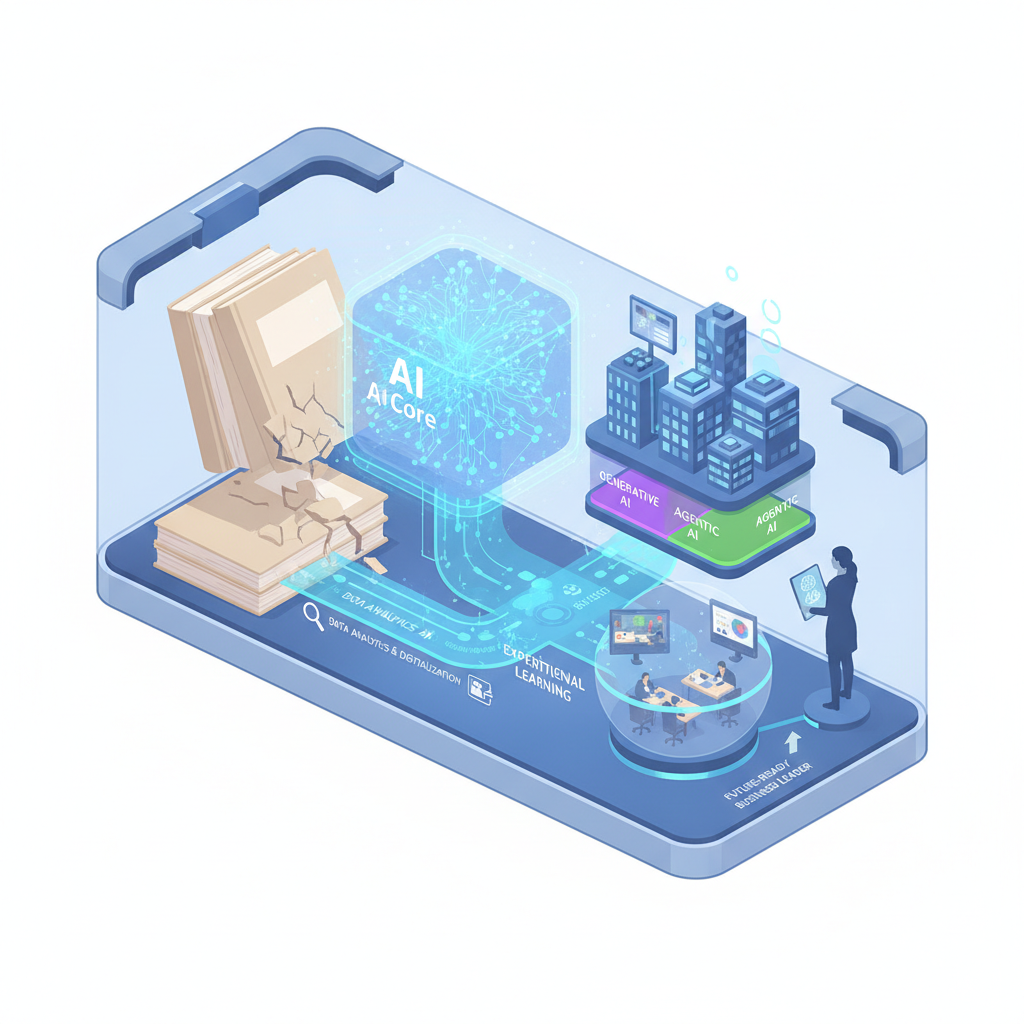
The article highlights the accelerating integration of Artificial Intelligence (AI) into management education, driven by the demand from Global Capability Centres (GCCs) and industries for graduates with advanced technological and analytical skills. It underscores the inadequacy of conventional textbook-based education and advocates for a curriculum that embeds AI, data analytics, and experiential learning to prepare future-ready business leaders.
Background
- India is experiencing rapid digitalisation across sectors, with AI adoption becoming a cornerstone of economic growth and competitiveness.
- Global Capability Centres (GCCs) in India are expanding, with 83% investing in Generative AI (GenAI) and 58% in Agentic AI, as per the EY GCC Pulse Survey 2025.
- Employers increasingly prioritise candidates with demonstrable AI skills over traditional degrees, with 32% giving equal weight to AI certifications and 40% preferring AI-skilled candidates, according to reports by Indeed and Nasscom.
- The startup ecosystem and fintech sectors in India are thriving, further amplifying the demand for technologically proficient graduates.
- Traditional management education, focused on rote learning and theoretical frameworks, is being challenged by the need for practical, AI-driven problem-solving skills.
What is the Role of Artificial Intelligence in Reshaping Management Education?
- AI is transitioning from a supportive tool to a core driver of business operations, necessitating its inclusion in management curricula to ensure graduates are industry-ready.
- Management education must evolve beyond textbook-based learning to incorporate experiential learning, case studies, and real-world AI applications to foster critical thinking and innovation.
- Courses in data analytics and Generative AI are being introduced in business schools to equip students with the technical skills required by GCCs and multinational corporations.
- Ethical leadership is a critical component, as AI adoption raises concerns about data privacy, algorithmic bias, and the societal impact of automation, requiring graduates to navigate these challenges responsibly.
- The demand for ‘technological adeptness’ is not limited to technical roles; even traditional management functions like finance, operations, and human resources now require AI literacy for effective decision-making.
Key Features
| Feature | Significance |
|---|---|
| Integration of AI and Data Analytics in Curriculum | Realigns management education with industry demands, ensuring graduates possess computational and analytical competencies essential for modern business operations. |
| Experiential and Problem-Based Learning | Facilitates the development of critical thinking and innovation by exposing students to real-world business challenges through simulations and case studies. |
| Ethical Leadership and Governance Modules | Addresses the moral and regulatory dimensions of AI deployment, preparing future managers to navigate ethical dilemmas in technologically-driven environments. |
| Industry-Academia Collaborations | Enhances the relevance of academic programmes by incorporating inputs from Global Capability Centres (GCCs) and technology-driven enterprises. |
| Certification in AI and Automation Tools | Provides tangible proof of technical proficiency, aligning with employer preferences for demonstrable AI skills over traditional degrees. |
Why it Matters
Economic and Strategic
- AI-driven management education enhances India’s competitiveness in the global digital economy by producing a workforce skilled in emerging technologies.
Industrial and Employment
- GCCs and tech-driven industries prioritise candidates with AI and automation skills, creating high-value employment opportunities for graduates.
Educational Reform
- Shifts the pedagogical paradigm from rote learning to competency-based education, fostering adaptability and lifelong learning.
Technological Sovereignty
- Reduces dependency on foreign expertise by cultivating domestic talent in AI and related domains, aligning with national digital transformation goals.
Challenges
1. Curriculum Obsolescence
- Traditional management syllabi lag behind rapid technological advancements, risking the irrelevance of academic programmes.
UPSC Link: GS Paper 2: Education
2. Faculty Upskilling
- Lack of adequately trained faculty in AI and data science impedes effective curriculum delivery and student engagement.
UPSC Link: GS Paper 1: Human Resource Development
3. Equity and Access
- Digital divide exacerbates disparities in access to AI-enabled education, particularly between urban and rural institutions.
UPSC Link: GS Paper 2: Social Justice
4. Ethical and Regulatory Gaps
- Absence of clear ethical frameworks for AI deployment in education raises concerns about data privacy and algorithmic bias.
UPSC Link: GS Paper 4: Ethics
5. Industry-Academia Mismatch
- Disconnect between academic offerings and industry needs leads to skill gaps and graduate unemployability.
UPSC Link: GS Paper 3: Employment
Challenges — UPSC Perspective
| Issue | Concern |
|---|---|
| Resource Constraints | Limited infrastructure and funding for AI integration in management institutions. |
| Resistance to Change | Traditional academic structures and faculty reluctance to adopt new pedagogical methods. |
| Data Privacy Risks | Exposure of student and institutional data to cyber threats and unauthorised access. |
| Certification Validity | Lack of standardised and universally recognised AI certifications for graduates. |
| Global Competition | Risk of Indian graduates being outpaced by peers from countries with advanced AI education systems. |
Way Forward
- Incorporate AI and data analytics modules as mandatory components in management curricula, aligned with industry standards.
- Establish faculty development programmes in collaboration with technology firms and IITs to bridge the skills gap.
- Promote public-private partnerships to fund AI-enabled labs and research centres in business schools.
- Develop standardised certification frameworks for AI and automation skills to enhance employability.
- Strengthen ethical governance frameworks to address data privacy and algorithmic bias in educational AI tools.
- Encourage experiential learning through internships with GCCs and tech-driven enterprises.
- Leverage digital infrastructure initiatives like SWAYAM and DIKSHA to democratise access to AI education.
- Foster interdisciplinary research in AI applications for business management to drive innovation.
UPSC Value Addition
Keywords for Mains Answer-Writing
Artificial Intelligence in Education · Management Education Reform · Experiential Learning · Digital Literacy in Higher Education · Global Capability Centres (GCCs) · Generative AI (GenAI) · Data Analytics in Business · Ethical Leadership in AI · Curriculum Modernisation · Technological Proficiency for Graduates
Concept Flow
Rapid AI adoption in industries → Increased demand for technologically skilled graduates → Pressure on management education to evolve → Integration of AI and data analytics in curricula → Development of experiential and ethical learning modules → Enhanced employability and industry readiness of graduates → Contribution to national digital economy and global competitiveness.
Prelims Practice Questions
Q1. Consider the following statements regarding the role of Artificial Intelligence (AI) in management education:
1. AI is now a core operational factor in business rather than a supportive tool.
2. Traditional classroom education remains sufficient for preparing graduates in the AI-driven economy.
3. Indian Global Capability Centres (GCCs) prioritise candidates with demonstrable AI skills over formal degrees.
How many of the above statements are correct?
- Only one
- Only two
- All three
- None
Answer: Only two — Statement 1 is correct as AI has become central to business operations. Statement 2 is incorrect because traditional education is deemed insufficient for AI-driven economies. Statement 3 is correct based on reports indicating a preference for AI skills over degrees.
Q2. Assertion (A): The integration of AI, data analytics, and digital skills into management education is essential for preparing future-ready graduates.
Reason (R): AI adoption in industries like finance, operations, and cybersecurity is rapidly increasing, necessitating technologically adept professionals.
Options:
A. Both A and R are true, and R is the correct explanation of A.
B. Both A and R are true, but R is not the correct explanation of A.
C. A is true, but R is false.
D. A is false, but R is true.
- A
- B
- C
- D
Answer: A — Both the assertion and reason are true, and the reason correctly explains the assertion. AI integration is essential due to rising industry demands for technologically skilled graduates.
Q3. Match the following AI applications in management education with their corresponding industry sectors:
Column I (AI Application) | Column II (Industry Sector)
1. Customer service automation | A. Finance
2. Predictive analytics for risk assessment | B. Operations
3. Automated cybersecurity threat detection | C. Marketing
4. Personalised digital marketing campaigns | D. Cybersecurity
- 1-A, 2-B, 3-D, 4-C
- 1-B, 2-A, 3-D, 4-C
- 1-D, 2-A, 3-B, 4-C
- 1-C, 2-D, 3-A, 4-B
Answer: 1-A, 2-B, 3-D, 4-C — Customer service automation is primarily used in finance (A), predictive analytics for risk assessment is common in operations (B), automated cybersecurity threat detection aligns with cybersecurity (D), and personalised digital marketing campaigns are used in marketing (C).
Mains Practice Question
✍ The integration of Artificial Intelligence (AI) into management education is no longer an optional enhancement but a structural necessity. Critically analyse the implications of this transformation for Indian business schools, with reference to experiential learning, ethical leadership, and the evolving demands of industries such as Global Capability Centres (GCCs). Also, outline the challenges in achieving this transition. (15 Marks)
Approach: MODEL-ANSWER SKELETON:
1. Introduction: Define AI integration in management education and its necessity in the current technological landscape.
2. Implications for Indian Business Schools:
a. Curriculum Modernisation: Shift from textbook-based learning to experiential learning (e.g., AI-driven case studies, simulations, internships with GCCs).
b. Ethical Leadership: Need for embedding AI ethics, data privacy, and responsible innovation frameworks (cite NEP 2020, AI Ethics frameworks by UNESCO/GOI).
c. Industry-Academia Collaboration: Partnerships with GCCs, fintech, and startups for real-world AI applications (reference EY GCC Pulse Survey 2025, Indeed-Nasscom reports).
3. Evolving Industry Demands:
a. GCCs’ preference for AI-skilled graduates (83% investing in GenAI, 58% in Agentic AI).
b. Employer trends: 40% prefer AI skills over degrees, 32% give equal weight to AI skills and formal education.
4. Challenges:
a. Faculty Upskilling: Resistance to change, lack of AI expertise among educators.
b. Infrastructure Gaps: High costs of AI tools, digital divide in institutions.
c. Ethical Concerns: Bias in AI algorithms, data privacy issues, and regulatory ambiguities.
5. Conclusion: Balancing innovation with inclusivity, ensuring equitable access to AI education, and aligning with national digital literacy goals.
Source: Hindustan Times
Generated by AanyaAi for educational purpose.

- Cabinet Approves MSP Hike for Rabi Crops 2027-28: Key Facts for UPSC & PCS - September 30, 2026
- सुप्रीम कोर्ट का पटाखों पर फैसला: पूर्ण प्रतिबंध नहीं, समय-सीमा तय करने का निर्देश - September 30, 2026
- Why Railways Launched LNG Trains Despite Near-Complete Electrification? - September 30, 2026

No Comments