


05 Aug Government May Call Special Session for Delimitation Bill: Key Updates for UPSC
✎ The Supreme Court (Number of Judges) Amendment Bill increases the sanctioned strength of Supreme Court judges from 34 to 38 to address case pendency and enhance judicial efficiency, while the Delimitation Bill remains under…
Subject Relevance — Where This Topic Fits
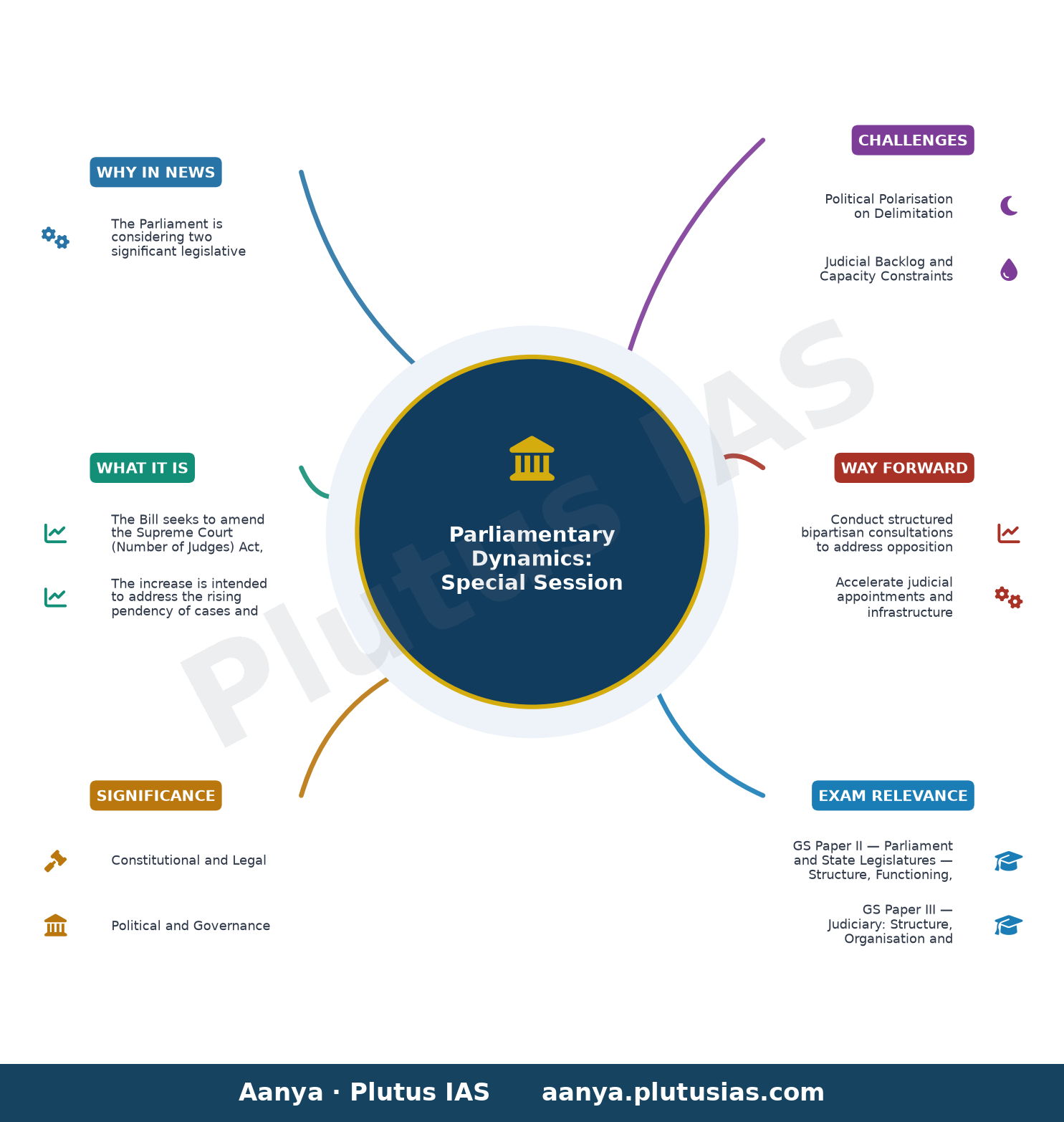
- GS Paper II — Parliament and State Legislatures — Structure, Functioning, Conduct of Business, Powers & Privileges and Issues Arising out of these | GS Paper III — Judiciary: Structure, Organisation and Functioning
- Prelims: Delimitation Commission, Supreme Court (Number of Judges) Amendment Bill, 2026, Article 170 (Composition of State Legislative Assemblies), Article 145 (Supreme Court Rules), Parliamentary Special Session, Judicial Appointments, Bankers Books Evidence Act, 1891
- Essay: The Role of Parliament in Democratic Governance: Accountability and Reform, Judicial Reforms: Balancing Independence and Efficiency
Quick Revision: The Supreme Court (Number of Judges) Amendment Bill increases the sanctioned strength of Supreme Court judges from 34 to 38 to address case pendency and enhance judicial efficiency, while the Delimitation Bill remains under parliamentary consideration for electoral representation reforms.
Why is this in the news?
The Parliament is considering two significant legislative developments: a potential special session to discuss the Delimitation Bill, and the passage of the Supreme Court (Number of Judges) Amendment Bill in the Rajya Sabha, which increases the sanctioned strength of Supreme Court judges from 34 to 38. These developments reflect ongoing debates on electoral representation and judicial capacity, with implications for constitutional governance and federal balance.
Background
- The Delimitation Commission is a statutory body constituted under the Delimitation Act, 2002, to readjust the division of territorial constituencies in India based on the latest census data.
- The last delimitation exercise was conducted in 2002, based on the 2001 Census, and was frozen until 2026 under the 84th Amendment Act, 2001, to protect the interests of Scheduled Castes and Scheduled Tribes.
- The Bankers Books Evidence Act, 1891, governs the admissibility of bank records as evidence in courts, originally framed during British colonial rule.
- The opposition has consistently raised concerns over perceived delays in passing key bills, including those related to electoral reforms and judicial capacity.
- Parliamentary special sessions are convened for focused legislative or deliberative purposes, as seen in April 2026, when a three-day special session was held but failed to pass critical bills.
What is the Supreme Court (Number of Judges) Amendment Bill?
- The Bill seeks to amend the Supreme Court (Number of Judges) Act, 1956, to increase the sanctioned strength of Supreme Court judges from 34 to 38.
- The increase is intended to address the rising pendency of cases and reduce the workload on existing judges, thereby enhancing judicial efficiency.
- The Collegium System, as evolved through judicial pronouncements, remains the primary mechanism for judicial appointments, though the Bill does not alter this process.
- The Bill was passed by the Lok Sabha on 3 August and by the Rajya Sabha on 5 August, reflecting bipartisan consensus on judicial capacity expansion.
- The increase aligns with global best practices, where larger benches facilitate faster disposal of complex constitutional and civil appeals.
- The Bill does not alter the constitutional provisions governing the Supreme Court’s jurisdiction under Article 136 (Special Leave Petition) or Article 142 (Enforcement of Decrees and Orders).
- The opposition has historically supported judicial reforms but has demanded greater transparency in judicial appointments and accountability in case disposal.
- The Bill is distinct from proposals for increasing the retirement age of judges or altering the retirement age of High Court judges, which are governed by separate legislative frameworks.
Key Features
| Feature | Significance |
|---|---|
| Proposed special session on delimitation | A potential three-day session (16–18 August) to deliberate the Delimitation Bill, aimed at addressing demographic shifts and electoral representation concerns. |
| Supreme Court (Number of Judges) Amendment Bill, 2026 | Increases the sanctioned strength of Supreme Court judges from 34 to 38, enhancing judicial capacity to handle rising litigation and backlog. |
| Bankers Books Evidence (Amendment) Bill, 2026 | Modernises the 1891 colonial-era law to recognise digital, electronic, and cloud-based bank records as admissible evidence in courts. |
| Congress-Opposition engagement on delimitation | Kiren Rijiju’s meeting with Congress MPs to discuss the Delimitation Bill, reflecting inter-party dialogue amid sustained opposition. |
| Parliamentary disruption and walkouts | Opposition protests, including walkouts and marches, highlighting political friction during legislative proceedings. |
Why it Matters
Constitutional and Legal
- The Delimitation Bill’s consideration underscores the constitutional mandate under Article 82 and the Delimitation Act, 2002, to redraw electoral boundaries based on the latest census data.
- The Supreme Court (Number of Judges) Amendment Bill, 2026, aligns with Article 124(1) of the Constitution, which empowers Parliament to determine the number of judges in the Supreme Court.
- The Bankers Books Evidence (Amendment) Bill, 2026, modernises evidence law under the Indian Evidence Act, 1872, to accommodate digital financial records.
Political and Governance
- The proposed special session on delimitation signals the government’s intent to prioritise electoral reforms, potentially impacting seat distribution in state legislatures and the Lok Sabha.
- Ongoing opposition protests and walkouts reflect broader political tensions, particularly on issues of electoral integrity and judicial appointments.
- The Supreme Court judge strength increase may expedite case disposal, addressing judicial backlog and enhancing constitutional governance.
Judicial and Administrative
- Increasing the Supreme Court’s judge strength to 38 aims to mitigate pendency, with the current backlog exceeding 70,000 cases (as per Supreme Court data).
- The Bankers Books Evidence Bill’s passage will streamline financial litigation, reducing reliance on archaic evidentiary standards.
Challenges
1. Political Polarisation on Delimitation
- Opposition parties, including Congress, have maintained a rigid stance on delimitation, citing concerns over potential electoral manipulation.
- Protests and walkouts during parliamentary sessions indicate deep-seated distrust, complicating consensus-building on constitutional amendments.
UPSC Link: GS-II: Parliament and State Legislatures
2. Judicial Backlog and Capacity Constraints
- Despite increasing judge strength, systemic delays in judicial appointments and infrastructure deficits persist, limiting immediate impact.
- The Supreme Court’s pendency remains high, with over 70,000 cases pending as of recent reports.
UPSC Link: GS-II: Judiciary
3. Modernising Legal Frameworks for Digital Economy
- The Bankers Books Evidence Bill’s passage is a step forward, but enforcement challenges remain, particularly in rural and semi-urban areas with limited digital literacy.
- Cybersecurity risks associated with cloud-based financial records necessitate robust safeguards.
UPSC Link: GS-III: Technology and Governance
4. Parliamentary Disruptions and Legislative Efficiency
- Frequent disruptions and walkouts undermine legislative productivity, delaying critical reforms.
- The government’s inability to pass the Delimitation Bill in April 2026 highlights procedural hurdles in consensus-building.
UPSC Link: GS-II: Parliament and State Legislatures
Challenges — UPSC Perspective
| Issue | Concern |
|---|---|
| Opposition’s rigid stance on delimitation | Risk of prolonged legislative deadlock, delaying electoral reforms. |
| Judicial backlog despite increased judge strength | Systemic inefficiencies persist due to infrastructure and appointment delays. |
| Digital evidence modernisation gaps | Enforcement challenges in rural areas and cybersecurity vulnerabilities. |
| Parliamentary disruptions | Reduced legislative output, affecting governance and reform agenda. |
Way Forward
- Conduct structured bipartisan consultations to address opposition concerns on delimitation, focusing on transparency and data integrity.
- Accelerate judicial appointments and infrastructure development to complement the increase in Supreme Court judge strength.
- Enhance digital literacy and cybersecurity frameworks to support the implementation of the Bankers Books Evidence (Amendment) Bill.
- Strengthen parliamentary discipline through presiding officers’ interventions to minimise disruptions and improve productivity.
- Publish detailed reports on delimitation methodology and data sources to build public trust and mitigate misinformation.
- Explore alternative dispute resolution mechanisms to reduce judicial backlog and expedite case disposal.
- Leverage technology for real-time monitoring of parliamentary proceedings to enhance accountability.
UPSC Value Addition
Keywords for Mains Answer-Writing
Delimitation · Parliamentary Special Session · Article 82 · Article 330 · Article 332 · Supreme Court (Number of Judges) Amendment Bill, 2026 · Judicial Appointments · Constitutional Amendment · Federalism · Separation of Powers · Judicial Independence · Bankers Books Evidence Act, 1891 · Digital Evidence · Constitutional Morality · Rule of Law
Constitutional & Policy Linkages
- Article 82: Delimitation of constituencies.
- Article 124(1): Supreme Court judge strength determination.
- Article 145: Power of Parliament to regulate Supreme Court procedures.
- Part V, Chapter IV: Union Judiciary (Articles 124–147).
Concept Flow
Demographic shifts → Constitutional mandate for delimitation (Article 82) → Proposed Delimitation Bill → Political opposition and protests → Government’s intent to convene special session → Legislative deadlock risk. → Rising judicial backlog → Supreme Court judge strength increase (Article 124(1)) → Enhanced judicial capacity → Systemic delays persist due to appointments and infrastructure → Need for complementary reforms. → Digital financial records → Bankers Books Evidence (Amendment) Bill, 2026 → Modernisation of evidence law → Enforcement challenges in rural areas → Cybersecurity risks → Need for digital literacy and safeguards. → Parliamentary disruptions → Reduced legislative output → Delayed reforms → Erosion of public trust → Need for presiding officers’ interventions and bipartisan dialogue.
Prelims Practice Questions
Q1. Consider the following statements regarding the Supreme Court (Number of Judges) Amendment Bill, 2026:
1. The Bill seeks to increase the number of judges in the Supreme Court from 34 to 38.
2. The Bill was first introduced in the Rajya Sabha and then passed by the Lok Sabha.
3. The Bill amends Article 124 of the Constitution of India.
How many of the above statements are correct?
- Only one
- Only two
- All three
- None
Answer: Only two — Statement 1 is correct as the Bill increases the strength from 34 to 38. Statement 2 is incorrect because the Bill was first passed by the Lok Sabha on 3 August 2026 and then by the Rajya Sabha. Statement 3 is correct as the Bill amends Article 124, which deals with the establishment and constitution of the Supreme Court.
Q2. Assertion (A): The Bankers Books Evidence (Amendment) Bill, 2026 replaces the colonial-era Bankers Books Evidence Act, 1891.
Reason (R): The new Bill aims to recognize digital, electronic, and cloud-based records as valid evidence in courts.
(a) Both A and R are true and R is the correct explanation of A.
(b) Both A and R are true but R is NOT the correct explanation of A.
(c) A is true but R is false.
(d) A is false but R is true.
- (a)
- (b)
- (c)
- (d)
Answer: (a) — Both the Assertion and Reason are true. The Bankers Books Evidence (Amendment) Bill, 2026 indeed replaces the 1891 Act and seeks to validate digital and electronic records as evidence, making R the correct explanation of A.
Q3. Match the following parliamentary bills with their respective objectives:
Column I (Bill) Column II (Objective)
A. Supreme Court (Number of Judges) 1. To validate digital and electronic records as evidence in courts
Amendment Bill, 2026
B. Bankers Books Evidence (Amendment) 2. To increase the number of judges in the Supreme Court
Bill, 2026
C. Constitution (One Hundred and Thirty- 3. To amend the delimitation process for Lok Sabha and State
First Amendment) Bill, 2026 Legislative Assemblies
D. Government of Union Territories 4. To amend provisions related to the governance of Union
(Amendment) Bill, 2026 Territories
Select the correct match:
- A-2, B-1, C-3, D-4
- A-1, B-2, C-3, D-4
- A-3, B-1, C-2, D-4
- A-2, B-3, C-1, D-4
Answer: A-2, B-1, C-3, D-4 — A matches with 2 (increases Supreme Court judges), B matches with 1 (validates digital records), C matches with 3 (amends delimitation), and D matches with 4 (amends Union Territories governance).
Mains Practice Question
✍ The Government of India has proposed a special parliamentary session to deliberate on the Delimitation Bill, 2026, amidst significant political opposition. In this context, critically examine the constitutional and political significance of delimitation in India. Also, analyse the implications of holding a special session for this purpose, particularly in light of the federal structure and the principle of constitutional morality. (15 Marks)
Approach: MODEL-ANSWER SKELETON:
1. **Definition and Constitutional Basis of Delimitation**
– Define delimitation as the process of redrawing the boundaries of parliamentary and assembly constituencies based on the latest census data (Article 82 and Article 330/332).
– Mention the Delimitation Commission, its composition (Chief Election Commissioner, two Election Commissioners, and a retired Supreme Court judge), and its statutory basis under the Delimitation Act, 2002.
2. **Historical Context and Political Significance**
– Highlight the 2002 Delimitation Act and its freeze on delimitation until the first census after 2026, citing the rationale of preventing political manipulation and ensuring stability.
– Discuss the political implications: potential shifts in electoral power, representation of marginalized communities (SC/ST), and regional imbalances.
3. **Federalism and Constitutional Morality**
– Examine the federal tensions: states’ concerns over loss of representation, Centre-state relations, and the role of the Election Commission as a constitutional authority.
– Discuss constitutional morality (as articulated in Bommai case, 1994) and its relevance to delimitation: fairness, non-partisanship, and adherence to constitutional principles.
4. **Special Parliamentary Session: Rationale and Implications**
– Analyse the necessity of a special session: urgency, political consensus-building, and the government’s intent to address opposition concerns.
– Critique the potential risks: politicization of a constitutional process, undermining the autonomy of the Delimitation Commission, and the precedent of bypassing regular parliamentary scrutiny.
5. **Recent Developments and Opposition Stance**
– Reference the April 2026 special session and the failure to pass the Bill, highlighting the opposition’s demand for broader consultations and concerns over demographic shifts.
– Discuss the role of political narratives (e.g., ‘one nation, one election’ debates) and their intersection with delimitation.
6. **Conclusion**
– Balance the need for a fair and transparent delimitation process with the risks of political interference.
– Argue for a consultative approach involving states, civil society, and constitutional experts to uphold federalism and constitutional morality.
Source: bhaskar.com
Generated by AanyaAi for educational purpose.

- UPSC Civil Services (Main) Examination 2026 — Animal Husbandry and Veterinary Science Optional Paper I: Question Paper | Plutus IAS - September 21, 2026
- UPSC Civil Services (Main) Examination 2026 — Malayalam (Compulsory): Question Paper | Plutus IAS - September 21, 2026
- यूएन महासभा में भारत के विदेश मंत्री जयशंकर के उच्चस्तरीय दौरे का महत्व - September 21, 2026

No Comments