


05 Aug UPSC Focus: Govt Schemes Boost Women’s Property Ownership & Empowerment
✎ Women’s property ownership is a multi-dimensional issue intersecting legal rights, economic security, and social norms; policy frameworks like PMAY and NRLM operationalize constitutional guarantees but require robust…
 Property ownership schemesEconomic empowerment policiesGender disparity dataNFHS survey dataConstitutional provisions
Subject Relevance — Where This Topic Fits
- GS Paper I — Role of Women and Women’s Organisations | GS Paper II — Government Policies and Interventions for Development | GS Paper III — Inclusive Growth and Associated Challenges
- Prelims: NFHS-5, PM Awas Yojana (PMAY), Women’s Land Ownership, Economic Empowerment of Women, Land Records and Gender, National Rural Livelihood Mission (NRLM), Women Samriddhi Yojana
- Essay: Women’s Empowerment: A Catalyst for Sustainable Development, The Intersection of Legal Rights and Economic Independence
Quick Revision: Women’s property ownership is a multi-dimensional issue intersecting legal rights, economic security, and social norms; policy frameworks like PMAY and NRLM operationalize constitutional guarantees but require robust implementation to bridge gender gaps in land and housing ownership.
Why is this in the news?
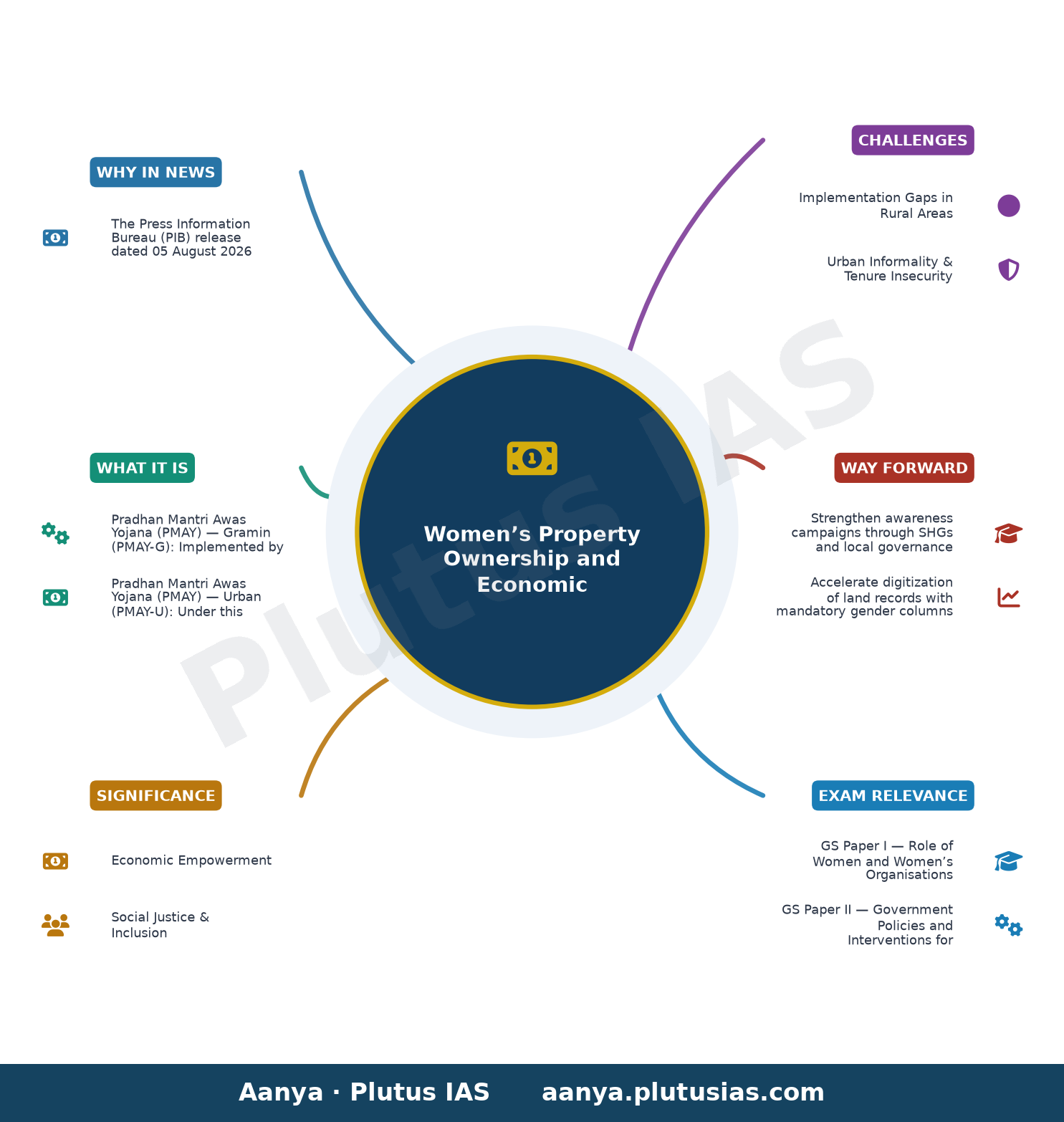
The Press Information Bureau (PIB) release dated 05 August 2026 highlights the role of multiple government schemes in promoting women’s property ownership and economic empowerment, citing data from the National Family Health Survey (NFHS-5) which reveals significant gender disparities in land and housing ownership. This underscores the need for policy interventions to bridge these gaps and align with constitutional and statutory provisions ensuring gender equality in property rights.
Background
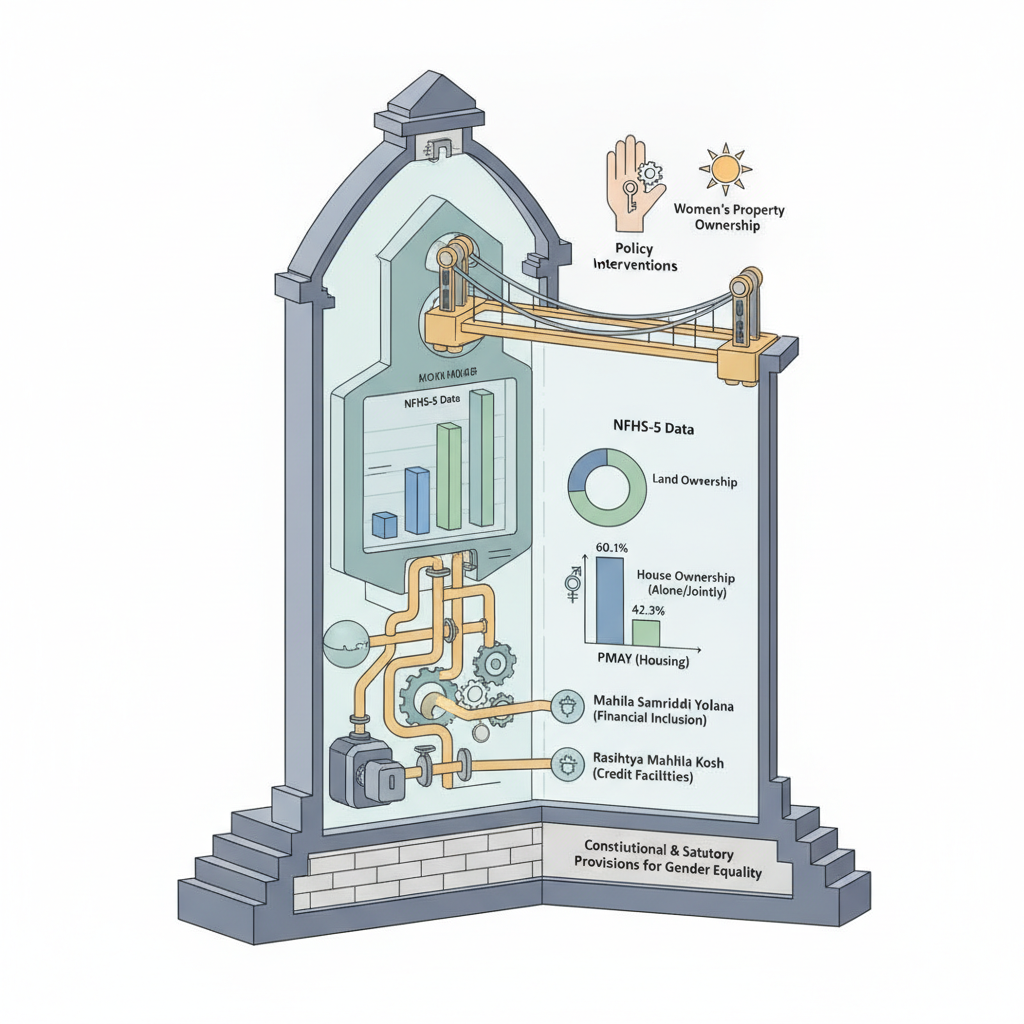
- The National Family Health Survey (NFHS) is a large-scale, multi-round survey conducted in India, providing data on health, nutrition, and socio-economic indicators. NFHS-5 (2019-21) reports that only 42.3% of women aged 15-49 own a house (alone or jointly) compared to 60.1% of men, and 31.7% of women own land (alone or jointly) compared to 42.3% of men, highlighting persistent gender disparities in asset ownership.
- Property ownership is a critical determinant of economic security, bargaining power within households, and access to credit, education, and healthcare for women. Legal frameworks such as the Hindu Succession (Amendment) Act, 2005, and state-specific land reforms have aimed to address these disparities by granting equal inheritance rights to women.
- The Constitution of India, through Articles 14, 15, and 16, guarantees equality before the law and prohibits discrimination on grounds of gender. Directive Principles of State Policy (Articles 38, 39, and 46) further emphasize the state’s responsibility to ensure equitable distribution of resources and opportunities for women.
- Economic empowerment of women is a key Sustainable Development Goal (SDG 5) target, linked to poverty reduction, gender equality, and inclusive growth. The government’s flagship schemes, such as PMAY and NRLM, are designed to operationalize these constitutional and statutory mandates.
- Land records in India are often gender-blind, with women’s names frequently omitted or recorded under male relatives’ names. The initiative by the Department of Land Resources to include gender-specific columns in Record of Rights (RoR) aims to address this systemic exclusion.
Women’s Property Ownership and Economic Empowerment: Key Policy Initiatives and Their Objectives
- Pradhan Mantri Awas Yojana (PMAY) — Gramin (PMAY-G): Implemented by the Ministry of Rural Development, PMAY-G mandates that houses under the scheme be allotted in the name of the female member of the household or jointly with the spouse, except for widows, unmarried individuals, separated persons, or transgender persons. This ensures women’s legal ownership and security of tenure.
- Pradhan Mantri Awas Yojana (PMAY) — Urban (PMAY-U): Under this scheme, the Ministry of Housing and Urban Affairs has made it mandatory for the female head of the household to be the owner or co-owner of the house. This policy shift aims to address urban housing disparities and enhance women’s economic agency.
- Deen Dayal Antyodaya Yojana — National Rural Livelihood Mission (NRLM): Implemented by the Ministry of Rural Development, NRLM focuses on mobilizing rural poor women into self-help groups (SHGs) to enhance their livelihoods. Economic independence through asset ownership and income generation is a core component of the mission.
- Land Rights and Gender Inclusion: The Department of Land Resources has urged all states and union territories to include gender-specific columns in land records (Record of Rights). This initiative seeks to systematically record women’s land ownership, enabling better policy targeting and legal protection.
- Legal and Constitutional Safeguards: The Hindu Succession (Amendment) Act, 2005, grants daughters equal coparcenary rights in ancestral property, while state-specific land reform laws (e.g., in Kerala, Tamil Nadu, and Karnataka) have historically aimed to redistribute land to women. These legal frameworks provide the foundation for women’s property rights.
- Economic Empowerment through Asset Ownership: Studies indicate that women’s ownership of assets, particularly land and housing, correlates with improved household welfare, including better nutrition, education, and health outcomes for children. It also enhances women’s decision-making power within households.
- Challenges in Implementation: Despite progressive policies, implementation gaps persist due to patriarchal social norms, lack of awareness, bureaucratic hurdles, and insufficient gender sensitization in land administration. Addressing these requires multi-stakeholder collaboration, including civil society and local governance bodies.
Key Features
| Feature | Significance |
|---|---|
| NFHS-5 (2019-21) data on property ownership | Reveals gender disparity in land and house ownership, highlighting the need for targeted interventions to enhance women’s economic agency. |
| Mandatory female ownership/sanction in PMAY-G | Ensures legal title to women, reducing vulnerability to dispossession and enabling collateral for credit access. |
| Female headship requirement in PMAY-U | Prioritizes women’s tenure security in urban housing, fostering financial independence and social recognition. |
| Inclusion of gender columns in land records (ROR) | Systematically documents female landowners, improving transparency and enabling policy targeting. |
| Integration with National Rural Livelihood Mission (DAY-NRLM) | Links asset ownership to livelihood support, creating a multiplier effect on economic empowerment. |
Why it Matters
Economic Empowerment
- Property ownership enhances women’s bargaining power within households, reducing gender-based economic disparities.
- Legal titles enable access to formal credit, fostering entrepreneurship and asset accumulation.
- Collateral security through property ownership improves participation in financial markets.
- Economic independence correlates with improved nutrition, education, and health outcomes for dependents.
Social Justice & Inclusion
- Schemes like PMAY-G and PMAY-U address structural gender biases in property inheritance and ownership.
- Mandatory female ownership in PMAY-U counters patriarchal norms in urban housing markets.
- Documentation of female landowners in ROR records counters historical exclusion from land records.
- Supports marginalized groups (widows, single women, transgender individuals) through targeted provisions.
Policy & Governance
- Data from NFHS-5 informs evidence-based policy design for gender-sensitive housing and land reforms.
- Inclusion of gender columns in ROR aligns with global best practices (e.g., FAO’s Voluntary Guidelines on Responsible Governance of Tenure).
- Inter-ministerial coordination (MoWCD, MoHUA, Rural Development) ensures holistic implementation of empowerment schemes.
Sustainable Development Goals (SDGs)
- Directly contributes to SDG 1 (No Poverty), SDG 5 (Gender Equality), and SDG 11 (Sustainable Cities and Communities).
- Indirectly supports SDG 2 (Zero Hunger) and SDG 3 (Good Health and Well-being) via improved household welfare.
Challenges
1. Implementation Gaps in Rural Areas
- Low awareness among rural women about property rights and scheme benefits.
- Resistance from patriarchal family structures in transferring property titles.
- Delays in land record digitization and gender column inclusion in some states.
- Limited convergence between housing schemes and livelihood programs.
UPSC Link: GS-II: Welfare schemes for vulnerable sections
2. Urban Informality & Tenure Insecurity
- High prevalence of informal housing in cities complicates title transfer processes.
- Lack of standardized ROR records in urban areas hampers documentation of female ownership.
- High property prices in urban centers limit accessibility for economically weaker sections.
UPSC Link: GS-II: Urban development and governance
3. Data Disparities & Monitoring
- NFHS-5 data is cross-sectional; longitudinal tracking of ownership trends is limited.
- Inconsistent reporting of gender-disaggregated data across states.
- Absence of real-time grievance redressal mechanisms for ownership disputes.
UPSC Link: GS-II: Government policies and interventions
4. Cultural & Legal Barriers
- Deep-rooted societal norms favoring male inheritance persist despite legal reforms.
- Legal loopholes in land ceiling laws allow circumvention of female ownership mandates.
- Lack of gender sensitization in local administration delays scheme implementation.
UPSC Link: GS-II: Social empowerment
Challenges — UPSC Perspective
| Issue | Concern |
|---|---|
| Patriarchal land inheritance norms | Undermines legal provisions for female ownership in rural and urban areas. |
| Low financial literacy among women | Limits utilization of property as collateral for credit access. |
| Inadequate convergence between schemes | Results in fragmented benefits without holistic empowerment. |
| Delayed land record updates | Hinders systematic documentation of female landowners. |
| Urban housing affordability crisis | Renders PMAY-U benefits inaccessible to economically weaker women. |
| Lack of gender-sensitive grievance mechanisms | Exacerbates delays in resolving ownership disputes. |
Government Initiatives — Must-Memorise for Prelims
- Pradhan Mantri Awas Yojana – Gramin (PMAY-G)
- Pradhan Mantri Awas Yojana – Urban (PMAY-U)
- Mahila Samriddhi Yojana (Ministry of Social Justice and Empowerment)
- Deendayal Antyodaya Yojana – National Rural Livelihood Mission (DAY-NRLM)
Way Forward
- Strengthen awareness campaigns through SHGs and local governance bodies to educate women on property rights and scheme benefits.
- Accelerate digitization of land records with mandatory gender columns across all states/UTs.
- Enhance inter-ministerial convergence to link housing schemes with livelihood programs (e.g., DAY-NRLM).
- Introduce gender-responsive budgeting in housing and land administration to prioritize female beneficiaries.
- Establish fast-track dispute resolution mechanisms for ownership conflicts in rural and urban areas.
- Expand financial literacy programs to enable women to leverage property as collateral for credit.
- Conduct periodic NFHS-like surveys to monitor progress in gender-disaggregated property ownership.
- Promote participatory land governance models involving women in decision-making processes.
UPSC Value Addition
Keywords for Mains Answer-Writing
Economic Empowerment of Women · Property Rights of Women · Pradhan Mantri Awas Yojana (PMAY) · National Family Health Survey (NFHS-5) · Land Ownership Patterns · Women’s Land Rights · Joint Property Ownership · Gender Budgeting · Women’s Economic Agency · Legal Safeguards for Women · Schemes for Women’s Empowerment · NFSA and Women’s Nutrition · Gender-Responsive Governance
Constitutional & Policy Linkages
- Article 15(3): Empowers the State to make special provisions for women’s welfare.
- Article 39(a): Directs the State to secure equal right to adequate means of livelihood.
- Article 39(d): Ensures equal pay for equal work, indirectly supported by economic independence.
- Article 46: Promotes educational and economic interests of weaker sections, including women.
Concept Flow
Patriarchal land inheritance norms → Gender disparity in property ownership (NFHS-5 data) → Economic vulnerability of women → Need for legal and policy interventions → Policy interventions (PMAY-G, PMAY-U, ROR reforms) → Mandatory female ownership/sanction → Legal title security → Access to credit and livelihood opportunities → Legal title security → Asset accumulation → Financial independence → Improved household welfare → Improved household welfare → Enhanced bargaining power → Reduced gender-based economic disparities → Reduced disparities → Progress toward SDGs (1, 5, 11) → Sustainable development and social justice
Prelims Practice Questions
Q1. Consider the following statements regarding the National Family Health Survey (NFHS-5):
1. NFHS-5 provides data on the percentage of women and men aged 15-49 who own a house or land.
2. According to NFHS-5, 42.3% of women in the 15-49 age group own a house either alone or jointly.
3. NFHS-5 data indicates that 31.7% of women in the 15-49 age group own land either alone or jointly.
4. NFHS-5 is conducted by the Ministry of Women and Child Development.
How many of the above statements are correct?
- Only one
- Only two
- Only three
- All
Answer: All — Statements 1, 2, and 3 are correct as per NFHS-5 data. Statement 4 is incorrect because NFHS is conducted by the Ministry of Health and Family Welfare, not the Ministry of Women and Child Development.
Q2. Assertion (A): The Pradhan Mantri Awas Yojana (PMAY) mandates that houses under the scheme must be allotted in the name of the female head of the household or jointly.
Reason (R): This provision aims to enhance women’s economic empowerment and ensure their long-term financial security.
Options:
A. Both A and R are true, and R is the correct explanation of A.
B. Both A and R are true, but R is not the correct explanation of A.
C. A is true, but R is false.
D. A is false, but R is true.
Answer: ? — Both Assertion (A) and Reason (R) are true. The PMAY guidelines explicitly require house allotment in the name of the female head of the household or jointly to promote women’s economic empowerment. The Reason (R) correctly explains the purpose behind this provision.
Q3. Match the following schemes with their respective ministries/departments:
Column I (Schemes)
A. Pradhan Mantri Awas Yojana (PMAY) – Gramin
B. Pradhan Mantri Awas Yojana (PMAY) – Urban
C. Deendayal Antyodaya Yojana – National Rural Livelihoods Mission
D. Mahila Samriddhi Yojana
Column II (Ministries/Departments)
1. Ministry of Rural Development
2. Ministry of Housing and Urban Affairs
3. Ministry of Social Justice and Empowerment
4. Ministry of Women and Child Development
Options:
A. A-1, B-2, C-1, D-3
B. A-2, B-1, C-3, D-4
C. A-1, B-2, C-3, D-4
D. A-2, B-1, C-4, D-3
Answer: ? — The correct matches are: A (PMAY-Gramin) – Ministry of Rural Development (1), B (PMAY-Urban) – Ministry of Housing and Urban Affairs (2), C (Deendayal Antyodaya Yojana) – Ministry of Rural Development (1), D (Mahila Samriddhi Yojana) – Ministry of Social Justice and Empowerment (3).
Mains Practice Question
✍ Critically examine the role of flagship schemes such as the Pradhan Mantri Awas Yojana (PMAY) and the Deendayal Antyodaya Yojana in promoting women’s economic empowerment through property ownership. How far have these schemes succeeded in addressing structural gender inequalities in land and housing ownership? Substantiate your answer with data from NFHS-5 and recent government initiatives. (15 Marks)
Approach: MODEL-ANSWER SKELETON:
1. **Introduction (2 marks)**
– Define economic empowerment of women and its linkage to property ownership.
– Highlight the gender gap in property ownership as per NFHS-5 data (42.3% women vs 60.1% men for house ownership; 31.7% women vs 42.3% men for land ownership).
2. **Role of PMAY in Women’s Empowerment (4 marks)**
– **PMAY-Gramin**: Mandate for house allotment in the name of female head of household or jointly (excluding widows/unmarried/transgender individuals).
– **PMAY-Urban**: Mandates female ownership or co-ownership as a prerequisite for eligibility.
– **Impact**: Data on increased female property ownership in rural and urban areas post-PMAY implementation.
– **Limitations**: Challenges in implementation (e.g., social resistance, lack of awareness, legal hurdles in joint ownership).
3. **Deendayal Antyodaya Yojana – National Rural Livelihoods Mission (4 marks)**
– Focus on SHG-based livelihoods and collective bargaining power.
– Link to property ownership: SHGs can leverage collective assets for credit access and asset creation.
– **Impact**: Case studies of women SHG members acquiring land or housing through group efforts.
– **Limitations**: Dependence on group dynamics, limited scalability, and lack of direct land ownership provisions.
4. **Structural Gender Inequalities and Remaining Gaps (3 marks)**
– **Legal Barriers**: Patriarchal inheritance laws (e.g., Hindu Succession Act, 1956, as amended in 2005) and their uneven implementation.
– **Social Norms**: Resistance to female property ownership in rural areas.
– **Data Gaps**: NFHS-5 does not capture intra-household control over property or decision-making power.
5. **Recent Government Initiatives (2 marks)**
– **Land Records Digitization**: Inclusion of gender columns in land records (ROR) to document female land ownership.
– **Gender Budgeting**: Allocation of funds under schemes like PMAY and Mahila Samriddhi Yojana for women-specific components.
6. **Conclusion (2 marks)**
– Summarize the progress made by schemes in promoting women’s property ownership.
– Emphasize the need for multi-pronged strategies: legal reforms, awareness campaigns, and gender-responsive implementation.
– Conclude with a balanced view: schemes have made strides but structural inequalities persist, requiring sustained efforts.
Source: PIB (Press Information Bureau)
Generated by AanyaAi for educational purpose.

- नासा-इसरो सहयोग: अंतरिक्ष अनुसंधान में नया मोड़, जानिए क्या है अगला कदम? - September 20, 2026
- NASA highlights ISRO partnership for future space missions in UPSC focus - September 20, 2026
- सीजी सरकार की श्रीरामलला दर्शन योजना: धमतरी के 2,176 श्रद्धालुओं को मिला अयोध्या दर्शन का अवसर - September 20, 2026

No Comments