


05 Aug UPSC Alert: Govt Strengthens Digital Infra, Cybersecurity & Data Protection
✎ Digital Public Infrastructure (DPI) in India enables secure, inclusive, and interoperable delivery of public services, reducing costs, enhancing transparency, and empowering citizens in the digital economy.
Subject Relevance — Where This Topic Fits
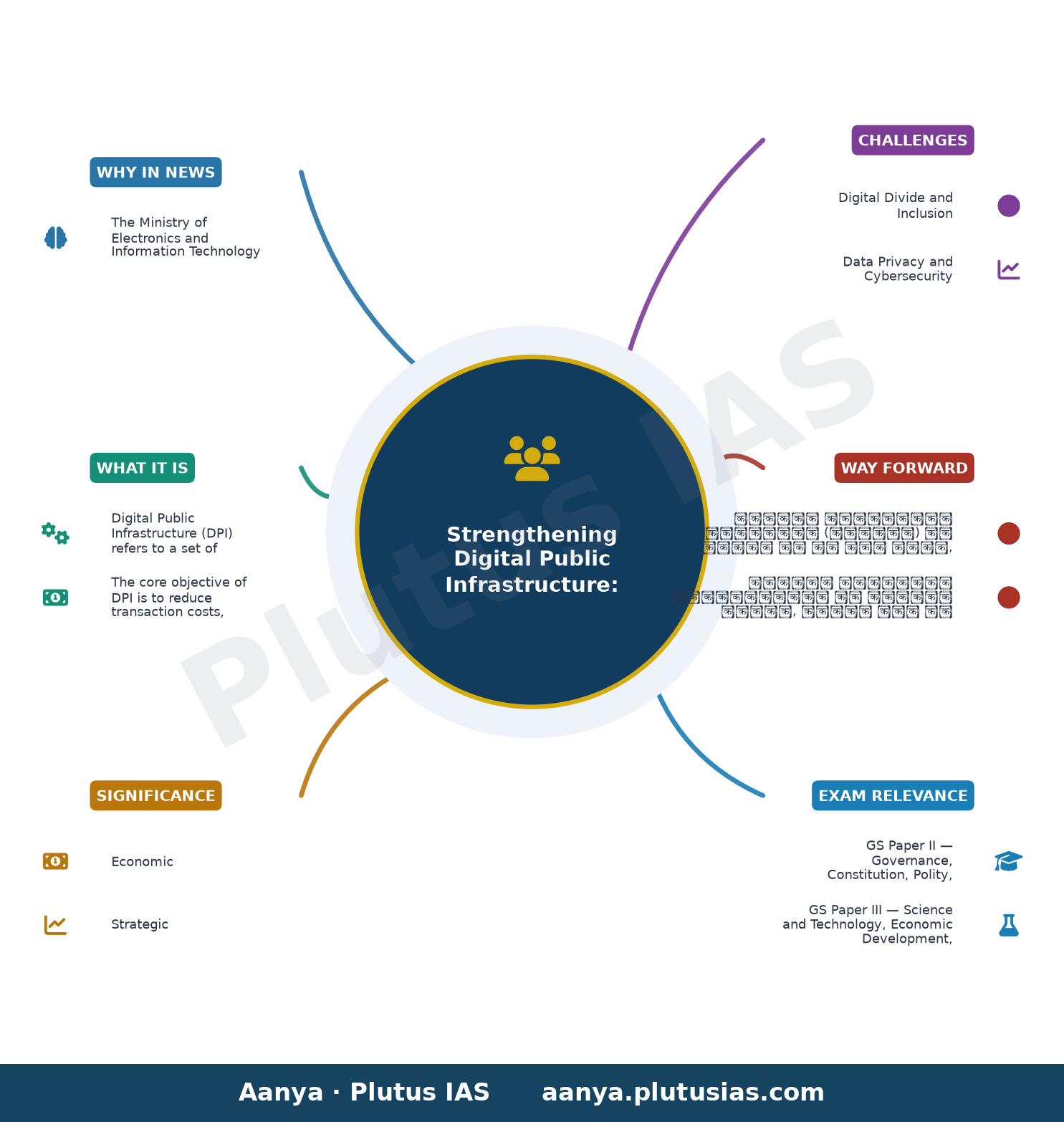
- GS Paper II — Governance, Constitution, Polity, Social Justice and International Relations | GS Paper III — Science and Technology, Economic Development, Environment, Security
- Prelims: Digital Public Infrastructure (DPI), Aadhaar, UPI, BharatNet, National Digital Health Mission, Digital Personal Data Protection Act 2023, Cybersecurity Policy, AI Mission, Data Empowerment and Protection Architecture (DEPA), e-Sanjeevani, UMANG, DigiLocker, Direct Benefit Transfer (DBT)
- Essay: Digital transformation as a tool for inclusive governance and equitable development, Balancing technological advancement with privacy, security, and ethical considerations in the digital age
Quick Revision: Digital Public Infrastructure (DPI) in India enables secure, inclusive, and interoperable delivery of public services, reducing costs, enhancing transparency, and empowering citizens in the digital economy.
Why is this in the news?
The Ministry of Electronics and Information Technology (MeitY) recently highlighted the progress of India’s Digital India initiative, emphasizing the strengthening of digital infrastructure, cybersecurity, and data protection. This update, released through a PIB press note dated August 5, 2026, underscores the government’s sustained efforts to create a secure, inclusive, and resilient digital ecosystem, aligning with the vision of a ‘Digital India’ that empowers citizens through technology-enabled governance and service delivery.
Background
- The Digital India programme was launched in July 2015 by the Government of India with the objective of transforming India into a digitally empowered society and knowledge economy.
- The programme is built on three core pillars: (1) strengthening digital infrastructure, (2) delivering government services digitally, and (3) empowering citizens through digital literacy and employment opportunities.
- Digital Public Infrastructure (DPI) has emerged as a strategic framework to enable seamless, interoperable, and inclusive delivery of public services through digital means.
- The exponential growth in internet penetration, from 25.15 crore users in March 2014 to over 109.27 crore in March 2026, reflects the success of initiatives like BharatNet and the Digital India programme.
- The reduction in data costs from ₹269 per GB in 2014 to ₹8–10 per GB in 2025–26 has democratized internet access, making India one of the most affordable data markets globally.
What is Digital Public Infrastructure (DPI) and its role in India’s Digital Transformation?
- Digital Public Infrastructure (DPI) refers to a set of shared digital systems, standards, and platforms that enable governments, businesses, and citizens to interact seamlessly, securely, and efficiently in the digital economy.
- The core objective of DPI is to reduce transaction costs, enhance transparency, and empower citizens by providing secure, inclusive, and citizen-centric digital services.
- Aadhaar serves as a trusted digital identity platform, enabling secure authentication for over 1.44 billion individuals, and is integrated with Direct Benefit Transfer (DBT) to disburse welfare benefits directly to beneficiaries’ bank accounts.
- UPI has revolutionized digital payments by enabling instant, interoperable transactions across 731 banks, serving over 55.49 crore users and 6.5 crore merchants, and supporting 85% of India’s digital payments and nearly 50% of global real-time payments.
- DigiLocker provides a secure, paperless document storage system with over 71.66 crore registered users, reducing the need for physical document verification.
- BharatNet, under the Digital India programme, with 2.21 lakh gram panchayats service-ready and 80,472 gram panchayats having active Points of Presence as of June 2026.
Key Features
| Feature | Significance |
|---|---|
| भारतनेट परियोजना | ग्रामीण और दूरस्थ क्षेत्रों में उच्च-गति ब्रॉडबैंड पहुंच सुनिश्चित कर डिजिटल विभाजन को कम करती है और सार्वजनिक सेवाओं के डिजिटल वितरण को सक्षम बनाती है। |
| डिजिटल सार्वजनिक अवसंरचना (डीपीआई) | किफायती डेटा, अंतर-प्रचालनीय सार्वजनिक प्लेटफार्मों और सहायित डिजिटल पहुंच बिंदुओं के माध्यम से नागरिकों को कल्याणकारी योजनाओं, डिजिटल भुगतान और ऑनलाइन शिक्षा तक पहुंच प्रदान करती है। |
| आधार-आधारित प्रमाणीकरण | 1.44 अरब से अधिक आधार संख्याओं के माध्यम से सुरक्षित, वास्तविक समय डिजिटल पहचान और प्रमाणीकरण सुनिश्चित करता है, जिससे प्रत्यक्ष लाभ अंतरण (डीबीटी) और अन्य सेवाओं में पारदर्शिता और दक्षता बढ़ती है। |
| यूनिफाइड पेमेंट्स इंटरफेस (UPI) | 55.49 करोड़ उपयोगकर्ताओं और 6.5 करोड़ व्यापारियों को जोड़कर वैश्विक स्तर पर सबसे बड़े वास्तविक समय डिजिटल भुगतान प्रणालियों में से एक बनाया है, जिससे वित्तीय समावेशन और डिजिटल अर्थव्यवस्था को बढ़ावा मिलता है। |
| डीबीटी (प्रत्यक्ष लाभ अंतरण) | 318 कल्याणकारी योजनाओं के माध्यम से 52 लाख करोड़ रुपये से अधिक के लाभों को सीधे लाभार्थियों के बैंक खातों में अंतरित कर भ्रष्टाचार और विलंब को कम करता है। |
Why it Matters
Economic
- डिजिटल अवसंरचना के विकास से स्टार्टअप, ई-कॉमर्स और सेवा क्षेत्रों में नवाचार और रोजगार सृजन को प्रोत्साहन मिला है, जिससे भारत की डिजिटल अर्थव्यवस्था का सकल घरेलू उत्पाद में योगदान बढ़ रहा है।
- सस्ते डेटा (8-10 रुपये प्रति जीबी) और उच्च कनेक्टिविटी ने डिजिटल सेवाओं की पहुंच और उपयोगिता को व्यापक बनाया है, जिससे ग्रामीण और शहरी क्षेत्रों के बीच डिजिटल असमानता में कमी आई है।
Strategic
- डिजिटल सार्वजनिक अवसंरचना (डीपीआई) जैसे प्लेटफार्मों के माध्यम से सरकारी सेवाओं का डिजिटलीकरण राष्ट्रीय सुरक्षा और डेटा संप्रभुता को मजबूत करता है, साथ ही वैश्विक डिजिटल शासन मानकों में भारत की स्थिति को उन्नत करता है।
- साइबर सुरक्षा और डेटा संरक्षण पर ध्यान केंद्रित करने से महत्वपूर्ण अवसंरचना और नागरिक डेटा को साइबर हमलों से बचाने में मदद मिलती है, जिससे राष्ट्रीय सुरक्षा सुनिश्चित होती है।
Social
- डिजिटल साक्षरता और ऑनलाइन शिक्षा तक पहुंच में सुधार ने सामाजिक समानता को बढ़ावा दिया है, विशेष रूप से महिलाओं, अनुसूचित जाति/जनजाति और आर्थिक रूप से कमजोर वर्गों के लिए।
- ई-स्वास्थ्य सेवाओं जैसे e-Sanjeevani ने ग्रामीण और दूरस्थ क्षेत्रों में स्वास्थ्य सेवा की पहुंच में सुधार किया है, जिससे स्वास्थ्य सेवाओं में भौगोलिक असमानताओं को कम किया जा रहा है।
Governance
- डिजिटल सेवाओं के माध्यम से सरकारी सेवाओं का पारदर्शी और कुशल वितरण प्रशासनिक दक्षता में सुधार करता है और भ्रष्टाचार को कम करता है।
- UMANG जैसे प्लेटफार्मों ने नागरिकों को एकीकृत सेवाओं तक पहुंच प्रदान कर सरकारी प्रक्रियाओं को सरल और सुलभ बनाया है।
Challenges
1. Digital Divide and Inclusion
- ग्रामीण क्षेत्रों में डिजिटल अवसंरचना की कमी और डिजिटल साक्षरता की कमी के कारण डिजिटल सेवाओं तक पहुंच में असमानता बनी हुई है।
- अनुसूचित जाति, अनुसूचित जनजाति, और आर्थिक रूप से कमजोर वर्गों को डिजिटल सेवाओं का लाभ उठाने में कठिनाइयों का सामना करना पड़ रहा है।
UPSC Link: GS3: Digital Divide
2. Data Privacy and Cybersecurity
- डिजिटल अवसंरचना के विस्तार के साथ साइबर हमलों, डेटा उल्लंघनों और ऑनलाइन धोखाधड़ी का खतरा बढ़ रहा है, जिससे नागरिकों के व्यक्तिगत डेटा की सुरक्षा सुनिश्चित करना एक प्रमुख चुनौती है।
- डेटा संरक्षण कानूनों के प्रभावी कार्यान्वयन और डिजिटल सार्वजनिक अवसंरचना की सुरक्षा के लिए मजबूत तंत्र की आवश्यकता है।
UPSC Link: GS3: Cybersecurity
3. Regulatory and Legal Framework
- डिजिटल अवसंरचना और सेवाओं के तेजी से विकास के कारण मौजूदा कानूनी ढांचे में अंतराल उत्पन्न हो रहा है, जिससे डेटा संरक्षण, साइबर अपराध और डिजिटल अधिकारों से संबंधित मुद्दों का समाधान करना कठिन हो रहा है।
- अंतर्राष्ट्रीय डेटा प्रवाह और डिजिटल व्यापार के संदर्भ में राष्ट्रीय डेटा संप्रभुता बनाए रखने के लिए स्पष्ट नीति निर्देशों की आवश्यकता है।
UPSC Link: GS2: Governance
4. Infrastructure and Connectivity
- भारतनेट जैसी परियोजनाओं के बावजूद, दूरस्थ और पहाड़ी क्षेत्रों में उच्च-गति इंटरनेट कनेक्टिविटी सुनिश्चित करना एक चुनौती बनी हुई है।
- ग्रामीण क्षेत्रों में अवसंरचना की कमी और रखरखाव संबंधी मुद्दों के कारण डिजिटल सेवाओं की गुणवत्ता और विश्वसनीयता प्रभावित हो रही है।
UPSC Link: GS3: Infrastructure
5. Public Awareness and Digital Literacy
- डिजिटल सेवाओं के लाभों और उनके उपयोग के तरीकों के बारे में जनता में जागरूकता की कमी है, जिससे डिजिटल सेवाओं का प्रभावी उपयोग सीमित हो रहा है।
- विशेष रूप से वृद्ध नागरिकों और कम शिक्षित व्यक्तियों के लिए डिजिटल साक्षरता कार्यक्रमों को और अधिक प्रभावी बनाने की आवश्यकता है।
UPSC Link: GS2: Social Justice
Challenges — UPSC Perspective
| Issue | Concern |
|---|---|
| डिजिटल विभाजन | ग्रामीण और शहरी क्षेत्रों के बीच डिजिटल सेवाओं तक पहुंच में असमानता |
| डेटा गोपनीयता | नागरिकों के व्यक्तिगत डेटा की सुरक्षा और साइबर हमलों से बचाव |
| कानूनी अंतराल | डिजिटल क्षेत्र में तेजी से बदलाव के कारण मौजूदा कानूनों में कमी |
| अवसंरचना की कमी | दूरस्थ क्षेत्रों में उच्च-गति इंटरनेट और डिजिटल सेवाओं की पहुंच सुनिश्चित करना |
| जन जागरूकता | डिजिटल सेवाओं के लाभों और उपयोग के तरीकों के बारे में सीमित जागरूकता |
Government Initiatives — Must-Memorise for Prelims
- भारतनेट परियोजना
- डिजिटल इंडिया कार्यक्रम
- आधार
- प्रत्यक्ष लाभ अंतरण (डीबीटी)
- यूनिफाइड पेमेंट्स इंटरफेस (UPI)
- डीजी लॉकर
Way Forward
- डिजिटल सार्वजनिक अवसंरचना (डीपीआई) के विकास को और तेज करना, विशेष रूप से ग्रामीण और दूरस्थ क्षेत्रों में, ताकि सभी नागरिकों को समान अवसर मिल सकें।
- डिजिटल साक्षरता कार्यक्रमों को व्यापक बनाना, विशेष रूप से महिलाओं, अनुसूचित जाति/जनजाति और आर्थिक रूप से कमजोर वर्गों के लिए, ताकि डिजिटल सेवाओं का प्रभावी उपयोग सुनिश्चित किया जा सके।
- साइबर सुरक्षा और डेटा संरक्षण के लिए मजबूत कानूनी ढांचे और तकनीकी उपायों को लागू करना, ताकि नागरिकों के डेटा की सुरक्षा सुनिश्चित की जा सके।
- डिजिटल अवसंरचना के रखरखाव और उन्नयन के लिए सार्वजनिक-निजी भागीदारी को बढ़ावा देना, ताकि सेवाओं की गुणवत्ता और विश्वसनीयता सुनिश्चित की जा सके।
- डिजिटल सेवाओं के उपयोग को बढ़ावा देने के लिए जन जागरूकता अभियान चलाना, ताकि नागरिकों को डिजिटल अर्थव्यवस्था में भाग लेने के लिए प्रोत्साहित किया जा सके।
- अंतर्राष्ट्रीय मानकों के अनुरूप डेटा संरक्षण कानूनों को और मजबूत करना, ताकि राष्ट्रीय डेटा संप्रभुता सुनिश्चित की जा सके।
- डिजिटल अवसंरचना के विकास में राज्यों की भागीदारी को बढ़ावा देना, ताकि क्षेत्रीय असमानताओं को कम किया जा सके।
UPSC Value Addition
Keywords for Mains Answer-Writing
Digital India Programme · Digital Public Infrastructure (DPI) · Cybersecurity · Data Protection · IndiaAI Mission · Aadhaar-enabled Direct Benefit Transfer (DBT) · Unified Payments Interface (UPI) · Digital Literacy · BharatNet · UMANG Platform · DigiLocker · e-Sanjeevani · Digital Divide · Data Sovereignty · National Digital Policy
Concept Flow
डिजिटल इंडिया कार्यक्रम का शुभारंभ (2015) → डिजिटल अवसंरचना का विकास (भारतनेट, डीपीआई) → नागरिकों को डिजिटल सेवाओं तक पहुंच (UPI, आधार, डीबीटी) → डिजिटल अर्थव्यवस्था और शासन में सुधार → सामाजिक समानता और आर्थिक विकास में योगदान। → डिजिटल अवसंरचना का विकास → उच्च-गति इंटरनेट कनेक्टिविटी → डिजिटल सेवाओं का विस्तार → नागरिकों की भागीदारी में वृद्धि → डिजिटल अर्थव्यवस्था का विकास। → डेटा संरक्षण और साइबर सुरक्षा पर ध्यान केंद्रित करना → नागरिकों के डेटा की सुरक्षा → विश्वास और पारदर्शिता में वृद्धि → डिजिटल अर्थव्यवस्था में निवेश आकर्षित करना। → डिजिटल सार्वजनिक अवसंरचना (डीपीआई) का विकास → सरकारी सेवाओं का डिजिटलीकरण → प्रशासनिक दक्षता में सुधार → भ्रष्टाचार में कमी। → डिजिटल साक्षरता कार्यक्रमों का विस्तार → नागरिकों की डिजिटल क्षमताओं में वृद्धि → डिजिटल सेवाओं का प्रभावी उपयोग → सामाजिक समानता में सुधार।
Prelims Practice Questions
Q1. Consider the following statements regarding the Digital India Programme:
1. It was launched in July 2015 with the vision of making technology accessible to all citizens.
2. BharatNet aims to connect all Gram Panchayats with high-speed internet.
3. The programme focuses solely on urban digital infrastructure and excludes rural areas.
How many of the above statements are correct?
- Only one
- Only two
- All three
- None
Answer: Only two — Statements 1 and 2 are correct. Statement 3 is incorrect as BharatNet specifically targets rural and remote areas to bridge the digital divide.
Q2. Assertion (A): The Unified Payments Interface (UPI) has become the world’s largest digital payment system.
Reason (R): UPI supports real-time digital payments and connects over 731 banks on a single platform.
Options:
A. Both A and R are true, and R is the correct explanation of A.
B. Both A and R are true, but R is NOT the correct explanation of A.
C. A is true, but R is false.
D. A is false, but R is true.
Answer: ? — Both A and R are true, and R correctly explains A. UPI’s scale and reach (731 banks, 55.49 crore users) make it the largest digital payment system globally.
Q3. Match the following initiatives with their respective objectives:
Column I (Initiative) | Column II (Objective)
———————————————|———————————————
A. BharatNet | 1. Providing secure and instant digital authentication
B. Aadhaar | 2. Connecting Gram Panchayats with high-speed internet
C. UMANG | 3. Delivering government services through a unified mobile app
D. DigiLocker | 4. Storing and sharing digital documents securely
Options:
A. A-2, B-1, C-3, D-4
B. A-1, B-2, C-3, D-4
C. A-3, B-1, C-2, D-4
D. A-4, B-2, C-1, D-3
Answer: ? — A-2 (BharatNet connects Gram Panchayats with high-speed internet), B-1 (Aadhaar provides secure digital authentication), C-3 (UMANG delivers government services via a unified app), D-4 (DigiLocker stores and shares digital documents securely).
Mains Practice Question
✍ Critically examine the role of Digital Public Infrastructure (DPI) in bridging the digital divide and enhancing governance in India. Also, discuss the challenges in ensuring data sovereignty and cybersecurity within this framework. (15 Marks)
Approach: MODEL-ANSWER SKELETON:
**Introduction (2 marks)**
– Define Digital Public Infrastructure (DPI) and its components (Aadhaar, UPI, DigiLocker, BharatNet, UMANG, e-Sanjeevani).
– State the vision of the Digital India Programme (2015) and its three interconnected goals: digital infrastructure, digital services, and digital empowerment.
**Role in Bridging the Digital Divide (4 marks)**
– **BharatNet**: Connecting 2.21 lakh Gram Panchayats (as of June 2026) with high-speed internet, reducing urban-rural disparity.
– **Digital Literacy**: Initiatives like Common Service Centres (CSCs) and affordable data (₹8-10/GB in 2025-26 vs ₹269/GB in 2014) enabling wider access.
– **Inclusive Service Delivery**: Platforms like UMANG (2,575 services) and e-Sanjeevani (48 crore+ consultations) ensuring last-mile delivery.
– **Data Affordability**: India’s position as one of the cheapest data markets globally (₹8-10/GB) facilitating mass adoption.
**Enhancing Governance (4 marks)**
– **Aadhaar-enabled DBT**: Direct Benefit Transfer (₹52 lakh crore+ transferred) reducing leakages and improving transparency.
– **UPI**: World’s largest digital payment system (55.49 crore users, 85% of India’s digital payments) streamlining financial inclusion.
– **DigiLocker**: 71.66 crore users and 936.03 crore+ documents issued, reducing bureaucratic hurdles.
– **Interoperability**: Standardized platforms (e.g., Aadhaar, UPI) enabling seamless service integration across sectors.
**Challenges in Data Sovereignty and Cybersecurity (3 marks)**
– **Data Localization**: Need for robust frameworks to prevent cross-border data flows and ensure sovereignty (e.g., Data Protection Act, 2023).
– **Cyber Threats**: Rising cyberattacks (e.g., ransomware, phishing) targeting critical infrastructure like BharatNet and UPI.
– **Privacy Concerns**: Aadhaar’s biometric data vulnerability and potential misuse (e.g., Supreme Court’s 2018 judgment on Aadhaar’s constitutional validity).
– **Regulatory Gaps**: Fragmented cybersecurity policies and lack of a unified national cybersecurity strategy.
**Conclusion (2 marks)**
– DPI has significantly reduced the digital divide and enhanced governance but faces critical challenges in data sovereignty and cybersecurity.
– Recommendations: Strengthen the Data Protection Act, 2023; establish a National Cybersecurity Authority; promote public-private partnerships for resilient infrastructure.
**Balanced View Required**: Highlight both achievements (e.g., UPI’s global leadership) and limitations (e.g., rural connectivity gaps, cyber threats).
Source: PIB (Press Information Bureau)
Generated by AanyaAi for educational purpose.

- यूपी हाईकोर्ट ने स्कूल बस सुरक्षा पर दिया सख्त आदेश, डीएम को 1 माह में रिपोर्ट देने का निर्देश - September 22, 2026
- UP High Court Directs DM & Chief Secretary on School Vehicle Safety: Key Facts for UPSC/PCS - September 22, 2026
- पेरियार टाइगर रिजर्व में 6 नई प्रजातियाँ खोजी गईं, जानिए क्या हैं विशेषताएँ - September 22, 2026

No Comments