


05 Aug Govt Clarifies: No Special Parliament Session on Women’s Reservation & Delimitation Bills
✎ The Women's Reservation Bill requires a special majority in Parliament and ratification by State Legislatures, while the Delimitation Bill, 2026, is constitutionally mandated to redraw constituency boundaries based on the latest…
Subject Relevance — Where This Topic Fits
- GS Paper II — Parliament and State Legislatures — Structure, Functioning, Conduct of Business, Issues Arising Out of These | GS Paper II — Constitutional Provisions for SCs, STs, Backward Classes, Minorities and Women
- Prelims: Women’s Reservation Bill, Delimitation Commission, 103rd Constitutional Amendment Act, 2019, Article 330A, 332A, Special Session of Parliament, Monsoon Session of Parliament 2026, Union Territory Police Powers, Foreign Contribution (Regulation) Amendment Bill, 2026
- Essay: The efficacy of constitutional amendments in addressing social equity: A case study of Women’s Reservation and Delimitation Bills, Parliamentary democracy in India: Challenges of legislative deadlock and the role of opposition
Quick Revision: The Women’s Reservation Bill requires a special majority in Parliament and ratification by State Legislatures, while the Delimitation Bill, 2026, is constitutionally mandated to redraw constituency boundaries based on the latest census data.
Why is this in the news?
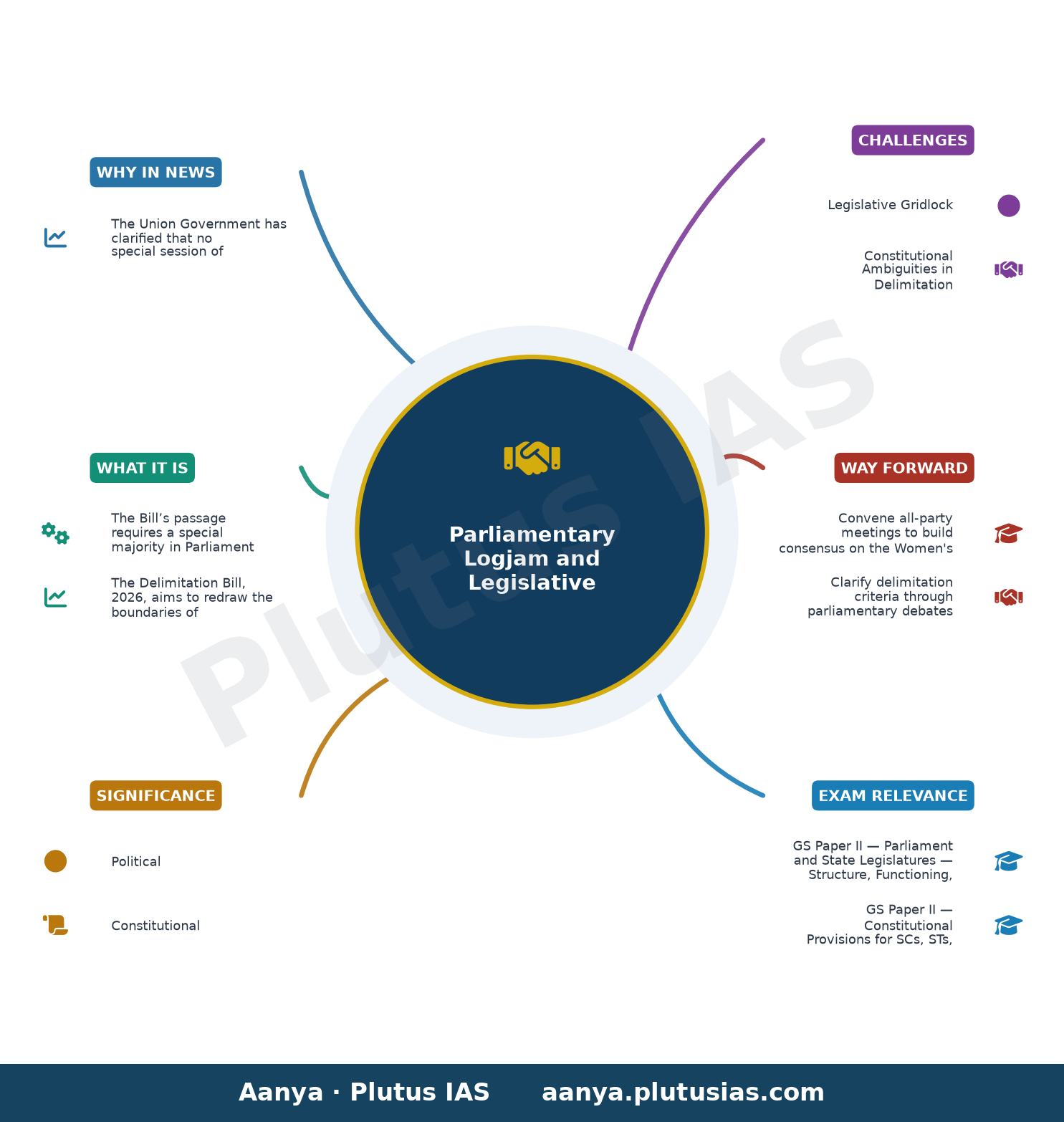
The Union Government has clarified that no special session of Parliament is scheduled from August 16–18, 2026, to deliberate on the Women’s Reservation Bill and the Delimitation Bill, despite media speculation. This clarification follows reports of a potential three-day session to advance these legislative priorities amid an ongoing parliamentary deadlock, particularly concerning the Delhi Police’s handling of student protests during the Monsoon Session’s inaugural day on July 20, 2026. The logjam underscores broader tensions in legislative functioning, constitutional governance, and the procedural hurdles to passing critical reforms.
Background
- The Delimitation Bill, 2026, aims to redraw the boundaries of parliamentary and assembly constituencies based on the most recent census data. Delimitation is constitutionally mandated every ten years under Article 82, though the last delimitation exercise was conducted in 2002 and deferred for Jammu and Kashmir and certain northeastern states.
- Parliament’s Monsoon Session 2026 commenced on July 20 and is scheduled to conclude on August 13, 2026. The session has been marked by disruptions, primarily over the Delhi Police’s alleged use of force against student protesters during a march to Parliament on July 20, 2026.
- The Union Territory of Delhi’s police force operates under the Union Home Ministry, making the Home Minister accountable for its actions. Opposition parties have demanded a statement from the Home Minister on the matter, contributing to the legislative deadlock.
- The Foreign Contribution (Regulation) Amendment Bill, 2026, is expected to be introduced for discussion and passage during the Monsoon Session, further complicating the session’s agenda and timing.
What are the Women’s Reservation Bill and the Delimitation Bill?
- The Bill’s passage requires a special majority in Parliament (two-thirds of members present and voting, with a majority of the total membership) and ratification by at least half of the State Legislatures, as per Article 368 of the Constitution. This makes its adoption a complex and politically sensitive process.
- The Delimitation Bill, 2026, aims to redraw the boundaries of parliamentary and assembly constituencies based on the most recent census data. Delimitation is constitutionally mandated under Article 82, which requires the delimitation of constituencies after every census.
- The last delimitation exercise was conducted in 2002 and was deferred for Jammu and Kashmir and certain northeastern states due to exceptional circumstances. The 2021 Census data, though delayed, will form the basis for the next delimitation exercise, which is expected to significantly alter the political landscape by reallocating seats based on population changes.
- The Delimitation Commission, a statutory body, is responsible for this exercise. Its recommendations are binding on the Election Commission of India and the government, ensuring that the process is impartial and data-driven.
- Both Bills are critical for addressing structural inequalities in political representation and electoral fairness. The Women’s Reservation Bill seeks to enhance gender parity in governance, while the Delimitation Bill aims to ensure equitable distribution of political power based on demographic changes.
- The Bills have faced political and procedural challenges, including opposition from parties that may perceive them as disadvantageous to their electoral prospects or regional interests.
Key Features
| Feature | Significance |
|---|---|
| Women’s Reservation Bill | Aims to reserve 33% of seats in the Lok Sabha and State Legislative Assemblies for women, addressing gender disparity in political representation. |
| Delimitation Bills | Proposes redrawing of electoral constituencies based on the latest census data to ensure equitable political representation across regions. |
| Special Parliament Session | A three-day session (Aug 16-18) proposed to deliberate on legislative priorities, reflecting the government’s agenda-setting authority. |
| Parliamentary Deadlock | Ongoing logjam due to opposition demands for a statement on alleged police action against student protesters, hindering legislative business. |
| Monsoon Session of Parliament | Scheduled from July 20 to August 13, 2026, serving as the primary forum for legislative scrutiny and debate during the monsoon period. |
Why it Matters
Political
- The proposed special session underscores the government’s intent to prioritise key legislative reforms, particularly those concerning gender representation and electoral restructuring.
- The deadlock highlights the Opposition’s strategy of leveraging procedural delays to extract concessions on unrelated issues, such as police accountability in Delhi.
- The Women’s Reservation Bill, if passed, would mark a historic milestone in India’s democratic evolution by institutionalising gender parity in political institutions.
- Delimitation, if implemented, could redefine electoral dynamics by realigning constituencies to reflect demographic shifts, potentially altering political power structures.
Constitutional
- The Women’s Reservation Bill is rooted in the constitutional mandate for equality (Article 14) and the Directive Principles of State Policy (Article 38, 39A), which advocate for social justice and gender equity.
- Delimitation is governed by Articles 81, 82, 170, and 330 of the Constitution, which outline the process of readjusting electoral boundaries post-census.
- Parliament’s power to summon special sessions is derived from Article 85(1), which vests the President with the authority to convene Parliament at such times and places as deemed necessary.
Administrative
- The logjam over the Delhi Police issue reflects tensions between federal and union territory governance, particularly in matters of law and order.
- The government’s refusal to extend the Monsoon Session suggests adherence to procedural norms, but also risks further legislative stagnation if deadlocks persist.
- The Opposition’s demand for a statement from the Home Minister on police action exemplifies the use of parliamentary forums to hold the executive accountable.
Societal
- The Women’s Reservation Bill addresses systemic underrepresentation of women in legislatures, which currently stands at approximately 15% in the Lok Sabha.
- Delimitation could impact marginalised communities by ensuring their voices are proportionally reflected in electoral constituencies, aligning with the principle of inclusive democracy.
Challenges
1. Legislative Gridlock
- Ongoing Opposition obstructionism risks delaying critical reforms, including the Women’s Reservation and Delimitation Bills.
- The deadlock over the Delhi Police issue demonstrates how unrelated grievances can derail legislative agendas.
- Parliament’s limited time during the Monsoon Session exacerbates delays, particularly for contentious Bills.
UPSC Link: Parliamentary procedures and functioning
2. Constitutional Ambiguities in Delimitation
- The delimitation process is constitutionally mandated but politically sensitive, as it can alter electoral outcomes and trigger disputes over fairness.
- The lack of consensus on delimitation criteria (e.g., population vs. geographical considerations) complicates its implementation.
- Historical delimitation exercises (e.g., 2002-08) faced legal challenges, underscoring the need for robust judicial and parliamentary oversight.
UPSC Link: Constitutional provisions on delimitation
3. Gender Representation Paradox
- Despite constitutional guarantees of equality, women’s political participation remains low, with resistance to reservation persisting in some quarters.
- The Women’s Reservation Bill’s passage is contingent on political consensus, which is often elusive due to entrenched patriarchal norms.
- The Bill’s implementation faces challenges in defining reservation criteria (e.g., sub-categories for OBC/SC/ST women).
UPSC Link: Women’s empowerment and constitutional provisions
4. Federal-UT Tensions
- The Delhi Police issue highlights the friction between the Union Government and the NCT of Delhi, raising questions about federalism and administrative autonomy.
- Opposition parties are leveraging this issue to mobilise support, complicating legislative negotiations.
- The Union Home Ministry’s control over Delhi Police underscores the Centre’s dominant role in union territory governance.
UPSC Link: Federalism and Centre-State relations
5. Public Trust in Institutions
- Prolonged legislative deadlocks erode public confidence in Parliament’s ability to address pressing issues.
- Perceived inaction on critical Bills (e.g., women’s reservation) may fuel disillusionment among marginalised groups.
- The Opposition’s use of procedural tactics to extract concessions risks undermining the sanctity of parliamentary democracy.
UPSC Link: Role of Parliament in Indian democracy
Challenges — UPSC Perspective
| Issue | Concern |
|---|---|
| Opposition Obstructionism | Deliberate delays in legislative business to extract concessions, undermining governance. |
| Constitutional Ambiguities in Delimitation | Lack of clarity on criteria for redrawing constituencies, leading to disputes. |
| Gender Representation Gaps | Persistent underrepresentation of women in legislatures despite constitutional guarantees. |
| Federal-UT Tensions | Conflict between the Centre and Delhi Government over law and order, affecting legislative productivity. |
| Public Trust Erosion | Perceived inaction and deadlocks may reduce faith in democratic institutions. |
| Implementation Challenges for Women’s Reservation | Resistance to sub-categorisation and potential legal hurdles in its enforcement. |
Way Forward
- Convene all-party meetings to build consensus on the Women’s Reservation and Delimitation Bills, ensuring broad political support.
- Clarify delimitation criteria through parliamentary debates and expert consultations to address constitutional ambiguities.
- Introduce a time-bound legislative agenda for the Monsoon Session to minimise disruptions and prioritise key Bills.
- Establish a parliamentary committee to examine the Delhi Police issue and propose reforms to prevent future logjams.
- Engage civil society and women’s rights groups to advocate for the Women’s Reservation Bill, mobilising public opinion.
- Explore constitutional amendments to streamline delimitation processes, reducing legal and political friction.
- Strengthen federal mechanisms to resolve Centre-UT disputes, ensuring smoother governance in Delhi and other union territories.
- Publish a white paper on the socio-economic impact of delimitation and women’s reservation to inform public discourse.
UPSC Value Addition
Keywords for Mains Answer-Writing
Women’s Reservation Bill 2026 · Constitution (106th Amendment) Act 2023 · Delimitation Commission · Parliamentary procedures · Special Session of Parliament · Lok Sabha and Rajya Sabha · Opposition and Government dynamics · Delhi Police and Union Territory powers · Foreign Contribution (Regulation) Amendment Bill 2026 · Constitutional amendments and procedures · Federalism and Union-State relations · Women’s political representation
Constitutional & Policy Linkages
- Article 14: Equality before law and equal protection of laws.
- Article 15(3): Special provisions for women and children.
- Article 38: Directive Principles promoting social justice.
- Article 39A: Equal justice and free legal aid.
- Article 81: Composition of the Lok Sabha.
- Article 82: Readjustment of constituencies post-census.
- Article 170: Composition of State Legislative Assemblies.
- Article 330: Reservation of seats for Scheduled Castes and Scheduled Tribes in the Lok Sabha.
Concept Flow
Ongoing legislative deadlock over Delhi Police issue → Opposition demands for Home Minister’s statement → Government’s refusal to extend Monsoon Session → Proposal for special session on Women’s Reservation and Delimitation Bills → Opposition scepticism and lack of consensus → Potential delays in critical reforms → Erosion of public trust in Parliament → Need for all-party consensus and procedural reforms.
Prelims Practice Questions
Q1. Consider the following statements regarding the Women’s Reservation Bill:
1. The Bill seeks to reserve one-third of the seats in the Lok Sabha and State Legislative Assemblies for women.
2. The Bill was introduced in the Lok Sabha in 2023 and has been referred to a Joint Parliamentary Committee.
3. The Bill requires a constitutional amendment and must be ratified by at least half of the State Legislatures.
How many of the above statements are correct?
- Only one
- Only two
- All three
- None
Answer: All three — Statements 1 and 2 are correct. Statement 3 is incorrect as constitutional amendments under Article 368 do not require ratification by State Legislatures unless they affect federal provisions.
Q2. Assertion (A): The Delimitation Commission is a statutory body constituted under the Delimitation Act, 2002.
Reason (R): The Delimitation Commission is responsible for the delimitation of constituencies for the purpose of elections to the Lok Sabha and State Legislative Assemblies.
- Both A and R are true, and R is the correct explanation of A.
- Both A and R are true, but R is not the correct explanation of A.
- A is true, but R is false.
- A is false, but R is true.
Answer: Both A and R are true, but R is not the correct explanation of A. — Both the Assertion and Reason are correct, and the Reason correctly explains the Assertion. The Delimitation Commission is indeed a statutory body under the Delimitation Act, 2002, and its primary function is to delimit constituencies.
Q3. Which of the following is NOT a function of the Delimitation Commission in India?
- To determine the number of seats to be reserved for Scheduled Castes and Scheduled Tribes in the Lok Sabha and State Legislative Assemblies.
- To conduct delimitation of constituencies based on the latest census data.
- To prepare and publish delimitation orders after due consultation with the Election Commission of India.
- To amend the Constitution to reserve seats for women in Parliament.
Answer: To amend the Constitution to reserve seats for women in Parliament. — The Delimitation Commission does not amend the Constitution. Reserving seats for women requires a constitutional amendment, which is not a function of the Delimitation Commission.
Mains Practice Question
✍ The Constitution (One Hundred and Sixth Amendment) Act, 2023, seeks to operationalise the Women’s Reservation Bill. However, its implementation remains contingent upon the completion of the delimitation process. Critically examine the constitutional and procedural challenges in the operationalisation of the Women’s Reservation Bill in light of recent parliamentary developments. (15 Marks)
Approach: MODEL-ANSWER SKELETON:
1. **Constitutional Basis and Provisions**:
– Reference to Article 330A (Lok Sabha) and Article 332A (State Legislatures) introduced by the Constitution (106th Amendment) Act, 2023.
– Reservation for women in seats to be determined by the Delimitation Commission post-2026 census.
2. **Delimitation Process and Challenges**:
– Role of the Delimitation Commission under Article 82 and the Delimitation Act, 2002.
– Dependence on census data (most recent census: 2011; next census likely in 2026).
– Procedural delays: consultation with Election Commission, State governments, and public objections.
3. **Parliamentary Dynamics and Political Consensus**:
– Government and Opposition stances on the Women’s Reservation Bill and Delimitation Bills.
– Recent parliamentary logjam: demands for statements (e.g., on Delhi Police actions) and lack of consensus.
– Role of the President in summoning a special session (Article 85) and the government’s prerogative.
4. **Federalism and State-Level Implementation**:
– State Legislative Assemblies’ role in ratifying constitutional amendments (if required).
– Potential resistance from State governments on delimitation orders.
5. **Judicial and Constitutional Safeguards**:
– Judicial review of delimitation orders (e.g., Supreme Court’s role in ensuring fairness).
– Ensuring reservations do not violate principles of equality (Article 14) or federalism.
6. **Way Forward**:
– Need for consensus among political parties to expedite the process.
– Possible use of technology (e.g., GIS mapping) to streamline delimitation.
– Lessons from past attempts (e.g., Women’s Reservation Bill introduced in 1996 but lapsed).
Source: Times of India
Generated by AanyaAi for educational purpose.

- यूएन महासभा में भारत के विदेश मंत्री जयशंकर के उच्चस्तरीय दौरे का महत्व - September 21, 2026
- मध्य प्रदेश: हाईकोर्ट ने बलात्कार मामले में आरोपी को डीएनए सबूत के आधार पर किया दोषमुक्त - September 21, 2026
- MP High Court Acquits Rape Convict Due to Negative DNA Evidence - September 21, 2026

No Comments