


06 Aug Rajya Sabha Passes Judges Bill 2026: Key Highlights for UPSC & State PCS
✎ The Supreme Court (Number of Judges) Amendment Bill, 2026, increases the sanctioned strength of the Supreme Court from 34 to 38 judges to address case pendency, but it does not address representational deficits or structural…
Subject Relevance — Where This Topic Fits
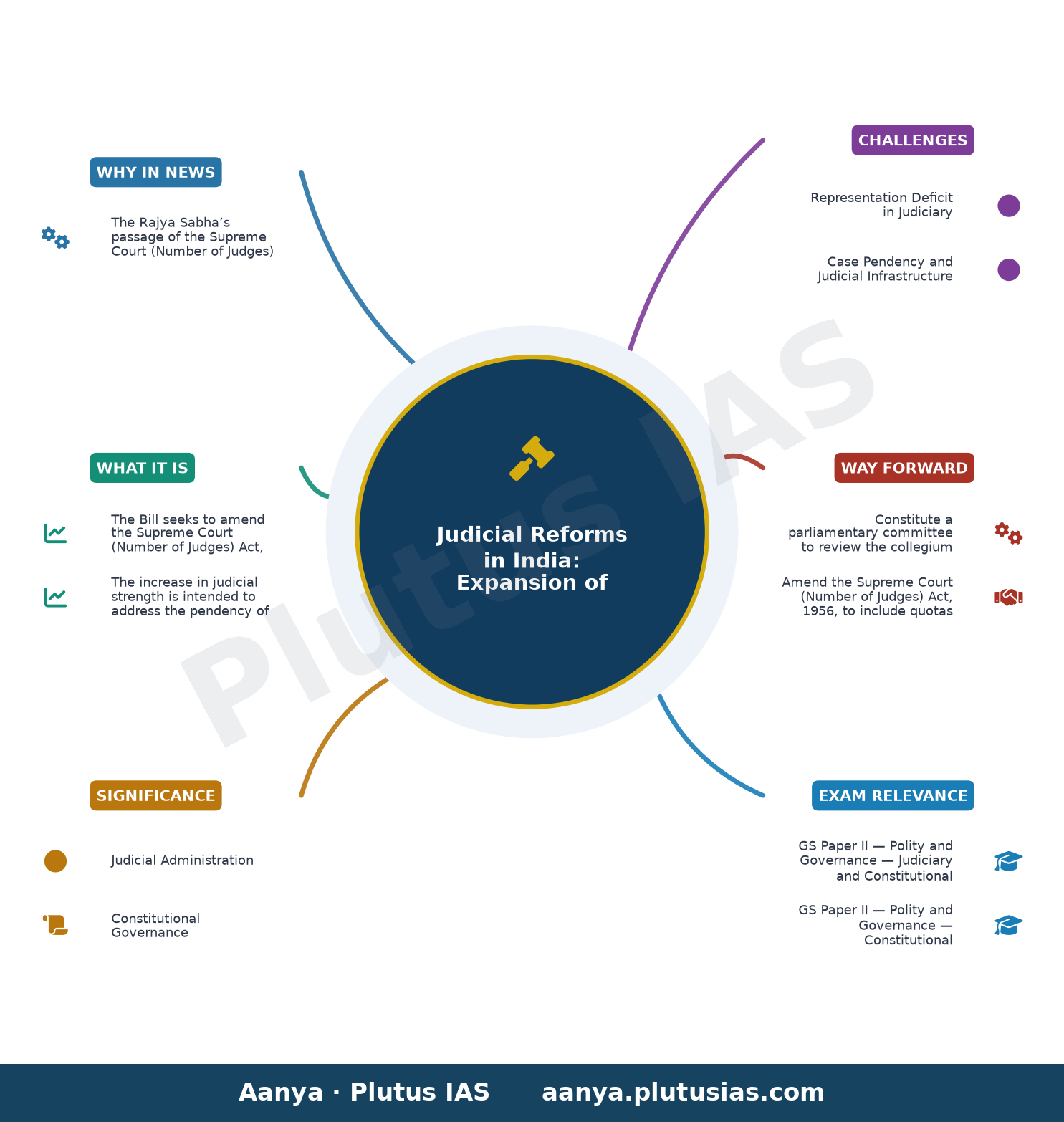
- GS Paper II — Polity and Governance — Judiciary and Constitutional Framework | GS Paper II — Polity and Governance — Constitutional Amendments and Parliamentary Procedures
- Prelims: Supreme Court (Number of Judges) Amendment Bill, 2026, Collegium System, Judicial Appointments Commission (JAC), Money Bill, Article 124 (Constitution), Judicial Vacancies, Article 370 abrogation case, Regional Benches of Supreme Court
- Essay: Judicial Reforms: Balancing Efficiency and Representation, The Role of the Judiciary in a Democratic Society: Challenges and Reforms
Quick Revision: The Supreme Court (Number of Judges) Amendment Bill, 2026, increases the sanctioned strength of the Supreme Court from 34 to 38 judges to address case pendency, but it does not address representational deficits or structural reforms such as regional benches.
Why is this in the news?
The Rajya Sabha’s passage of the Supreme Court (Number of Judges) Amendment Bill, 2026, which increases the sanctioned strength of the Supreme Court from 34 to 38 judges, including the Chief Justice of India, has drawn significant attention. The Bill, which replaces an ordinance promulgated in May 2026, was passed by both Houses of Parliament. The legislative process has sparked debates on the government’s use of the ordinance route, the judiciary’s representational deficits, and the need for structural reforms to enhance access to justice.
Background
- The Supreme Court of India, established under Article 124 of the Constitution, currently has a sanctioned strength of 34 judges, including the Chief Justice of India (CJI).
- The Collegium System, evolved through judicial pronouncements, governs the appointment and transfer of judges in higher judiciary, including the Supreme Court and High Courts.
- The Union government, in May 2026, promulgated an ordinance to increase the Supreme Court’s strength to 38 judges, citing the pendency of cases and the need for judicial efficiency.
- Opposition parties have raised concerns over the ordinance route, citing procedural irregularities and the lack of adequate representation of marginalised communities in the judiciary.
- The judiciary has been under scrutiny for its representational deficits, with data indicating low representation of Scheduled Castes (SCs), Scheduled Tribes (STs), Other Backward Classes (OBCs), religious minorities, and women in higher judiciary.
What is the Supreme Court (Number of Judges) Amendment Bill, 2026?
- The Bill seeks to amend the Supreme Court (Number of Judges) Act, 1956, to increase the sanctioned strength of the Supreme Court from 34 to 38 judges, including the Chief Justice of India.
- The increase in judicial strength is intended to address the pendency of cases and enhance the court’s capacity to dispose of matters efficiently.
- The Bill replaces an ordinance promulgated in May 2026, which was issued just days before the Supreme Court’s summer vacation, raising questions about the government’s urgency.
- The Bill does not address structural reforms such as the establishment of regional benches or the representation of marginalised communities in the judiciary.
Key Features
| Feature | Significance |
|---|---|
| Supreme Court (Number of Judges) Amendment Bill, 2026 | Increases the sanctioned strength of Supreme Court judges from 34 to 38, including the Chief Justice of India, to enhance judicial capacity and reduce case pendency. |
| Ordinance route (Supreme Court (Number of Judges) Ordinance, 2026) | Demonstrates executive urgency in judicial reforms, bypassing parliamentary debate initially, raising concerns about legislative oversight and constitutional propriety. |
| Regional benches demand | Highlights the need for decentralized judicial access, addressing geographical disparities in justice delivery and reducing burden on the Supreme Court. |
| Diversity deficit in judiciary | Exposes systemic underrepresentation of Scheduled Castes (SCs), Scheduled Tribes (STs), Other Backward Classes (OBCs), religious minorities, and women in higher judiciary. |
| Pendency in lower courts | Underscores the critical gap in judicial infrastructure at the district level, where the majority of pending cases (5.07 crore) await resolution. |
Why it Matters
Judicial Administration
- Augments the Supreme Court’s capacity to dispose of cases expeditiously, addressing the backlog of constitutional and appellate matters.
- Sets a precedent for periodic review of judicial strength to align with case load and demographic changes.
- Raises questions about the efficacy of collegium system in ensuring diversity and inclusivity in judicial appointments.
Constitutional Governance
- Examines the executive’s use of ordinance power in judicial reforms, testing the balance between urgency and parliamentary sovereignty.
- Reinforces the principle of separation of powers by scrutinizing the role of the judiciary in recommending appointments versus executive notification.
Social Justice
- Highlights structural barriers in judicial appointments, particularly for marginalized groups (SCs, STs, minorities, women, LGBTQ+ individuals).
- Underscores the need for affirmative action in higher judiciary to reflect India’s socio-cultural diversity and uphold Article 14 (equality) and Article 15 (non-discrimination).
Federalism
- Demands for regional benches of the Supreme Court challenge the unitary character of the apex court, advocating for decentralized judicial governance.
- Reflects regional aspirations for equitable access to justice, particularly in states like Tamil Nadu and Jammu & Kashmir.
Challenges
1. Representation Deficit in Judiciary
- Data from 2021–2026 shows only 26 SC, 14 ST, 80 OBC, and 37 minority judges appointed out of 593 total appointments, indicating systemic exclusion.
- Women constitute a mere 16% of High Court appointments, far below their demographic proportion, raising concerns about gender parity.
- Lack of representation perpetuates bias in judicial decision-making and undermines public trust in the judiciary.
UPSC Link: GS-II: Judiciary – Composition and Appointments
2. Case Pendency and Judicial Infrastructure
- Over 5.07 crore cases pending across India, with the majority languishing in district and subordinate courts due to inadequate judge strength.
- Inadequate infrastructure in lower courts exacerbates delays, disproportionately affecting marginalized communities.
- Increasing Supreme Court judges alone may not resolve systemic inefficiencies without concurrent reforms in lower judiciary.
UPSC Link: GS-II: Judiciary – Pendency and Backlog
3. Executive Overreach via Ordinance
- Use of ordinance route to amend judicial strength raises concerns about bypassing parliamentary scrutiny and democratic deliberation.
- Ordinances, if not ratified promptly, can lead to legal uncertainty and undermine constitutional governance.
- Constitutional validity of ordinances in judicial reforms requires judicial review under Article 143 (advisory jurisdiction) or Article 32 (writ jurisdiction).
UPSC Link: GS-II: Parliament – Ordinance Making Power
4. Regional Disparities in Justice Delivery
- Demand for regional benches stems from the Supreme Court’s geographical concentration in Delhi, creating access barriers for litigants from distant states.
- Regional benches could reduce travel costs and delays but require constitutional amendments (Article 130) and logistical planning.
- Federal tensions may arise if states perceive regional benches as a dilution of judicial unity.
UPSC Link: GS-II: Federalism – Centre-State Relations
5. Collegium System and Appointment Bottlenecks
- The collegium system’s opacity in appointments exacerbates diversity deficits, as it lacks transparent criteria for inclusivity.
- Executive’s limited role (notification only) reduces accountability in addressing representation gaps.
- Reforms such as a National Judicial Commission (NJC) could enhance transparency and diversity in appointments.
UPSC Link: GS-II: Judiciary – Collegium System
Challenges — UPSC Perspective
| Issue | Concern |
|---|---|
| Underrepresentation of marginalized groups | Perpetuates systemic bias and undermines the judiciary’s legitimacy as a democratic institution. |
| Pendency in lower courts | Delays justice delivery, disproportionately affecting socio-economically weaker sections. |
| Executive’s ordinance route | Bypasses parliamentary debate, raising constitutional concerns about separation of powers. |
| Regional access disparities | Centralized Supreme Court creates geographical barriers to justice, particularly for litigants in distant states. |
| Collegium system opacity | Lacks transparent criteria for diversity, exacerbating representation deficits in higher judiciary. |
Way Forward
- Constitute a parliamentary committee to review the collegium system and propose reforms for inclusive judicial appointments.
- Amend the Supreme Court (Number of Judges) Act, 1956, to include quotas for SCs, STs, OBCs, minorities, and women in higher judiciary appointments.
- Establish a National Judicial Commission (NJC) with representatives from the executive, judiciary, and civil society to oversee appointments and diversity metrics.
- Expand the Supreme Court’s regional benches incrementally, starting with high-priority states (e.g., Tamil Nadu, Jammu & Kashmir), subject to constitutional amendments.
- Increase the sanctioned strength of district and subordinate courts by 50% over five years, with dedicated funding for infrastructure and judge appointments.
- Mandate annual diversity audits of judicial appointments, with public disclosure of data on caste, gender, and minority representation.
- Launch a constitutional amendment to enable the Supreme Court to establish benches outside Delhi, ensuring federal inclusivity.
- Introduce a fast-track mechanism for disposing of cases pending for over five years, with special benches for vulnerable groups.
UPSC Value Addition
Keywords for Mains Answer-Writing
Supreme Court (Number of Judges) Amendment Bill, 2026 · Judicial appointments and diversity · Collegium system · Supreme Court judge strength · Regional benches of Supreme Court · Representation deficit in judiciary · Article 370 abrogation and judiciary · Parliamentary oversight of judiciary · Judicial reforms and inclusivity · Pendency of cases in lower courts
Constitutional & Policy Linkages
- Article 124: Supreme Court’s establishment and jurisdiction (appointment of judges).
- Article 130: Seat of the Supreme Court (regional benches).
- Article 14: Equality before law (representation deficit).
- Article 15: Prohibition of discrimination (inclusive judiciary).
- Article 16: Equality of opportunity in public employment (judicial appointments).
Concept Flow
Increasing case pendency → Executive introduces ordinance to augment Supreme Court judges → Parliament debates Bill → Opposition raises diversity deficit and regional access issues → Collegium system’s opacity exposed → Demand for lower court reforms and regional benches → Calls for constitutional amendments and judicial reforms.
Prelims Practice Questions
Q1. Consider the following statements regarding the Supreme Court (Number of Judges) Amendment Bill, 2026:
1. The Bill seeks to increase the sanctioned strength of Supreme Court judges from 34 to 38.
2. The Bill was introduced via an ordinance in May 2026, four days before the Supreme Court’s summer vacation.
3. The Bill addresses the representation deficit of Scheduled Castes, Scheduled Tribes, Other Backward Classes, and minorities in the judiciary.
How many of the above statements are correct?
- Only one
- Only two
- All three
- None
Answer: Only two — Statement 1 is correct: the Bill increases the strength from 34 to 38. Statement 2 is incorrect: the ordinance was promulgated before the Bill was introduced in Parliament. Statement 3 is incorrect: the Bill does not specifically address representation deficits; this was a criticism raised during the debate.
Q2. Assertion (A): The Supreme Court Collegium system is the sole authority responsible for recommending judicial appointments to the Supreme Court and High Courts.
Reason (R): The Constitution of India explicitly vests the power of judicial appointments exclusively in the Collegium system.
- Both A and R are true and R is the correct explanation of A
- Both A and R are true but R is NOT the correct explanation of A
- A is true but R is false
- A is false but R is true
Answer: A is false but R is true — Assertion (A) is true: the Collegium system recommends appointments. Reason (R) is false: the Constitution does not explicitly vest this power exclusively in the Collegium; it evolved through judicial pronouncements (e.g., Second and Third Judges Cases).
Q3. Match the following provisions related to judicial reforms with their respective constitutional or statutory sources:
Column I
A. Article 124(2)
B. Article 217
C. Supreme Court (Number of Judges) Act, 1956
D. Article 124A
Column II
1. Empowers Parliament to determine the maximum number of judges in the Supreme Court
2. Deals with the appointment of High Court judges
3. Provides for the establishment of the National Judicial Appointments Commission (NJAC)
4. Pertains to the appointment of Supreme Court judges
Answer: ? — A-4 (Article 124(2) pertains to the appointment of Supreme Court judges), B-2 (Article 217 deals with High Court judge appointments), C-1 (The Supreme Court (Number of Judges) Act, 1956 empowers Parliament to fix the maximum number of judges), D-3 (Article 124A was inserted to provide for the NJAC, though it was struck down by the Supreme Court).
Mains Practice Question
✍ Critically examine the constitutional and institutional implications of increasing the sanctioned strength of the Supreme Court judges from 34 to 38 through legislative action. Also, discuss the concerns raised regarding diversity deficits in the judiciary and the feasibility of establishing regional benches of the Supreme Court. (15 Marks)
Approach: MODEL-ANSWER SKELETON:
1. **Constitutional Framework**:
– Article 124(1) empowers Parliament to determine the number of Supreme Court judges (Supreme Court (Number of Judges) Act, 1956).
– Role of the Collegium system (Second and Third Judges Cases) in judicial appointments.
– Distinction between ‘sanctioned strength’ and ‘actual appointments’.
2. **Institutional Implications**:
– Impact on judicial efficiency: potential for faster disposal of cases vs. dilution of quality.
– Collegium’s role in vetting appointments: whether increased strength dilutes its efficacy.
– Executive-legislature-judiciary balance: concerns over parliamentary oversight vs. judicial autonomy.
3. **Diversity Deficits**:
– Data from the Law Ministry (2021–2026): representation of SCs (26/593), STs (14/593), OBCs (80/593), minorities (37/593), and women (96/593).
– Critique of the Collegium’s opacity in ensuring diversity (e.g., lack of transparency in criteria).
– Comparison with global standards (e.g., South Africa’s judicial diversity policies).
4. **Regional Benches**:
– Arguments for: reducing pendency, improving access to justice, and reflecting federal principles.
– Arguments against: potential dilution of Supreme Court’s uniformity in interpretation, logistical challenges.
– Reference to the Supreme Court’s 2014 judgment rejecting the plea for regional benches (Balakrishnan Committee Report).
5. **Conclusion**:
– Need for a holistic judicial reform agenda addressing both structural and representational issues.
– Role of Parliament in ensuring diversity through amendments to the Collegium system or NJAC-like mechanisms (despite NJAC’s invalidation).
Key cases: Second Judges Case (1993), Third Judges Case (1998), Balakrishnan Committee Report (2014).
Source: The Indian Express
Generated by AanyaAi for educational purpose.

- यूएन महासभा में भारत के विदेश मंत्री जयशंकर के उच्चस्तरीय दौरे का महत्व - September 21, 2026
- मध्य प्रदेश: हाईकोर्ट ने बलात्कार मामले में आरोपी को डीएनए सबूत के आधार पर किया दोषमुक्त - September 21, 2026
- MP High Court Acquits Rape Convict Due to Negative DNA Evidence - September 21, 2026

No Comments