


06 Aug UPSC Exam: How BioE3 Policy Boosts India’s Bioeconomy & Jobs
✎ BioE3 Policy is India’s strategic roadmap to transform biotechnology into a high-capacity bio-manufacturing powerhouse, driving economic growth, environmental sustainability, and employment while positioning the nation as a…
Subject Relevance — Where This Topic Fits
- GS Paper III — Science and Technology; GS Paper III — Environment and Climate Change; GS Paper III — Economic Development; GS Paper III — Science and Technology — Developments and their Applications and Effects in Everyday Life
- Prelims: BioE3 Policy, Bioeconomy, Bio-manufacturing, Biofoundry, Biomanufacturing Hubs, Bioplastics, Active Pharmaceutical Ingredients (APIs), Precision Medicine, mRNA therapeutics, Monoclonal Antibodies, Gene Therapy, Cell Therapy, Bio-AI, Synthetic Biology, Carbon Capture, Blue Economy, Make in India, Start-up India
- Essay: Technological Self-Reliance in the 21st Century: The Role of Bioeconomy in India’s Growth Trajectory, Innovation-Driven Development: Balancing Economic Growth, Environmental Sustainability, and Employment Generation
Quick Revision: BioE3 Policy is India’s strategic roadmap to transform biotechnology into a high-capacity bio-manufacturing powerhouse, driving economic growth, environmental sustainability, and employment while positioning the nation as a global leader in the bioeconomy by 2030.
Why is this in the news?
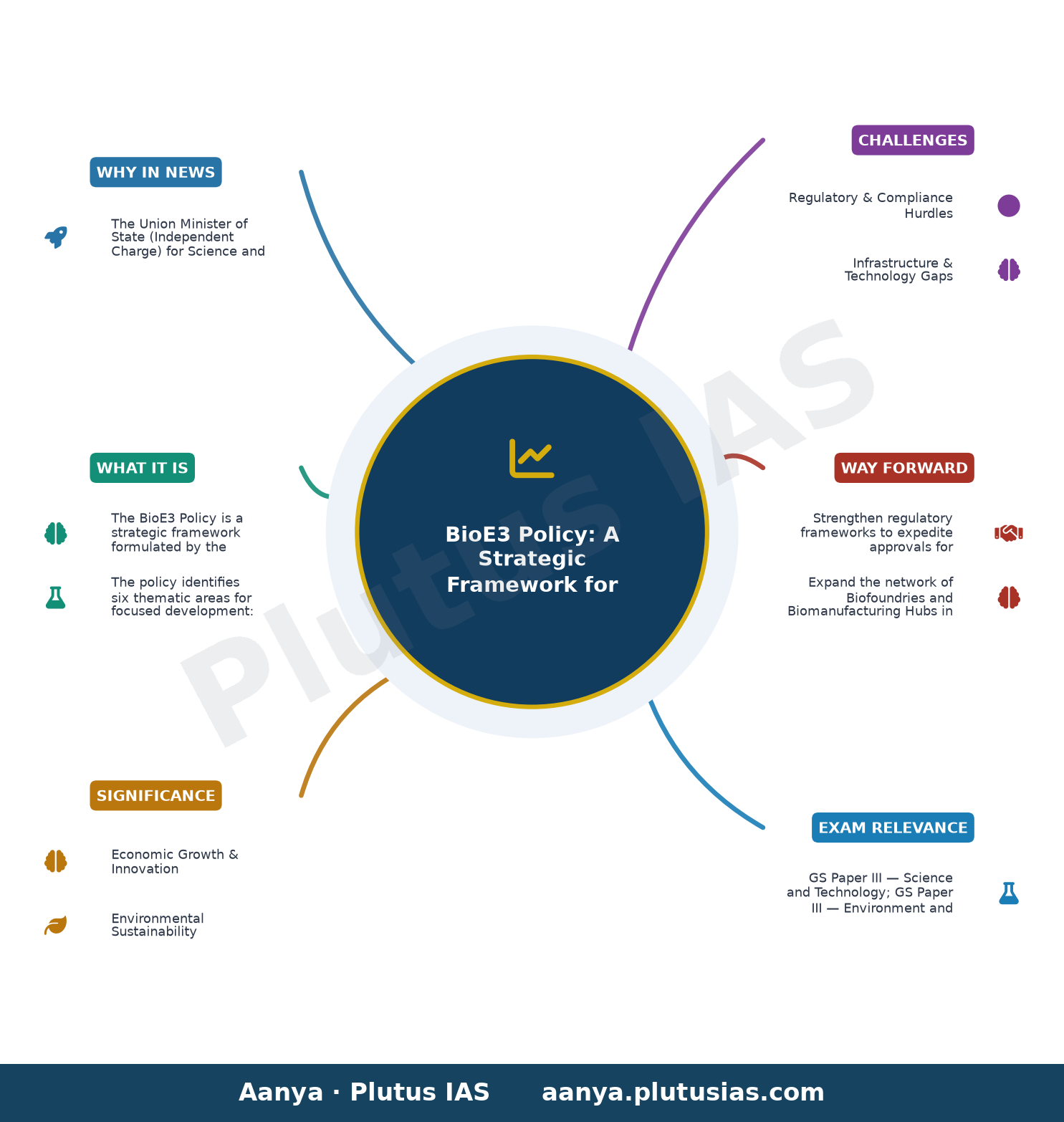
The Union Minister of State (Independent Charge) for Science and Technology, Dr. Jitendra Singh, highlighted in a written reply to the Rajya Sabha on 06 August 2026 the contributions of the BioE3 (Biotechnology for Economy, Environment, and Employment) Policy in establishing bio-manufacturing centres and biofoundries to foster high-capacity bio-manufacturing. The policy, launched by the Department of Biotechnology (DBT), aims to catalyse indigenous bio-manufacturing capabilities, generate employment, and advance India’s bioeconomy towards a USD 300 billion target by 2030 through targeted interventions in six thematic areas and five priority sectors.
Background
- The BioE3 Policy was introduced by the Government of India to leverage biotechnology for economic diversification, environmental sustainability, and employment generation, aligning with the broader objectives of Atmanirbhar Bharat and the National Bioeconomy Strategy.
- India’s bioeconomy, valued at approximately USD 80 billion in 2024, is projected to grow significantly with targeted policy interventions, including the establishment of bio-manufacturing hubs and biofoundries.
- The policy builds on existing initiatives such as the National Mission on Bioeconomy and the Make in India programme, integrating biotechnology with advanced manufacturing and digital technologies like Bio-AI.
- The establishment of bio-manufacturing hubs and biofoundries is part of a broader strategy to reduce import dependence in critical sectors such as pharmaceuticals, chemicals, and agricultural inputs.
- The policy emphasizes public-private partnerships, with 70% financial support from the government and 30% contribution from private stakeholders, to ensure sustainable and scalable implementation.
- The BioE3 Policy is aligned with global trends in bio-manufacturing, including the circular economy, carbon neutrality, and precision health, positioning India as a competitive player in the global bioeconomy.
What is the BioE3 Policy?
- The BioE3 Policy is a strategic framework formulated by the Department of Biotechnology (DBT) to promote high-capacity bio-manufacturing in India by establishing bio-manufacturing hubs, biofoundries, and Bio-AI hubs across the country.
- The policy identifies six thematic areas for focused development: bio-based chemicals and enzymes, bioplastics, active pharmaceutical ingredients (APIs), functional foods and smart proteins, precision medicine (including monoclonal antibodies, mRNA therapeutics, cell and gene therapies), and climate-resilient agriculture.
- Additionally, the policy prioritises five emerging sectors: Ayurveda agriculture innovation, genome diagnostics, synthetic biology, biomolecular design, and Bio-AI Hubs, to foster innovation and commercialisation.
- Bio-manufacturing hubs and biofoundries are state-of-the-art facilities designed to enable the scalable production of bio-based products, including pharmaceuticals, chemicals, and biomaterials, using advanced biotechnological processes.
- The policy incorporates a rigorous multi-stage evaluation mechanism for selecting proposals, including technical and financial assessments, expert consultations, and co-financing models to ensure viability and sustainability.
- BioE3 aims to generate approximately 1,500 direct and indirect employment opportunities in tier II and tier III cities over the next five years, thereby promoting inclusive growth and regional development.
- The policy is expected to contribute significantly to India’s bioeconomy, with a target of USD 300 billion by 2030, by strengthening indigenous capabilities, reducing import dependence, and fostering a robust innovation ecosystem.
- The BioE3 Policy integrates digital technologies, particularly Bio-AI, to enhance research, development, and commercialisation in biotechnology, aligning with the broader vision of a technology-driven economy.
Key Features
| Feature | Significance |
|---|---|
| Six Thematic Areas of BioE3 Policy | Identifies priority sectors such as bio-based chemicals, bioplastics, active pharmaceutical ingredients, enzymes, functional foods, smart proteins, precision biomedicine, climate-resilient agriculture, biofuels, carbon capture, marine and space biotechnology, and Bio-AI hubs. |
| Biofoundries & Biomanufacturing Hubs | Establishes state-of-the-art facilities for high-throughput biomanufacturing, enabling rapid prototyping, validation, and scaling of bio-based innovations. |
| Multi-layered Evaluation Criteria | Ensures selection of proposals based on technical feasibility, financial viability, expert review, and alignment with national objectives and cost-sharing mechanisms. |
| 70:30 Funding Model | Provides up to 70% financial support for projects under BioE3, with the remaining 30% contributed by private stakeholders, fostering public-private partnerships. |
| Employment Generation Target | Aims to create approximately 1,500 direct and indirect employment opportunities in tier-II and tier-III cities over the next five years. |
Why it Matters
Economic Growth & Innovation
- Accelerates indigenous biomanufacturing capabilities, reducing import dependence in critical sectors like pharmaceuticals, chemicals, and food processing.
- Enhances India’s global competitiveness in the bioeconomy, targeting a $300 billion valuation by 2030.
- Promotes high-value biotech startups and MSMEs through financial incentives and access to advanced infrastructure.
Environmental Sustainability
- Supports transition to bio-based alternatives (e.g., bioplastics, biofuels) to reduce carbon footprint and plastic pollution.
- Advances carbon capture technologies and climate-resilient agricultural practices to mitigate climate change impacts.
- Encourages circular economy models through waste-to-value bioprocesses.
Strategic Autonomy & Self-Reliance
- Strengthens domestic production of essential biomolecules (e.g., monoclonal antibodies, mRNA therapeutics) to reduce reliance on foreign supply chains.
- Fosters indigenous innovation in precision biomedicine, gene therapy, and synthetic biology.
- Aligns with ‘Atmanirbhar Bharat’ and ‘Make in India’ initiatives by localizing high-tech biomanufacturing.
Employment & Skill Development
- Creates skilled employment in tier-II and tier-III cities, addressing regional disparities in job opportunities.
- Promotes interdisciplinary research and development, bridging gaps between academia, industry, and government.
Challenges
1. Regulatory & Compliance Hurdles
- Complex approval processes for biomanufacturing facilities and bio-based products may delay project implementation.
- Need for harmonized standards and certifications to ensure market acceptance of bio-based innovations.
UPSC Link: GS3: Science & Tech Policy
2. Infrastructure & Technology Gaps
- Limited availability of advanced biomanufacturing hubs and biofoundries in non-metropolitan regions.
- Dependence on imported enzymes and specialized equipment may hinder cost-effective scaling.
UPSC Link: GS3: Industrial Policy
3. Funding & Investment Risks
- High initial capital requirements for biotech startups and MSMEs, despite 70% government support.
- Uncertainty in return on investment (ROI) due to long gestation periods in biomanufacturing projects.
UPSC Link: GS3: Investment Models
4. Talent & Knowledge Ecosystem
- Shortage of skilled workforce in emerging fields like synthetic biology, Bio-AI, and precision medicine.
- Need for stronger academia-industry collaborations to translate research into commercial applications.
UPSC Link: GS2: Education & Skill Development
5. Public Awareness & Acceptance
- Limited public understanding of bio-based products may slow market adoption (e.g., bioplastics, smart proteins).
- Ethical and biosafety concerns surrounding gene therapy and synthetic biology require robust communication strategies.
UPSC Link: GS3: Bioethics & Biosafety
Challenges — UPSC Perspective
| Issue | Concern |
|---|---|
| Regulatory Delays | Complex approval processes for biomanufacturing facilities and products. |
| High Capital Costs | Significant initial investment required despite government subsidies. |
| Skill Shortages | Lack of specialized workforce in emerging biotech domains. |
| Market Acceptance | Low awareness and skepticism towards bio-based alternatives. |
| Supply Chain Dependence | Reliance on imported enzymes and equipment for biomanufacturing. |
Way Forward
- Strengthen regulatory frameworks to expedite approvals for biomanufacturing facilities and bio-based products.
- Expand the network of Biofoundries and Biomanufacturing Hubs in tier-II and tier-III cities to decentralize innovation.
- Enhance public-private partnerships to bridge funding gaps and accelerate commercialization of biotech startups.
- Invest in skill development programs focused on synthetic biology, Bio-AI, and precision medicine to build a competent workforce.
- Promote awareness campaigns to educate stakeholders and consumers about the benefits of bio-based alternatives.
- Develop standardized certification protocols for bio-based products to ensure market trust and compliance.
- Leverage international collaborations to access advanced technologies and best practices in biomanufacturing.
UPSC Value Addition
Keywords for Mains Answer-Writing
BioE3 Policy · Bio-manufacturing hubs · Bio-foundries · Bio-AI hubs · Indigenous biomanufacturing · Biotech startups · Bioeconomy target of USD 300 billion by 2030 · Make in India in biotechnology · National Bioeconomy Strategy · Biomanufacturing clusters · 70% central financial assistance for biomanufacturing projects · Employment generation in Tier II and Tier III cities · Precision biomedicine · Climate-resilient agriculture · Bio-based chemicals and enzymes
Concept Flow
BioE3 Policy Announcement (2026) → Identification of Six Thematic Areas → Establishment of Biofoundries & Biomanufacturing Hubs → Multi-layered Proposal Evaluation → 70:30 Funding Model → Employment Generation in Tier-II/III Cities → Indigenous Biomanufacturing Capabilities → $300 Billion Bioeconomy Target by 2030
Prelims Practice Questions
Q1. Consider the following statements regarding the BioE3 Policy of the Government of India:
1. The BioE3 Policy aims to establish bio-manufacturing hubs and bio-foundries to promote high-capacity biomanufacturing.
2. The policy identifies six thematic areas including bio-based chemicals, bioplastics, and active pharmaceutical ingredients.
3. Financial assistance under the policy is limited to a maximum of 50% of the project cost for private sector participation.
4. The policy targets the creation of approximately 1500 direct and indirect employment opportunities in Tier II and Tier III cities over the next five years.
How many of the above statements are correct?
- Only one
- Only two
- Only three
- All four
Answer: Only three — Statements 1, 2, and 4 are correct. Statement 3 is incorrect as the policy provides financial assistance up to 70% of the project cost.
Q2. Assertion (A): The BioE3 Policy prioritizes the establishment of Bio-AI hubs as one of the five identified priority areas.
Reason (R): The policy aims to integrate artificial intelligence with biomanufacturing to enhance innovation and efficiency in the biotechnology sector.
Options:
A. Both A and R are true, and R is the correct explanation of A.
B. Both A and R are true, but R is not the correct explanation of A.
C. A is true, but R is false.
D. A is false, but R is true.
Answer: ? — Both Assertion (A) and Reason (R) are true. The BioE3 Policy explicitly identifies Bio-AI hubs as a priority area, and the integration of AI with biomanufacturing is a key objective to enhance innovation and efficiency.
Q3. Match the following thematic areas identified under the BioE3 Policy with their respective descriptions:
Column I (Thematic Area)
A. Bio-based chemicals and enzymes
B. Functional foods and smart proteins
C. Precision biomedicine
D. Climate-resilient agriculture
Column II (Description)
1. Development of monoclonal antibodies, mRNA therapeutics, and gene therapies
2. Production of bio-based alternatives to traditional plastics and chemicals
3. Enhancement of agricultural productivity through biotechnology to withstand climate change
4. Development of nutritionally enhanced foods and alternative protein sources
Options:
A – 2, B – 4, C – 1, D – 3
A – 1, B – 3, C – 2, D – 4
A – 3, B – 2, C – 4, D – 1
A – 4, B – 1, C – 3, D – 2
Answer: ? — The correct matches are: A – 2 (Bio-based chemicals and enzymes align with producing alternatives to traditional chemicals), B – 4 (Functional foods and smart proteins focus on nutritionally enhanced foods), C – 1 (Precision biomedicine involves advanced therapies like monoclonal antibodies), and D – 3 (Climate-resilient agriculture aims to enhance productivity under climate stress).
Mains Practice Question
✍ The BioE3 Policy represents a strategic shift towards fostering indigenous biomanufacturing capabilities and expanding the bioeconomy in India. Critically examine the policy’s objectives, implementation mechanisms, and potential challenges in achieving its stated goals of creating a USD 300 billion bioeconomy by 2030. Also, assess the role of public-private partnerships in this initiative. (15 Marks)
Approach: MODEL-ANSWER SKELETON:
1. **Introduction (2 Marks)**: Define the BioE3 Policy and its overarching goal of promoting high-capacity biomanufacturing to achieve a USD 300 billion bioeconomy by 2030. Highlight its alignment with the ‘Make in India’ initiative and the National Bioeconomy Strategy.
2. **Objectives of the BioE3 Policy (3 Marks)**:
– Establish bio-manufacturing hubs and bio-foundries to enable high-capacity biomanufacturing.
– Identify six thematic areas: bio-based chemicals, bioplastics, active pharmaceutical ingredients, functional foods, smart proteins, precision biomedicine, climate-resilient agriculture, biofuels, carbon capture, and futuristic marine and space research.
– Promote indigenous innovation and reduce reliance on imported biotechnology.
– Generate employment opportunities in Tier II and Tier III cities.
3. **Implementation Mechanisms (4 Marks)**:
– **Financial Incentives**: Up to 70% central financial assistance for biomanufacturing projects, with the remaining 30% contributed by the private sector.
– **Institutional Framework**: Establishment of bio-manufacturing hubs, bio-foundries, and Bio-AI hubs through a rigorous multi-layered evaluation process.
– **Public-Private Partnerships (PPP)**: Engagement of startups, MSMEs, and private industries to foster innovation and scalability.
– **Research and Development**: Focus on R&D in identified thematic areas to drive innovation.
4. **Potential Challenges (3 Marks)**:
– **Regulatory and Compliance**: Stringent regulatory frameworks for biomanufacturing and biotechnology products.
– **Infrastructure Gaps**: Limited infrastructure in Tier II and Tier III cities for establishing biomanufacturing hubs.
– **Skilled Workforce**: Shortage of skilled personnel in advanced biotechnology and bio-manufacturing.
– **Market Competition**: Competition from established global players in biotechnology.
– **Funding Constraints**: Ensuring sustained funding and financial viability of projects.
5. **Role of Public-Private Partnerships (3 Marks)**:
– **Innovation and Scalability**: PPPs enable the integration of cutting-edge research with industrial-scale production, accelerating the commercialization of biotechnology innovations.
– **Resource Mobilization**: Private sector investment (e.g., INR 602.09 crore committed so far) complements public funding, reducing the financial burden on the government.
– **Employment Generation**: PPPs facilitate the creation of direct and indirect employment opportunities, particularly in non-metropolitan cities.
– **Risk Sharing**: PPPs distribute risks between public and private entities, enhancing project sustainability.
6. **Conclusion (2 Marks)**: Summarize the transformative potential of the BioE3 Policy in positioning India as a global leader in biomanufacturing. Emphasize the need for continuous policy support, infrastructure development, and skill enhancement to overcome challenges and achieve the USD 300 billion bioeconomy target by 2030.
Source: PIB (Press Information Bureau)
Generated by AanyaAi for educational purpose.

- महाराष्ट्र में त्योहार जुलूसों पर बॉम्बे हाईकोर्ट का बड़ा फैसला: पटाखे, लेजर और संगीत पर रोक - September 24, 2026
- Bombay HC Bans Firecrackers, Music in Maharashtra Processions: Key UPSC Analysis - September 24, 2026
- तमिलनाडु में महिला कर्मचारियों के लिए सवैतनिक माहवारी अवकाश नीति पर HC का आदेश - September 24, 2026

No Comments