


06 Aug Lok Sabha Passes Bill: UPI Transactions May Soon Incur Charges
✎ The amendment to the Payment and Settlement Systems Act, 2007 removes the legal prohibition on levying Merchant Discount Rate (MDR) on UPI transactions, empowering the government to permit charges while maintaining the broader…
Subject Relevance — Where This Topic Fits
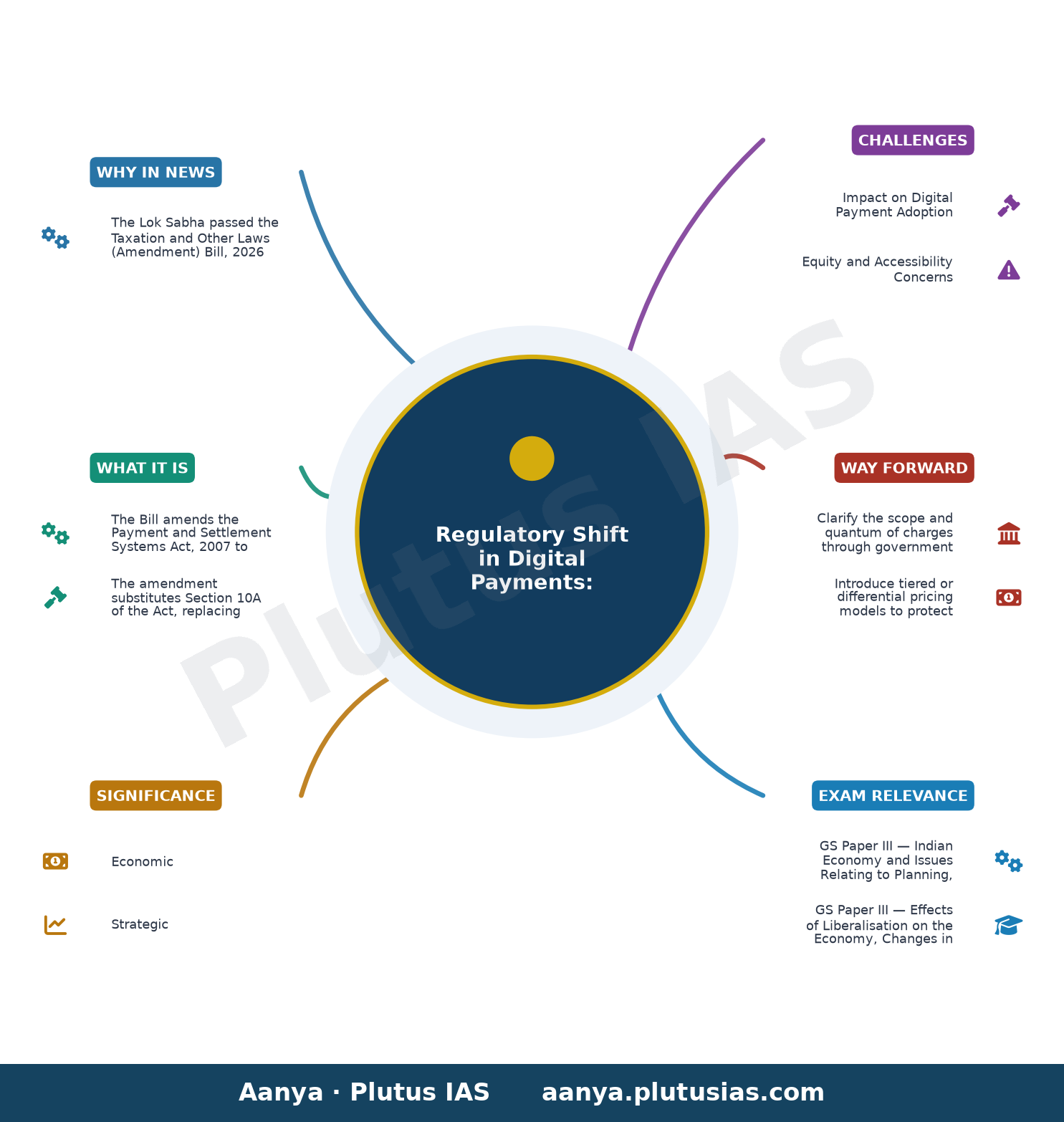
- GS Paper III — Indian Economy and Issues Relating to Planning, Mobilisation of Resources, Growth, Development and Employment | GS Paper III — Effects of Liberalisation on the Economy, Changes in Industrial Policy and their Effects on Industrial Growth
- Prelims: Unified Payments Interface (UPI), Merchant Discount Rate (MDR), Payment and Settlement Systems Act 2007, Digital Payment Ecosystem, Section 10A of Payment and Settlement Systems Act 2007, Section 269SU of Income Tax Act 1961
Quick Revision: The amendment to the Payment and Settlement Systems Act, 2007 removes the legal prohibition on levying Merchant Discount Rate (MDR) on UPI transactions, empowering the government to permit charges while maintaining the broader objective of a sustainable digital payment ecosystem.
Why is this in the news?
The Lok Sabha passed the Taxation and Other Laws (Amendment) Bill, 2026 on August 6, 2026, which includes provisions to amend the Payment and Settlement Systems Act, 2007. The amendment seeks to empower the government to permit banks and payment service providers to levy charges on UPI and other notified electronic payment modes, thereby removing the existing legal prohibition on Merchant Discount Rate (MDR) for such transactions. This legislative move marks a significant shift in the regulatory framework governing digital payments in India, with potential implications for consumers, merchants, and the broader digital economy.
Background
- The Payment and Settlement Systems Act, 2007 was enacted to regulate payment systems in India, ensuring stability, efficiency, and consumer protection in electronic fund transfers.
- Section 10A of the Act explicitly prohibited banks and payment system providers from imposing any charges on electronic payments, including UPI transactions, to promote digital inclusion and affordability.
- The proposed amendment aligns with the government’s broader objective of creating a sustainable revenue model for banks, payment service providers, and infrastructure firms while ensuring the digital payments ecosystem remains robust and innovative.
- The amendment was introduced as part of a comprehensive taxation legislation and was passed without debate due to Opposition sloganeering, reflecting the political sensitivity surrounding digital payment policies.
What is the Payment and Settlement Systems (Amendment) Bill, 2026?
- The Bill amends the Payment and Settlement Systems Act, 2007 to remove the prohibition on levying Merchant Discount Rate (MDR) on UPI and other notified electronic payment modes, thereby allowing banks and payment service providers to charge fees for such transactions.
- The amendment substitutes Section 10A of the Act, replacing the reference to ‘electronic modes of payment prescribed under Section 269SU of the Income Tax Act, 1961’ with a broader provision empowering the government to specify modes on which charges may be levied via notification.
- The Bill does not impose an immediate levy but provides the legal framework for the government to permit charges, ensuring flexibility in policy implementation based on market dynamics and stakeholder consultations.
- The move aims to address the revenue sustainability concerns of banks and payment infrastructure firms, which have historically relied on MDR for profitability in digital payment ecosystems.
- The amendment does not affect real-time gross settlement (RTGS) or national electronic funds transfer (NEFT) systems, which already levy service charges, as these are distinct from UPI-based transactions.
- The policy shift reflects a broader trend of evolving regulatory frameworks to balance digital inclusion with the financial viability of payment service providers in a rapidly digitising economy.
- The legislative change underscores the government’s intent to foster innovation in digital payments while ensuring equitable cost-sharing between consumers, merchants, and service providers.
Key Features
| Feature | Significance |
|---|---|
| Amendment to Section 10A, Payment and Settlement Systems Act, 2007 | Removes the prohibition on banks and payment service providers (PSPs) from levying charges on electronic payment modes, including UPI, thereby enabling revenue generation for ecosystem stakeholders. |
| Substitution of Section 10A reference to Section 269SU of Income Tax Act, 1961 | Replaces the fixed list of electronic payment modes under Section 269SU with a flexible notification-based mechanism, allowing the government to include or exclude payment modes dynamically. |
| Merchant Discount Rate (MDR) exemption removal | Enables banks and PSPs to impose MDR on UPI and other notified electronic payment modes, aligning digital payment charges with those of RTGS/NEFT transactions. |
| Revenue model sustainability for banks and PSPs | Provides a legal framework for banks and PSPs to earn revenue from digital payment infrastructure, ensuring long-term viability of the ecosystem. |
| Government notification-based flexibility | Allows the central government to specify which electronic payment modes may attract charges, ensuring policy adaptability to evolving digital payment trends. |
Why it Matters
Economic
- Enables revenue generation for banks and PSPs, addressing the financial sustainability of digital payment infrastructure by allowing charges on UPI transactions.
- Aligns UPI transaction charges with those of traditional payment systems (RTGS/NEFT), creating a uniform revenue model across digital payment modes.
- Potential reduction in government subsidy burden on digital payment incentives, such as those under Section 269SU of the Income Tax Act, 1961.
Strategic
- Supports the monetisation of digital public infrastructure (DPI) by introducing cost-sharing mechanisms, ensuring long-term viability of India’s digital payment ecosystem.
- Enhances the financial autonomy of banks and PSPs, reducing reliance on government subsidies or cross-subsidisation models for digital payment services.
Policy and Governance
- Demonstrates the government’s intent to balance consumer convenience with ecosystem sustainability, reflecting a shift from free-to-use digital services to a cost-sharing model.
- Provides a legal framework for dynamic policy adjustments, allowing the government to respond to technological and market changes in digital payments.
Consumer and Business Impact
- May lead to increased transaction costs for consumers and small businesses, potentially affecting the affordability and adoption of digital payment modes.
- Could incentivise banks and PSPs to invest further in digital payment infrastructure, improving service quality and innovation.
Challenges
1. Impact on Digital Payment Adoption
- Risk of reduced adoption of UPI and other digital payment modes due to introduction of charges, particularly among price-sensitive users and small businesses.
- Potential increase in cash transactions, undermining the government’s push for a less-cash economy and financial inclusion goals.
UPSC Link: GS3: Digital Economy
2. Equity and Accessibility Concerns
- Charges may disproportionately affect low-income users and small merchants, exacerbating digital divides in financial services access.
- Lack of clear exemptions for micro-enterprises and economically weaker sections could lead to exclusionary practices.
UPSC Link: GS2: Inclusive Growth
3. Revenue Model Sustainability vs. Consumer Protection
- Balancing the need for revenue generation with consumer protection and affordability remains a critical challenge for policymakers.
- Risk of regulatory arbitrage if charges are imposed inconsistently across payment modes, leading to market distortions.
UPSC Link: GS3: Financial Inclusion
4. Operational and Compliance Burden
- Banks and PSPs may face increased compliance costs in implementing and managing transaction charges, particularly for small-value transactions.
- Potential for disputes and grievances related to charge imposition, necessitating robust grievance redressal mechanisms.
UPSC Link: GS3: Financial Sector Reforms
Challenges — UPSC Perspective
| Issue | Concern |
|---|---|
| Digital Payment Adoption | Risk of reduced UPI usage due to charges, impacting financial inclusion and cashless economy goals. |
| Equity and Accessibility | Charges may disproportionately affect low-income users and small businesses, exacerbating digital divides. |
| Revenue Model Sustainability | Need to balance ecosystem viability with affordability and consumer protection. |
| Operational Complexity | Increased compliance burden for banks and PSPs in implementing and managing transaction charges. |
| Regulatory Arbitrage | Risk of inconsistent charge imposition across payment modes, leading to market distortions. |
Way Forward
- Clarify the scope and quantum of charges through government notifications to ensure transparency and predictability for consumers and businesses.
- Introduce tiered or differential pricing models to protect small-value transactions and economically weaker sections from excessive charges.
- Strengthen grievance redressal mechanisms to address disputes related to charge imposition and ensure fair practices by banks and PSPs.
- Conduct impact assessments to evaluate the effect of charges on digital payment adoption, particularly among low-income users and small businesses.
- Enhance financial literacy campaigns to educate users about the rationale behind charges and alternative payment options.
- Explore cross-subsidisation models where revenue from high-value transactions subsidises low-value transactions to maintain affordability.
- Monitor and evaluate the policy’s impact on the digital payment ecosystem, including changes in transaction volumes, user behaviour, and market competition.
UPSC Value Addition
Keywords for Mains Answer-Writing
Unified Payments Interface (UPI) · Payment and Settlement Systems Act, 2007 · Merchant Discount Rate (MDR) · Digital payment ecosystem sustainability · Section 10A of the Payment and Settlement Systems Act, 2007 · Section 269SU of the Income Tax Act, 1961 · BHIM-UPI QR codes · Rationalisation of transaction charges · Financial inclusion and digital public infrastructure · Regulatory arbitrage in digital payments
Concept Flow
Government introduces amendment to Payment and Settlement Systems Act, 2007 → Removal of Section 10A prohibition on charges for electronic payment modes → Notification-based flexibility for specifying payment modes subject to charges → Potential imposition of Merchant Discount Rate (MDR) on UPI and other digital payments → Impact on consumer adoption and digital payment ecosystem sustainability → Balancing revenue generation with financial inclusion and affordability goals → Policy adjustments based on impact assessments and stakeholder feedback
Prelims Practice Questions
Q1. Consider the following statements regarding the Payment and Settlement Systems Act, 2007:
1. Section 10A of the Act prohibits banks from imposing any charges on electronic payments.
2. The Act empowers the Central Government to specify electronic modes of payment for which charges may be levied.
3. Section 269SU of the Income Tax Act, 1961 mandates large businesses to accept payments through RuPay debit cards and BHIM-UPI QR codes.
How many of the above statements are correct?
- Only one
- Only two
- All three
- None
Answer: All three — Statements 1 and 3 are correct. Statement 2 is incorrect as Section 10A prohibits charges on prescribed electronic modes, but the amendment allows the government to specify modes where charges may be levied.
Q2. Assertion (A): The proposed amendments to the Payment and Settlement Systems Act, 2007 aim to enable banks to levy charges on UPI transactions.
Reason (R): The amendments seek to remove the existing legal provision that prevents banks from charging Merchant Discount Rate (MDR) on notified electronic payment modes.
Options:
A. Both A and R are true, and R is the correct explanation of A.
B. Both A and R are true, but R is not the correct explanation of A.
C. A is true, but R is false.
D. A is false, but R is true.
- A
- B
- C
- D
Answer: A — Both A and R are true, and R correctly explains A as the amendment removes the prohibition on levying MDR, enabling charges on UPI transactions.
Mains Practice Question
✍ Critically examine the implications of the proposed amendments to the Payment and Settlement Systems Act, 2007, which authorise the government to permit banks to levy charges on UPI transactions. How far does this move align with the objectives of financial inclusion and the sustainability of the digital payments ecosystem in India? (15 Marks)
Approach: MODEL-ANSWER SKELETON:
1. **Context and Provisions**:
– Briefly explain the Payment and Settlement Systems Act, 2007, and Section 10A (prohibition on charges for electronic payments).
– Highlight the proposed amendment to substitute Section 10A, allowing the government to specify electronic modes where charges may be levied.
– Reference Section 269SU of the Income Tax Act, 1961, which mandates large businesses to accept digital payments via RuPay/BHIM-UPI.
2. **Rationale for the Amendment**:
– **Sustainability of Digital Payments Ecosystem**: Discuss the need for revenue models for banks, payment service providers (PSPs), and infrastructure firms to maintain and upgrade UPI infrastructure.
– **Rationalisation of Charges**: Explain how levying small charges on UPI transactions could deter misuse (e.g., spam transactions) while ensuring affordability for small businesses and consumers.
– **Comparison with RTGS/NEFT**: Note that real-time payments via RTGS/NEFT already attract service charges, and UPI has been an outlier in this regard.
3. **Potential Implications**:
– **Financial Inclusion**: Analyse whether levying charges could disproportionately impact small merchants and low-income users, potentially undermining the goal of financial inclusion.
– **Competitive Dynamics**: Discuss how this may affect the dominance of UPI (backed by NPCI) and the entry of private players in the digital payments space.
– **Consumer Behaviour**: Examine whether charges could slow the adoption of digital payments among the masses, given UPI’s current popularity and zero-cost model.
4. **Balancing Act**:
– **Regulatory Safeguards**: Suggest measures such as capping charges, exempting small transactions, or cross-subsidising to mitigate adverse effects on inclusion.
– **Alternative Revenue Models**: Discuss the feasibility of other models (e.g., interchange fees, government subsidies) to sustain the ecosystem without burdening end-users.
5. **Conclusion**:
– Weigh the trade-offs between sustainability and inclusion, and argue for a calibrated approach that preserves UPI’s accessibility while ensuring the ecosystem’s viability.
Source: The Hindu
Generated by AanyaAi for educational purpose.

- Namami Gange: 70 Sewage Projects & 4,263 MLD Capacity Under NGM-II - August 6, 2026
- लोकसभा ने पारित किया बिल: यूपीआई लेनदेन पर लग सकेंगे शुल्क - August 6, 2026
- Lok Sabha Passes Bill: UPI Transactions May Soon Incur Charges - August 6, 2026

No Comments