


06 Aug Namami Gange: 70 Sewage Projects & 4,263 MLD Capacity Under NGM-II
✎ Namami Gange Mission Phase-II integrates sewage infrastructure augmentation, biodiversity conservation, and wetland restoration to rejuvenate the Ganga basin, with measurable outcomes such as 4,263 MLD sewage treatment capacity…
Subject Relevance — Where This Topic Fits
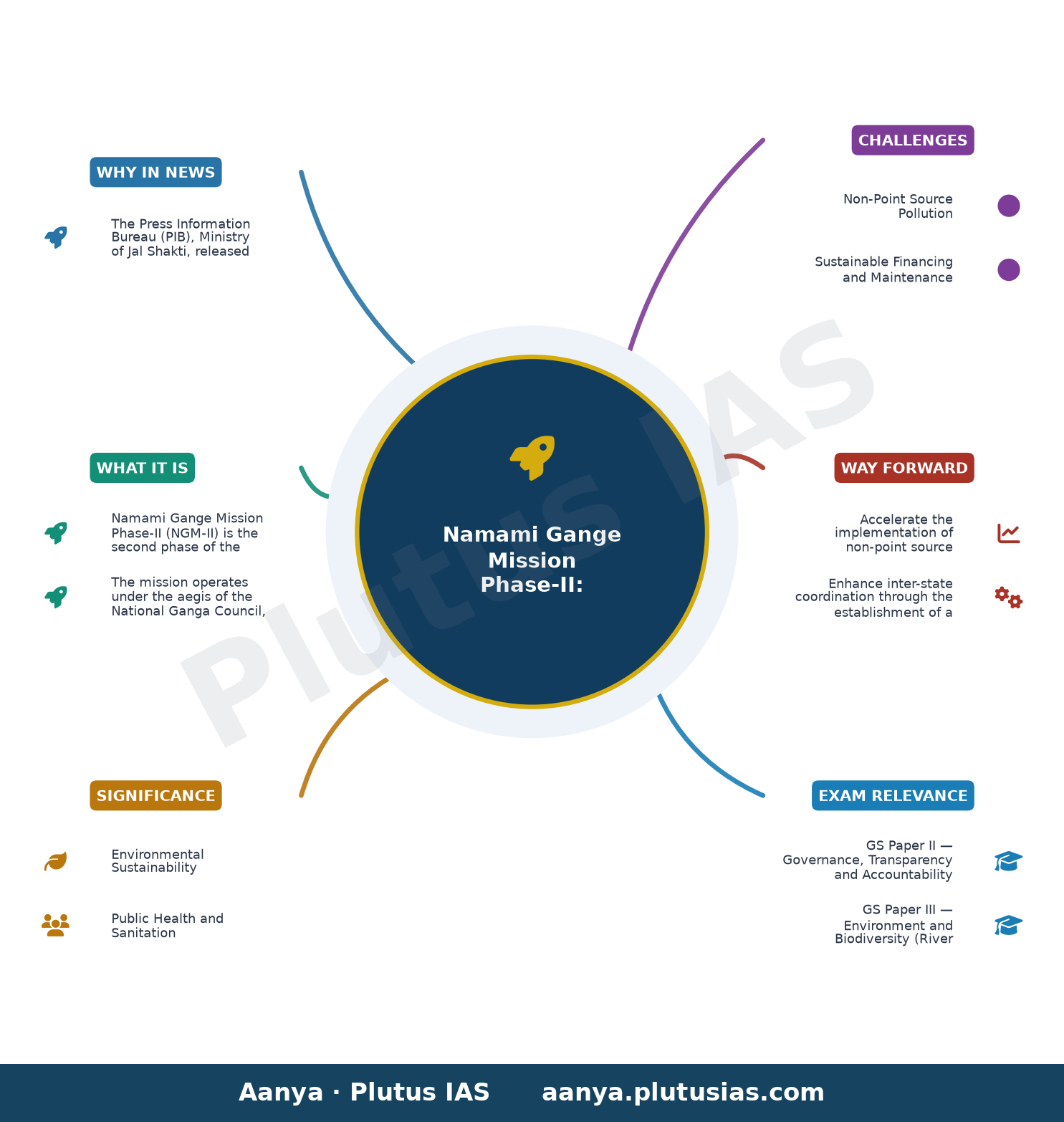
- GS Paper II — Governance, Transparency and Accountability (Implementation of flagship schemes) | GS Paper III — Environment and Biodiversity (River rejuvenation, wetland conservation, pollution control)
- Prelims: Namami Gange Mission, CPCB Polluted River Segments (PRS), Sewage Treatment Plants (STPs), Benthic Macroinvertebrates, River Ranching, Gharial Conservation Action Plan, Wetland (Conservation and Management) Rules, 2017
- Essay: Environmental conservation and sustainable development: Balancing ecological integrity with developmental imperatives, Public-private partnerships in environmental governance: Lessons from the Ganga rejuvenation initiative
Quick Revision: Namami Gange Mission Phase-II integrates sewage infrastructure augmentation, biodiversity conservation, and wetland restoration to rejuvenate the Ganga basin, with measurable outcomes such as 4,263 MLD sewage treatment capacity and the rescue of 6,800 aquatic animals by June 2026.
Why is this in the news?
The Press Information Bureau (PIB), Ministry of Jal Shakti, released a progress update on 6 August 2026 detailing the implementation of 70 sewage infrastructure projects under Namami Gange Mission Phase-II (NGM-II) during 2025, including the commissioning of 25 Sewage Treatment Plants (STPs). The cumulative sewage treatment capacity created under the Namami Gange programme has reached 4,263 MLD by June 2026. Additionally, the Central Pollution Control Board (CPCB) reported improvements in the pollution status of key segments of the Ganga main stem between 2018 and 2025, alongside biodiversity conservation milestones such as the rescue and rehabilitation of 6,800 aquatic animals and the documentation of 215 fish species in the river system.
Background
- The Namami Gange Mission was launched in 2014 as a flagship programme of the Government of India under the Ministry of Jal Shakti, with the objective of rejuvenating the Ganga River and its tributaries through a multi-sectoral approach.
- The programme is implemented by the National Mission for Clean Ganga (NMCG), which functions as the implementing arm of the National Ganga Council.
- Pollution in the Ganga basin stems from untreated sewage, industrial effluents, agricultural runoff, and unregulated solid waste disposal, necessitating integrated infrastructure and ecological interventions.
- The Central Pollution Control Board (CPCB) classifies river segments as Polluted River Segments (PRS) based on water quality parameters such as Biochemical Oxygen Demand (BOD), Dissolved Oxygen (DO), and faecal coliform counts.
- Biodiversity conservation in the Ganga basin is critical due to its status as a Ramsar wetland site network and a biodiversity hotspot for aquatic fauna including the Gangetic dolphin, gharial, and several turtle species.
- The programme aligns with the National Wetland Conservation Programme and the National Biodiversity Action Plan, integrating conservation with livelihood enhancement for riparian communities.
What is the Namami Gange Mission Phase-II and how does it function?
- Namami Gange Mission Phase-II (NGM-II) is the second phase of the Namami Gange programme, focusing on scaling up sewage infrastructure, biodiversity conservation, and ecological restoration in the Ganga basin.
- The mission operates under the aegis of the National Ganga Council, chaired by the Prime Minister, ensuring high-level political commitment and inter-ministerial coordination.
- Key components include the establishment and upgradation of Sewage Treatment Plants (STPs), interception and diversion of sewage flows, and the creation of riverfront development projects to reduce pollution and enhance ecological flows.
- Biodiversity conservation is integrated through habitat restoration, species-specific conservation programmes (e.g., gharial, Gangetic dolphin, freshwater turtles), and river ranching to restore fish populations.
- The mission incorporates scientific monitoring through the establishment of the National River Research Centre at the Wildlife Institute of India (WII), Dehradun, and the deployment of aquatic animal rescue ambulances for rapid response to distressed species.
- Wetland conservation is prioritised under the Wetland (Conservation and Management) Rules, 2017, with scientific identification, notification, and management planning for ecologically critical wetlands in the basin.
- The mission also promotes afforestation along the riverbanks and in riparian zones, utilising native species to enhance ecological connectivity and reduce soil erosion.
Key Features
| Feature | Significance |
|---|---|
| Sewerage Infrastructure Projects (STPs) under NGM-II (2025) | Expansion of sewage treatment capacity to 4,263 MLD by June 2026, addressing point-source pollution in the Ganga basin. |
| Pollution Monitoring and Assessment (CPCB Report, 2025) | Documentation of partial improvement in pollution levels across key stretches of the Ganga mainstem, with removal of polluted segments in Uttarakhand. |
| Biodiversity Conservation Initiatives | Integration of ecological restoration, species conservation, and community participation to revive aquatic and riparian ecosystems. |
| Scientific Surveys and Species Documentation | Identification of 3,037 gharials and documentation of 215 fish species, including critically endangered taxa like the Red-crowned Roofed Turtle. |
| Wetland Restoration and Management | Prioritization and scientific management of wetlands under the Wetlands (Conservation and Management) Rules, 2017, to enhance hydrological and ecological functions. |
Why it Matters
Environmental Sustainability
- Restoration of the Ganga’s ecological integrity through systematic pollution control and habitat rehabilitation.
- Enhancement of aquatic biodiversity, supporting keystone species like the Ganga dolphin and gharial, critical for riverine food webs.
- Mitigation of anthropogenic pressures on the Ganga basin’s 1.1 million sq. km catchment area, a vital freshwater resource.
Public Health and Sanitation
- Reduction in waterborne diseases by treating 4,263 MLD of sewage, directly impacting 500+ million people dependent on the Ganga.
- Improved river water quality, reducing reliance on contaminated groundwater sources in riparian communities.
Scientific and Institutional Capacity
- Establishment of the National River Research Centre at the Wildlife Institute of India, Dehradun, for long-term ecological monitoring.
- Development of specialized rescue centers and India’s first dolphin ambulance, strengthening wildlife conservation infrastructure.
Community and Governance Integration
- Deployment of 5,500+ Ganga Praharis across 113 districts, fostering grassroots participation in biodiversity conservation.
- Collaboration with state forest departments and civil society (e.g., TSAFI) for species-specific conservation programs.
Challenges
1. Non-Point Source Pollution
- Agricultural runoff, including fertilizers and pesticides, remains a major contributor to river pollution despite STP expansions.
- Lack of comprehensive land-use planning in the Ganga basin exacerbates diffuse pollution sources.
UPSC Link: GS3: Environmental Pollution
2. Sustainable Financing and Maintenance
- High operational costs of STPs and wetland restoration require long-term fiscal commitments from state governments.
- Dependence on central funding (e.g., NGM) may lead to discontinuities in project implementation.
UPSC Link: GS2: Centre-State Relations
3. Habitat Fragmentation and Anthropogenic Pressures
- Urbanization, sand mining, and dam construction disrupt river connectivity, threatening migratory species like the Hilsa.
- Encroachment of riparian zones for agriculture and infrastructure reduces critical floodplains and wetlands.
UPSC Link: GS3: Biodiversity Conservation
4. Climate Change Vulnerabilities
- Increased frequency of extreme weather events (floods/droughts) alters river flow regimes, impacting water quality and biodiversity.
- Glacial retreat in the Himalayas may reduce base flow in the Ganga, exacerbating water scarcity.
UPSC Link: GS3: Climate Change
5. Monitoring and Enforcement Gaps
- Inconsistent compliance with environmental norms by industries and municipalities along the Ganga corridor.
- Limited real-time monitoring infrastructure to track pollution sources and ecological parameters.
UPSC Link: GS3: Environmental Governance
Challenges — UPSC Perspective
| Issue | Concern |
|---|---|
| Agricultural Runoff | Persistent diffuse pollution from fertilizers, pesticides, and livestock waste despite STPs. |
| Urban Wastewater Discharge | Inadequate coverage of sewage networks in rapidly urbanizing towns along the Ganga. |
| Sand Mining and Riverbed Excavation | Destruction of aquatic habitats and disruption of sediment flow, affecting species like the Ganga dolphin. |
| Climate-Induced Hydrological Shifts | Altered monsoon patterns and glacial melt impacting river discharge and water quality. |
| Institutional Coordination Gaps | Fragmented governance between central agencies (NMCG), state governments, and local bodies. |
| Public Awareness and Behavioral Change | Limited community engagement in waste segregation and sustainable agricultural practices. |
Government Initiatives — Must-Memorise for Prelims
- Namami Gange Programme (Phase II)
- National Mission for Clean Ganga (NMCG)
Way Forward
- Accelerate the implementation of non-point source pollution control measures, including agricultural best practices and riparian buffer zones.
- Enhance inter-state coordination through the establishment of a dedicated Ganga Basin Authority with statutory powers.
- Expand real-time water quality monitoring networks using IoT and remote sensing technologies for adaptive management.
- Strengthen enforcement of the Wetlands Rules, 2017, through regular audits and community-led monitoring.
- Promote climate-resilient infrastructure in the Ganga basin, including floodplain restoration and sediment management.
- Develop a comprehensive river basin management plan integrating hydrology, ecology, and socio-economic factors.
- Foster public-private partnerships for sustainable financing of STPs, wetland restoration, and biodiversity programs.
- Institutionalize the Ganga Prahari network as a formal cadre for long-term ecological monitoring and community engagement.
UPSC Value Addition
Keywords for Mains Answer-Writing
Namami Gange Programme · Ganga Rejuvenation · Sewerage Treatment Plants (STPs) · Polluted River Stretches (PRS) · Biodiversity Conservation · River Dolphin Conservation · Wetland Restoration · National Mission for Clean Ganga (NMCG) · Gharial Conservation Action Plan · River Ranching · Benthic Macro-invertebrates · Biological Water Quality (BWQ)
Constitutional & Policy Linkages
- Article 48A: Directive Principle of State Policy on environmental protection and improvement.
- Article 51A(g): Fundamental Duty to protect and improve the natural environment.
Concept Flow
Anthropogenic Pollution (Industrial/Urban Sewage, Agricultural Runoff) → Degradation of River Ecosystems → Implementation of Namami Gange Programme → Expansion of STPs and Wetland Restoration → Improvement in Water Quality and Biodiversity → Enhanced Public Health and Ecological Resilience → Sustainable River Basin Management
Prelims Practice Questions
Q1. Consider the following statements regarding the Namami Gange Programme:
1. It aims to create 4,263 MLD of sewage treatment capacity by June 2026.
2. It includes the establishment of four aquatic animal rescue and rehabilitation centres.
3. The programme has documented 215 fish species in the Ganga river basin.
4. It mandates the notification of wetlands under the Wetlands (Conservation and Management) Rules, 2017.
How many of the above statements are correct?
- Only one
- Only two
- Only three
- All four
Answer: All four — Statements 1, 2, and 3 are correct. Statement 4 is incorrect as the programme assists in the identification and notification of wetlands but does not mandate it under the Rules.
Q2. Assertion (A): The National Mission for Clean Ganga (NMCG) has established India’s first dolphin rescue ambulance.
Reason (R): The Ganges River Dolphin is a critically endangered species requiring urgent conservation measures.
Options:
A. Both A and R are true, and R is the correct explanation of A.
B. Both A and R are true, but R is not the correct explanation of A.
C. A is true, but R is false.
D. A is false, but R is true.
- A
- B
- C
- D
Answer: A — Both A and R are true. The establishment of the dolphin rescue ambulance is a direct conservation measure for the critically endangered Ganges River Dolphin, making R the correct explanation of A.
Q3. Match the following initiatives under the Namami Gange Programme with their respective objectives:
Column I (Initiative) | Column II (Objective)
1. River Ranching | A. Restoration of wetlands
2. Gharial Conservation Action Plan | B. Release of fish seeds to enhance native fish populations
3. Wetland Restoration | C. Scientific assessment and protection of gharials
4. Biodiversity Parks | D. Creation of green spaces along the Ganga basin
Options:
A. 1-B, 2-C, 3-A, 4-D
B. 1-A, 2-B, 3-C, 4-D
C. 1-C, 2-D, 3-A, 4-B
D. 1-D, 2-A, 3-B, 4-C
- A
- B
- C
- D
Answer: A — 1-B: River Ranching involves releasing fish seeds to enhance native fish populations. 2-C: The Gharial Conservation Action Plan focuses on the scientific assessment and protection of gharials. 3-A: Wetland Restoration aims to restore wetlands. 4-D: Biodiversity Parks are created as green spaces along the Ganga basin.
Mains Practice Question
✍ The Namami Gange Programme represents a multi-dimensional approach to river rejuvenation, integrating infrastructure development, biodiversity conservation, and community participation. Critically analyse the programme’s achievements and limitations in achieving its stated objectives. Substantiate your answer with reference to recent data and initiatives. (15 Marks)
Approach: MODEL-ANSWER SKELETON:
1. **Introduction (2 Marks)**
– Briefly outline the Namami Gange Programme (NMG) as a flagship initiative of the Government of India, launched in 2014, with the objective of cleaning and rejuvenating the Ganga river basin.
– Mention its multi-pronged approach: sewage infrastructure, biodiversity conservation, wetland restoration, and community engagement.
2. **Achievements (6 Marks)**
– **Sewage Management:** Creation of 4,263 MLD sewage treatment capacity by June 2026; implementation of 70 sewerage infrastructure projects, including 25 operational STPs in 2025.
– **Biodiversity Conservation:** Documentation of 215 fish species (206 native, 9 exotic); release of 2.05 crore fish seeds; conservation of 3,037 gharials and 1,500+ freshwater turtles; establishment of four aquatic animal rescue centres and India’s first dolphin rescue ambulance.
– **Wetland Restoration:** Scientific identification and notification of wetlands; restoration of ecologically critical wetlands in the Ganga basin.
– **Community Participation:** Creation of 5,500+ Ganga Praharis; establishment of seven Ganga Biodiversity Parks in Uttar Pradesh.
3. **Limitations and Challenges (5 Marks)**
– **Polluted River Stretches (PRS):** Partial improvement in PRS in Uttar Pradesh, Bihar, and West Bengal; persistent pollution in certain segments (e.g., Bihar’s Buxar to Bhagalpur stretch).
– **Infrastructure Gaps:** Despite progress, sewage treatment capacity remains insufficient to address the entire pollution load.
– **Biodiversity Threats:** Continued anthropogenic pressures, including illegal fishing and habitat degradation, pose risks to conserved species.
– **Regulatory and Governance Issues:** Fragmented implementation across states; challenges in enforcing environmental regulations and ensuring inter-state coordination.
4. **Conclusion (2 Marks)**
– While the NMG has made significant strides in sewage management and biodiversity conservation, achieving holistic river rejuvenation requires addressing persistent pollution sources, strengthening governance, and enhancing community ownership. The programme serves as a model for integrated river basin management but necessitates sustained efforts and adaptive strategies.
Source: PIB (Press Information Bureau)
Generated by AanyaAi for educational purpose.

- राजस्थान पंचायत चुनाव 2026: सरपंच-वार्ड पदों की आरक्षण लॉटरी आज, जानिए आरक्षण तय करने की प्रक्रिया - September 24, 2026
- Rajasthan Panchayat Polls 2026: Reservation Lottery for Sarpanch & Ward Panch Seats Today - September 24, 2026
- यूपी में पहली बार तेंदुओं का बधियाकरण: मानव-वन्यजीव संघर्ष रोकेगा अभियान - September 24, 2026

No Comments