


06 Aug Why UPSC Aspirants Must Develop AI-Resistant Skills in 2026 Exam
✎ In an AI-saturated educational landscape, the core mission of schooling must pivot from algorithmic efficiency to the cultivation of uniquely human competencies—critical thinking, creativity, emotional intelligence, and ethical…
Subject Relevance — Where This Topic Fits
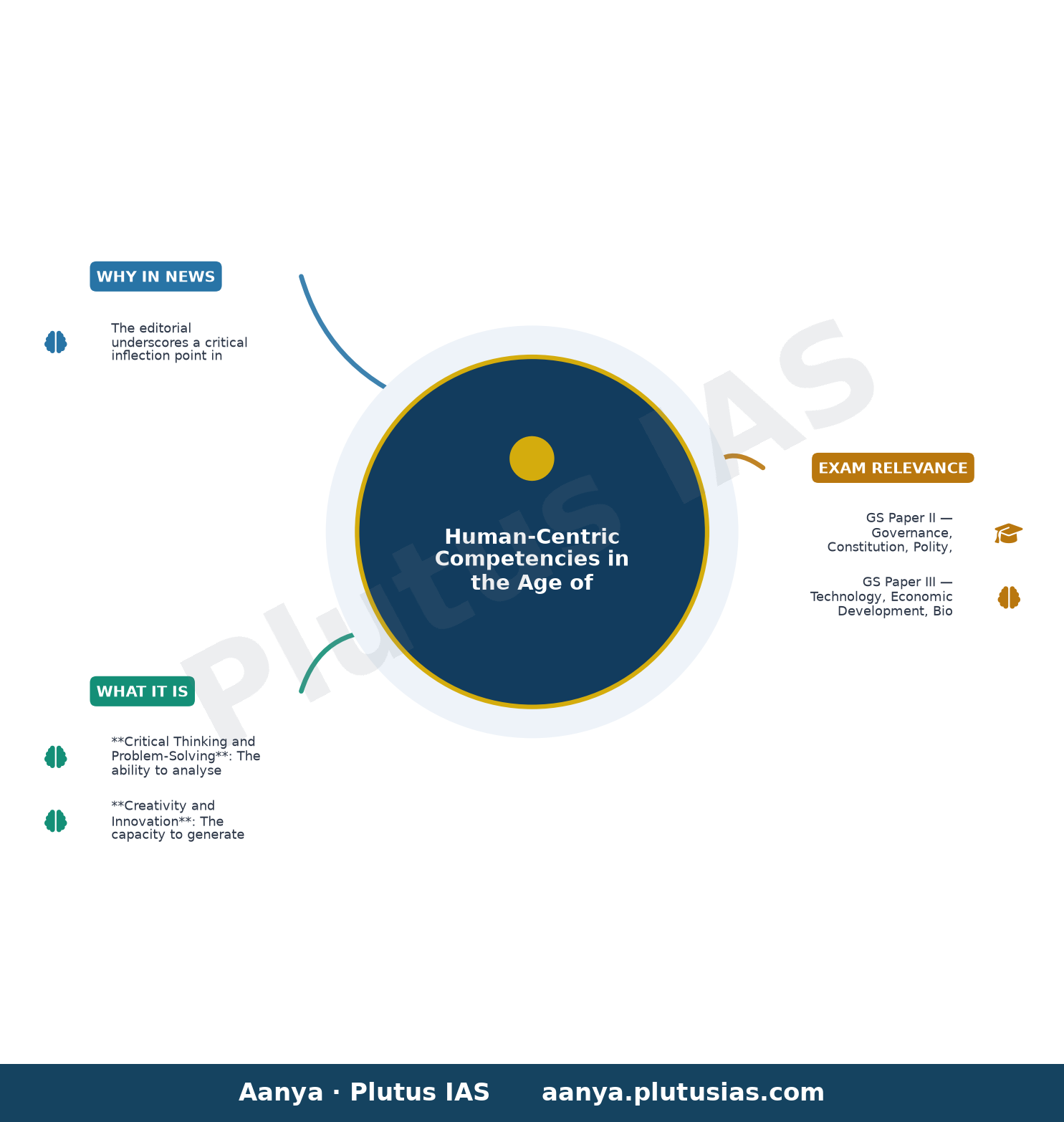
- GS Paper II — Governance, Constitution, Polity, Social Justice and International Relations (Education Policy and Digital Governance) | GS Paper III — Technology, Economic Development, Bio diversity, Environment, Security and Disaster Management (Impact of AI on Employment and Skill Development)
- Prelims: NEP 2020, National Curriculum Framework (NCF) 2023, AI literacy, 21st Century Skills, Bloom’s Taxonomy, Project-Based Learning (PBL), Experiential Learning, Competency-Based Education (CBE)
- Essay: The interplay between technological advancement and human development: Can machines replicate the soul of education?, Preparing the youth for an uncertain future: The primacy of human skills in an AI-driven world
Quick Revision: In an AI-saturated educational landscape, the core mission of schooling must pivot from algorithmic efficiency to the cultivation of uniquely human competencies—critical thinking, creativity, emotional intelligence, and ethical reasoning—ensuring students remain architects of their own intellectual and moral development.
Why is this in the news?
The editorial underscores a critical inflection point in global education policy, where the ubiquity of AI tools necessitates a deliberate shift from algorithmic dependence to the cultivation of uniquely human cognitive and socio-emotional competencies. This discourse is particularly salient for India, where the National Education Policy (NEP) 2020 and the National Curriculum Framework (NCF) 2023 are being operationalised amidst rapid digital transformation. The article highlights Norway’s policy stance on generative AI, which serves as a comparative benchmark for India’s evolving approach to AI integration in education.
Background
- The National Education Policy (NEP) 2020 explicitly mandates the integration of technology in education while emphasising the preservation of foundational human skills such as critical thinking, creativity, and ethical reasoning.
- The National Curriculum Framework (NCF) 2023, aligned with NEP 2020, introduces competency-based education (CBE) and project-based learning (PBL) to foster higher-order cognitive and socio-emotional competencies in students.
- The global discourse on AI in education has shifted from whether AI should be used to how it can be leveraged to augment, rather than replace, human cognition, as evidenced by policy frameworks in countries like Norway.
- India’s Digital India and Atal Innovation Mission (AIM) initiatives have accelerated the adoption of AI tools in classrooms, necessitating a parallel focus on human-centric skill development to mitigate the risk of over-reliance on technology.
What are uniquely human skills in the context of AI-driven education?
- **Critical Thinking and Problem-Solving**: The ability to analyse information, identify biases, evaluate arguments, and devise innovative solutions to complex problems, which AI tools cannot autonomously replicate due to their reliance on pre-existing data patterns.
- **Creativity and Innovation**: The capacity to generate novel ideas, approaches, and artefacts, including artistic expression, entrepreneurial ventures, and scientific breakthroughs, which stems from human intuition, emotional depth, and contextual understanding.
- **Emotional Intelligence (EQ)**: The skill to recognise, understand, and manage one’s own emotions and those of others, fostering empathy, collaboration, and leadership—qualities that AI lacks due to its inability to experience emotions or build genuine human relationships.
- **Communication and Collaboration**: Proficiency in articulating ideas clearly, actively listening, negotiating, and working effectively in diverse teams, which requires emotional resonance and cultural sensitivity that AI tools cannot emulate.
- **Ethical Reasoning and Moral Judgement**: The ability to discern right from wrong, navigate moral dilemmas, and make decisions aligned with societal values, which is inherently human and cannot be programmed into AI systems without explicit human oversight.
- **Adaptability and Resilience**: The capacity to learn continuously, pivot in response to change, and thrive in uncertain environments, which is critical in an era of rapid technological and socio-economic transformation.
- **Metacognition**: The higher-order thinking skill of reflecting on one’s own learning processes, identifying strengths and weaknesses, and strategising for improvement, which AI tools can assist with but not replace entirely.
- **Cultural and Contextual Awareness**: The understanding of socio-cultural nuances, historical contexts, and ethical implications in diverse settings, which requires human empathy and lived experience that AI cannot replicate.
UPSC Value Addition
Keywords for Mains Answer-Writing
Artificial Intelligence in education · Human-centric skills · Critical thinking · Creativity · Communication skills · AI literacy · Soft skills vs technical competence · 21st-century competencies · Pedagogical transformation · AI governance in schools
Prelims Practice Questions
Q1. Consider the following statements regarding the role of Artificial Intelligence (AI) in education:
1. AI can analyse data, generate presentations, and assist with coding.
2. AI can replace human judgement, empathy, and leadership in educational settings.
3. Norway has announced that generative AI should not be used by primary school students.
4. AI tools are universally recommended for all age groups in educational institutions.
How many of the above statements are correct?
- All four
- Only three
- Only two
- Only one
Answer: Only three — Statements 1 and 3 are correct. Statement 2 is incorrect because AI cannot replace human judgement, empathy, or leadership. Statement 4 is incorrect as Norway restricts AI use for primary students and introduces it gradually for older students.
Q2. Assertion (A): The primary focus of education in the age of AI should be on developing technical competence and knowledge.
Reason (R): AI can perform a myriad of technical tasks with remarkable speed, making traditional knowledge dispensable.
Options:
A. Both A and R are true, and R is the correct explanation of A.
B. Both A and R are true, but R is NOT the correct explanation of A.
C. A is true, but R is false.
D. A is false, but R is true.
Answer: ? — Assertion (A) is true, but Reason (R) is false. While technical competence remains important, the focus must shift to human-centric skills such as critical thinking and creativity, as these cannot be replicated by AI.
Q3. Match the following AI-related educational initiatives with their respective countries:
Column I (Initiative) | Column II (Country)
1. Restriction of generative AI for primary school students | A. India
2. Gradual introduction of AI under teacher supervision for older students | B. Norway
3. Prioritisation of AI literacy in the education system | C. United States
4. Focus on building foundational skills before AI reliance | D. Singapore
- 1-B, 2-B, 3-D, 4-A
- 1-B, 2-B, 3-A, 4-D
- 1-A, 2-C, 3-D, 4-B
- 1-D, 2-A, 3-C, 4-B
Answer: 1-B, 2-B, 3-A, 4-D — 1-B (Norway restricts generative AI for primary students), 2-B (Norway introduces AI gradually for older students), 3-D (Singapore prioritises AI literacy), 4-A (India focuses on foundational skills before AI reliance).
Mains Practice Question
✍ Critically examine the proposition that Artificial Intelligence (AI) in education must complement, rather than substitute, human-centric skills such as critical thinking, creativity, and communication. Substantiate your answer with reference to recent global educational policies and the Indian context. (15 Marks)
Approach: MODEL-ANSWER SKELETON:
1. **Introduction (2 marks)**: Define AI in education and its dual role as a tool and a disruptor. State the proposition that AI should complement human skills.
2. **Human-centric skills vs. AI capabilities (3 marks)**:
– List human-centric skills (critical thinking, creativity, communication, empathy, leadership).
– Contrast with AI capabilities (data analysis, pattern recognition, automation).
– Cite examples of AI tools in education (e.g., generative AI, adaptive learning platforms).
3. **Global educational policies (4 marks)**:
– Discuss Norway’s policy on restricting AI for primary students and gradual introduction for older students.
– Highlight Singapore’s focus on AI literacy and foundational skills.
– Mention other countries (e.g., Finland, Estonia) integrating AI literacy into curricula.
4. **Indian context (3 marks)**:
– Reference the NEP 2020’s emphasis on 21st-century competencies and multidisciplinary learning.
– Discuss the need for AI literacy programmes in Indian schools.
– Highlight challenges (e.g., digital divide, teacher training, infrastructure).
5. **Critique and balance of views (3 marks)**:
– Present arguments for AI as a tool to enhance learning (personalised learning, accessibility).
– Present counterarguments (over-reliance on AI, erosion of foundational skills).
– Conclude with a balanced view: AI as an enabler, not a replacement, for human skills.
Source: Hindustan Times
Generated by AanyaAi for educational purpose.

- बिहार सरकार का बड़ा फैसला: कारोबार शुरू करने में होगी आसानी, जानिए कैसे मिलेगा फायदा - September 23, 2026
- Bihar Launches Single Window Portal for 62 Business Services: UPSC & PCS Guide - September 23, 2026
- ग्रीनलैंड समझौता: अमेरिका को मिले अतिरिक्त रक्षा क्षेत्र, जानिए पूरा मामला - September 23, 2026

No Comments