


06 Aug Why UPSC Aspirants Must Develop AI-Resistant Skills in 2026
✎ The future of education must prioritise the development of human-centric competencies—critical thinking, creativity, emotional intelligence, and ethical reasoning—to ensure students can leverage AI as a tool rather than become…
Subject Relevance — Where This Topic Fits
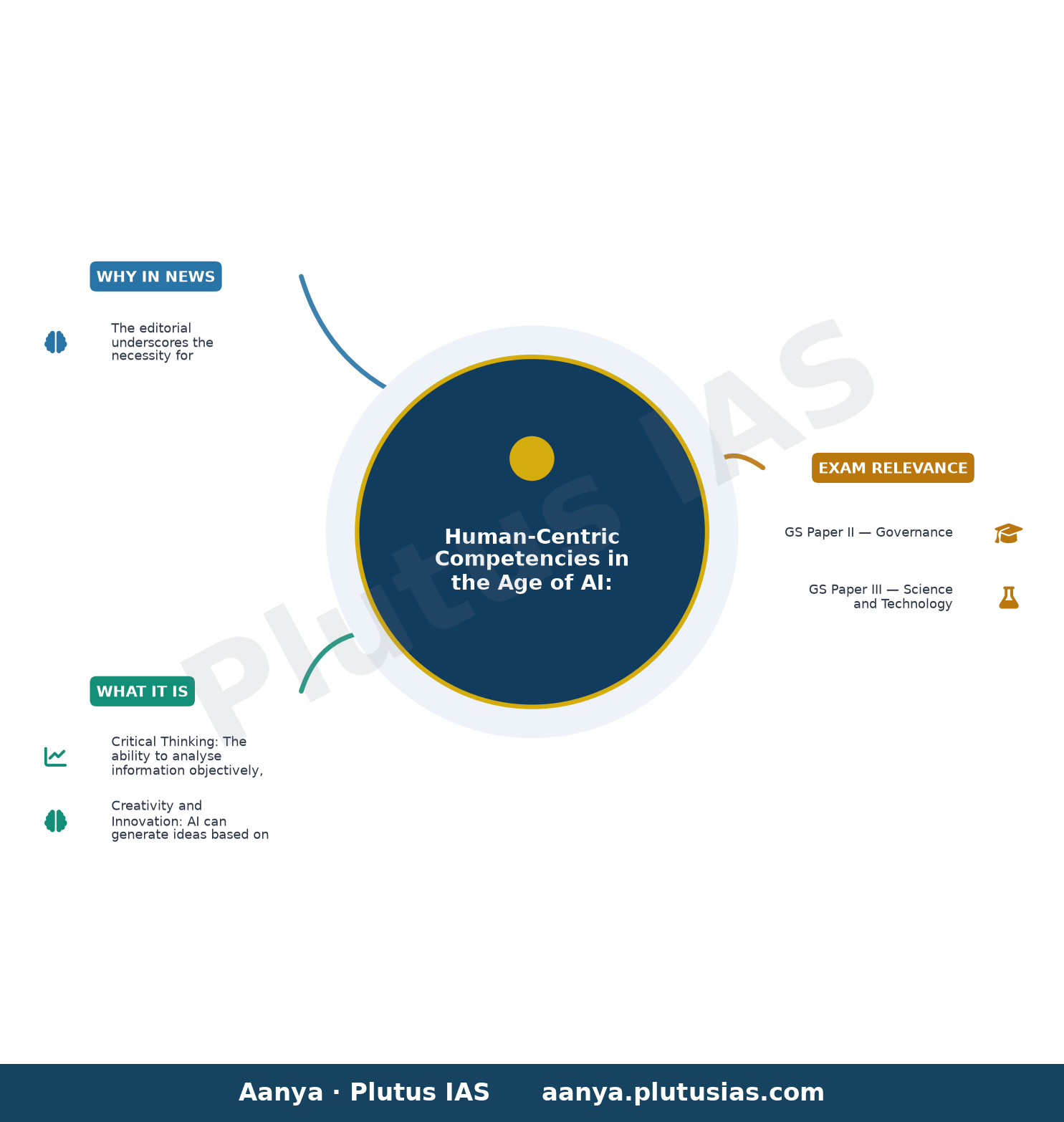
- GS Paper II — Governance | GS Paper III — Science and Technology | GS Paper IV — Ethics
- Prelims: Artificial Intelligence (AI), generative AI, critical thinking, socio-emotional skills, NEP 2020, AI literacy, human-AI complementarity
- Essay: The interplay between technological advancement and human development: Navigating the future of education and work, Ethics in the digital age: Balancing innovation with human-centric values
Quick Revision: The future of education must prioritise the development of human-centric competencies—critical thinking, creativity, emotional intelligence, and ethical reasoning—to ensure students can leverage AI as a tool rather than become dependent on it.
Why is this in the news?
The editorial underscores the necessity for educational systems to prioritise the cultivation of human-centric skills—such as critical thinking, creativity, empathy, and ethical reasoning—amidst the pervasive integration of AI tools in learning environments. It highlights global policy shifts to illustrate the broader debate on how AI should complement rather than substitute human cognition in education.
Background
- The National Education Policy (NEP) 2020 emphasises the development of 21st-century skills, including critical thinking, collaboration, and creativity, to prepare students for a rapidly evolving job market.
- AI tools, such as generative AI models, are increasingly being integrated into classrooms for tasks like content creation, data analysis, and personalised learning, raising questions about their impact on foundational cognitive processes.
- Research indicates that while AI excels at data processing and pattern recognition, it lacks the capacity for human judgement, emotional intelligence, and ethical reasoning, which are essential for complex decision-making.
- The World Economic Forum’s Future of Jobs Report (2023) identifies critical thinking, resilience, and adaptability as among the top skills required for future workforces, underscoring the need for a human-centric approach to education.
- India’s National Curriculum Framework (NCF) 2023 aligns with these global trends, advocating for a shift from rote learning to experiential and inquiry-based learning to foster higher-order cognitive skills.
What are Human-Centric Competencies in the AI Era?
- Critical Thinking: The ability to analyse information objectively, identify biases, and evaluate arguments without relying solely on algorithmic outputs. This skill is indispensable for navigating misinformation and making informed decisions in an AI-saturated environment.
- Creativity and Innovation: AI can generate ideas based on existing data, but human creativity—rooted in imagination, originality, and problem-solving—remains irreplaceable for breakthrough innovations and artistic expression.
- Emotional Intelligence (EQ): The capacity to understand, manage, and express emotions, as well as empathise with others, is a uniquely human trait. EQ is crucial for leadership, teamwork, and building meaningful interpersonal relationships.
- Ethical Reasoning: AI systems operate within frameworks defined by humans, making ethical decision-making—such as addressing bias, ensuring fairness, and upholding privacy—a critical skill for students to develop.
- Adaptability and Resilience: In a world where technological disruption is constant, the ability to learn new skills, pivot in response to change, and persist through challenges is vital for long-term success.
- Communication Skills: While AI can draft emails or generate reports, human communication—including active listening, nuanced persuasion, and cross-cultural understanding—remains essential for collaboration and leadership.
- Judgement and Decision-Making: AI can process vast amounts of data, but human judgement—weighing context, values, and long-term consequences—is necessary for making sound decisions in ambiguous or high-stakes situations.
- Collaboration and Leadership: AI tools can facilitate teamwork, but the ability to inspire, motivate, and guide others through complex human dynamics is a distinctly human capability.
UPSC Value Addition
Keywords for Mains Answer-Writing
Artificial Intelligence in education · Human-centric learning paradigm · Critical thinking in pedagogy · Emotional intelligence and leadership · AI literacy in school curriculum · Human-AI complementarity in learning · 21st-century skills framework · Teacher-student interaction in AI era · Autonomy and agency in education · Ethical dimensions of AI in classrooms
Prelims Practice Questions
Q1. Consider the following statements regarding the role of Artificial Intelligence (AI) in education:
1. AI can analyse data and generate presentations but cannot replace human judgement.
2. Norway has restricted generative AI use for primary school students to develop foundational skills.
3. AI can perform technical tasks with remarkable speed but lacks the ability to build trust.
How many of the above statements are correct?
- Only one
- Only two
- All three
- None
Answer: All three — Statements 1, 2, and 3 are all correct. AI enhances efficiency but cannot replicate human traits like judgement, trust-building, or empathy. Norway’s policy restricts AI use for primary students to prioritise foundational learning.
Q2. Assertion (A): The integration of AI in education should prioritise complementing rather than substituting human thinking.
Reason (R): AI lacks capabilities such as empathy, leadership, and independent problem-solving that are essential for holistic education.
- Both A and R are true, and R is the correct explanation of A.
- Both A and R are true, but R is not the correct explanation of A.
- A is true, but R is false.
- A is false, but R is true.
Answer: Both A and R are true, and R is the correct explanation of A. — Both assertion and reason are correct, and the reason directly explains the assertion. AI tools should augment human cognitive processes rather than replace them, as human-centric skills remain irreplaceable.
Q3. Match the following countries with their respective policies on AI use in primary education:
Column I (Country) | Column II (Policy on AI in Primary Education)
Norway | A. Gradual introduction under teacher supervision
India | B. Restricted use to develop foundational skills
United States | C. No explicit restrictions; focus on AI literacy
Germany | D. Emphasis on ethical guidelines for AI integration
Select the correct match:
- Norway-A, India-B, United States-C, Germany-D
- Norway-B, India-A, United States-C, Germany-D
- Norway-B, India-C, United States-A, Germany-D
- Norway-A, India-C, United States-D, Germany-B
Answer: Norway-B, India-A, United States-C, Germany-D — Norway restricts AI use for primary students (B). India’s policy is not explicitly restrictive but focuses on AI literacy (C). The United States encourages AI literacy without strict restrictions (C). Germany emphasises ethical guidelines (D).
Mains Practice Question
✍ ‘The future of education lies not in the algorithms that power AI, but in the human skills that algorithms cannot replicate.’ Critically examine this proposition with reference to the evolving role of AI in education and the necessity of fostering 21st-century skills. (15 Marks)
Approach: MODEL-ANSWER SKELETON:
1. **Introduction (2 marks)**: Define AI’s role in education and the proposition’s core argument.
2. **AI’s Capabilities and Limitations (4 marks)**:
– AI’s strengths: data analysis, automation, personalised learning (cite OECD/UNESCO reports).
– AI’s limitations: lack of empathy, ethical reasoning, creativity, and independent judgement (reference Howard Gardner’s theory of multiple intelligences).
3. **21st-Century Skills Framework (4 marks)**:
– Critical thinking, creativity, communication, collaboration (4Cs framework by P21).
– Emotional intelligence and leadership (Daniel Goleman’s model).
– Adaptability and ethical reasoning (World Economic Forum’s Future of Jobs Report).
4. **Policy and Pedagogical Shifts (3 marks)**:
– Norway’s restrictive AI policy for primary students (link to foundational learning).
– India’s NEP 2020 emphasis on experiential and holistic learning.
– Role of teachers as facilitators in AI-integrated classrooms (cite NCF 2023 draft).
5. **Counterarguments and Balanced View (2 marks)**:
– AI as a tool for equity in education (e.g., adaptive learning for rural students).
– Risks of over-reliance on AI (e.g., deskilling, loss of human touch).
6. **Conclusion (2 marks)**: Reiterate the proposition with a balanced stance, emphasising human-centric education as the cornerstone of future-ready learning.
Source: Hindustan Times
Generated by AanyaAi for educational purpose.

- हिमाचल में डिजिटल भुगतान क्रांति: बिलासपुर अव्वल, महिलाओं की भागीदारी 93% तक पहुंची - September 23, 2026
- Himachal Pradesh Leads in Digital Payments: Bilaspur Tops, Women’s Role Rises - September 23, 2026
- केरल लोक सेवा आयोग ने उच्च न्यायालय में दायर किया मामला, सदस्यों के खिलाफ मामला रद्द करने की मांग - September 23, 2026

No Comments