


06 Aug UPSC Alert: Government Strengthens Deepfake Regulations for AI Content
✎ Deepfakes are AI-generated synthetic media posing risks to identity, security, and public order; India regulates them via IT Act 2000 (Sections 66D, 66E, 69A), Indian Justice Code 2023 (Sections 319, 336, 353), and IT Rules 2021…
Subject Relevance — Where This Topic Fits
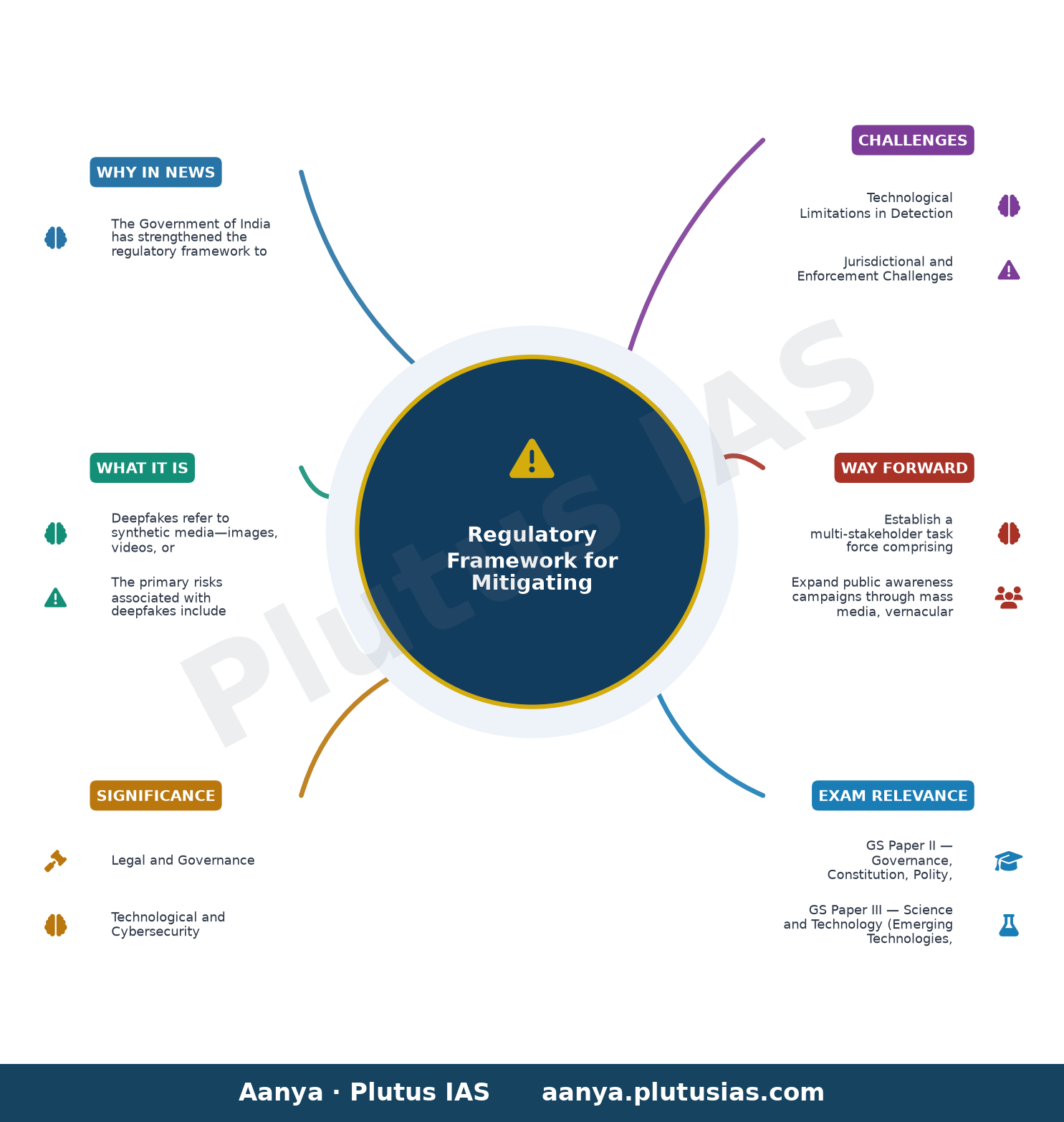
- GS Paper II — Governance, Constitution, Polity, Social Justice and International Relations (Cyber Governance, Digital Rights, and Cybercrime) | GS Paper III — Science and Technology (Emerging Technologies, Cybersecurity, and Ethical AI)
- Prelims: Deepfake, IT Act 2000, IT Rules 2021, Indian Justice Code 2023, Section 66D (Cyber Impersonation), Section 69A (Blocking of Content), Section 79 (Safe Harbour), AI-generated content labeling, Cybercrime, Intermediary Liability
- Essay: Ethical governance of artificial intelligence: Balancing innovation and societal protection, The role of state regulation in safeguarding digital sovereignty in the age of deepfakes
Quick Revision: Deepfakes are AI-generated synthetic media posing risks to identity, security, and public order; India regulates them via IT Act 2000 (Sections 66D, 66E, 69A), Indian Justice Code 2023 (Sections 319, 336, 353), and IT Rules 2021 (mandating labeling and 3-hour removal of illegal content).
Why is this in the news?
The Government of India has strengthened the regulatory framework to address the proliferation of deepfakes—AI-generated synthetic media including audio, video, and text—by amending the Information Technology (Intermediary Guidelines and Digital Media Ethics Code) Rules, 2021. The amendments mandate labeling of AI-generated content and reduce the timeline for removal of illegal content from 36 hours to 3 hours, reflecting a proactive stance to curb misinformation, impersonation, and threats to public order. This initiative aligns with global efforts to regulate generative AI while addressing India’s unique socio-political context.
Background
- The proliferation of deepfakes has escalated globally due to advancements in generative AI models such as Generative Adversarial Networks (GANs) and diffusion models, enabling hyper-realistic synthetic media.
- Deepfakes pose multifaceted risks including identity theft, financial fraud, electoral manipulation, and threats to national security and social cohesion.
- India’s digital ecosystem has over 800 million internet users, making it highly vulnerable to AI-generated disinformation campaigns, particularly during elections and public emergencies.
- The Indian Justice Code, 2023, introduced specific penal provisions to address cyber impersonation and the creation of false electronic records, directly relevant to deepfake offenses.
- The government has previously issued advisories to social media platforms to combat misinformation and deepfakes, including the 2023 advisory on pre-emptive action against deepfakes.
What are Deepfakes and the Regulatory Framework to Address Them?
- Deepfakes refer to synthetic media—images, videos, or audio—generated using artificial intelligence techniques like deep learning, which can convincingly replicate real individuals, events, or voices.
- The primary risks associated with deepfakes include identity theft, financial fraud, electoral interference, defamation, and the spread of disinformation leading to public disorder or communal tension.
- The regulatory framework in India is anchored in the Information Technology Act, 2000, which provides the legal basis for addressing cybercrimes, including those facilitated by deepfakes.
- Key sections of the IT Act relevant to deepfakes include: Section 66D (punishment for cyber impersonation), Section 66E (violation of privacy), Section 67 (publishing obscene material), and Section 69A (blocking of content in the interest of sovereignty and integrity of India).
- The Indian Justice Code, 2023, introduces specific penal provisions: Section 319 (fraud by impersonation), Section 336 (fraud by creating false electronic records), and Section 353 (spreading false information to incite public disorder or fear).
- The Information Technology (Intermediary Guidelines and Digital Media Ethics Code) Rules, 2021, impose obligations on intermediaries to monitor and remove illegal content, including deepfakes, within stipulated timelines.
- The 2026 amendments to the IT Rules mandate that AI-generated content must be labeled to inform users of its synthetic nature, enhancing transparency and accountability.
Key Features
| Feature | Significance |
|---|---|
| Mandatory labelling of AI-generated content under IT Rules | Enables users to distinguish synthetic content from authentic material, reducing misinformation risks and enhancing transparency in digital communication. |
| Reduction of takedown time for illegal content from 36 hours to 3 hours | Accelerates response to harmful deepfake content, mitigating immediate social, political, or economic consequences of misinformation. |
| Enhanced due diligence obligations for intermediaries (IT Rules, 2021) | Ensures proactive monitoring and swift action against deepfake dissemination, aligning with global best practices for platform accountability. |
| Mandatory grievance redressal mechanisms for intermediaries | Provides users with structured recourse against deepfake-related violations, ensuring procedural fairness and compliance. |
| Provisions for user verification and traceability in SSMIs (Social Media Intermediaries) | Facilitates law enforcement access to originators of harmful deepfake content, aiding in investigation and deterrence of cybercrimes. |
Why it Matters
Legal and Governance
- Strengthens the legal framework under the IT Act (Sections 66, 67, 69A, 79) and BNS (Sections 319, 336, 353) to address deepfake-induced fraud, impersonation, and disinformation as cognizable offences.
- Clarifies intermediary liability, shifting from passive to active responsibility in moderating AI-generated synthetic content.
- Aligns with constitutional principles of dignity (Article 21) and free speech (Article 19(1)(a)) by balancing regulation with user rights.
Technological and Cybersecurity
- Encourages adoption of automated detection tools by intermediaries to identify and flag deepfake content in real-time, reducing manual oversight burdens.
- Promotes development of watermarking and provenance technologies for AI-generated media, enhancing traceability and authenticity verification.
Societal and Democratic
- Protects electoral integrity by curbing deepfake propaganda that could manipulate voter perceptions or incite communal tensions during elections.
- Safeguards individual privacy and reputation against malicious impersonation, particularly for public figures and vulnerable groups.
- Mitigates risks of deepfake-driven financial fraud, identity theft, and reputational harm in professional and personal domains.
Economic
- Reduces transaction costs associated with cybercrime investigations by enabling faster takedowns and traceability of deepfake originators.
- Supports the growth of India’s AI and digital media sectors by fostering trust in synthetic content ecosystems.
Challenges
1. Technological Limitations in Detection
- Deepfake detection algorithms struggle with high-quality, low-latency synthetic content, leading to false negatives and delayed interventions.
- Evolving AI techniques (e.g., diffusion models) outpace regulatory updates, creating a persistent detection gap.
- Resource constraints for smaller intermediaries to deploy advanced detection tools effectively.
UPSC Link: GS3: Cybersecurity, Science & Tech
2. Jurisdictional and Enforcement Challenges
- Cross-border nature of deepfake dissemination complicates jurisdictional clarity and law enforcement coordination.
- Anonymity tools (VPNs, encrypted platforms) hinder traceability of deepfake creators, especially in dark web ecosystems.
- Inconsistent implementation of IT Rules across platforms due to varying technical and operational capacities.
UPSC Link: GS2: Governance, International Relations
3. Balancing Regulation and Innovation
- Over-regulation may stifle innovation in AI-driven creative industries, including gaming, animation, and virtual influencers.
- Risk of censorship overreach if intermediaries adopt overly restrictive content moderation policies to avoid liability.
- Need for proportional penalties to deter misuse without discouraging legitimate AI applications.
UPSC Link: GS3: IPR, Startup Ecosystem
4. Public Awareness and Digital Literacy
- Low awareness among users about deepfake risks and reporting mechanisms, leading to underutilization of grievance redressal systems.
- Cultural and linguistic diversity in India complicates the design of effective awareness campaigns and detection tools.
- Misinformation fatigue may reduce public vigilance over time, necessitating continuous education efforts.
UPSC Link: GS4: Ethics, Human Development
5. Ethical and Constitutional Dilemmas
- Risk of over-criminalization where benign AI applications (e.g., deepfake art) are conflated with malicious intent, violating Article 19(1)(a).
- Potential for state overreach in content moderation, raising concerns about surveillance and censorship under Article 21.
- Need for clear definitions of ‘harmful’ deepfake content to avoid subjective interpretations by intermediaries.
UPSC Link: GS2: Fundamental Rights
Challenges — UPSC Perspective
| Issue | Concern |
|---|---|
| Detection accuracy | False positives/negatives in identifying deepfakes reduce trust in automated systems and increase manual review burdens. |
| Cross-border enforcement | Jurisdictional conflicts and lack of international cooperation hinder prosecution of deepfake creators. |
| User anonymity tools | VPNs and encrypted platforms obscure identities, complicating traceability of deepfake originators. |
| Platform heterogeneity | Variations in technical capacity among intermediaries lead to inconsistent compliance with IT Rules. |
| Legal ambiguity | Lack of precise definitions for ‘harmful’ deepfake content creates enforcement challenges and potential misuse. |
| Digital divide | Low digital literacy in rural and marginalized communities increases vulnerability to deepfake exploitation. |
Way Forward
- Establish a multi-stakeholder task force comprising government, tech industry, academia, and civil society to develop standardized deepfake detection benchmarks and protocols.
- Expand public awareness campaigns through mass media, vernacular content, and school curricula to educate users on identifying and reporting deepfakes.
- Incentivize R&D in AI-driven deepfake detection tools through grants, tax benefits, and public-private partnerships to bridge technological gaps.
- Strengthen international cooperation via bilateral/multilateral agreements to address cross-border deepfake dissemination and harmonize enforcement mechanisms.
- Develop a national grievance redressal portal for deepfake-related complaints, integrating AI-assisted triage for faster resolution.
- Mandate periodic audits of intermediaries’ compliance with IT Rules, with penalties for non-adherence to ensure accountability.
- Promote voluntary adoption of blockchain-based provenance systems for AI-generated content to enhance traceability and authenticity.
- Conduct regular training programs for law enforcement agencies to improve investigation capabilities in deepfake-related cybercrimes.
UPSC Value Addition
Keywords for Mains Answer-Writing
Artificial Intelligence Regulation · Deepfake Content · IT Act 2000 and Amendments · IT Rules 2021 (Intermediary Guidelines) · Cybersecurity and Digital Ethics · Misinformation and Disinformation · Intermediary Liability · AI-generated Synthetic Media · Constitutional Safeguards for Digital Rights · Global AI Governance Models
Concept Flow
AI-generated synthetic content (deepfakes) → Rapid dissemination via social media platforms → Potential for misinformation, fraud, and reputational harm → Regulatory response through IT Rules and BNS amendments → Mandatory labelling and takedown timelines → Intermediary liability and due diligence obligations → Enforcement challenges due to technological and jurisdictional constraints → Need for multi-stakeholder collaboration and public awareness → Long-term goal: Trustworthy AI ecosystems aligned with constitutional values and democratic norms.
Prelims Practice Questions
Q1. Consider the following statements regarding the regulation of deepfake content in India:
1. The IT Rules 2021 mandate that AI-generated content must be labeled as such.
2. The time limit for removal of illegal content by intermediaries has been reduced to 3 hours.
3. The IT Act 2000 does not provide for penalties for identity theft under Section 66C.
4. The Indian Penal Code (BNS 2023) criminalizes fraud through impersonation under Section 319.
How many of the above statements are correct?
- Only one
- Only two
- Only three
- All four
Answer: Only three — Statements 1, 2, and 4 are correct. Statement 3 is incorrect as Section 66C of the IT Act 2000 specifically penalizes identity theft.
Q2. Assertion (A): The IT Rules 2021 require social media intermediaries with over 50 lakh users to publish compliance reports annually.
Reason (R): The IT Rules 2021 mandate that intermediaries must appoint a grievance officer to address user complaints within a stipulated time frame.
Which of the following is correct?
- Both A and R are true, and R is the correct explanation of A.
- Both A and R are true, but R is not the correct explanation of A.
- A is true, but R is false.
- A is false, but R is true.
Answer: Both A and R are true, but R is not the correct explanation of A. — Both A and R are true. The IT Rules 2021 require intermediaries to publish annual compliance reports and appoint grievance officers, but R does not explain A as the compliance report requirement is independent of the grievance redressal mechanism.
Q3. Match the following provisions of the IT Act 2000 with their respective descriptions:
Column I (Provision) | Column II (Description)
1. Section 66D | A. Penalty for publishing or transmitting obscene material
2. Section 67 | B. Penalty for cheating by impersonation
3. Section 66C | C. Penalty for identity theft
4. Section 69A | D. Power to issue directions for blocking public access to any information
Select the correct match:
- 1-B, 2-A, 3-C, 4-D
- 1-C, 2-A, 3-B, 4-D
- 1-D, 2-B, 3-A, 4-C
- 1-A, 2-C, 3-D, 4-B
Answer: 1-B, 2-A, 3-C, 4-D — Correct matches: 1-B (Section 66D: Cheating by impersonation), 2-A (Section 67: Publishing obscene material), 3-C (Section 66C: Identity theft), 4-D (Section 69A: Blocking access to information).
Mains Practice Question
✍ The Government of India has recently strengthened the regulatory framework to address the threats posed by AI-generated deepfake content. In this context, critically examine the efficacy of the existing legal and regulatory mechanisms in India to counter disinformation and synthetic media. Also, suggest measures to enhance the robustness of these mechanisms to ensure a safe and trustworthy digital ecosystem. (15 Marks)
Approach: MODEL-ANSWER SKELETON:
1. **Introduction**: Define deepfakes, their potential for misuse, and the need for regulation. Mention the recent regulatory changes (IT Rules 2021 amendments, reduced timeframe for content removal).
2. **Legal Framework**:
– **IT Act 2000**: Sections 66C (identity theft), 66D (cheating by impersonation), 67 (obscene content), 69A (blocking access), 79 (intermediary liability).
– **Indian Penal Code (BNS 2023)**: Sections 319 (impersonation fraud), 336 (fraud via false electronic records), 353 (false information causing public mischief).
– **IT Rules 2021**: Mandatory labeling of AI-generated content, grievance redressal mechanisms, compliance reporting, and intermediary obligations.
3. **Efficacy Analysis**:
– **Strengths**: Clear statutory provisions, reduced timeframe for content removal (3 hours), mandatory labeling, and intermediary accountability.
– **Limitations**: Enforcement challenges (jurisdictional issues, technological sophistication), lack of dedicated AI-specific legislation, and ambiguity in defining ‘illegal content’.
– **Judicial Precedents**: Reference to landmark cases like *Shreya Singhal v. Union of India* (2015) on intermediary liability and *Puttaswamy v. Union of India* (2017) on privacy rights.
4. **Comparative Perspective**:
– Contrast with global models (EU AI Act, US Executive Order on AI Safety). Highlight India’s proactive stance but need for harmonization with international standards.
5. **Suggestions for Enhancement**:
– **Legislative**: Enact a dedicated ‘Digital Safety Act’ to address AI-specific threats, including deepfakes.
– **Technological**: Mandate AI watermarking, develop automated detection tools, and invest in digital literacy programs.
– **Institutional**: Strengthen the role of the proposed ‘Digital India Corporation’ and enhance coordination between intermediaries, law enforcement, and civil society.
– **Judicial**: Establish specialized cyber courts for swift adjudication of digital crimes.
6. **Conclusion**: Balance between innovation and regulation, emphasizing the need for a multi-stakeholder approach to foster a secure digital ecosystem.
Source: PIB (Press Information Bureau)
Generated by AanyaAi for educational purpose.

- तमिलनाडु में बस किराए में संशोधन: सरकार को चार सप्ताह और समय मिला, उच्च न्यायालय का फैसला - September 22, 2026
- Madras HC gives Tamil Nadu 4 weeks to revise bus fares amid diesel price surge - September 22, 2026
- कुल्लू: NHPC की पार्वती-2 परियोजना के खिलाफ एफआईआर, 12 सदस्यीय जांच समिति गठित - September 21, 2026

No Comments