


06 Aug Jal Jeevan Mission 2.0: Centre Releases ₹6,154 Crore to 10 States in FY 2026-27
✎ Jal Jeevan Mission 2.0 shifts focus from infrastructure creation to sustainable O&M, digital governance (SNA Sparsh, Sujalam Bharat ID), and community ownership (VWSCs) to ensure long-term rural water security by December 2028.
Subject Relevance — Where This Topic Fits
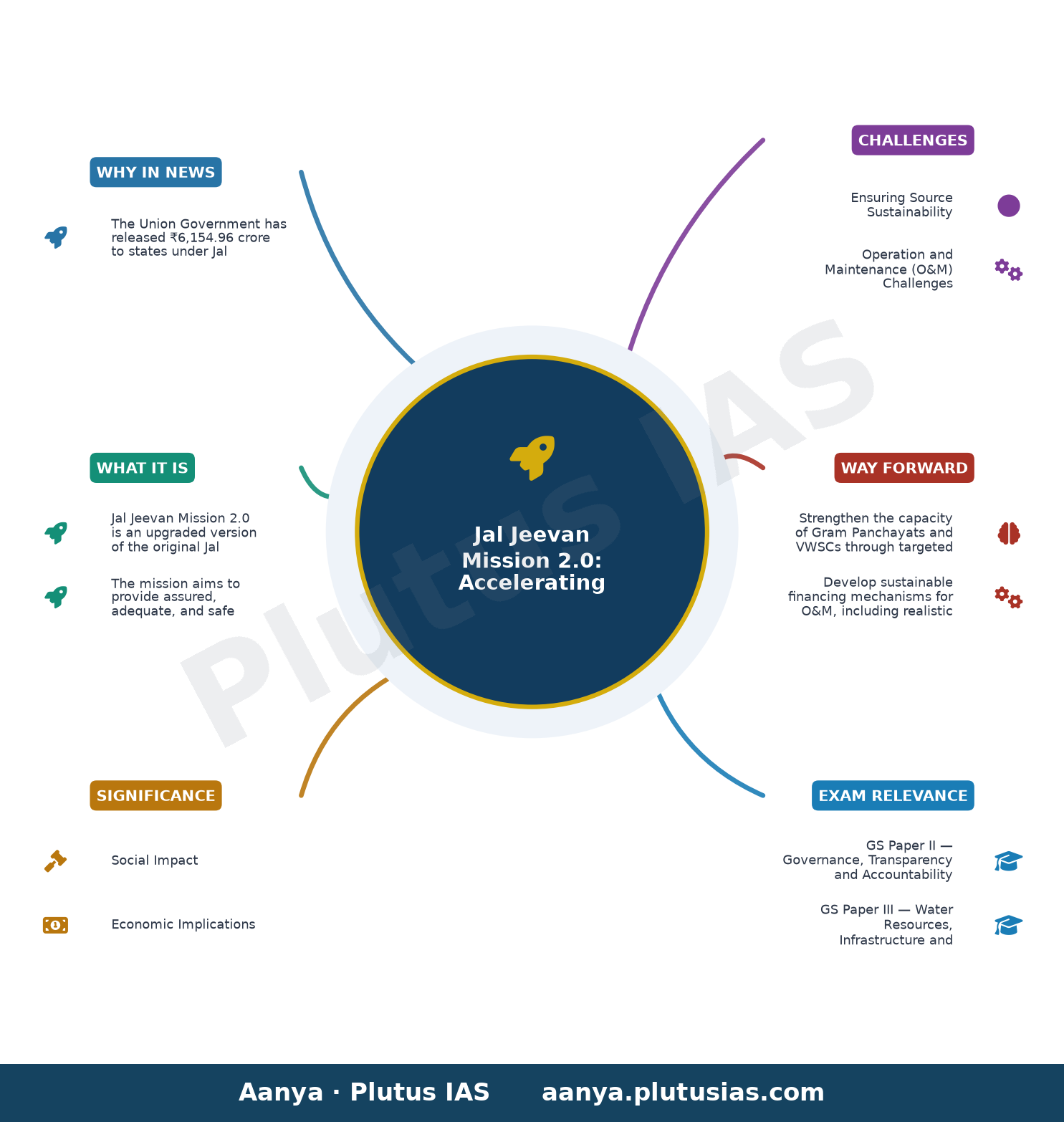
- GS Paper II — Governance, Transparency and Accountability | GS Paper III — Water Resources, Infrastructure and Digital Governance
- Prelims: Jal Jeevan Mission 2.0, Har Ghar Jal, SNA Sparsh, Village Water and Sanitation Committees (VWSCs), PM Gati Shakti Platform, Sujalam Bharat ID
- Essay: Role of Digital Public Infrastructure in Governance: Case Study of Jal Jeevan Mission 2.0, Community Participation in Sustainable Development: Lessons from Rural Water Supply Initiatives
Quick Revision: Jal Jeevan Mission 2.0 shifts focus from infrastructure creation to sustainable O&M, digital governance (SNA Sparsh, Sujalam Bharat ID), and community ownership (VWSCs) to ensure long-term rural water security by December 2028.
Why is this in the news?
The Union Government has released ₹6,154.96 crore to states under Jal Jeevan Mission (JJM) 2.0 for the financial year 2026-27, including ₹5,289.09 crore as central assistance to 10 states and ₹865.87 crore through the ‘SNA Sparsh’ platform to 13 states. This marks a significant step in sustaining the momentum of the mission, which aims to provide assured, adequate, and safe drinking water to all rural households by December 2028. The release underscores the shift from infrastructure creation to operational excellence, digital monitoring, and community-led management in rural water supply systems.
Background
- JJM 2.0 emphasizes not just infrastructure creation but sustainable operation and maintenance (O&M), water quality monitoring, community ownership, and digital governance.
- The ‘SNA Sparsh’ platform was introduced to streamline fund disbursement, expenditure tracking, and financial monitoring at the scheme level, enhancing transparency and accountability.
- Between the completion of JJM 1.0 and the approval of JJM 2.0, several states continued implementing rural water supply schemes using their own resources to maintain progress.
- The mission aligns with the Sustainable Development Goal 6 (SDG 6) target of universal and equitable access to safe and affordable drinking water for all.
What is Jal Jeevan Mission 2.0?
- Jal Jeevan Mission 2.0 is an upgraded version of the original Jal Jeevan Mission, approved by the Union Cabinet on 10 March 2026, with an extended implementation timeline until December 2028.
- The mission aims to provide assured, adequate, and safe drinking water to every rural household through Functional Household Tap Connections (FHTC), with a focus on sustainability and community participation.
- The financial outlay for JJM 2.0 is ₹8.69 lakh crore, including ₹3.59 lakh crore in central assistance, making it one of the largest rural water supply initiatives globally.
- A key shift in JJM 2.0 is the focus on Operation and Maintenance (O&M), ensuring long-term functionality of water supply systems rather than just infrastructure creation.
- The mission introduces ‘SNA Sparsh’, a digital platform for scheme-based fund disbursement, expenditure tracking, and financial monitoring, enhancing transparency and accountability.
- JJM 2.0 mandates the creation of ‘Sujalam Bharat ID’ for water supply assets, enabling unique identification and digital mapping of rural water infrastructure on the PM Gati Shakti Platform.
- Community ownership is strengthened through the formation of Village Water and Sanitation Committees (VWSCs), which are responsible for the operation, maintenance, and monitoring of water supply systems at the grassroots level.
- Water quality monitoring is institutionalized through regular testing and digital reporting, ensuring safe drinking water supply to rural households.
Key Features
| Feature | Significance |
|---|---|
| Extension of Mission Duration | Ensures continued focus and resource allocation for achieving universal rural tap water connectivity until December 2028. |
| Shift from Infrastructure to O&M | Emphasises sustainable service delivery through robust operation and maintenance, led by Gram Panchayats, ensuring long-term functionality of water supply systems. |
| Source Sustainability | Focuses on maintaining and rejuvenating water sources, critical for the uninterrupted and reliable supply of potable water. |
| Water Quality Monitoring | Prioritises the delivery of safe drinking water by implementing stringent quality checks and surveillance mechanisms. |
| Community Ownership | Promotes active participation and responsibility of local communities in managing and maintaining water infrastructure, fostering accountability and sustainability. |
| Digital Governance (SNA Sparsh, Sujalam Bharat ID, PM Gati Shakti) | Enhances transparency, efficiency, and real-time monitoring of fund utilisation, project progress, and asset management through technological integration. |
Why it Matters
Social Impact
- Ensures access to safe and adequate drinking water for rural households, directly improving public health outcomes by reducing waterborne diseases.
- Reduces the drudgery of women and girls who traditionally bear the responsibility of fetching water, thereby enhancing their educational and economic opportunities.
- Promotes equity and inclusion by providing essential services to all rural communities, irrespective of their socio-economic status.
Economic Implications
- Stimulates local economies through infrastructure development and employment generation in the water sector.
- Reduces healthcare expenditures by preventing water-related illnesses, leading to a more productive workforce.
- Enhances agricultural productivity in some regions by ensuring water availability for domestic use, freeing up other sources for irrigation.
Governance and Administrative Reforms
- Strengthens decentralised governance by empowering Gram Panchayats and Village Water and Sanitation Committees (VWSCs) in planning, implementation, and management of water supply schemes.
- Improves financial accountability and transparency through platforms like ‘SNA Sparsh’, enabling scheme-based payments and real-time monitoring of expenditures.
- Fosters inter-ministerial coordination and efficient resource allocation through integration with platforms like PM Gati Shakti for infrastructure mapping.
Environmental Sustainability
- Emphasises source sustainability, promoting conservation and rejuvenation of local water bodies and groundwater resources.
- Encourages responsible water management practices at the community level, contributing to long-term ecological balance.
Challenges
1. Ensuring Source Sustainability
- Depleting groundwater levels and erratic rainfall patterns pose significant threats to the long-term viability of water sources.
- Inadequate watershed management and unchecked industrial/agricultural pollution further exacerbate source degradation.
UPSC Link: Environment: Conservation, pollution
2. Operation and Maintenance (O&M) Challenges
- Lack of technical expertise and financial resources at the Gram Panchayat level for effective O&M of complex water supply infrastructure.
- Insufficient community contribution and ownership for routine maintenance and minor repairs, leading to system breakdowns.
UPSC Link: Governance: Local self-government
3. Water Quality Surveillance
- Challenges in establishing and maintaining robust water quality testing infrastructure, especially in remote areas.
- Ensuring regular testing and timely remedial action for contaminated sources remains a logistical hurdle.
UPSC Link: Social Sector: Health, human resources
4. Inter-State and Intra-State Disparities
- Variations in implementation pace and fund utilisation across states and regions due to differing administrative capacities and political will.
- Addressing the specific needs of difficult terrains, tribal areas, and drought-prone regions requires tailored approaches.
UPSC Link: Social Justice: Regional imbalances
5. Behavioural Change and Community Participation
- Overcoming traditional practices and fostering a sense of collective responsibility for water conservation and infrastructure maintenance.
- Ensuring equitable distribution and preventing misuse of water resources at the local level.
UPSC Link: Social Justice: Vulnerable sections
Challenges — UPSC Perspective
| Issue | Concern |
|---|---|
| Groundwater Depletion | Threatens long-term sustainability of water sources for rural supply. |
| Technical Capacity at Local Level | Hinders effective operation and maintenance of water infrastructure. |
| Financial Sustainability of O&M | Reliance on government funding without adequate community contribution for system upkeep. |
| Water Quality Monitoring Gaps | Ensuring consistent testing and addressing contamination effectively in all rural areas. |
| Community Ownership Deficit | Lack of active participation and responsibility in managing local water assets. |
| Digital Divide | Challenges in leveraging digital governance tools in areas with poor connectivity or digital literacy. |
Government Initiatives — Must-Memorise for Prelims
- Jal Jeevan Mission (JJM) 2.0
- Jal Jeevan Mission (JJM) 1.0
- PM Gati Shakti
Way Forward
- Strengthen the capacity of Gram Panchayats and VWSCs through targeted training programs on technical aspects of O&M, financial management, and community mobilisation.
- Develop sustainable financing mechanisms for O&M, including realistic user charges and community contributions, complemented by state support.
- Intensify efforts for source sustainability through integrated watershed management, rainwater harvesting, and rejuvenation of traditional water bodies, linking with other relevant schemes.
- Establish a robust, decentralised water quality surveillance system with community participation, ensuring regular testing at village level and prompt reporting of contamination.
- Leverage digital platforms like ‘SNA Sparsh’ and ‘Sujalam Bharat ID’ to enhance transparency, accountability, and real-time monitoring of fund flow, asset creation, and service delivery.
- Promote behavioural change communication campaigns to foster a sense of ownership, responsible water usage, and conservation ethics among rural communities.
- Address regional disparities by providing additional support and flexible guidelines for states facing unique geographical or socio-economic challenges in implementation.
- Integrate rural water supply planning with broader rural development initiatives to ensure holistic and synergistic outcomes.
UPSC Value Addition
Keywords for Mains Answer-Writing
Jal Jeevan Mission 2.0 · Safe Drinking Water · Community Ownership · Digital Governance · SNA Sparsh Platform · Rural Water Supply · Source Sustainability · Village Water and Sanitation Committee (VWSC) · PM Gati Shakti Platform · Geo-tagging of Assets · Water Quality Monitoring · O&M of Water Systems · Sujalam Bharat ID · Long-term Water Security · Union Budget 2026-27 · Union Ministry of Jal Shakti · Panchayati Raj Institutions (PRIs) · Sustainable Development Goals (SDG 6) · Water Supply Schemes · Public Fund Utilisation Efficiency
Constitutional & Policy Linkages
- {‘article’: ‘Article 243G’, ‘note’: ‘Empowering Panchayats for local development’}
- {‘article’: ‘Article 243W’, ‘note’: ‘Empowering Municipalities for urban services’}
- {‘article’: ‘Article 243ZD’, ‘note’: ‘District Planning Committees for integrated planning’}
- {‘article’: ‘Seventh Schedule, List II (State List), Entry 17’, ‘note’: ‘Water supply subject to state legislative power’}
Concept Flow
Government commitment to universal tap water access → Extension of Jal Jeevan Mission (JJM) 2.0 → Increased central financial assistance to states → Focus on O&M, source sustainability, digital governance → Enhanced community ownership and accountability → Improved rural health and socio-economic indicators → Achievement of Sustainable Development Goal 6
Prelims Practice Questions
Q1. Consider the following statements regarding Jal Jeevan Mission (JJM) 2.0:
1. Jal Jeevan Mission 2.0 aims to provide tap water connections to all rural households by December 2028.
2. The mission includes a dedicated platform called ‘SNA Sparsh’ for plan-based fund disbursement and real-time monitoring.
3. The central share of funding under JJM 2.0 is entirely released through the State Finance Commissions.
4. The mission emphasizes the handover of completed water supply schemes to Village Water and Sanitation Committees (VWSCs) for operation and maintenance.
How many of the above statements are correct?
- Only one
- Only two
- Only three
- All
Answer: Only three — Statements 1, 2, and 4 are correct. Statement 3 is incorrect as the central share is released through the SNA Sparsh platform and not solely through State Finance Commissions.
Q2. Assertion (A): The ‘SNA Sparsh’ platform under Jal Jeevan Mission 2.0 enhances transparency and accountability in fund utilisation.
Reason (R): It enables geo-tagging of rural water supply infrastructure and digital mapping on the PM Gati Shakti platform.
In the context of the above two statements, which one of the following is correct?
- Both A and R are true, and R is the correct explanation of A
- Both A and R are true, but R is not the correct explanation of A
- A is true but R is false
- A is false but R is true
Answer: Both A and R are true, but R is not the correct explanation of A — Both the assertion and reason are true. The SNA Sparsh platform indeed enhances transparency and accountability by enabling real-time monitoring and geo-tagging of assets on the PM Gati Shakti platform, which directly supports the explanation of the assertion.
Q3. Match the following states with the amount of central funds released under Jal Jeevan Mission 2.0 for the financial year 2026-27 (as per the given data):
Column I (State) Column II (Amount Released in ₹ Crore)
A. Uttar Pradesh 1. 669.92
B. Assam 2. 2,711.52
C. Maharashtra 3. 594.44
D. Karnataka 4. 795.74
Select the correct match:
- A-2, B-1, C-3, D-4
- A-1, B-2, C-3, D-4
- A-2, B-3, C-1, D-4
- A-4, B-1, C-2, D-3
Answer: A-2, B-1, C-3, D-4 — The correct matches are: A (Uttar Pradesh) – 2,711.52; B (Assam) – 669.92; C (Maharashtra) – 594.44; D (Karnataka) – 795.74.
Mains Practice Question
✍ ‘Jal Jeevan Mission 2.0 represents a paradigm shift from infrastructure creation to sustainable service delivery through community ownership and digital governance.’ Critically examine this statement with reference to the mission’s objectives, institutional mechanisms, and recent progress. (15 Marks)
Approach: MODEL-ANSWER SKELETON:
1. **Context and Objectives of JJM 2.0**:
– Transition from JJM 1.0 (infrastructure focus) to JJM 2.0 (service delivery, O&M, water quality, and sustainability).
– Core objective: Provide reliable, adequate, and safe tap water to all rural households by December 2028.
– Total outlay: ₹8.69 lakh crore, with ₹3.59 lakh crore central assistance.
2. **Institutional Mechanisms for Community Ownership**:
– Role of Panchayati Raj Institutions (PRIs) and Village Water and Sanitation Committees (VWSCs).
– Formal handover of completed schemes to VWSCs for O&M (e.g., ‘Jal Aapda’ initiative).
– ‘Sujalam Bharat ID’ for unique identification of water assets.
3. **Digital Governance and Transparency**:
– ‘SNA Sparsh’ platform: Plan-based fund disbursement, real-time monitoring, and geo-tagging of assets on PM Gati Shakti.
– Data-driven decision-making: Water quality monitoring, ‘Jal Seva Assessment’ for community-led evaluations.
– Accountability mechanisms: Auditing, public fund utilisation efficiency, and transparency in fund release (e.g., ₹5,289.09 crore released to 10 states and ₹865.87 crore via SNA Sparsh to 13 states in 2026-27).
4. **Critical Examination**:
– **Strengths**: Shift towards sustainability, community participation, and digital tools addresses long-term water security challenges.
– **Challenges**: Implementation gaps in remote areas, varying state capacities, and ensuring equitable access.
– **Comparative Perspective**: Contrast with traditional approaches (e.g., centrally managed schemes) and global best practices (e.g., community-led total sanitation models).
5. **Conclusion**:
– JJM 2.0’s emphasis on community ownership and digital governance is a progressive step toward achieving SDG 6 (Clean Water and Sanitation).
– Success hinges on sustained political will, adequate funding, and robust institutional frameworks at the grassroots level.
Source: PIB (Press Information Bureau)
Generated by AanyaAi for educational purpose.

- राज्यों द्वारा सरकारी प्रतिभूतियों की नीलामी में ₹16,750 करोड़ का सफल संग्रह - September 22, 2026
- RBI Auction Results: State Govt Securities Yield Trends & Implications for UPSC 2026 - September 22, 2026
- सुप्रीम कोर्ट का चुनाव आयोग से बड़ा सवाल: दिल्ली में 33 लाख मतदाताओं को नोटिस देने का क्या आधार है? - September 22, 2026

No Comments