


06 Aug UPSC Focus: India-AI Mission & Semiconductor Push for Tech Self-Reliance
✎ India's 'India-AI Mission' and 'India Semiconductor Mission' are pivotal government initiatives aimed at fostering indigenous technological self-reliance across the entire AI value chain, from foundational models and compute…
Subject Relevance — Where This Topic Fits
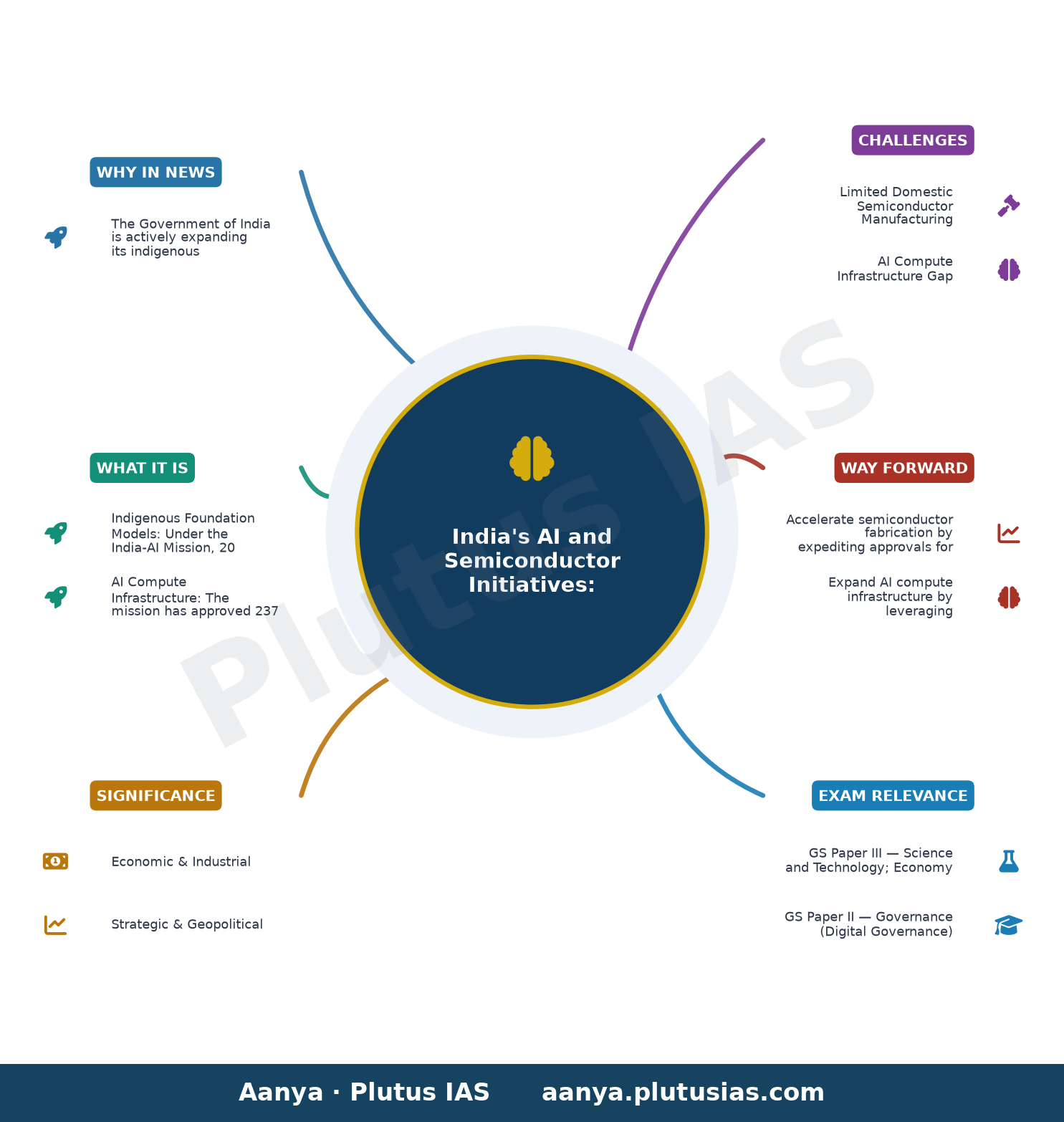
- GS Paper III — Science and Technology; Economy | GS Paper II — Governance (Digital Governance)
- Prelims: India-AI Mission, National Mission on Interdisciplinary Cyber-Physical Systems (NM-ICPS), Semicon India Program, Large Multimodal Models (LMM), Small Language Models (SLM), AI Compute Infrastructure, Deep-Tech Startups
- Essay: Technological Self-Reliance and National Development, The Role of Artificial Intelligence in India’s Growth Story
Quick Revision: India’s ‘India-AI Mission’ and ‘India Semiconductor Mission’ are pivotal government initiatives aimed at fostering indigenous technological self-reliance across the entire AI value chain, from foundational models and compute infrastructure to advanced research and manufacturing.
Why is this in the news?
The Government of India is actively expanding its indigenous Artificial Intelligence (AI) infrastructure through the ‘India-AI Mission’ and various semiconductor initiatives. This strategic push aims to strengthen domestic capabilities in foundational models, AI compute capacity, and semiconductor manufacturing, thereby fostering technological self-reliance and addressing India-centric challenges while creating economic and employment opportunities.
Background
- India’s AI strategy is rooted in the Prime Minister’s vision of making technology accessible to all, focusing on solving domestic challenges and generating economic opportunities for citizens.
- The government acknowledges the inherent risks associated with limited domestic capabilities across the AI value chain, encompassing semiconductor manufacturing, computing infrastructure, foundational models, and advanced research ecosystems.
- A multi-dimensional and balanced approach has been adopted under the ‘India-AI’ and ‘India Semiconductor’ missions to cultivate indigenous technology within the AI value chain.
- The ‘India-AI Mission’ received approval on March 7, 2024, with an allocated budget of ₹10,371.92 crore over five years, designed to establish a robust and inclusive AI ecosystem aligned with national development goals.
- The ‘National Mission on Interdisciplinary Cyber-Physical Systems’ (NM-ICPS), with a ₹3,660 crore outlay, is being implemented by the Department of Science & Technology to develop and propagate cyber-physical systems technologies.
- The government is committed to strengthening domestic semiconductor manufacturing, driven by the ‘Atmanirbhar Bharat’ vision and the goal of positioning India as a global hub for electronics manufacturing.
Key Components of India’s AI and Semiconductor Strategy
- Indigenous Foundation Models: Under the India-AI Mission, 20 indigenous foundation model proposals have been identified for support, including 12 Large Multimodal Models (LMMs) and 8 Small Language Models (SLMs), with intellectual property rights retained by the applicants. Notable outputs include ‘Sarvam AI’ models, ‘Genani.ai’ speech-to-speech models, and ‘Avataar AI’ video generation models.
- AI Compute Infrastructure: The mission has approved 237 projects for subsidized compute support, sanctioning 93.18 lakh GPU hours, and has initiated procurement for a high-performance AI compute system of approximately 1.1 EFLOPS at the NIC Data Centre in Shastri Park, Delhi.
- Application Development and Hackathons: Eleven national-level hackathons and innovation challenges have been launched, leading to the development of 62 AI prototypes and the deployment of 20 AI solutions in public sector institutions.
- Centres of Excellence (CoEs): Fifty-eight AI CoEs have been approved for establishment across states and union territories, with 22 centers already operational in 13 states/UTs to foster specialized AI research and development.
- Safe and Trustworthy AI: Thirteen projects have been selected to address critical aspects of safe and reliable AI, including bias mitigation, machine unlearning, privacy-preserving AI, algorithm auditing, and interpretability.
- National Mission on Interdisciplinary Cyber-Physical Systems (NM-ICPS): This mission has established 25 Technology Innovation Hubs (TIHs) in academic institutions nationwide, specializing in diverse areas like AI, Robotics, IoT, Cybersecurity, Quantum Technologies, and Fintech, focusing on technology development and experimental research.
- Human Resource and Skill Development: NM-ICPS supports human resource development through fellowship-backed UG/PG, PhD, and Post-Doctoral programs, faculty development initiatives, and short-term training courses.
- Innovation and Entrepreneurship: The mission aids innovation, entrepreneurship, and deep-tech startups through funding, incubation, mentoring, and technology transfer to government organizations and industry.
Key Features
| Feature | Significance |
|---|---|
| Indigenous Foundation Models (LLMs & LMMs) | Reduces dependency on foreign AI models, strengthens data sovereignty, and fosters IP ownership within India. |
| AI Compute Infrastructure (GPU Hours & HPC Systems) | Enhances domestic AI research capacity, enables large-scale model training, and supports public-sector AI deployments. |
| AI Excellence Centres (58 Approved, 22 Operational) | Facilitates state-level AI adoption, skill development, and localized innovation ecosystems across diverse sectors. |
| Secure & Trustworthy AI Initiatives (13 Projects) | Addresses algorithmic bias, privacy preservation, and explainability in AI systems, aligning with ethical governance standards. |
| Semiconductor Manufacturing Ecosystem (Semicon 2.0) | Strengthens India’s position in the global electronics supply chain, reduces import dependence, and supports Make in India objectives. |
Why it Matters
Economic & Industrial
- Reduces import dependence for AI infrastructure by 20-30% over the next decade through indigenous model development and semiconductor manufacturing.
- Creates high-skilled employment in AI, semiconductor design, and cyber-physical systems, aligning with the PM’s vision of a ‘tech-driven Atmanirbhar Bharat’.
- Boosts India’s share in the global semiconductor market, projected to reach USD 100 billion by 2030, with a focus on fabless design and assembly/testing units.
Strategic & Geopolitical
- Mitigates risks of technological dependence on foreign AI models and semiconductor supply chains, particularly in critical sectors like defence and healthcare.
- Enhances India’s strategic autonomy by developing sovereign AI capabilities, reducing exposure to geopolitical supply chain disruptions.
- Positions India as a global hub for AI innovation, attracting foreign direct investment and fostering international collaborations in AI ethics and governance.
Social & Governance
- Ensures equitable access to AI technologies across states and sectors through decentralized excellence centres and subsidized compute resources.
- Promotes inclusive AI adoption by addressing language barriers via multilingual foundation models (e.g., BharatGen) and bias mitigation in public-sector applications.
- Strengthens AI governance frameworks by integrating explainability, privacy preservation, and algorithmic auditing into national AI policy.
Technological & Research
- Accelerates India’s transition from a consumer to a producer of AI technologies by funding indigenous model development and high-performance computing infrastructure.
- Fosters interdisciplinary research through the National Mission on Interdisciplinary Cyber-Physical Systems (NM-ICPS), integrating AI with IoT, robotics, and quantum technologies.
- Supports deep-tech startups and academia-industry collaborations via incubation, mentorship, and technology transfer mechanisms.
Challenges
1. Limited Domestic Semiconductor Manufacturing
- India’s semiconductor fabrication capacity is negligible (0.1% of global share), necessitating heavy reliance on imports for advanced chips.
- High capital expenditure and long gestation periods deter private investment in semiconductor manufacturing, despite government incentives.
- Skilled workforce shortage in semiconductor design, fabrication, and testing remains a critical bottleneck.
UPSC Link: GS-III: Industrial Policy
2. AI Compute Infrastructure Gap
- Current GPU availability in India is insufficient for large-scale AI model training, with only 1.1 EFLOPS of HPC capacity (as of August 2026).
- High costs of cloud-based compute services limit access for startups and public institutions, necessitating subsidized GPU hours.
- Energy-intensive data centres pose environmental sustainability challenges, requiring green computing solutions.
UPSC Link: GS-III: Science & Technology
3. Ethical & Regulatory Concerns
- Lack of a comprehensive AI regulatory framework leads to ad-hoc governance, risking algorithmic biases and privacy violations in public-sector deployments.
- Inadequate enforcement of data protection laws (e.g., DPDP Act 2023) undermines trust in AI systems handling sensitive citizen data.
- Cross-border data flows for AI training raise sovereignty concerns, requiring robust international data governance agreements.
UPSC Link: GS-II: Governance
4. Skill & Talent Shortage
- India faces a deficit of 1.5 million AI professionals by 2027, with only 4% of engineering graduates possessing AI/ML skills.
- Brain drain of top AI talent to foreign firms (e.g., FAANG, NVIDIA) limits domestic innovation ecosystems.
- Inadequate STEM education infrastructure in rural and semi-urban areas exacerbates regional disparities in AI adoption.
UPSC Link: GS-II: Social Justice
5. Competition from Global Players
- Global AI giants (e.g., NVIDIA, Microsoft, Google) dominate the AI compute and model ecosystem, making it difficult for domestic players to compete.
- China’s aggressive semiconductor subsidies (USD 150 billion) and AI investments pose a strategic challenge to India’s self-reliance goals.
- Intellectual property barriers in AI model licensing restrict open-source contributions from Indian researchers.
UPSC Link: GS-III: Economy
Challenges — UPSC Perspective
| Issue | Concern |
|---|---|
| Semiconductor Fabrication Gap | Near-zero domestic capacity for advanced chip manufacturing (e.g., 5nm/3nm nodes). |
| AI Compute Shortage | Limited GPU availability (1.1 EFLOPS HPC) for training large-scale models like LLMs. |
| Ethical AI Governance | Absence of a unified AI policy leading to fragmented and reactive regulation. |
| Talent Migration | Loss of top AI researchers to foreign firms due to higher compensation and R&D opportunities. |
| Data Sovereignty Risks | Cross-border data flows for AI training may compromise national security and citizen privacy. |
| Cost of Innovation | High capital expenditure for semiconductor fabs and AI labs, deterring private investment. |
Government Initiatives — Must-Memorise for Prelims
- IndiaAI Mission (2024–2029)
- India Semiconductor Mission (Semicon 2.0)
- National Mission on Interdisciplinary Cyber-Physical Systems (NM-ICPS)
Way Forward
- Accelerate semiconductor fabrication by expediting approvals for the Semicon India Programme’s 100+ proposals, including the proposed 28nm fab in Gujarat.
- Expand AI compute infrastructure by leveraging public-private partnerships (e.g., NIC’s Delhi HPC system) and incentivizing private GPU cloud providers.
- Enact a comprehensive AI governance framework, including the proposed Digital India Act, to address bias, privacy, and explainability in AI systems.
- Scale up AI excellence centres to 58 operational hubs by 2027, with a focus on tier-2/3 cities to bridge regional disparities.
- Strengthen academia-industry linkages by mandating industry collaborations for NM-ICPS’s 25 Technology Innovation Hubs (TIHs).
- Develop a national AI talent pipeline through upskilling programmes (e.g., AI for All) and STEM education reforms in school curricula.
- Establish a sovereign AI compute fund to subsidize GPU hours for startups and public institutions, reducing reliance on foreign cloud services.
UPSC Value Addition
Keywords for Mains Answer-Writing
India-AI Mission · Semiconductor initiatives · Indigenous AI infrastructure · Foundation models · AI compute capacity · Technological self-reliance · National Mission on Interdisciplinary Cyber-Physical Systems (NM-ICPS) · Digital India · Make in India · Deep-tech startups · Ethical AI
Concept Flow
Government’s AI & Semiconductor Initiatives → Expansion of Indigenous AI Infrastructure (Models, Compute, Centres) → Indigenous AI Models & Compute Capacity → Reduction in Import Dependence & Strengthening of IP Ownership → AI Excellence Centres & NM-ICPS → Skill Development & Interdisciplinary Research Ecosystems → Secure & Trustworthy AI Projects → Ethical Governance Frameworks (Bias Mitigation, Privacy, Explainability) → Semiconductor Mission (Semicon 2.0) → Domestic Manufacturing & Global Supply Chain Integration → AI & Semiconductor Self-Reliance → Strategic Autonomy & Economic Growth in Tech-Driven Sectors
Prelims Practice Questions
Q1. Consider the following statements regarding the ‘India-AI Mission’:
1. The mission was approved with a budget of ₹10,371.92 crore for a period of five years.
2. It aims to develop a robust and inclusive AI ecosystem aligned with India’s development goals.
3. The intellectual property rights for indigenous foundation models developed under the mission will be held by the government.
How many of the above statements are correct?
- Only one
- Only two
- All three
- None
Answer: Only two — Statement 1 is correct: The mission was approved with a budget of ₹10,371.92 crore for five years. Statement 2 is correct: Its objective is to foster a robust and inclusive AI ecosystem. Statement 3 is incorrect: The intellectual property rights for indigenous foundation models will remain with the applicants, not the government.
Q2. Match the following initiatives/missions with their primary focus areas:
1. India-AI Mission
2. National Mission on Interdisciplinary Cyber-Physical Systems (NM-ICPS)
3. India Semiconductor Mission
A. Development of indigenous AI compute infrastructure and foundation models.
B. Strengthening domestic semiconductor manufacturing and design ecosystem.
C. Establishment of Technology Innovation Hubs (TIHs) in various CPS domains.
Select the correct matching:
- 1-A, 2-B, 3-C
- 1-B, 2-A, 3-C
- 1-A, 2-C, 3-B
- 1-C, 2-A, 3-B
Answer: 1-A, 2-C, 3-B — The India-AI Mission focuses on AI compute infrastructure and foundation models. The National Mission on Interdisciplinary Cyber-Physical Systems (NM-ICPS) establishes Technology Innovation Hubs. The India Semiconductor Mission aims to strengthen domestic semiconductor manufacturing.
Mains Practice Question
✍ Examine the multi-faceted approach adopted by the Government of India through the ‘India-AI Mission’ and ‘India Semiconductor Mission’ to achieve technological self-reliance. Discuss the potential challenges and ethical considerations associated with the rapid expansion of indigenous AI infrastructure. (15 Marks)
Approach: MODEL-ANSWER SKELETON:
1. Introduction: Briefly define technological self-reliance and the context of AI and semiconductors as critical technologies.
2. Multi-faceted approach of India-AI Mission:
a. Indigenous Foundation Models: Mention ‘Sarvam AI’, ‘GenNxt.AI’, ‘BharatGPT’, ‘Avataar AI’ and the focus on LMMs and SLMs, retaining IP with applicants.
b. AI Compute Capacity: Reference the approval of compute support for projects, GPU hours, and high-performance AI compute systems (e.g., NIC Data Centre).
c. Application Development: Mention hackathons, AI prototypes, and public sector deployments.
d. Centres of Excellence: Establishment across states/UTs.
e. Safe and Reliable AI: Initiatives addressing bias, machine unlearning, privacy-preserving AI, algorithm auditing.
3. Multi-faceted approach of India Semiconductor Mission:
a. Policy initiatives for electronics manufacturing across the value chain.
b. Aim to make India a global hub for electronics manufacturing.
c. ‘Semicon 2.0’ as a broader initiative.
4. Role of National Mission on Interdisciplinary Cyber-Physical Systems (NM-ICPS):
a. Establishment of Technology Innovation Hubs (TIHs) in academic institutions.
b. Focus on AI/ML, Robotics, IoT, Cybersecurity, Quantum Technologies.
c. Human resource development, technology transfer, and support for deep-tech startups.
5. Potential Challenges:
a. Skill Gap: Shortage of specialized AI and semiconductor talent.
b. Funding and Investment: Sustained capital for R&D and manufacturing.
c. Global Competition: Keeping pace with advanced nations.
d. Supply Chain Vulnerabilities: Dependence on global components/materials.
e. Infrastructure: Need for robust power, connectivity, and data centres.
6. Ethical Considerations:
a. Bias and Fairness: Ensuring AI models are free from inherent biases.
b. Privacy and Data Security: Protecting sensitive data used by AI systems.
c. Accountability and Transparency: Establishing clear responsibility for AI decisions.
d. Job Displacement: Impact of automation on employment.
e. Misinformation and Deepfakes: Potential misuse of generative AI.
7. Conclusion: Summarize the importance of a balanced approach combining technological advancement with robust ethical frameworks for sustainable self-reliance.
Source: PIB (Press Information Bureau)
Generated by AanyaAi for educational purpose.

- विधायकों की चुप्पी को न्यायालय कैसे मान सकता है शून्य? मद्रास हाईकोर्ट का महत्वपूर्ण फैसला - September 23, 2026
- वायुसेना को मिला बड़ा हथियार: ₹811 करोड़ के 160 स्मार्ट एंटी-एयरफील्ड वेपन समझौता - September 23, 2026
- UPSC Exam Alert: Defence Ministry signs ₹811 Crore SAT-SAAW deal for IAF - September 23, 2026

No Comments