


07 Aug Kerala POCSO Cases Rise: Key Trends & UPSC State PCS Analysis 2025
✎ The POCSO Act, 2012, is a child-centric legislation that mandates stringent punishments for sexual offences against minors, emphasises child-friendly trial processes, and requires mandatory reporting to ensure accountability and…
Subject Relevance — Where This Topic Fits
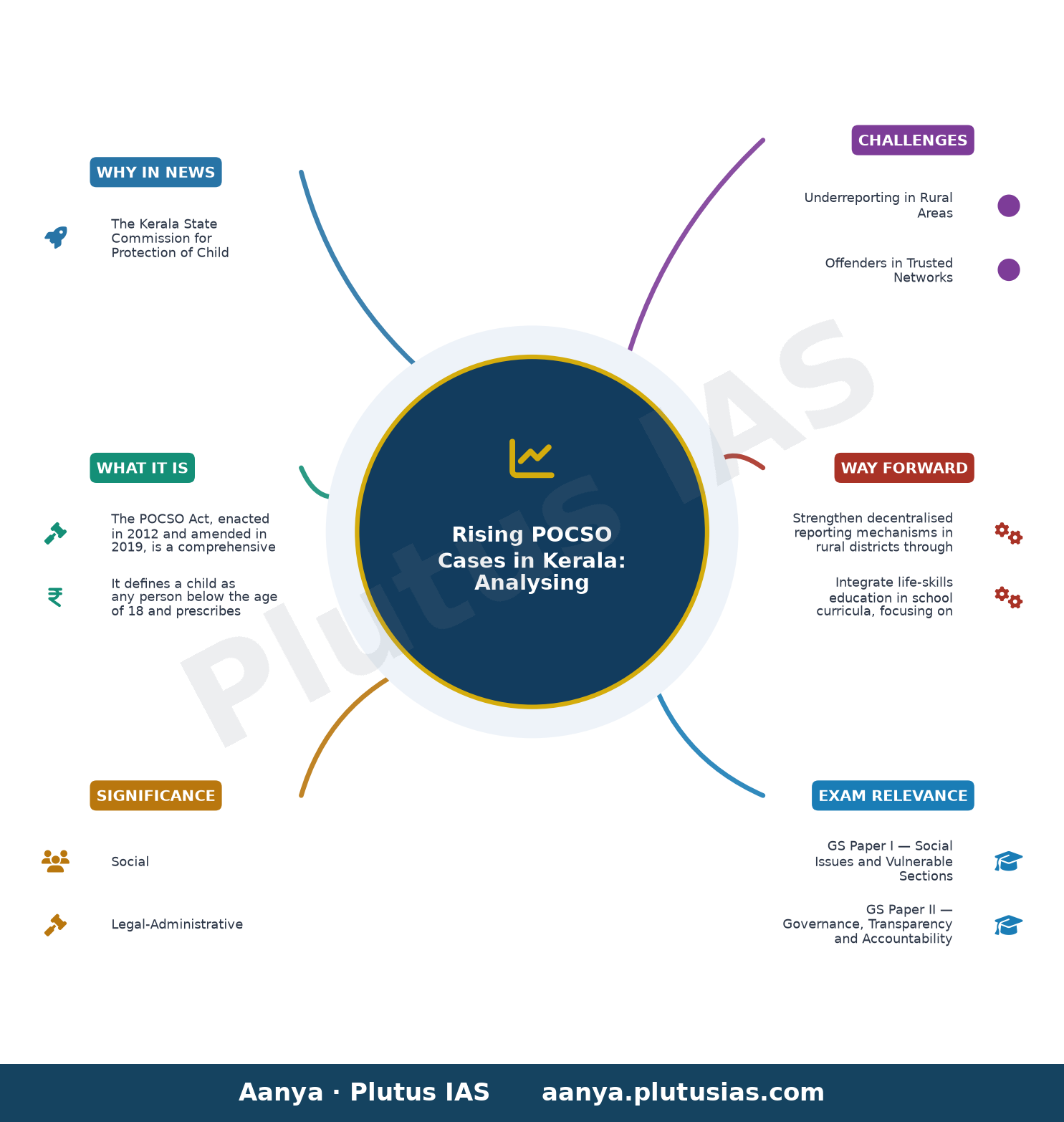
- GS Paper I — Social Issues and Vulnerable Sections | GS Paper II — Governance, Transparency and Accountability | GS Paper III — Internal Security and Disaster Management
- Prelims: POCSO Act, 2012, Kerala State Commission for Protection of Child Rights (KSCPCR), State Crime Records Bureau (SCRB), Child Sexual Abuse (CSA), Vulnerable Sections, Cyber Crimes against Children, Life Skills Education
- Essay: The erosion of childhood: Causes and consequences of rising child sexual abuse in India, Balancing child protection with systemic accountability: Lessons from Kerala’s POCSO trends
Quick Revision: The POCSO Act, 2012, is a child-centric legislation that mandates stringent punishments for sexual offences against minors, emphasises child-friendly trial processes, and requires mandatory reporting to ensure accountability and protection.
Why is this in the news?
The Kerala State Commission for Protection of Child Rights (KSCPCR) has released its annual report for 2025-26, highlighting a continued rise in cases registered under the Protection of Children from Sexual Offences (POCSO) Act in Kerala. While the increase reflects improved reporting mechanisms and reduced hesitation among victims, it also underscores persistent vulnerabilities, particularly among adolescent girls and in familiar domestic spaces. The report’s findings necessitate a re-evaluation of child protection policies, with a focus on preventive education, legal literacy, and institutional accountability.
Background
- The POCSO Act, 2012, was enacted to provide a robust legal framework for the protection of children from sexual offences, including penetrative and non-penetrative assault, sexual harassment, and pornography.
- Kerala established the Kerala State Commission for Protection of Child Rights (KSCPCR) in 2013 under the Commissions for Protection of Child Rights Act, 2005, to monitor child rights violations and recommend corrective measures.
- The State Crime Records Bureau (SCRB) compiles and analyses crime data, including POCSO cases, to inform policy and enforcement strategies.
- Kerala has consistently reported higher POCSO cases compared to national averages, attributed to factors such as higher legal literacy, urbanisation, and better access to reporting mechanisms.
- The rise in reported cases does not necessarily indicate an increase in actual incidents but reflects improved awareness, reduced stigma, and stronger institutional responses.
- The vulnerability of children to sexual abuse within familial and familiar environments remains a critical concern, as highlighted by the KSCPCR report.
What is the Protection of Children from Sexual Offences (POCSO) Act, 2012?
- The POCSO Act, enacted in 2012 and amended in 2019, is a comprehensive legislation designed to protect children under 18 years of age from sexual abuse, exploitation, and pornography.
- It defines a child as any person below the age of 18 and prescribes stringent punishments, including imprisonment and fines, for offenders.
- The Act mandates the establishment of Special Courts for the speedy trial of POCSO cases, ensuring child-friendly procedures and protection of victims’ identities.
- It includes provisions for mandatory reporting of sexual offences against children by individuals, institutions, and authorities, with penalties for non-compliance.
- The Act recognises different forms of sexual abuse, including penetrative and non-penetrative assault, sexual harassment, and the use of children in pornographic materials.
- It emphasises the need for child-friendly investigation and trial processes, including the appointment of support persons and the use of audio-visual aids.
- The Act also addresses cyber crimes against children, including online grooming, sextortion, and the circulation of explicit content involving minors.
- The POCSO Act operates in conjunction with other laws such as the Juvenile Justice (Care and Protection of Children) Act, 2015, and the Information Technology Act, 2000.
Key Features
| Feature | Significance |
|---|---|
| Rise in POCSO cases (2025 vs 2024) | Indicates improved reporting mechanisms and reduced stigma, but does not necessarily signify a proportional increase in actual crimes. |
| Highest reporting in Thiruvananthapuram | Reflects urbanisation, population density, and better access to reporting mechanisms, not necessarily higher prevalence. |
| Gender distribution (86% girls) | Highlights the disproportionate vulnerability of female children to sexual offences, requiring gender-sensitive interventions. |
| Age-wise vulnerability (15-18 years) | Adolescents face heightened risk due to physical, emotional, and social factors, necessitating targeted protection strategies. |
| Offenders in familiar spaces (22% in survivor’s home) | Emphasises the need for life-skills education and awareness to recognise and report abuse within trusted environments. |
Why it Matters
Social
- Underscores systemic failures in child protection despite legal frameworks like POCSO, necessitating a multi-stakeholder approach.
- Exposes the prevalence of abuse within private and familiar spaces, challenging societal norms of trust and safety.
- Highlights the intersectionality of vulnerability with gender, age, and disability, requiring tailored interventions.
Legal-Administrative
- Demonstrates the efficacy of awareness campaigns and legal literacy in improving reporting, validating state-led interventions.
- Reveals gaps in data granularity (27% unclear locations), indicating the need for robust monitoring and investigation frameworks.
- Shows the role of State Crime Records Bureau in tracking trends, essential for evidence-based policymaking.
Policy
- Validates the necessity of child protection policies under the POCSO Act, but calls for stronger implementation and grievance redressal.
- Highlights the need for integrating life-skills education in school curricula to empower children with knowledge of bodily autonomy and reporting mechanisms.
Challenges
1. Underreporting in Rural Areas
- Lower reporting in rural districts suggests limited access to POCSO mechanisms, necessitating decentralised reporting channels.
- Cultural stigma and fear of social ostracisation may deter victims from reporting, requiring community-level awareness.
UPSC Link: GS2: Governance, GS3: Social Justice
2. Offenders in Trusted Networks
- Majority of offences occur within familiar spaces, exploiting societal trust, demanding stricter background checks for caregivers.
- Requires mandatory training for parents, teachers, and community leaders on recognising and reporting abuse.
UPSC Link: GS1: Society, GS4: Ethics
3. Data Gaps in Reporting
- 27% of cases lack clear location data, hindering targeted interventions and resource allocation.
- Need for standardised data collection protocols across districts to ensure accuracy and comparability.
UPSC Link: GS2: Governance, GS3: Disaster Management
4. Vulnerability of Adolescents
- 55% of survivors are aged 15-18, indicating heightened risk during adolescence due to physical, emotional, and social changes.
- Requires age-specific interventions, including peer-led awareness and counselling services.
UPSC Link: GS1: Society, GS2: Social Justice
5. Disability-Inclusive Protection
- 3% of survivors are differently abled, a rise from previous years, indicating systemic neglect in protection mechanisms.
- Need for accessible reporting channels, sign-language interpreters, and disability-sensitive investigation protocols.
UPSC Link: GS2: Social Justice, GS3: Inclusive Growth
Challenges — UPSC Perspective
| Issue | Concern |
|---|---|
| Rural-Urban Disparity in Reporting | Limited access to POCSO mechanisms and cultural barriers reduce reporting in rural areas. |
| Offenders in Familiar Spaces | Exploitation of trust within families and communities complicates detection and prevention. |
| Data Incompleteness | Lack of granular data on offence locations impedes targeted policy responses. |
| Adolescent Vulnerability | High risk among 15-18-year-olds due to physical and social transitions. |
| Disability-Specific Gaps | Inadequate protection mechanisms for differently abled children exacerbate vulnerability. |
Government Initiatives — Must-Memorise for Prelims
- Protection of Children from Sexual Offences (POCSO) Act, 2012
- One Stop Centre Scheme (Sakhi)
- Child Protection Services (CPS) under Mission Vatsalya
Way Forward
- Strengthen decentralised reporting mechanisms in rural districts through mobile reporting units and helplines.
- Integrate life-skills education in school curricula, focusing on bodily autonomy, consent, and reporting mechanisms.
- Mandate background checks for caregivers, including domestic workers, tutors, and relatives in frequent contact with children.
- Establish disability-sensitive reporting channels with sign-language support and accessible documentation.
- Conduct district-wise audits of POCSO cases to identify gaps in reporting and investigation, with corrective action plans.
- Launch community-level awareness campaigns targeting parents, teachers, and religious leaders to dismantle stigma.
- Enhance collaboration between State Crime Records Bureau, child rights commissions, and NGOs for real-time data sharing.
UPSC Value Addition
Keywords for Mains Answer-Writing
Protection of Children from Sexual Offences (POCSO) Act, 2012 · Kerala State Commission for Protection of Child Rights · child sexual abuse · legal literacy and awareness · vulnerability of children · gender disparity in POCSO cases · age-wise vulnerability in child abuse · familiar spaces and perpetrators in child abuse · differently-abled children and POCSO · Thiruvananthapuram district POCSO cases · reporting mechanisms for child abuse · State Crime Records Bureau (SCRB) · life skill education for children
Constitutional & Policy Linkages
- {‘Article 15(3)’: ‘Empowers the State to make special provisions for children, including protection from sexual offences.’}
- {‘Article 21’: ‘Right to life and personal liberty includes the right to a safe and secure childhood.’}
- {‘Article 24’: ‘Prohibits employment of children below 14 years, indirectly linked to child protection frameworks.’}
Concept Flow
Increased legal literacy and awareness campaigns → Reduced stigma and hesitation in reporting → Rise in documented POCSO cases. → Urbanisation and population density → Greater access to reporting mechanisms → Higher reported cases in districts like Thiruvananthapuram. → Offenders exploiting familial and community trust → Sexual crimes predominantly in private spaces → Need for life-skills education. → Adolescent vulnerability (15-18 years) → Physical and social transitions → Heightened risk requiring targeted interventions. → Data gaps in reporting locations → Incomplete understanding of offence patterns → Requirement for standardised data protocols. → Rise in differently abled survivors → Systemic neglect in protection mechanisms → Need for inclusive reporting channels.
Prelims Practice Questions
Q1. Consider the following statements regarding the Protection of Children from Sexual Offences (POCSO) Act, 2012:
1. The Act defines a child as any person below the age of 18 years.
2. It mandates the establishment of Special Courts for the trial of offences under the Act.
3. The Act does not cover offences committed in the cyberspace.
4. The Act provides for mandatory reporting of sexual offences against children by any person who has knowledge of such offences.
How many of the above statements are correct?
- Only one
- Only two
- Only three
- All four
Answer: Only three — Statements 1, 2, and 4 are correct. Statement 3 is incorrect as the POCSO Act, 2012, explicitly includes offences committed in the cyberspace under its ambit (Section 11).
Q2. Assertion (A): The Kerala State Commission for Protection of Child Rights reported a rise in POCSO cases in 2025 compared to 2024.
Reason (R): The increase in POCSO cases in Kerala is solely due to an actual rise in the number of crimes against children.
- Both A and R are true, and R is the correct explanation of A
- Both A and R are true, but R is NOT the correct explanation of A
- A is true but R is false
- A is false but R is true
Answer: A is true but R is false — Assertion (A) is true as the report confirms an increase in POCSO cases from 4,607 in 2024 to 4,765 in 2025. Reason (R) is false because the report attributes the rise to improved legal literacy, awareness activities, and lesser hesitation in reporting, not solely to an actual increase in crimes.
Q3. Match the following districts of Kerala with the number of POCSO cases reported in 2025:
Column I (District) Column II (Number of Cases)
A. Thiruvananthapuram 1. 502
B. Kollam 2. 689
C. Malappuram 3. 465
D. Kozhikode 4. 460
Select the correct match:
- A-2, B-1, C-3, D-4
- A-1, B-2, C-3, D-4
- A-2, B-3, C-1, D-4
- A-4, B-1, C-3, D-2
Answer: A-2, B-1, C-3, D-4 — The correct match is: A-2 (Thiruvananthapuram: 689 cases), B-1 (Kollam: 502 cases), C-3 (Malappuram: 465 cases), and D-4 (Kozhikode: 460 cases).
Mains Practice Question
✍ The rising number of POCSO cases reported in Kerala reflects not merely an increase in the incidence of child sexual abuse but a systemic improvement in the reporting and recording of such offences. Critically analyse this proposition with reference to the provisions of the POCSO Act, 2012, and the role of child rights commissions. Also, examine the socio-demographic patterns of vulnerability highlighted in the Kerala State Commission for Protection of Child Rights report. (15 Marks)
Approach: MODEL-ANSWER SKELETON:
1. **Introduction**: Define the POCSO Act, 2012, and its objective to protect children from sexual offences. Mention the role of child rights commissions under the Commissions for Protection of Child Rights Act, 2005.
2. **Rising POCSO Cases in Kerala**:
– Data from the Kerala State Commission for Protection of Child Rights (2025-26 report): 4,765 cases in 2025 vs. 4,607 in 2024.
– Factors contributing to the rise: improved legal literacy, awareness campaigns, and reduced hesitation in reporting.
– Contrast with 2013 data (1,002 cases) to highlight the role of systemic improvements.
3. **Provisions of POCSO Act, 2012**:
– Section 3: Definition of penetrative and non-penetrative assault.
– Section 4: Punishment for penetrative assault.
– Section 11: Sexual harassment and punishment.
– Section 21: Mandatory reporting of offences.
– Section 28: Establishment of Special Courts.
4. **Role of Child Rights Commissions**:
– Monitoring compliance with the POCSO Act.
– Conducting awareness programmes and legal literacy initiatives.
– Receiving and redressing complaints of child rights violations.
5. **Socio-Demographic Patterns of Vulnerability**:
– Gender disparity: 86% of survivors are girls (4,167 out of 4,818).
– Age-wise vulnerability: 55% in 15-18 years, 33% in 10-14 years.
– Location of offences: 22% in survivors’ houses, 13% in offenders’ houses; 10% in public spaces.
– Differently-abled children: 3% of survivors (154 cases).
6. **Critical Analysis**:
– **Positive Aspects**: Improved reporting mechanisms, reduced stigma, and stronger legal frameworks.
– **Challenges**: Underreporting in rural areas, lack of uniform implementation of POCSO provisions, and socio-cultural barriers.
– **Suggestions**: Strengthening of Special Courts, capacity-building for law enforcement, and integration of life skill education in school curricula.
7. **Conclusion**: Reiterate that the rise in POCSO cases is a reflection of systemic improvements rather than an actual increase in crimes, while acknowledging the need for further reforms to address underlying vulnerabilities.
Source: The Hindu
Generated by AanyaAi for educational purpose.

- आईआईडब्ल्यूडब्ल्यू 2026: जल सुरक्षा के लिए नवाचार, जलवायु-लचीलेपन और डिजिटल समाधान - September 24, 2026
- IIWW 2026: AI & Climate-Resilient Water Solutions for UPSC Mains - September 24, 2026
- राजस्थान पंचायत चुनाव 2026: सरपंच-वार्ड पदों की आरक्षण लॉटरी आज, जानिए आरक्षण तय करने की प्रक्रिया - September 24, 2026

No Comments