


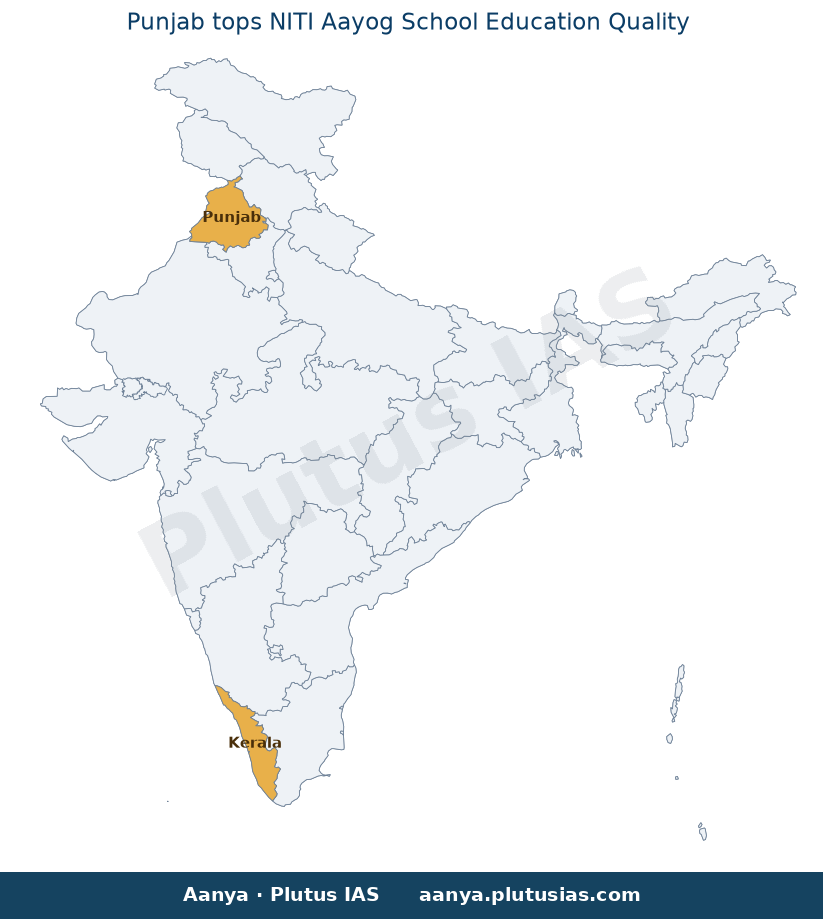
07 Aug Punjab tops NITI Aayog Education Index 2026, surpasses Kerala
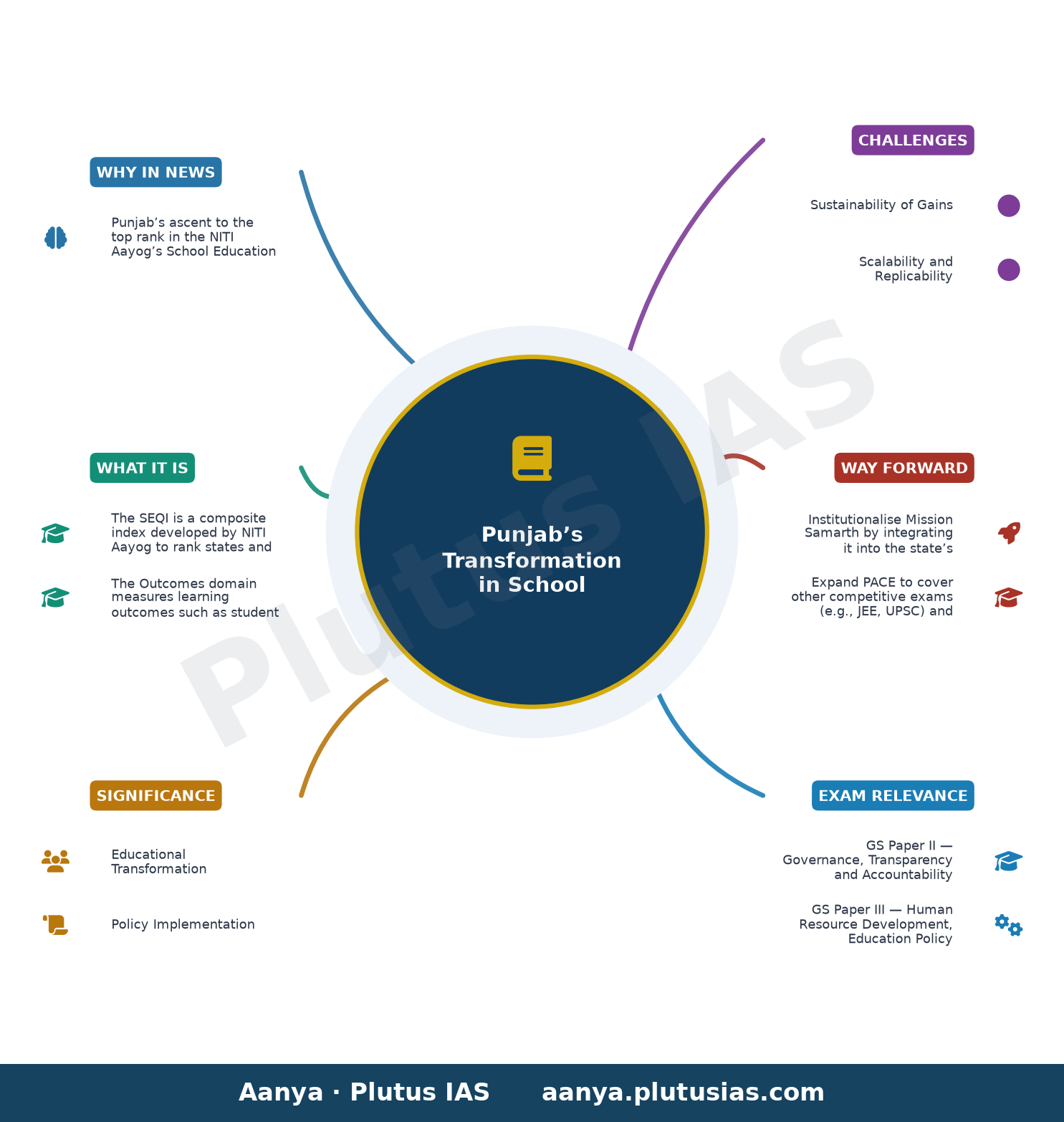
✎ The NITI Aayog’s School Education Quality Index (SEQI) ranks states based on Outcomes, Governance and Management, and Equity, using a composite scoring system to drive educational reforms.
Subject Relevance — Where This Topic Fits
- GS Paper II — Governance, Transparency and Accountability | GS Paper III — Human Resource Development, Education Policy
- Prelims: NITI Aayog, School Education Quality Index (SEQI), Mission Samarth, PACE initiative, NEET-UG, AI in school curriculum
- Essay: The Role of State-led Educational Reforms in National Development, Equity in Education: Bridging the Divide Between Government and Private Schooling
Quick Revision: The NITI Aayog’s School Education Quality Index (SEQI) ranks states based on Outcomes, Governance and Management, and Equity, using a composite scoring system to drive educational reforms.
Why is this in the news?
Punjab’s ascent to the top rank in the NITI Aayog’s School Education Quality Index (SEQI) 2026, surpassing Kerala, marks a significant shift in India’s discourse on public education. This development is noteworthy as it demonstrates how targeted governance, infrastructure investment, and pedagogical innovation can transform systemic deficits into measurable outcomes. The state’s reported achievements—ranging from improved NEET qualification rates in government schools to the introduction of Artificial Intelligence as a core subject—challenge prevailing narratives about the efficacy of government-run educational institutions and invite scrutiny into the replicability of such interventions.
Background
- The NITI Aayog’s School Education Quality Index (SEQI) is a composite index designed to evaluate the performance of states and Union Territories in school education across 41 indicators spanning three domains: Outcomes, Governance and Management, and Equity. The index was first introduced in 2019 and has since become a benchmark for assessing educational progress at the sub-national level.
- Kerala has consistently ranked among the top states in the SEQI due to its historically strong public education system, high literacy rates, and robust governance mechanisms. Its dominance in the index has been attributed to factors such as universal access, teacher training, and community participation.
- Punjab’s ranking shift in 2026 follows a period of acute infrastructural and pedagogical deficits. As of 2022, the state reported 8,000 schools without boundary walls, 3,200 without functional toilets, and approximately 4 lakh children sitting on classroom floors, indicating systemic neglect in school infrastructure.
- The state’s education system also suffered from delayed textbook distribution, with textbooks reaching schools only by October–November, resulting in significant loss of instructional time.
- The Aam Aadmi Party (AAP)-led government in Punjab, which assumed office in July 2022, identified education as a priority sector and launched multi-pronged interventions under flagship programmes such as ‘Mission Samarth’ and ‘Punjab Academic Coaching for Excellence’ (PACE).
What is the NITI Aayog School Education Quality Index (SEQI)?
- The SEQI is a composite index developed by NITI Aayog to rank states and Union Territories based on their performance in school education across three domains: Outcomes, Governance and Management, and Equity.
- The Outcomes domain measures learning outcomes such as student performance in national assessments, transition rates, and participation in competitive examinations like NEET and JEE.
- The Governance and Management domain evaluates the efficiency of administrative processes, including teacher training, school infrastructure, and resource utilisation.
- The Equity domain assesses the inclusivity of the education system, focusing on access, retention, and learning outcomes for marginalised groups such as Scheduled Castes, Scheduled Tribes, and girls.
- The index uses a weighted scoring system to generate a composite score for each state, enabling comparative analysis and identification of best practices.
- States are categorised into three groups for ranking: Large States, Small States, and Union Territories, with separate benchmarks for each group.
- The SEQI serves as a policy tool for the central government to incentivise states to improve educational outcomes through targeted interventions and resource allocation.
- The index is aligned with the Sustainable Development Goal 4 (SDG 4), which aims to ensure inclusive and equitable quality education for all.
Key Features
| Feature | Significance |
|---|---|
| NITI Aayog School Education Quality Index (SEQI) 2026 | A composite index measuring state-wise performance in school education across 41 indicators, including learning outcomes, equity, infrastructure, and governance. Punjab’s top rank reflects systemic improvements in these domains. |
| Mission Samarth | Punjab’s foundational learning programme that groups students by learning ability rather than grade, ensuring mastery of basic literacy and numeracy before advancing. This model addresses learning deficits at the foundational stage. |
| Punjab Academic Coaching for Excellence (PACE) | A targeted coaching initiative for government school students preparing for competitive examinations like NEET, resulting in a 1100% increase in NEET qualifiers from government schools (2021-2026). |
| Artificial Intelligence (AI) as a core subject (Classes I-XII) | Punjab became the first state to integrate AI into the school curriculum, aligning with the National Education Policy 2020’s emphasis on emerging technologies and future-ready skills. |
| Infrastructure upgradation of 19,125 schools (₹3638 crore) | Comprehensive investment in school infrastructure, including boundary walls, functional toilets, and timely textbook distribution, addressing systemic neglect and creating conducive learning environments. |
Why it Matters
Educational Transformation
- Demonstrates the potential for systemic turnaround in public education through targeted governance, reversing decades of underinvestment and neglect in Punjab’s government schools.
- Highlights the role of data-driven interventions (e.g., Mission Samarth) in addressing learning gaps, particularly for students from marginalised backgrounds.
- Shows that competitive exam success (e.g., NEET) in government schools is achievable with structured coaching and foundational learning support, challenging the perception of government schools as inferior.
Policy Implementation
- Illustrates the effective translation of the National Education Policy (NEP) 2020 into state-level action, particularly in foundational literacy, equity, and technology integration.
- Demonstrates the importance of decentralised governance (e.g., district-level monitoring by the Education Minister) in achieving measurable outcomes in education.
- Provides a model for other states to replicate, particularly in addressing infrastructure deficits and learning poverty.
Socio-Economic Impact
- Improved educational outcomes in government schools reduce reliance on private coaching, lowering the financial burden on low-income families and promoting social equity.
- Increased representation of government school students in competitive exams (e.g., NEET) challenges elitism in higher education access and fosters meritocracy.
- Enhanced school infrastructure and safety (e.g., boundary walls, toilets) directly improves student retention, particularly for girls and children from rural areas.
Challenges
1. Sustainability of Gains
- Ensuring long-term funding for programmes like Mission Samarth and PACE, which require continuous teacher training and resource allocation.
- Preventing regression in learning outcomes due to political or administrative changes, as seen in past cycles of educational reforms in India.
- Addressing the urban-rural divide in access to quality education, despite improvements in infrastructure.
UPSC Link: GS2: Issues relating to development and management of Social Sector/Services relating to Education
2. Scalability and Replicability
- Replicating Punjab’s model in states with weaker administrative capacity or higher fiscal constraints (e.g., Bihar, Uttar Pradesh).
- Ensuring equitable distribution of resources across districts, including remote and border areas where infrastructure deficits are most acute.
- Balancing rapid expansion of programmes with quality assurance, particularly in teacher training and curriculum design.
UPSC Link: GS2: Government policies and interventions for development in various sectors
3. Curriculum and Pedagogy Reform
- Integrating AI and other emerging technologies into school curricula without compromising foundational learning in core subjects like mathematics and science.
- Training teachers to adopt student-centric pedagogies (e.g., level-based grouping) and digital literacy, which requires sustained professional development.
- Aligning state-level reforms with national standards (e.g., NEP 2020) while accommodating local socio-cultural contexts.
UPSC Link: GS2: Issues relating to development and management of Social Sector/Services relating to Education
4. Equity and Inclusion
- Ensuring that marginalised groups (e.g., SC/ST, girls, children with disabilities) benefit equally from reforms, as systemic biases may persist in access to coaching and infrastructure.
- Addressing intersectional challenges, such as the higher dropout rates among adolescent girls in rural areas due to safety concerns or early marriage.
- Monitoring and mitigating unintended consequences, such as the diversion of resources from other critical sectors (e.g., health, agriculture) to education.
UPSC Link: GS2: Welfare schemes for vulnerable sections of the population
5. Accountability and Transparency
- Maintaining transparency in the allocation and utilisation of funds (e.g., ₹3638 crore for infrastructure) to prevent leakages or misappropriation.
- Establishing independent audits and third-party evaluations to assess the impact of programmes like Mission Samarth and PACE.
- Ensuring grievance redressal mechanisms for stakeholders, including parents, teachers, and students, to report inefficiencies or malpractices.
UPSC Link: GS2: Role of civil services in policy implementation
Challenges — UPSC Perspective
| Issue | Concern |
|---|---|
| Teacher Training and Capacity Building | Ensuring all teachers are adequately trained to implement level-based grouping, digital literacy, and foundational learning strategies. |
| Equitable Resource Distribution | Preventing disparities in infrastructure and coaching access between urban and rural schools, particularly in border districts. |
| Political and Administrative Continuity | Mitigating risks of policy reversals due to changes in government or bureaucratic resistance to reform. |
| Monitoring and Evaluation | Developing robust data systems to track progress in learning outcomes and programme effectiveness over time. |
| Community Engagement | Building trust among parents and communities to encourage participation in government schools and reduce reliance on private institutions. |
| Integration with Higher Education | Ensuring that improvements in school education translate into better outcomes in higher education and competitive exams. |
Government Initiatives — Must-Memorise for Prelims
- Mission Samarth (Punjab)
- Punjab Academic Coaching for Excellence (PACE)
- NITI Aayog School Education Quality Index (SEQI) 2026
Way Forward
- Institutionalise Mission Samarth by integrating it into the state’s annual budget and long-term education plan, ensuring continuity beyond political cycles.
- Expand PACE to cover other competitive exams (e.g., JEE, UPSC) and include vocational training to diversify career pathways for government school students.
- Strengthen teacher training programmes through partnerships with national institutions (e.g., NCERT, IITs) and digital platforms for continuous professional development.
- Develop a state-wide digital dashboard to monitor real-time progress in infrastructure, learning outcomes, and programme implementation.
- Launch targeted interventions for marginalised groups, such as girls’ STEM scholarships and inclusive classrooms for children with disabilities.
- Enhance community engagement through parent-teacher associations and local governance bodies to foster ownership of school reforms.
- Conduct independent evaluations of Mission Samarth and PACE to identify best practices and areas for improvement.
- Align Punjab’s reforms with the National Education Policy 2020’s goals, including foundational literacy, multilingualism, and experiential learning.
UPSC Value Addition
Keywords for Mains Answer-Writing
NITI Aayog School Education Quality Index · Foundational Literacy and Numeracy (FLN) · Mission Samarth Punjab · Artificial Intelligence in School Curriculum · NEET-UG performance of Government Schools · Public School Infrastructure Development · Level-based Teaching Pedagogy · Punjab Academic Coaching for Excellence (PACE) · Constitutional Provisions on Education (Article 21A, DPSP) · State Education Reforms and Governance · Comparative Education Rankings · Sustainable Development Goal 4 (SDG 4) · Digital Pedagogy in School Education · Teacher Training and Capacity Building
Concept Flow
Neglect and systemic underinvestment in Punjab’s government schools (pre-2022) → High dropout rates, poor infrastructure, and learning poverty → NITI Aayog’s SEQI 2026 ranks Punjab lowest among major states → Formation of Mission Samarth and PACE to address foundational learning and competitive exam success → Infrastructure upgradation (₹3638 crore) and AI integration in curriculum → Measurable improvements in learning outcomes (e.g., NEET qualifiers from 80 to 882) → Top rank in SEQI 2026 and replication potential for other states
Prelims Practice Questions
Q1. Consider the following statements regarding the NITI Aayog School Education Quality Index (SEQI) 2026:
1. Punjab has been ranked first in SEQI 2026, overtaking Kerala.
2. SEQI measures performance exclusively on infrastructure parameters such as boundary walls and toilets.
3. The index includes learning outcomes as one of its key performance indicators.
How many of the above statements are correct?
- Only one
- Only two
- All three
- None
Answer: All three — Statement 1 is correct as per the news report. Statement 2 is incorrect because SEQI evaluates multiple dimensions including learning outcomes, equity, and governance, not just infrastructure. Statement 3 is correct as learning outcomes are a core component of SEQI.
Q2. Assertion (A): The ‘Mission Samarth’ initiative in Punjab employs a level-based teaching model where students are grouped by learning ability rather than grade.
Reason (R): This pedagogical approach aims to ensure foundational literacy and numeracy for all students by addressing learning gaps irrespective of their grade level.
In the context of the above two statements, which one of the following is correct?
- Both A and R are true, and R is the correct explanation of A
- Both A and R are true, but R is not the correct explanation of A
- A is true but R is false
- A is false but R is true
Answer: Both A and R are true, but R is not the correct explanation of A — The assertion (A) is factually accurate as per the news report. The reason (R) correctly explains the purpose of the level-based teaching model, which is to bridge learning gaps and ensure foundational skills.
Q3. Match the following initiatives with their respective states:
Column I (Initiative) | Column II (State)
————————————-|——————-
1. Mission Samarth | A. Kerala
2. Artificial Intelligence in Curriculum | B. Punjab
3. Foundational Literacy Mission | C. Tamil Nadu
4. Samagra Shiksha Abhiyan | D. Odisha
Select the correct match:
- 1-B, 2-B, 3-A, 4-C
- 1-B, 2-B, 3-D, 4-C
- 1-A, 2-B, 3-D, 4-C
- 1-B, 2-A, 3-D, 4-C
Answer: 1-B, 2-B, 3-D, 4-C — Mission Samarth and Artificial Intelligence in Curriculum are initiatives of Punjab as per the news report. Foundational Literacy Mission is associated with Odisha, and Samagra Shiksha Abhiyan is a centrally sponsored scheme implemented across states including Kerala and Tamil Nadu.
Mains Practice Question
✍ The transformation of Punjab’s government school education system, as highlighted by its top ranking in the NITI Aayog School Education Quality Index (SEQI) 2026, exemplifies a paradigm shift in foundational learning and governance. Critically analyse the key pedagogical and governance reforms introduced by Punjab that contributed to this achievement. (15 Marks)
Approach: MODEL-ANSWER SKELETON:
1. **Foundational Learning Reforms**:
– Level-based teaching model under ‘Mission Samarth’ grouping students by learning ability rather than grade to address foundational literacy and numeracy (FLN) gaps. Cite the shift from Class 8 students unable to write simple sentences to improved learning outcomes.
– Reference to the National Education Policy (NEP) 2020 emphasis on FLN and multi-level teaching.
2. **Governance and Infrastructure Reforms**:
– Timely distribution of textbooks (by March 31) addressing the earlier delay till October-November.
– Infrastructure upgradation: 19,125 schools upgraded with boundary walls, functional toilets, and elimination of floor-sitting (4 lakh children affected earlier).
– ₹3638 crore expenditure on infrastructure as per the report.
3. **Teacher Capacity Building and Accountability**:
– Personal visits by the Education Minister to over 2,000 schools, including remote and border areas, ensuring on-ground monitoring.
– Engagement of over 70,000 teachers annually under ‘Mission Samarth’.
4. **Academic Coaching and Performance Metrics**:
– ‘Punjab Academic Coaching for Excellence (PACE)’ initiative leading to a surge in NEET-UG qualifiers from government schools (80 in 2021 to 882 in 2026).
– Introduction of Artificial Intelligence as a core subject from Classes I to XII, aligning with NEP 2020’s emphasis on digital pedagogy.
5. **Comparative Context and Critique**:
– Contrast with Kerala’s historically strong education system to highlight the significance of Punjab’s turnaround.
– Critique: Sustainability of reforms, equitable access across socio-economic groups, and long-term impact on higher education and employment.
6. **Constitutional and Policy Framework**:
– Link reforms to Article 21A (Right to Education) and SDG 4 (Quality Education).
– Role of NITI Aayog’s SEQI in incentivising state-level reforms through competitive federalism.
Source: The Hindu
Generated by AanyaAi for educational purpose.

- किशाऊ परियोजना विवाद: पंजाब सुप्रीम कोर्ट पहुंचेगा, जानें पूरा मामला - September 22, 2026
- Punjab to Challenge Kishau Project in Supreme Court: Key Polity & Governance Issue for UPSC - September 22, 2026
- दिल्ली हाईकोर्ट ने बदले ‘वरिष्ठ अधिवक्ता’ के नियम, 100-प्वाइंट प्रणाली हुई खत्म - September 22, 2026

No Comments