


07 Aug Kerala POCSO Cases Rise: Child Rights Report Highlights Vulnerability
✎ The POCSO Act, 2012, is a victim-centric legislation that mandates stringent penalties, child-friendly procedures, and mandatory reporting to protect children from sexual abuse, with rising cases in Kerala reflecting both…
Subject Relevance — Where This Topic Fits
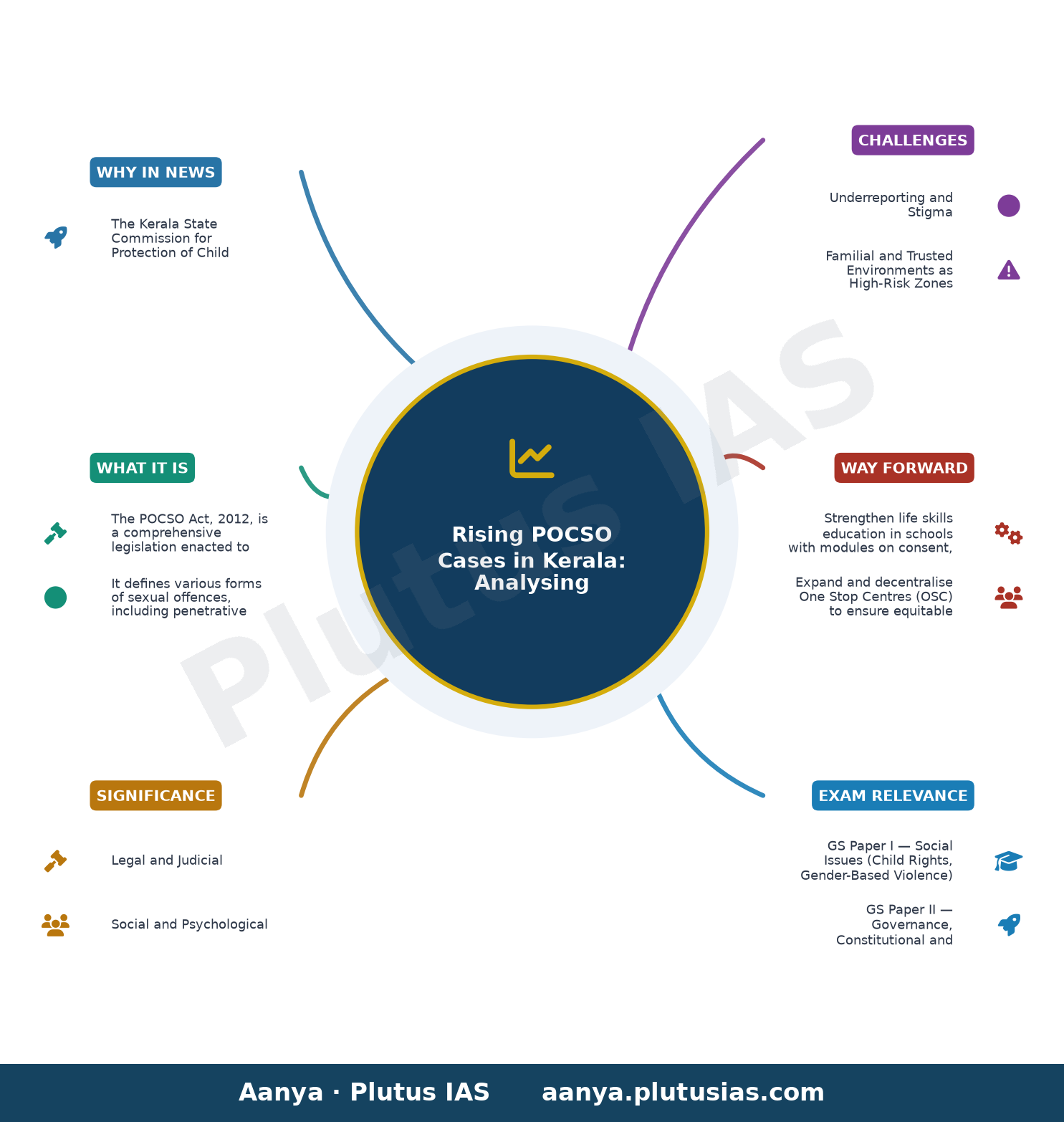
- GS Paper I — Social Issues (Child Rights, Gender-Based Violence) | GS Paper II — Governance, Constitutional and Statutory Bodies (Role of State Commissions for Child Rights) | GS Paper III — Internal Security (Protection of Children from Sexual Offences)
- Prelims: POCSO Act 2012, Kerala State Commission for Protection of Child Rights (KSCPCR), State Crime Records Bureau (SCRB), Thiruvananthapuram district, Child survivors, gender-wise distribution, Differently-abled children, Life skills education
- Essay: The paradox of rising reported crimes in the presence of protective legislation: A case study of POCSO in Kerala, Balancing child protection with societal awareness: Lessons from Kerala’s POCSO trends
Quick Revision: The POCSO Act, 2012, is a victim-centric legislation that mandates stringent penalties, child-friendly procedures, and mandatory reporting to protect children from sexual abuse, with rising cases in Kerala reflecting both improved reporting and persistent systemic vulnerabilities.
Why is this in the news?
The Kerala State Commission for Protection of Child Rights (KSCPCR) has reported a marginal but persistent rise in POCSO cases in Kerala for 2025 (4,765 cases) compared to 2024 (4,607 cases), with Thiruvananthapuram district recording the highest number. While this trend may reflect improved reporting mechanisms and heightened legal literacy, it also underscores persistent vulnerabilities among children, particularly girls and those in the 15–18 age group. The data highlights the predominance of offences in private and familiar spaces, necessitating a re-evaluation of preventive strategies, including life skills education and community awareness.
Background
- The Protection of Children from Sexual Offences (POCSO) Act, 2012, was enacted to address child sexual abuse by defining stringent penalties and establishing a child-friendly justice system.
- Kerala established the Kerala State Commission for Protection of Child Rights (KSCPCR) in 2013 under the Commissions for Protection of Child Rights Act, 2005, to monitor the implementation of child rights and investigate complaints.
- The State Crime Records Bureau (SCRB) in Kerala compiles and analyses crime data, including POCSO cases, to inform policy and enforcement.
- Kerala has historically been a leader in social indicators, including literacy and gender parity, yet its POCSO data reveals systemic gaps in child protection within private and familial settings.
- The rise in POCSO cases coincides with national trends of increasing reporting of sexual crimes against children, attributed to improved awareness, legal literacy, and reduced stigma in reporting.
What is the Protection of Children from Sexual Offences (POCSO) Act, 2012?
- The POCSO Act, 2012, is a comprehensive legislation enacted to protect children under 18 years from sexual abuse, exploitation, and pornography.
- It defines various forms of sexual offences, including penetrative and non-penetrative assault, sexual harassment, and pornography, with stringent punishments ranging from 7 years to life imprisonment.
- The Act mandates the establishment of Special Courts for speedy trial of POCSO cases, ensuring child-friendly procedures such as in-camera trials and the use of interpreters.
- It introduces the concept of ‘child-friendly’ reporting, recording of evidence, and the appointment of Special Public Prosecutors to handle such cases.
- The Act requires mandatory reporting of sexual offences against children by any person who has knowledge of the offence, failing which they may face penalties.
- It includes provisions for the rehabilitation and compensation of child survivors, including medical, psychological, and legal support.
- The Act applies to all Indian citizens and non-citizens within India’s jurisdiction, including foreign nationals involved in offences against Indian children.
Key Features
| Feature | Significance |
|---|---|
| Rising POCSO cases in Kerala (2013-2025) | Demonstrates improved reporting mechanisms and legal literacy, not necessarily an increase in actual crimes. |
| Gender distribution of survivors (86% girls) | Highlights systemic gendered vulnerability and the need for targeted interventions for girls. |
| Age-wise vulnerability (55% in 15-18 years) | Indicates adolescence as a critical period requiring focused protection measures. |
| Location of offences (22% in survivor’s home) | Underscores the prevalence of familial and trusted environments as high-risk zones. |
| Differently-abled survivors (3% in 2025) | Signals the need for inclusive child protection strategies addressing multiple vulnerabilities. |
Why it Matters
Legal and Judicial
- The rise in POCSO cases reflects enhanced access to justice and reduced stigma in reporting, aligning with the Act’s objectives of victim-centric justice.
- Judicial efficiency in POCSO cases is critical, given the Act’s stringent timelines for investigation and trial to prevent re-traumatisation.
- The data underscores the need for specialised courts and trained personnel to handle POCSO cases sensitively.
Social and Psychological
- The high percentage of girl survivors (86%) necessitates gender-sensitive counselling and rehabilitation programmes.
- Familial and trusted environments as primary sites of abuse highlight the failure of protective social structures, requiring community-level interventions.
- The vulnerability of adolescents (55% in 15-18 years) calls for age-appropriate life skills education on consent and bodily autonomy.
Administrative and Institutional
- The Kerala State Commission for Protection of Child Rights’ annual report serves as a critical tool for policy formulation and resource allocation.
- District-wise disparities in reporting (e.g., Thiruvananthapuram vs. Malappuram) suggest the need for equitable access to reporting mechanisms across regions.
- The role of State Crime Records Bureau in data compilation is vital for evidence-based policymaking and monitoring.
Challenges
1. Underreporting and Stigma
- Despite improved reporting, stigma and fear of social ostracisation may still deter some victims from coming forward.
- Cultural taboos around discussing sexual abuse, particularly in conservative communities, persist as barriers to reporting.
UPSC Link: GS2-Social Justice
2. Familial and Trusted Environments as High-Risk Zones
- A majority of offences occur in private or familiar spaces, indicating systemic failures in trust-based relationships.
- Perpetrators often include family members or close acquaintances, complicating legal and social interventions.
- The challenge lies in balancing familial bonds with the imperative of child protection.
UPSC Link: GS1-Society
3. Adolescent Vulnerability
- Adolescents (15-18 years) constitute the largest group of survivors, reflecting gaps in awareness and preventive education.
- The transition from childhood to adulthood is marked by increased exposure to risk, necessitating targeted interventions.
- Life skills education in schools remains underutilised despite its proven efficacy in prevention.
UPSC Link: GS2-Education
4. Inclusive Protection for Differently-Abled Children
- Differently-abled children (3% of survivors) face compounded vulnerabilities due to communication barriers and dependency.
- Existing support systems often lack the capacity to address the specific needs of differently-abled survivors.
- The rise in reported cases (from 2% to 3%) may indicate improved awareness, but gaps in accessibility persist.
UPSC Link: GS2-Social Justice
5. District-Wise Disparities in Reporting
- Urbanised districts like Thiruvananthapuram report higher cases, possibly due to better access to reporting mechanisms and awareness.
- Rural and less urbanised districts may face underreporting due to limited access to support services and legal literacy.
- Equitable distribution of child protection resources is essential to address regional disparities.
UPSC Link: GS2-Governance
Challenges — UPSC Perspective
| Issue | Concern |
|---|---|
| Stigma and Social Ostracisation | Deters victims from reporting, delaying justice and perpetuating cycles of abuse. |
| Familial and Trusted Environments as High-Risk Zones | Complicates legal and social interventions due to pre-existing trust relationships. |
| Adolescent Vulnerability (15-18 years) | Indicates gaps in preventive education and life skills training. |
| Inclusive Protection for Differently-Abled Children | Lack of tailored support systems exacerbates vulnerabilities. |
| District-Wise Disparities in Reporting | Highlights inequitable access to child protection mechanisms across regions. |
| Cyber Exploitation and Online Abuse | Rising digital penetration increases risks, requiring robust cyber safety measures. |
Government Initiatives — Must-Memorise for Prelims
- Protection of Children from Sexual Offences (POCSO) Act, 2012
- One Stop Centres (OSC) Scheme
- Child Protection Services (CPS) under Mission Vatsalya
Way Forward
- Strengthen life skills education in schools with modules on consent, bodily autonomy, and reporting mechanisms for children aged 10-18.
- Expand and decentralise One Stop Centres (OSC) to ensure equitable access across districts, particularly in rural and tribal areas.
- Enhance training for law enforcement, judiciary, and medical professionals on POCSO Act provisions and victim-centric approaches.
- Launch targeted awareness campaigns in collaboration with local communities to reduce stigma and improve reporting rates.
- Develop specialised support systems for differently-abled children, including accessible reporting mechanisms and counselling services.
- Establish district-level child protection committees to monitor implementation of POCSO Act and address regional disparities.
- Promote cyber safety initiatives to mitigate risks of online abuse, including digital literacy programmes for children and parents.
- Increase funding for forensic and psychological support services to ensure timely and trauma-informed interventions.
UPSC Value Addition
Keywords for Mains Answer-Writing
POCSO Act · Child Protection Mechanisms · Child Rights Commissions · Vulnerability of Children · Legal Literacy · Awareness Campaigns · Sexual Offences against Children · Child Survivors · Age-group Vulnerability · Familiar Spaces Crime
Concept Flow
Rising POCSO cases in Kerala → Improved legal literacy and awareness → Better reporting mechanisms → Data compilation by State Crime Records Bureau → Policy formulation by Kerala State Commission for Protection of Child Rights → Need for targeted interventions → Strengthening of child protection systems
Prelims Practice Questions
Q1. Consider the following statements regarding the Protection of Children from Sexual Offences (POCSO) Act, 2012:
1. The Act defines a ‘child’ as any person below the age of eighteen years.
2. The Act mandates the establishment of Special Courts for the speedy trial of offences.
3. The Act includes provisions for child-friendly procedures for recording evidence.
How many of the above statements are correct?
- Only one
- Only two
- All three
- None
Answer: All three — Statement 1 is correct: The POCSO Act, 2012, defines a child as any person below the age of eighteen years, consistent with the United Nations Convention on the Rights of the Child. Statement 2 is correct: The Act mandates the establishment of Special Courts to ensure speedy trial of offences under the Act. Statement 3 is correct: The Act incorporates child-friendly procedures for reporting, investigation, and trial, including provisions for recording the child’s statement in a sensitive manner.
Q2. Which of the following bodies is responsible for monitoring the implementation of the Protection of Children from Sexual Offences (POCSO) Act, 2012, at the state level?
- National Commission for Protection of Child Rights (NCPCR)
- State Commission for Protection of Child Rights (SCPCR)
- National Human Rights Commission (NHRC)
- State Women’s Commission
Answer: State Commission for Protection of Child Rights (SCPCR) — The State Commission for Protection of Child Rights (SCPCR) is mandated to monitor the implementation of the POCSO Act, 2012, at the state level, as per the Commissions for Protection of Child Rights Act, 2005. The NCPCR performs this function at the national level.
Mains Practice Question
✍ Despite the existence of robust legal frameworks like the POCSO Act, cases of child sexual abuse continue to rise. Critically examine the factors contributing to this trend and suggest comprehensive measures to enhance child protection in India. (15 Marks)
Approach: MODEL-ANSWER SKELETON:
1. **Introduction:** Briefly acknowledge the rising trend of POCSO cases, citing the Kerala report as a contemporary example, and the dual interpretation of this rise (increased reporting vs. increased crime).
2. **Factors Contributing to the Trend (Critical Examination):**
* **Socio-cultural factors:** Prevalence of abuse in familiar spaces, trust deficit, societal stigma, lack of comprehensive sex education.
* **Systemic challenges:** Gaps in reporting mechanisms, delays in justice delivery, inadequate victim support services, insufficient legal literacy among children and guardians.
* **Technological advancements:** Rise of cyber-crimes against children.
* **Underreporting vs. Actual Increase:** Discuss the nuance that increased numbers might also reflect better awareness, legal literacy, and reduced hesitation in reporting, as highlighted by the report.
3. **Comprehensive Measures to Enhance Child Protection:**
* **Strengthening Legal Frameworks:** Effective implementation of POCSO Act, Juvenile Justice (Care and Protection of Children) Act, 2015.
* **Awareness and Education:** Life skills training for children (e.g., ‘good touch, bad touch’), community awareness campaigns, legal literacy programs for parents and teachers.
* **Institutional Reforms:** Capacity building for police, judiciary, and child protection agencies; establishment of more child-friendly courts and support services (e.g., ‘One Stop Centres’).
* **Role of Commissions:** Empowering National and State Commissions for Protection of Child Rights (NCPCR/SCPCR) for proactive monitoring and intervention.
* **Community Participation:** Encouraging reporting, creating safe spaces for children, involving local self-governments.
* **Addressing Digital Threats:** Cyber safety education, robust mechanisms to report and investigate online child abuse.
4. **Conclusion:** Emphasise a multi-pronged approach involving legislative, administrative, social, and educational interventions for creating a truly protective environment for children.
Source: The Hindu
Generated by AanyaAi for educational purpose.

- छत्तीसगढ़: ओपी चौधरी ने केलो नदी में उतरकर किया 29.99 करोड़ रुपये के प्रोजेक्ट का उद्घाटन - September 24, 2026
- Chhattisgarh Finance Minister Launches ₹29.99 Cr Kelo River Cleaning Project - September 24, 2026
- UPSC Exam: Coal Ministry’s Special Campaign 6 for E-Waste & Governance Reforms - September 24, 2026

No Comments