


07 Aug Punjab Tops NITI Aayog Education Index 2026, Overtakes Kerala
✎ Punjab’s ascent to the top rank in NITI Aayog’s SEQI 2026 underscores the transformative potential of state-led governance reforms, infrastructural investments, and pedagogical innovations in reversing systemic educational…
Subject Relevance — Where This Topic Fits
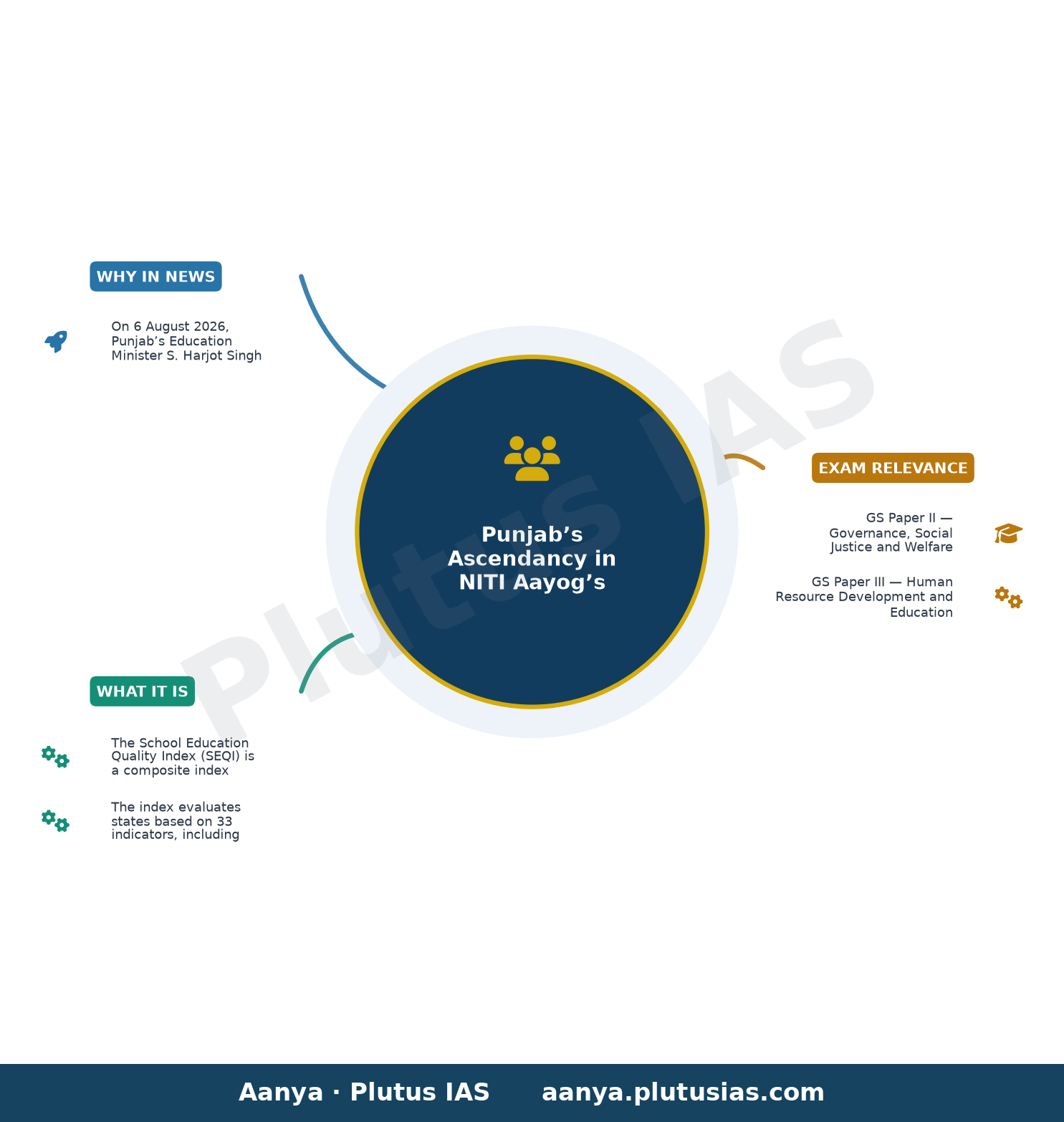
- GS Paper II — Governance, Social Justice and Welfare | GS Paper III — Human Resource Development and Education
- Prelims: NITI Aayog School Education Quality Index (SEQI), Mission Samarth, PACE initiative, NEET-UG, foundational literacy and numeracy, AI in school curriculum, government school infrastructure upgradation
- Essay: The role of state-led educational reforms in reversing systemic neglect: A case study of Punjab’s transformation, Public-private partnerships in education: Balancing equity and excellence in India’s school system
Quick Revision: Punjab’s ascent to the top rank in NITI Aayog’s SEQI 2026 underscores the transformative potential of state-led governance reforms, infrastructural investments, and pedagogical innovations in reversing systemic educational deficits.
Why is this in the news?
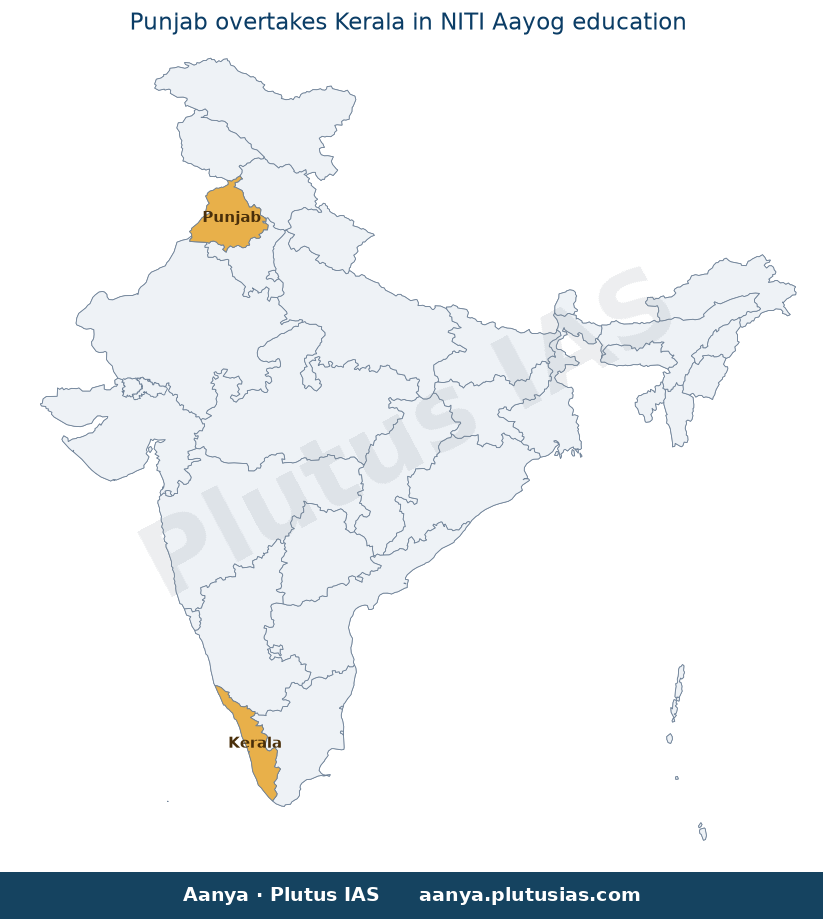
On 6 August 2026, Punjab’s Education Minister S. Harjot Singh Bains announced that Punjab had secured the top rank in NITI Aayog’s School Education Quality Index (SEQI) 2026, surpassing Kerala. This achievement was attributed to a four-year transformation agenda involving infrastructure upgradation, foundational learning interventions, and systemic pedagogical reforms, including the introduction of Artificial Intelligence as a core subject from Classes I to XII. The announcement highlighted measurable outcomes such as a surge in NEET qualifiers from government schools and the implementation of a large-scale foundational learning programme, ‘Mission Samarth’, which has been recognised as one of India’s largest initiatives in this domain.
Background
- The NITI Aayog’s School Education Quality Index (SEQI) is a composite index designed to evaluate the performance and improvement of states and Union Territories in school education, focusing on learning outcomes, equity, and governance.
- Kerala has historically been a leader in school education outcomes in India, consistently topping SEQI rankings due to its robust public education system and high literacy rates.
- In July 2022, Punjab’s government schools faced severe infrastructural and pedagogical challenges, including the absence of boundary walls in over 8,000 schools, non-functional toilets in 3,200 schools, and approximately 4 lakh students sitting on classroom floors due to inadequate seating arrangements.
- Textbook distribution delays in Punjab resulted in academic sessions being shortened, with textbooks reaching schools only by October-November, thereby reducing effective teaching time.
- The Aam Aadmi Party (AAP)-led government in Punjab, which assumed office in July 2022, initiated a governance model emphasising direct engagement with schools, including visits to over 2,000 government schools across all districts, including border and remote areas.
What is the NITI Aayog School Education Quality Index (SEQI)?
- The School Education Quality Index (SEQI) is a composite index developed by NITI Aayog to assess the performance and improvement of states and Union Territories in school education across three domains: Outcomes, Governance Processes Aiding Outcomes, and Equity.
- The index evaluates states based on 33 indicators, including learning outcomes, access to education, infrastructure, equity in education, and governance mechanisms such as teacher training and student-teacher ratios.
- SEQI aims to incentivise states to improve educational outcomes by providing a comparative benchmark and recognising best practices through annual rankings.
- The index was first introduced in 2019 and has since been updated periodically to incorporate new dimensions of educational quality and equity.
- Kerala has consistently ranked among the top performers in SEQI due to its high literacy rates, strong public education infrastructure, and equitable access to education.
- The 2026 edition of SEQI introduced additional parameters to assess the integration of technology in education, including the inclusion of Artificial Intelligence as a core subject in school curricula.
UPSC Value Addition
Keywords for Mains Answer-Writing
NITI Aayog School Education Quality Index 2026 · Punjab government schools transformation · Mission Samarth · PACE initiative · foundational learning programmes · NEET-UG performance in government schools · AI integration in school curriculum · infrastructure upgradation in education · level-based teaching model · government school enrolment trends
Prelims Practice Questions
Q1. Consider the following statements regarding the NITI Aayog School Education Quality Index (SEQI) 2026:
1. Punjab has overtaken Kerala to rank No. 1 in SEQI 2026.
2. The SEQI assesses states based on infrastructure, learning outcomes, and equity.
3. The SEQI 2026 includes a new parameter on Artificial Intelligence integration in school curricula.
4. The SEQI is released annually by the Ministry of Education.
How many of the above statements are correct?
- Only one
- Only two
- Only three
- All four
Answer: Only three — Statements 1 and 2 are correct. Statement 3 is incorrect as AI integration is a state-led initiative, not a SEQI parameter. Statement 4 is incorrect as the SEQI is released biennially by NITI Aayog, not annually by the Ministry of Education.
Q2. Assertion (A): The ‘Mission Samarth’ programme in Punjab groups students by learning ability rather than grade to ensure foundational literacy.
Reason (R): The programme aims to address learning gaps by teaching students from lower grade syllabi if required.
In the context of the above two statements, which one of the following is correct?
- Both A and R are true, and R is the correct explanation of A.
- Both A and R are true, but R is not the correct explanation of A.
- A is true, but R is false.
- A is false, but R is true.
Answer: Both A and R are true, and R is the correct explanation of A. — Both A and R are true, and R correctly explains A. ‘Mission Samarth’ explicitly uses a level-based teaching model to group students by learning ability and address foundational gaps.
Q3. Match the following initiatives with their respective states:
Column I (Initiative) | Column II (State)
— | —
1. Mission Samarth | A. Kerala
2. PACE initiative | B. Punjab
3. AI integration in school curriculum | C. Tamil Nadu
4. Infrastructure upgradation of 19,125 schools | D. Punjab
Select the correct match:
- 1-B, 2-D, 3-A, 4-D
- 1-D, 2-B, 3-A, 4-D
- 1-B, 2-D, 3-D, 4-A
- 1-A, 2-B, 3-D, 4-C
Answer: 1-B, 2-D, 3-A, 4-D — 1-B (Mission Samarth is a Punjab initiative), 2-D (PACE initiative is also a Punjab programme), 3-A (Kerala is a pioneer in AI integration in education), 4-D (Infrastructure upgradation of 19,125 schools is a Punjab initiative).
Mains Practice Question
✍ Critically examine the role of state-led foundational learning programmes in transforming government school education outcomes in India. Refer to the ‘Mission Samarth’ initiative of Punjab and its impact on NEET-UG performance among government school students. (15 Marks)
Approach: MODEL-ANSWER SKELETON:
1. **Context and Definition** (2 Marks):
– Define foundational learning programmes and their significance in India’s education policy (e.g., NEP 2020, National Achievement Survey).
– Highlight the crisis in government schools: infrastructure deficits, learning poverty, and inequity (cite ASER reports, NITI Aayog SEQI data).
2. **Mission Samarth: Design and Mechanism** (4 Marks):
– Explain the level-based teaching model: grouping students by learning ability, not grade; modular syllabi; teacher training.
– Link to Punjab’s ‘PACE’ initiative: coaching for competitive exams, AI integration in curriculum (Classes I–XII), and infrastructure upgradation (₹3638 crore).
– Cite data: NEET-UG qualifiers from government schools rising from 80 (2021) to 882 (2026); 12 lakh students covered; 70,000 teachers engaged annually.
3. **Impact and Outcomes** (4 Marks):
– **Quantitative**: Improved NEET-UG performance, textbook distribution timelines (February 15 to March 31), infrastructure metrics (boundary walls, toilets).
– **Qualitative**: Student testimonials (e.g., Harnoorpreet Kaur’s AIR 3140), community trust in government schools.
– **Comparative**: Contrast with Kerala’s historical dominance in SEQI and Punjab’s overtaking.
4. **Challenges and Critiques** (3 Marks):
– Sustainability: Scaling ‘Mission Samarth’ nationwide; teacher capacity and attrition.
– Equity: Ensuring inclusion for marginalised groups (SC/ST, rural, border areas).
– Policy alignment: Coherence with NEP 2020’s 5+3+3+4 framework and digital divide in AI adoption.
5. **Conclusion** (2 Marks):
– State-led foundational programmes can transform outcomes but require sustained funding, political will, and community engagement.
– Punjab’s model offers a replicable framework for other states, but long-term evaluation is essential.
Source: The Hindu
Generated by AanyaAi for educational purpose.

- यूएनजीए 2026: युद्ध, एआई और सुधार – दुनिया के नेता क्या करेंगे? (UPSC दृष्टिकोण) - September 22, 2026
- 40 दिन बाद भी संसद सत्र अनिर्णीत, महिला आरक्षण विधेयक पर सरकार की तैयारी - September 22, 2026
- Why Parliament Session Still Unprorogued After 40 Days? Women’s Quota Law Buzz Explained - September 22, 2026

No Comments