


07 Aug Rajya Sabha Chairman urges Amit Shah to attend House amid Opposition protests
✎ The Rajya Sabha Chairman’s directive to the Centre to consider Amit Shah’s presence underscores the constitutional expectation that ministers must account for their actions in Parliament, even as procedural rules govern the…
Subject Relevance — Where This Topic Fits
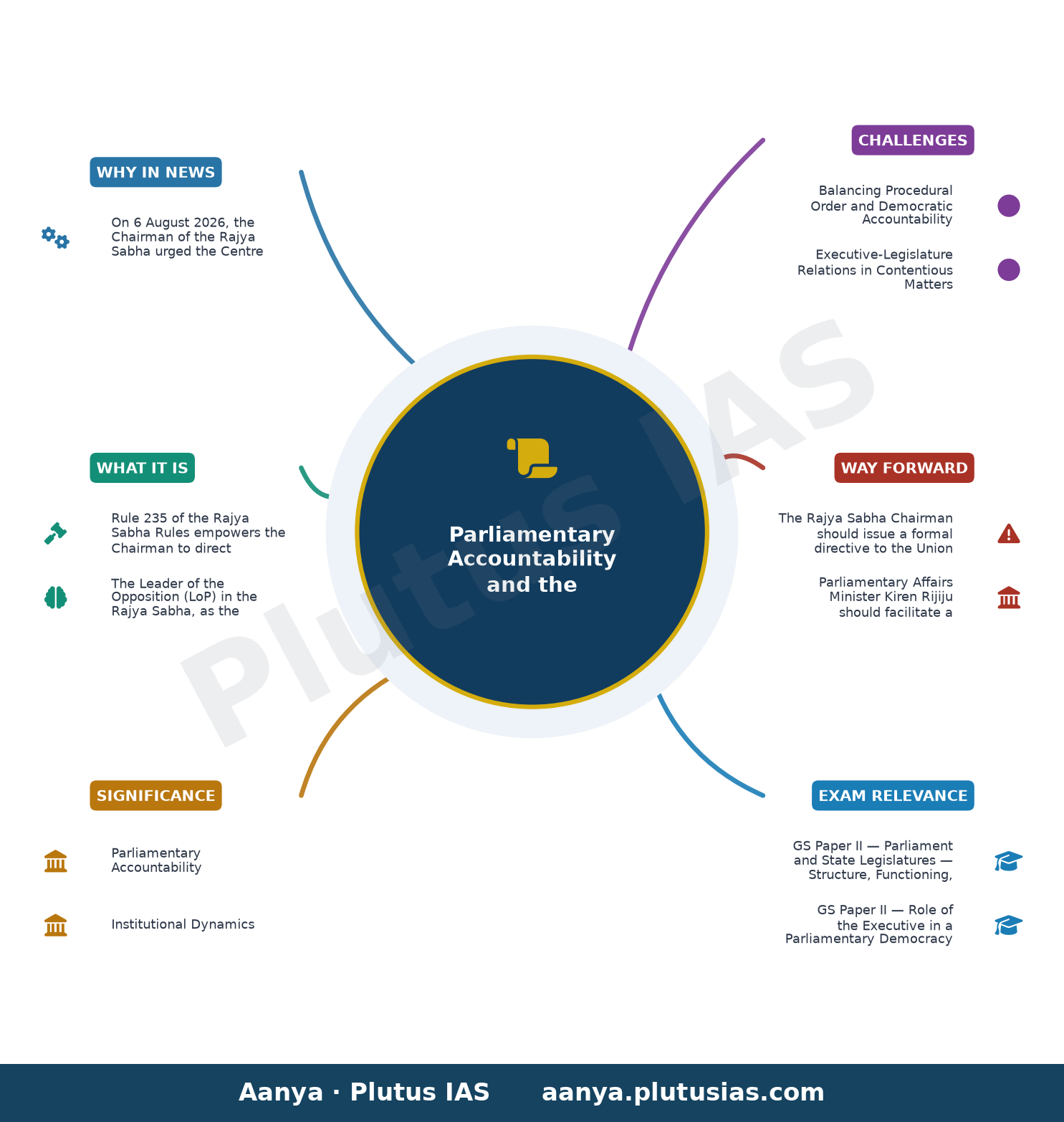
- GS Paper II — Parliament and State Legislatures — Structure, Functioning, Conduct of Business, Powers & Privileges and Issues Arising out of these | GS Paper II — Role of the Executive in a Parliamentary Democracy
- Prelims: Rajya Sabha, Zero Hour, Leader of the Opposition, Parliamentary Rules 235 and 240, Parliamentary Affairs Minister, Union Home Minister, Article 75 of the Constitution, Collective Responsibility, Censure Motion
- Essay: The Role of Opposition in a Parliamentary Democracy: Balancing Accountability and Disruption, Institutional Trust and Constitutional Morality: The Case of Executive-Legislature Relations
Quick Revision: The Rajya Sabha Chairman’s directive to the Centre to consider Amit Shah’s presence underscores the constitutional expectation that ministers must account for their actions in Parliament, even as procedural rules govern the conduct of debates and interruptions.
Why is this in the news?
On 6 August 2026, the Chairman of the Rajya Sabha urged the Centre to consider the Opposition’s demand for the presence of Union Home Minister Amit Shah to address allegations of excessive use of force by security personnel during a protest on 20 July 2026. This development underscores the recurring tension between executive accountability and parliamentary decorum, particularly when opposition members seek direct ministerial responses to grave public concerns. The episode also highlights procedural disputes over the invocation of Rules 235 and 240, which govern interruptions and repetitive speeches, reflecting deeper institutional frictions in the functioning of the Upper House.
Background
- The Rajya Sabha, as the Council of States, is constitutionally mandated to ensure executive accountability through debates, questions, and adjournment motions, though its effectiveness is often constrained by the numerical strength of the ruling party.
- The July 2026 protest by youngsters against alleged paper leaks in competitive examinations escalated into a confrontation with security forces, prompting opposition allegations of disproportionate use of force, including lathi charges and detentions.
- The Opposition, led by Mallikarjun Kharge, has consistently demanded the presence of the Union Home Minister in the Rajya Sabha to address these allegations, invoking the principle of ministerial responsibility under Article 75 of the Constitution.
- The Parliamentary Affairs Minister, Kiren Rijiju, countered by invoking Rules 235 and 240 to restrict repetitive interruptions and speeches, arguing that the Opposition’s demands were being raised without citing specific procedural grounds.
- The Chairman’s intervention reflects an attempt to mediate between the Opposition’s demand for accountability and the Government’s insistence on procedural compliance, a recurring theme in parliamentary debates over executive-legislature relations.
- The incident also raises questions about the role of the Leader of the Opposition in holding the executive to account, particularly in a House where the ruling party holds a majority.
Constitutional and Procedural Framework Governing Ministerial Presence in Parliament
- Rule 235 of the Rajya Sabha Rules empowers the Chairman to direct members to discontinue their speeches or interventions if they are deemed irrelevant or repetitive, while Rule 240 allows the Chairman to intervene if a member persists in raising the same matter without new facts or arguments.
- The Leader of the Opposition (LoP) in the Rajya Sabha, as the principal critic of the Government, plays a pivotal role in ensuring executive accountability, though their effectiveness is often limited by the lack of a constitutional guarantee for their recognition or powers.
- Ministers are expected to attend Parliament sessions to respond to questions, debates, and adjournment motions, but their presence is not mandatory unless specifically demanded through procedural motions or the Chairman’s directions.
- The principle of ministerial accountability is reinforced by parliamentary conventions, such as the requirement for ministers to provide factual responses to starred and unstarred questions, and to appear in the House when summoned through formal notices.
- The Opposition’s demand for Amit Shah’s presence in the Rajya Sabha is rooted in the expectation that the Home Minister, as the head of the security apparatus, should directly address allegations of excessive force, aligning with the broader democratic principle of transparency and accountability.
- The Chairman’s role in mediating such disputes is critical, as they must balance the Opposition’s right to seek answers with the Government’s procedural objections, ensuring that parliamentary democracy functions within the bounds of constitutional morality.
Key Features
| Feature | Significance |
|---|---|
| Rajya Sabha Chairman’s directive to consider Amit Shah’s presence | Asserts the Chair’s constitutional authority under Article 89(2) to ensure accountability of Union Ministers in the House, reinforcing parliamentary norms. |
| Opposition’s demand for Home Minister’s response | Highlights the Opposition’s role in holding the executive accountable for alleged excesses during the July 20 protest, invoking democratic vigilance. |
| Parliamentary Rules 235 and 240 invoked by Kiren Rijiju | Demonstrates the procedural tools available to the Chair to regulate debate and prevent repetition, underscoring the structured nature of parliamentary proceedings. |
| Leader of Opposition’s assertion of rights under Rules of Procedure | Reinforces the institutional role of the Opposition in ensuring executive accountability and the right to raise matters of national importance. |
| Adjournment of House due to interruptions | Illustrates the procedural consequences of unregulated debate and the Chair’s role in maintaining decorum. |
Why it Matters
Parliamentary Accountability
- The demand for Amit Shah’s presence in the Rajya Sabha underscores the constitutional principle of ministerial responsibility, where the executive is accountable to the legislature for actions taken in its name.
- The Opposition’s insistence on addressing the July 20 protest crackdown reflects the democratic expectation that the executive must justify its actions to Parliament, particularly in cases involving allegations of excessive force.
- The Chairman’s directive to consider the request reinforces the Chair’s role as an impartial arbiter, ensuring that the House functions within the bounds of its Rules of Procedure.
Institutional Dynamics
- The exchange between Mallikarjun Kharge and Kiren Rijiju highlights the tension between the Opposition’s right to raise issues and the Treasury Benches’ attempts to regulate debate through procedural rules.
- The invocation of Rules 235 and 240 by Rijiju demonstrates the executive’s use of parliamentary procedures to curtail Opposition demands, raising questions about the balance between order and freedom of expression in the House.
- The adjournment of the House due to interruptions underscores the procedural challenges in maintaining orderly debate, particularly on contentious issues.
Democratic Vigilance
- The Opposition’s demand for the Home Minister’s presence is rooted in the democratic principle that the executive must be answerable to the legislature for its actions, especially in matters involving public order and security forces.
- The protest slogans (‘Amit Shah jawaab do’) reflect public dissatisfaction with the executive’s perceived lack of transparency, which Parliament is constitutionally mandated to address.
- The Chairman’s intervention to consider the Opposition’s request signals the institutional expectation that the executive must engage with Parliament on matters of public concern.
Challenges
1. Balancing Procedural Order and Democratic Accountability
- The Opposition’s demand for the Home Minister’s presence risks disrupting procedural order if not managed within the Rules of Procedure, potentially leading to repeated adjournments.
- The executive’s use of Rules 235 and 240 to regulate debate may be perceived as an attempt to stifle Opposition voices, raising concerns about the erosion of democratic accountability.
- The House’s adjournment due to interruptions highlights the challenge of maintaining decorum while ensuring that Opposition concerns are addressed.
UPSC Link: Parliamentary Procedures and Accountability
2. Executive-Legislature Relations in Contentious Matters
- The July 20 protest crackdown involves allegations of excessive force by security forces, a matter that falls under the executive’s domain but requires parliamentary scrutiny.
- The Opposition’s demand for the Home Minister’s presence reflects broader concerns about the executive’s transparency and willingness to engage with Parliament on contentious issues.
- The executive’s reliance on procedural rules to regulate debate may be seen as an attempt to avoid direct accountability, further straining executive-legislature relations.
UPSC Link: Role of Parliament in Executive Oversight
3. Maintaining Parliamentary Decorum
- The repeated interruptions and adjournments in the House highlight the challenge of maintaining decorum while addressing contentious issues.
- The Opposition’s slogans and demands, while legitimate, risk disrupting the structured nature of parliamentary proceedings if not managed within the Rules of Procedure.
- The Chair’s role in balancing the Opposition’s right to raise issues with the need for orderly debate is critical to preserving the House’s credibility.
UPSC Link: Parliamentary Ethics and Decorum
Challenges — UPSC Perspective
| Issue | Concern |
|---|---|
| Opposition’s demand for Home Minister’s presence | Potential disruption of procedural order if not managed within parliamentary rules. |
| Executive’s use of Rules 235 and 240 | Perceived attempt to stifle Opposition voices and avoid direct accountability. |
| House adjournments due to interruptions | Erosion of productive legislative time and public perception of inefficiency. |
| Chair’s role in regulating debate | Risk of perceived bias in maintaining order, affecting the House’s credibility. |
| Public dissatisfaction with executive transparency | Undermining trust in democratic institutions and parliamentary accountability. |
| Balancing democratic vigilance and procedural order | Challenge of ensuring executive accountability without disrupting parliamentary decorum. |
Way Forward
- The Rajya Sabha Chairman should issue a formal directive to the Union Home Minister to appear in the House and address the Opposition’s concerns regarding the July 20 protest crackdown, ensuring transparency and accountability.
- Parliamentary Affairs Minister Kiren Rijiju should facilitate a structured discussion on the matter, allowing the Opposition to raise questions while adhering to the Rules of Procedure to avoid adjournments.
- The Opposition should present specific, evidence-based questions to the Home Minister, focusing on the alleged excesses by security forces and the executive’s response to the protest.
- The Chair should consider amending or clarifying Rules 235 and 240 to balance the need for procedural order with the Opposition’s right to raise issues of national importance.
- The executive should proactively engage with Parliament on contentious matters, providing timely updates and justifications for its actions to prevent repeated demands for ministerial presence.
- Parliamentary leaders from both sides should hold pre-session consultations to agree on the scope and format of discussions, reducing the likelihood of procedural disputes.
- The media and civil society should monitor the proceedings to ensure that parliamentary accountability is upheld, and any perceived attempts to stifle debate are highlighted.
- The Opposition should explore alternative mechanisms, such as submitting formal notices or raising matters during Zero Hour, to ensure their concerns are recorded in the House’s proceedings.
UPSC Value Addition
Keywords for Mains Answer-Writing
Rajya Sabha Chairperson’s role in parliamentary decorum · Leader of Opposition rights in Parliament · Rules 235 and 240 of Rajya Sabha Procedure and Conduct of Business Rules, 1964 · Parliamentary accountability of Union Home Minister · Zero Hour and adjournment motions in Rajya Sabha · Parliamentary Affairs Minister’s discretionary powers · Opposition’s right to demand ministerial presence · Parliamentary supremacy versus executive accountability · Conduct of Ministers in Parliament · Parliamentary ethics and disruption · July 20 protest and alleged security force excesses · Parliamentary sovereignty and ministerial responsibility
Constitutional & Policy Linkages
- {‘Article 75(3)’: ‘Collective responsibility of the Union Council of Ministers to Parliament.’}
- {‘Article 89(2)’: ‘Role of the Rajya Sabha Chairman in regulating proceedings.’}
- {‘Article 105(1)’: ‘Privileges and immunities of Parliamentarians in raising matters of public interest.’}
- {‘Article 118’: ‘Rules of Procedure and Conduct of Business in Parliament.’}
Concept Flow
July 20 protest crackdown by security forces → Opposition alleges excessive force → Opposition demands Home Minister’s presence in Rajya Sabha → Rajya Sabha Chairman directs Centre to consider request → Parliamentary Affairs Minister invokes Rules 235 and 240 to regulate debate → Opposition Leader asserts right to raise issues → House adjourns due to interruptions → Chairman intervenes to balance accountability and order → Executive-Legislature tension escalates → Demand for structured discussion to ensure transparency.
Prelims Practice Questions
Q1. Consider the following statements regarding the Rules of Procedure and Conduct of Business in the Rajya Sabha: 1. Rule 235 empowers the Chairman to direct members to discontinue their interruptions. 2. Rule 240 prohibits members from raising the same matter repeatedly without the Chair’s permission. 3. Rule 240 applies only to members of the Opposition and not to the ruling party. How many of the above statements are correct?
- Only one
- Only two
- All three
- None
Answer: Only two — Statement 1 is correct as Rule 235 empowers the Chairman to direct members to discontinue interruptions. Statement 2 is correct as Rule 240 prohibits members from referring to the same matter repeatedly without the Chair’s permission. Statement 3 is incorrect as Rule 240 applies to all members, regardless of their political affiliation.
Q2. Assertion (A): The Rajya Sabha Chairman can direct the Union Home Minister to appear in the House to address the Opposition’s demands. Reason (R): The Chairman’s role is limited to maintaining decorum and cannot compel the presence of a Minister.
- Both A and R are true, and R is the correct explanation of A
- Both A and R are true, but R is not the correct explanation of A
- A is true, but R is false
- A is false, but R is true
Answer: A is false, but R is true — Assertion (A) is true as the Chairman can nudge the Centre to consider the Opposition’s request for the Home Minister’s presence, as seen in the cited instance. Reason (R) is false because the Chairman’s role includes facilitating accountability and can influence ministerial presence, though not unilaterally compel it.
Q3. Match the following parliamentary terms with their correct descriptions: 1. Zero Hour 2. Adjournment Motion 3. Leader of Opposition 4. Parliamentary Affairs Minister A. The time immediately following the Question Hour when members can raise matters of urgent public importance without prior notice. B. A motion to draw the attention of the House to a matter of urgent public importance and to seek the House’s decision. C. The minister responsible for coordinating the government’s legislative agenda and managing parliamentary business. D. The leader of the largest Opposition party in the House, recognized by the Chairman.
- 1-A, 2-B, 3-D, 4-C; 1-B, 2-A, 3-C, 4-D; 1-C, 2-D, 3-A, 4-B; 1-D, 2-C, 3-B, 4-A
- answer_letter_sequence_indexed_as_0:1
- explain_format_statement_wise: Statement 1 correctly matches Zero Hour with its description (A). Statement 2 correctly matches Adjournment Motion with its description (B). Statement 3 correctly matches Leader of Opposition with its description (D). Statement 4 correctly matches Parliamentary Affairs Minister with its description (C).
- format_match_pairing
Answer: 1-A, 2-B, 3-D, 4-C; 1-B, 2-A, 3-C, 4-D; 1-C, 2-D, 3-A, 4-B; 1-D, 2-C, 3-B, 4-A —
Mains Practice Question
✍ Critically examine the constitutional and parliamentary mechanisms that enable the Opposition to demand the presence of a Union Minister in the Rajya Sabha. Also, analyse the limits of such mechanisms in ensuring executive accountability. (15 Marks)
Approach: MODEL-ANSWER SKELETON:
1. **Constitutional Foundations of Ministerial Accountability**:
– Reference to Article 75(3) of the Constitution: Collective responsibility of the Council of Ministers to the Lok Sabha. Discuss the extension of this principle to the Rajya Sabha, given its role as a federal chamber.
– Cite Article 88: Rights of Ministers as members of Parliament to speak and participate in proceedings.
2. **Parliamentary Rules and Procedures**:
– **Rules 235 and 240 of the Rajya Sabha Procedure and Conduct of Business Rules, 1964**: Explain how these rules govern interruptions and repetition, and their role in maintaining decorum while allowing Opposition demands.
– **Zero Hour and Adjournment Motions**: Discuss the procedural avenues available to the Opposition to raise matters of urgent public importance, including the cited instance of the July 20 protest.
3. **Role of the Chairman of Rajya Sabha**:
– Powers under Rule 235 to direct members to discontinue interruptions and maintain order.
– The Chairman’s discretion to allow or disallow repeated demands, as seen in the cited instance where the Chairman nudged the Centre to consider the Opposition’s request.
– Discuss the limits of the Chairman’s role in compelling ministerial presence, citing precedents.
4. **Executive Accountability and Ministerial Presence**:
– **Parliamentary Sovereignty vs. Executive Privilege**: Examine the tension between the Opposition’s right to demand answers and the executive’s discretion in deciding the timing and manner of responses.
– **Precedents and Conventions**: Cite instances where Union Ministers have appeared in the Rajya Sabha to address Opposition demands (e.g., Home Minister’s presence in 2024-25 sessions).
5. **Contemporary Challenges and Reforms**:
– Discuss the challenges posed by repeated disruptions and adjournments, citing the cited instance where the House was adjourned twice.
– Analyse the need for reforms to balance Opposition rights with parliamentary efficiency, referencing the **National Commission to Review the Working of the Constitution (NCRWC, 2002)** recommendations on parliamentary accountability.
6. **Conclusion**:
– Weigh the effectiveness of existing mechanisms in ensuring executive accountability.
– Argue for a balanced approach that strengthens the Opposition’s right to demand answers while respecting the executive’s operational constraints.
**Key Thinkers/Reports/Cases**:
– **NCRWC (2002)**: Recommendations on strengthening parliamentary accountability.
– **B.R. Ambedkar’s views on parliamentary democracy**: Emphasis on the Opposition’s role in holding the executive accountable.
– **Precedents**: Cite specific instances from the Rajya Sabha’s recent sessions where similar demands were made and addressed.
Source: The Indian Express
Generated by AanyaAi for educational purpose.

- Karnataka HC rules against insurance condition on tractor-trailers for hire/reward use - October 3, 2026
- युवा संगम: सिक्किम-राजस्थान सांस्कृतिक आदान-प्रदान से सीखें विरासत - October 3, 2026
- Karnataka Launches Praja Seva Legal Aid Centre for Court Case Resolution - October 3, 2026

No Comments