


07 Aug Lok Sabha Passes MSME Development (Amendment) Bill 2026: Key Provisions Explained
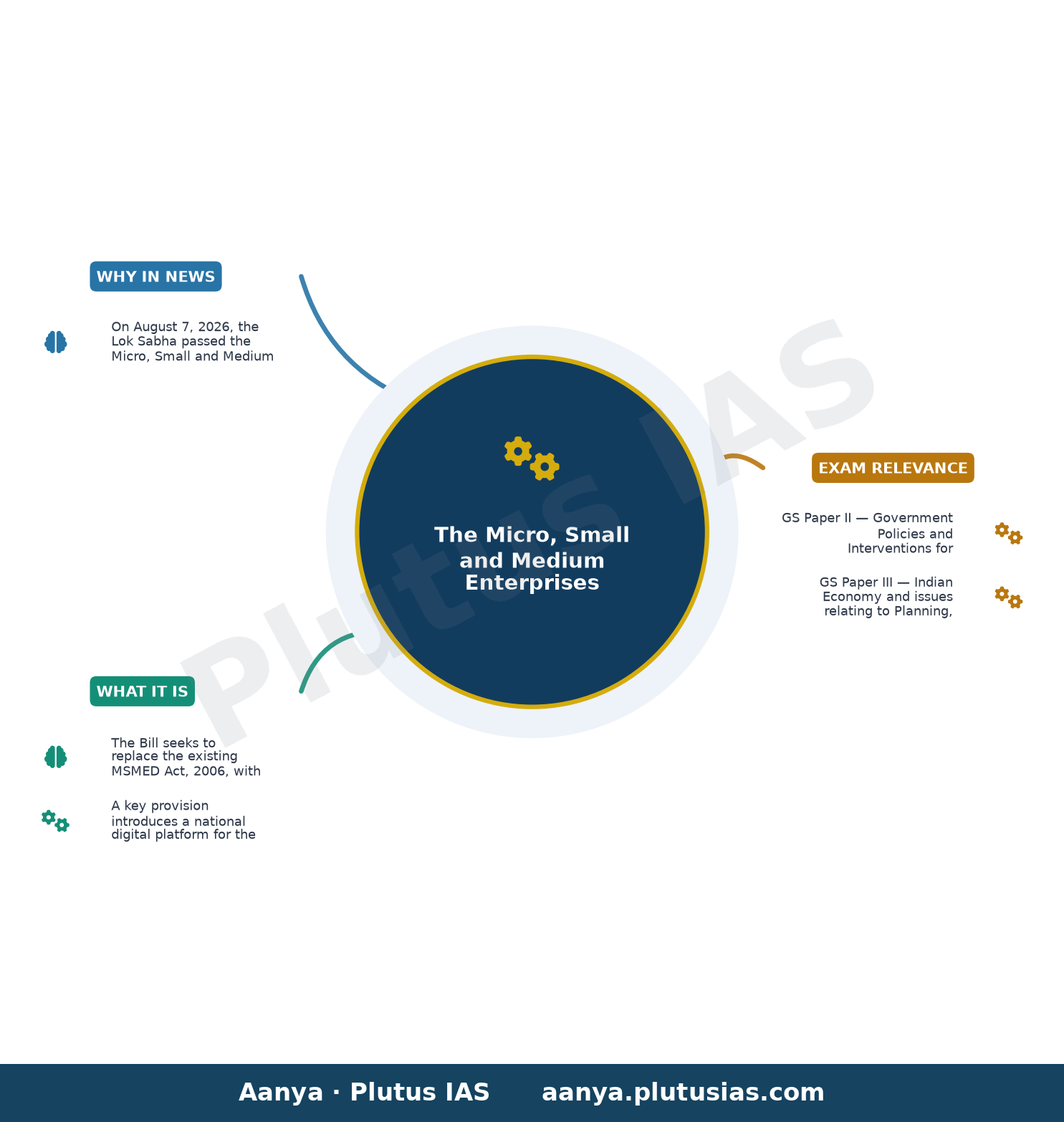
✎ The Micro, Small and Medium Enterprises Development (Amendment) Bill, 2026, replaces the MSMED Act, 2006, by introducing a national digital platform for voluntary MSME registration.
Subject Relevance — Where This Topic Fits
- GS Paper II — Government Policies and Interventions for Development in various sectors | GS Paper III — Indian Economy and issues relating to Planning, Mobilization of Resources, Growth, Development and Employment
- Prelims: MSMED Act 2006, Udyam Registration Portal, Ease of Doing Business, Digital Public Infrastructure, Credit Guarantee Scheme for MSMEs, Classification of MSMEs, National Digital Platform, Other Laws (Amendment) Bill 2026
- Essay: The role of digital public infrastructure in transforming India’s entrepreneurial ecosystem, Balancing regulatory compliance with ease of doing business for MSMEs
Quick Revision: The Micro, Small and Medium Enterprises Development (Amendment) Bill, 2026, replaces the MSMED Act, 2006, by introducing a national digital platform for voluntary MSME registration.
Why is this in the news?
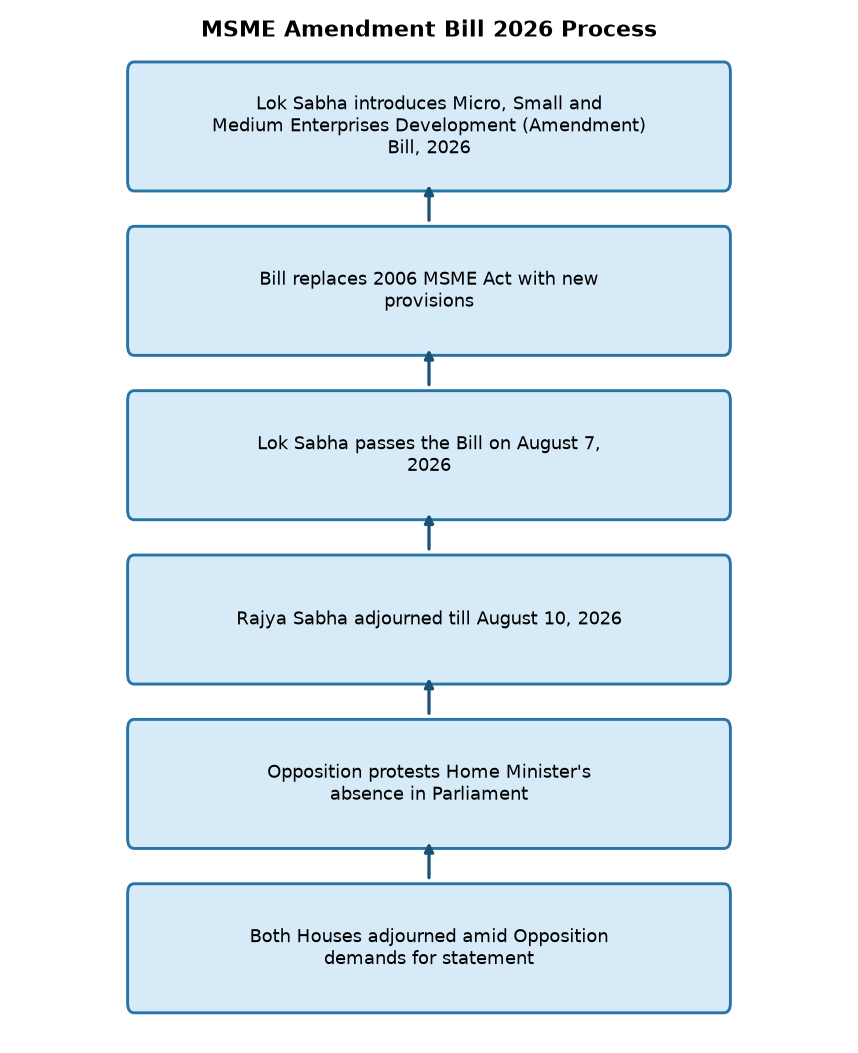
On August 7, 2026, the Lok Sabha passed the Micro, Small and Medium Enterprises Development (Amendment) Bill, 2026, which seeks to replace the MSMED Act, 2006. The Bill introduces a national digital platform for voluntary and free registration of MSMEs, aligning with the government’s broader vision of leveraging technology for ease of doing business and formalisation of the MSME sector. The Bill’s passage assumes significance amid ongoing debates on regulatory reforms, digital public infrastructure, and the need for inclusive growth in India’s manufacturing and services economy.
Background
- The Micro, Small and Medium Enterprises Development (MSMED) Act, 2006, was enacted to provide a legal framework for the classification, registration, and promotion of MSMEs in India, aiming to enhance their competitiveness and access to credit.
- The Act defines MSMEs based on investment in plant and machinery or equipment, with thresholds revised periodically to reflect inflation and sectoral dynamics.
- The Udyam Registration Portal, launched in 2020, replaced the erstwhile Udyog Aadhaar Memorandum (UAM) system, offering a simplified, online registration process for MSMEs.
- The government has consistently emphasised the MSME sector as a critical driver of employment generation, innovation, and inclusive growth, contributing approximately 30% to India’s GDP and 45% to exports.
- The COVID-19 pandemic underscored the vulnerabilities of MSMEs, prompting policy interventions such as the Emergency Credit Line Guarantee Scheme (ECLGS) and the Atmanirbhar Bharat Abhiyan to mitigate liquidity constraints.
- The proposed amendments reflect a broader shift towards digital governance, with the Bill mandating the establishment of a national digital platform for MSME registration, streamlining compliance and reducing bureaucratic hurdles.
What is the Micro, Small and Medium Enterprises Development (Amendment) Bill, 2026?
- The Bill seeks to replace the existing MSMED Act, 2006, with updated provisions to align with contemporary economic and technological realities, including the rise of digital entrepreneurship and the gig economy.
- A key provision introduces a national digital platform for the free and voluntary registration of MSMEs, ensuring seamless integration with other government databases such as GST, PAN, and Aadhaar.
- It proposes amendments to enhance the ease of doing business for MSMEs by simplifying compliance requirements, reducing regulatory burdens, and improving access to credit through integrated digital systems.
- It aligns with the government’s broader initiatives such as the Digital India programme, Startup India, and Make in India, by fostering a conducive ecosystem for MSME growth and formalisation.
UPSC Value Addition
Keywords for Mains Answer-Writing
Micro, Small and Medium Enterprises Development (Amendment) Bill, 2026 · MSME Act, 2006 · National digital platform for MSME registration · Parliamentary procedures and legislative amendments · Role of the Speaker and Chairperson in Parliament · Opposition’s demand for Ministerial presence in Parliament · Federalism and Centre-State relations in legislative processes · Ease of doing business reforms for MSMEs · Voluntary registration of MSMEs · Parliamentary Affairs Minister’s role in legislative business
Prelims Practice Questions
Q1. Consider the following statements regarding the Micro, Small and Medium Enterprises Development (Amendment) Bill, 2026:
1. The Bill seeks to replace the MSME Development Act, 2006.
2. It mandates compulsory registration of all MSMEs on a national digital platform.
3. The Bill introduces provisions for the voluntary registration of MSMEs.
4. The Bill was passed by the Lok Sabha on August 7, 2026.
How many of the above statements are correct?
- Only one
- Only two
- Only three
- All
Answer: All — Statements 1, 3, and 4 are correct. Statement 2 is incorrect as the Bill provides for *voluntary* registration, not compulsory.
Q2. Assertion (A): The Speaker of the Lok Sabha has the authority to direct a Minister to attend the House during its proceedings.
Reason (R): The Constitution of India explicitly empowers the Speaker to summon any Minister to attend Parliament sessions.
- Both A and R are true, and R is the correct explanation of A.
- Both A and R are true, but R is NOT the correct explanation of A.
- A is true, but R is false.
- A is false, but R is true.
Answer: A is false, but R is true. — Assertion (A) is true as the Speaker can direct a Minister to attend proceedings, though this is not explicitly mentioned in the Constitution. Reason (R) is false because the Constitution does not explicitly empower the Speaker to summon Ministers.
Q3. Match the following Parliamentary terms with their correct descriptions:
Column I
1. Adjournment
2. Prorogation
3. Dissolution
4. Censure Motion
Column II
A. Termination of a session of Parliament without any definite date for its next sitting.
B. Ending the life of the Lok Sabha before the expiry of its term.
C. Formal termination of a session of Parliament, marking the end of business for that session.
D. A formal expression of disapproval of the conduct of a Minister or the government.
- 1-A, 2-C, 3-B, 4-D
- 1-C, 2-A, 3-B, 4-D
- 1-A, 2-B, 3-C, 4-D
- 1-D, 2-C, 3-A, 4-B
Answer: 1-A, 2-C, 3-B, 4-D — The correct matches are: 1-A (Adjournment), 2-C (Prorogation), 3-B (Dissolution), and 4-D (Censure Motion).
Mains Practice Question
✍ The Micro, Small and Medium Enterprises Development (Amendment) Bill, 2026 seeks to replace the MSME Act, 2006 with a focus on digital integration and voluntary registration. Critically examine the legislative and administrative implications of this amendment for India’s MSME sector. Also, discuss the role of Parliament in ensuring accountability of the executive in the context of recent legislative proceedings. (15 Marks)
Approach: MODEL-ANSWER SKELETON:
1. **Introduction (2 marks)**:
– Briefly outline the MSME sector’s significance in India’s economy (contribution to GDP, employment, and exports).
– State the key provisions of the MSME Development Act, 2006 (classification of enterprises, credit facilities, and promotional schemes).
– Highlight the need for legislative reforms in the MSME sector.
2. **Key provisions of the Amendment Bill (4 marks)**:
– Replacement of the 2006 Act with the 2026 Bill.
– Introduction of a national digital platform for *voluntary* registration of MSMEs (contrast with compulsory registration under the 2006 Act).
– Streamlining of regulatory processes to enhance ease of doing business.
– Any changes in credit facilitation, dispute resolution, or promotional schemes.
3. **Legislative implications (4 marks)**:
– **Digital integration**: Assess the potential impact of a national digital platform on MSME registration, compliance, and access to government schemes (e.g., Udyam Registration portal).
– **Voluntary vs. compulsory registration**: Discuss the rationale behind shifting to voluntary registration and its potential benefits (reduced compliance burden) and drawbacks (underreporting, loss of data for policy formulation).
– **Federalism**: Examine the role of the Centre vs. States in implementing the digital platform and ensuring uniformity in MSME policies.
– **Accountability mechanisms**: Discuss how the amendment aligns with broader ease-of-doing-business reforms (e.g., reduction in compliance costs, faster dispute resolution).
4. **Parliamentary accountability and recent proceedings (3 marks)**:
– **Legislative process**: Explain the stages of the Bill’s passage (introduction, Standing Committee scrutiny, Lok Sabha passage) and the role of the Speaker/Chairperson in ensuring smooth proceedings.
– **Opposition’s demand for Ministerial presence**: Critically analyse the Opposition’s demand for the Home Minister’s presence in Parliament and the government’s response (e.g., Kiren Rijiju’s statement on Ministerial attendance).
– **Role of Parliament**: Discuss Parliament’s role in holding the executive accountable, including debates, adjournments, and the use of parliamentary procedures (e.g., calling attention motions, zero-hour discussions).
5. **Conclusion (2 marks)**:
– Summarise the potential benefits of the amendment (e.g., digital empowerment, reduced compliance burden) and challenges (e.g., underreporting, implementation gaps).
– Emphasise the need for Parliament to balance legislative efficiency with robust accountability mechanisms to ensure the executive’s responsiveness to parliamentary and public demands.
Source: The Hindu
Generated by AanyaAi for educational purpose.

- सुप्रीम कोर्ट ने कावेरी जल पुनर्वितरण याचिका खारिज की, जानें पूरा मामला - September 22, 2026
- Supreme Court Rejects Plea for 70 TMC Cauvery Water Reallocation: Key UPSC Analysis - September 22, 2026
- उत्तराखंड में असिस्टेंट प्रोफेसर भर्ती: यूकेपीएससी करेगा चयन, जानिए बदलाव - September 22, 2026

No Comments