


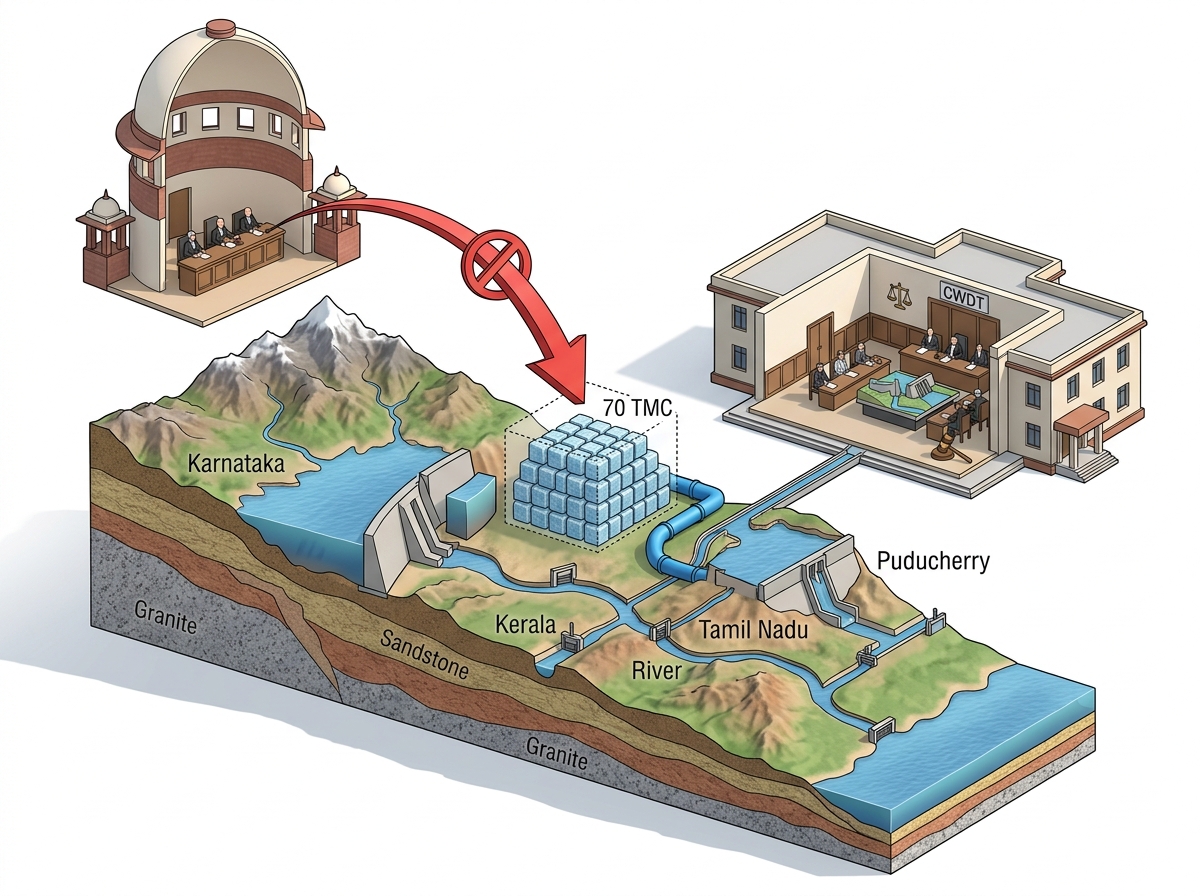
22 Sep Supreme Court Rejects Plea for 70 TMC Cauvery Water Reallocation: Key UPSC Analysis
✎ The Supreme Court’s refusal to reallocate Cauvery water in 2026 reaffirms the primacy of institutional mechanisms (CWMA/CWRC) over judicial intervention in inter-state water disputes, as mandated by the Inter-State Water Disputes…
Subject Relevance — Where This Topic Fits
- GS Paper II — Functions and Responsibilities of the Union and the States, Issues and Challenges Pertaining to the Federal Structure | GS Paper III — Conservation, Environmental Pollution and Degradation, Water Resources
- Prelims: Cauvery Water Disputes Tribunal (CWDT), Cauvery Water Management Authority (CWMA), Cauvery Water Regulation Committee (CWRC), Inter-State Water Disputes Act, 1956, Supreme Court’s advisory jurisdiction
- Essay: Federalism and Centre-State Relations in India: Balancing Autonomy and Cooperation, Judicial Activism vs. Judicial Restraint: The Role of the Supreme Court in Inter-State Disputes
Quick Revision: The Supreme Court’s refusal to reallocate Cauvery water in 2026 reaffirms the primacy of institutional mechanisms (CWMA/CWRC) over judicial intervention in inter-state water disputes, as mandated by the Inter-State Water Disputes Act, 1956.
Why is this in the news?
The Supreme Court, on 22 September 2026, declined to entertain a fresh plea seeking the reallocation of 70 TMC (thousand million cubic feet) of Cauvery river water to Karnataka from the share of Tamil Nadu, citing the ongoing inter-state dispute and the existence of established institutional mechanisms for resolution. The decision underscores the judiciary’s reluctance to intervene in matters already before specialised tribunals and highlights the procedural complexities in inter-state water governance.
Background
- The Cauvery river dispute is a long-standing inter-state conflict primarily between Karnataka and Tamil Nadu, with Kerala and Puducherry also involved as stakeholders, arising from competing claims over water sharing.
- The Cauvery Water Disputes Tribunal (CWDT), constituted under the Inter-State Water Disputes Act, 1956, delivered its final award in 2007, allocating specific water shares to each riparian state based on historical usage and rainfall patterns.
- In 2018, the Supreme Court modified the CWDT award, reducing Karnataka’s share while increasing Tamil Nadu’s allocation, and directed the establishment of the Cauvery Water Management Authority (CWMA) and the Cauvery Water Regulation Committee (CWRC) for implementation and monitoring.
- The CWMA and CWRC function as institutional mechanisms to ensure compliance with the Tribunal’s directives, particularly during periods of water scarcity, by regulating water releases from Karnataka to Tamil Nadu.
- Recent monsoon deficits in 2026 have exacerbated tensions, with Tamil Nadu alleging inadequate water releases by Karnataka despite CWMA directives, while Karnataka contends it has complied with the prescribed flow of 9,000 cusecs (cubic feet per second) to Tamil Nadu.
- The Supreme Court’s refusal to entertain the fresh plea reflects its adherence to the principle of judicial restraint in matters governed by specialised statutory bodies and ongoing inter-state adjudication.
Inter-State Water Disputes in India: Legal and Institutional Framework
- The Inter-State Water Disputes Act, 1956, provides the legal framework for resolving disputes over water sharing between states, empowering the central government to constitute Tribunals for adjudication.
- The CWMA, constituted in 2018, is a statutory body tasked with implementing the Tribunal’s award, monitoring water releases, and ensuring compliance with directives issued by the CWRC during periods of water scarcity.
- The CWRC functions as the operational arm of the CWMA, issuing real-time directives to riparian states to regulate water flows, particularly during droughts or monsoon deficits, to prevent disputes from escalating.
- Judicial intervention in inter-state water disputes is guided by the principle of judicial restraint, with courts typically deferring to the decisions of specialised Tribunals and statutory bodies unless there are clear violations of constitutional or statutory provisions.
- The Supreme Court’s refusal to entertain the 2026 plea underscores the importance of exhausting institutional mechanisms before seeking judicial redress, aligning with the constitutional scheme of federal governance and cooperative federalism.
- The case highlights the challenges of balancing state autonomy with the need for equitable water distribution, particularly in the context of climate variability and increasing water stress across river basins.
UPSC Value Addition
Keywords for Mains Answer-Writing
Inter-State River Water Disputes · Cauvery Water Disputes Tribunal (CWDT) · Cauvery Water Management Authority (CWMA) · Cauvery Water Regulation Committee (CWRC) · Inter-State Water Disputes Act, 1956 · Supreme Court jurisdiction under Article 136 · Doctrine of Prior Appropriation · Equitable apportionment of river waters · Inter-State River Water Disputes (Amendment) Act, 2019 · Constitutional provisions on water disputes (Article 262) · Judicial activism in water governance · Federalism and water resource management
Prelims Practice Questions
Q1. Consider the following statements regarding the Cauvery Water Disputes Tribunal (CWDT):
1. The CWDT was constituted under the Inter-State River Water Disputes Act, 1956.
2. The CWDT’s award was notified by the Government of India in 2013.
3. The Cauvery Water Management Authority (CWMA) was established before the CWDT’s final award.
4. The CWMA operates under the Ministry of Jal Shakti.
How many of the above statements are correct?
- Only one
- Only two
- Only three
- All four
Answer: Only three — Statements 1 and 2 are correct. The CWDT was constituted under the Inter-State River Water Disputes Act, 1956, and its award was notified in 2013. Statement 3 is incorrect as the CWMA was established after the CWDT’s final award in 2018. Statement 4 is incorrect as the CWMA operates under the Ministry of Jal Shakti, but it was established post-2013.
Q2. Assertion (A): The Supreme Court’s jurisdiction under Article 136 of the Constitution is discretionary.
Reason (R): Article 136 empowers the Supreme Court to grant special leave to appeal from any judgment, decree, determination, sentence, or order in any cause or matter passed or made by any court or tribunal in the territory of India.
- Both A and R are true, and R is the correct explanation of A
- Both A and R are true, but R is not the correct explanation of A
- A is true but R is false
- A is false but R is true
Answer: A is true but R is false — Assertion (A) is true: the Supreme Court’s jurisdiction under Article 136 is discretionary. Reason (R) is also true but does not explain why the jurisdiction is discretionary; it merely states the scope of the power. The discretionary nature arises from the Court’s inherent power to refuse leave to appeal.
Q3. Match the following institutions with their respective roles in the Cauvery water dispute:
Column I (Institution) | Column II (Role)
— | —
1. Cauvery Water Disputes Tribunal (CWDT) | A. Monitors and enforces the implementation of the Tribunal’s award
2. Cauvery Water Management Authority (CWMA) | B. Constituted under the Inter-State River Water Disputes Act, 1956
3. Cauvery Water Regulation Committee (CWRC) | C. Provides technical and administrative support to CWMA
4. Ministry of Jal Shakti | D. Implements the directions of the CWMA and CWRC
- 1-B, 2-A, 3-D, 4-C
- 1-B, 2-A, 3-C, 4-D
- 1-A, 2-B, 3-D, 4-C
- 1-C, 2-D, 3-A, 4-B
Answer: 1-B, 2-A, 3-D, 4-C — The correct match is: 1-B (CWDT was constituted under the Inter-State River Water Disputes Act, 1956), 2-A (CWMA monitors and enforces the Tribunal’s award), 3-D (CWRC implements the directions of the CWMA and CWRC), and 4-C (Ministry of Jal Shakti provides technical and administrative support to CWMA).
Mains Practice Question
✍ The Supreme Court’s refusal to entertain a fresh plea seeking reallocation of 70 TMC of Cauvery river water highlights the constitutional and institutional complexities in inter-State river water disputes. Critically examine the efficacy of the existing legal and institutional framework for resolving such disputes in India. Also, analyse the role of judicial intervention in ensuring equitable apportionment of river waters. (15 Marks)
Approach: MODEL-ANSWER SKELETON:
1. **Introduction (2 Marks)**
– Briefly define inter-State river water disputes and their constitutional significance (Article 262).
– Mention the Cauvery dispute as a case study to frame the discussion.
2. **Legal Framework (4 Marks)**
– **Inter-State River Water Disputes Act, 1956**: Constitution of tribunals (CWDT), time-bound adjudication, and binding awards.
– **Inter-State River Water Disputes (Amendment) Act, 2019**: Reforms such as single tribunal, permanent data banks, and dispute resolution mechanisms.
– **Constitutional Provisions**: Article 262 (exclusion of jurisdiction of courts) and Article 136 (Supreme Court’s discretionary jurisdiction).
– **Critique**: Delays in tribunal awards, lack of enforcement mechanisms, and ambiguity in the role of the Supreme Court.
3. **Institutional Mechanisms (4 Marks)**
– **Cauvery Water Disputes Tribunal (CWDT)**: Final award (2013) and its enforcement challenges.
– **Cauvery Water Management Authority (CWMA)**: Role in monitoring and enforcing the Tribunal’s award (established in 2018).
– **Cauvery Water Regulation Committee (CWRC)**: Technical body for real-time regulation.
– **Critique**: Institutional fragmentation, lack of coordination, and political interference.
4. **Judicial Intervention (3 Marks)**
– **Supreme Court’s Role**: Discretionary jurisdiction (Article 136), suo motu interventions, and balancing federalism.
– **Recent Judgments**: Reference to the Supreme Court’s 2018 judgment upholding the CWDT’s award and its 2026 refusal to entertain fresh pleas.
– **Critique**: Judicial activism vs. judicial overreach, and the need for a more structured approach.
5. **Way Forward (2 Marks)**
– **Reforms**: Strengthening the CWMA, data-driven decision-making, and early warning systems.
– **Alternative Dispute Resolution**: Mediation and negotiation frameworks to reduce litigation.
– **Conclusion**: Emphasise the need for a balanced approach combining legal, institutional, and judicial reforms to ensure equitable water distribution.
Source: orissapost.com
Generated by AanyaAi for educational purpose.
Related guides on our sites
- Current affairs for upsc 2026
- Best PSIR optional coaching for upsc
- Best PSIR optional teacher for upsc
- Best teacher of PSIR optional for upsc

- Supreme Court Rejects Plea for 70 TMC Cauvery Water Reallocation: Key UPSC Analysis - September 22, 2026
- उत्तराखंड में असिस्टेंट प्रोफेसर भर्ती: यूकेपीएससी करेगा चयन, जानिए बदलाव - September 22, 2026
- UKPSC to Recruit Assistant Professors in Uttarakhand Aided Colleges: Draft Policy - September 22, 2026

No Comments