


07 Aug Rajya Sabha Approves Appropriation Bill 2026; Lok Sabha Passes Taxation Bill
✎ The Appropriation (No. 3) Bill, 2026, authorises additional expenditure from the Consolidated Fund of India under Article 114 of the Constitution, while the Taxation and Other Laws (Amendment) Bill, 2026, seeks to amend key…
Subject Relevance — Where This Topic Fits
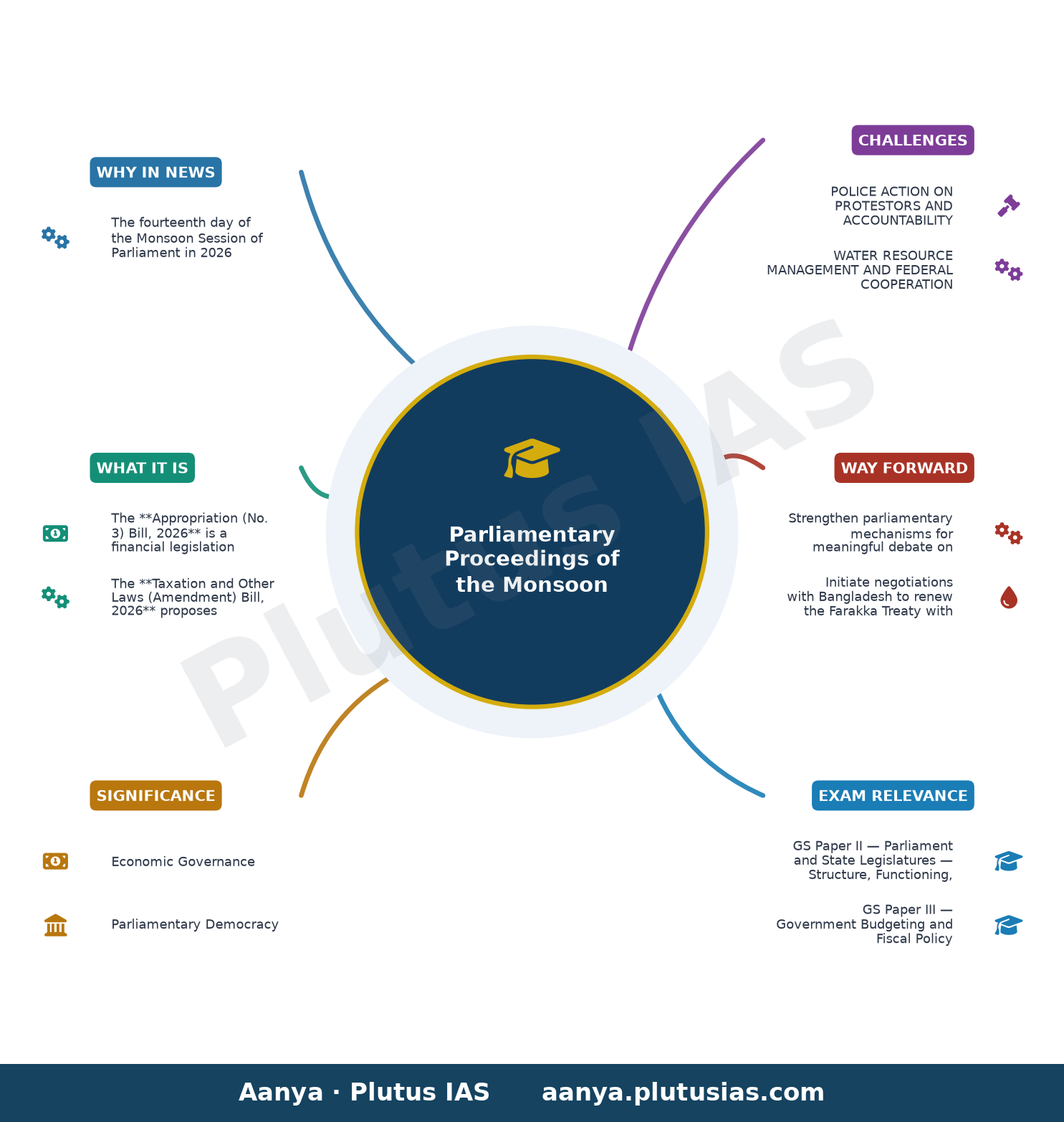
- GS Paper II — Parliament and State Legislatures — Structure, Functioning, Conduct of Business, Powers & Privileges | GS Paper III — Government Budgeting and Fiscal Policy
- Prelims: Appropriation Bill, Consolidated Fund of India, Payment and Settlement Systems Act 2007, Income-tax Act 2025, Finance Act 2026, Article 114 of the Constitution, Rajya Sabha, Lok Sabha, Leader of Opposition, Consolidated Fund of India
Quick Revision: The Appropriation (No. 3) Bill, 2026, authorises additional expenditure from the Consolidated Fund of India under Article 114 of the Constitution, while the Taxation and Other Laws (Amendment) Bill, 2026, seeks to amend key fiscal and regulatory statutes to address contemporary economic challenges.
Why is this in the news?
The fourteenth day of the Monsoon Session of Parliament in 2026 witnessed critical legislative actions, including the passage of the Taxation and Other Laws (Amendment) Bill, 2026 in the Lok Sabha and the approval of the Appropriation (No. 3) Bill, 2026 in the Rajya Sabha. Concurrently, the Opposition raised substantive concerns regarding alleged police violence during a protest at Jantar Mantar, demanding a statement from the Union Home Minister. These developments underscore the interplay between fiscal governance, parliamentary procedure, and legislative accountability in India’s democratic framework.
Background
- The Constitution of India, under Article 114, mandates that all expenditure from the Consolidated Fund of India must be authorised by Parliament through the passage of Appropriation Bills. The Appropriation (No. 3) Bill, 2026, is the third such bill in the financial year 2025–26, authorising additional expenditure beyond the amounts already approved in the Annual Financial Statement.
- The Taxation and Other Laws (Amendment) Bill, 2026, seeks to amend the Payment and Settlement Systems Act, 2007, the Income-tax Act, 2025, and the Finance Act, 2026, reflecting the government’s intent to update fiscal and regulatory frameworks to address contemporary economic and technological challenges.
- The Opposition’s demand for a statement from the Union Home Minister on alleged police violence during a protest at Jantar Mantar in July 2026 highlights the tension between executive accountability and parliamentary oversight, particularly in matters concerning law and order.
- The Indo-Bangladesh Farakka Treaty of 1996, set to expire in 2026, remains a contentious issue, with concerns raised about its impact on the water-sharing arrangements for the Ganga/Ganges and the resultant implications for Bihar’s groundwater resources.
- The Monsoon Session of Parliament, as a constitutional mechanism, serves as a platform for deliberating legislative proposals, financial allocations, and matters of public importance, ensuring the executive remains accountable to the legislature.
- The role of the Rajya Sabha as a revising chamber is exemplified in its approval of the Appropriation (No. 3) Bill, 2026, following its passage in the Lok Sabha, thereby completing the legislative process for additional expenditure.
Key Legislative Instruments and Parliamentary Processes in Focus
- The **Appropriation (No. 3) Bill, 2026** is a financial legislation introduced under Article 114 of the Constitution, authorising the payment and appropriation of additional sums from the Consolidated Fund of India for the financial year 2025–26. Such bills are essential for ensuring that the government has the necessary funds to meet unforeseen or additional expenditure during the fiscal year.
- The **Taxation and Other Laws (Amendment) Bill, 2026** proposes amendments to three critical statutes: the Payment and Settlement Systems Act, 2007 (regulating digital payments and settlement systems), the Income-tax Act, 2025 (governing direct taxation), and the Finance Act, 2026 (enacting the Union Budget provisions). These amendments are likely aimed at addressing gaps in regulatory oversight, tax administration, and fiscal governance.
- The **Payment and Settlement Systems Act, 2007** provides the legal framework for regulating payment systems in India, including digital payment mechanisms, clearing corporations, and settlement systems. Amendments to this Act may focus on enhancing security, interoperability, and consumer protection in digital transactions.
- The **Income-tax Act, 2025** governs the levy, collection, and administration of direct taxes in India. Proposed amendments could include changes to tax slabs, deductions, compliance procedures, or measures to curb tax evasion and promote transparency.
- The **Finance Act, 2026** is the legislative instrument that gives effect to the Union Budget’s tax proposals for the financial year. Amendments to this Act may include changes to tax rates, exemptions, or procedural aspects of tax administration.
- The **Consolidated Fund of India** is the principal account of the Government of India, into which all revenues received, loans raised, and receipts from recoveries of loans are credited. All expenditure from this fund must be authorised by Parliament through Appropriation Bills.
- Parliamentary procedures governing financial legislation require that Appropriation Bills be passed by both Houses of Parliament (Lok Sabha and Rajya Sabha) before they receive the President’s assent. The Rajya Sabha’s role as a revising chamber ensures scrutiny of financial proposals, though its powers are limited in matters of taxation and expenditure.
- The Opposition’s demand for a statement from the Union Home Minister on police action during a protest at Jantar Mantar underscores the principle of **ministerial accountability** to Parliament. This aligns with the constitutional provision that ministers are collectively responsible to the legislature for the administration of their respective ministries.
Key Features
| Feature | Significance |
|---|---|
| Appropriation (No.3) Bill, 2026 | Authorises additional expenditure from the Consolidated Fund of India for the financial year 2025-26, ensuring continuity of government operations and funding for approved schemes. |
| Taxation and Other Laws (Amendment) Bill, 2026 | Proposes amendments to the Payment and Settlement Systems Act, 2007; Income-tax Act, 2025; and Finance Act, 2026, aimed at rationalising tax administration and aligning with contemporary economic practices. |
| Parliamentary Procedure in Rajya Sabha | Demonstrates the role of the Chairman in facilitating discussions on Opposition demands, such as the request for a statement by the Home Minister on police action against protestors. |
| Special Mentions in Rajya Sabha | Provides a platform for MPs to raise issues of public importance, including regional concerns like the Indo-Bangladesh Farakka Treaty and groundwater depletion in Bihar. |
| Jammu & Kashmir Financial Oversight | Highlights the Centre’s role in addressing developmental gaps in J&K post-Article 370 abrogation, with a focus on clearing overhangs and ensuring financial prudence. |
Why it Matters
Economic Governance
- The Appropriation (No.3) Bill ensures the availability of funds for critical government expenditures, preventing disruptions in public service delivery and welfare schemes.
- Amendments to tax laws under the Taxation Bill aim to streamline compliance, reduce litigation, and enhance revenue buoyancy, aligning with fiscal consolidation objectives.
- The passage of financial Bills during the Monsoon Session underscores the legislature’s role in maintaining fiscal discipline and transparency in budgetary processes.
Parliamentary Democracy
- The Opposition’s demand for a statement by the Home Minister on police action reflects the constitutional principle of accountability, where the executive is held responsible for its actions in the legislature.
- The Chairman’s intervention in conveying Opposition concerns to the executive highlights the presiding officer’s role in facilitating constructive dialogue between the government and the Opposition.
- Special Mentions provide a mechanism for MPs to highlight regional and sectoral issues, ensuring diverse representation of public concerns in parliamentary proceedings.
Federalism and Inter-State Relations
- The debate on the Indo-Bangladesh Farakka Treaty underscores the importance of inter-state and international water-sharing agreements, particularly for states like Bihar that are downstream of the Ganga.
- Concerns raised about groundwater depletion in Bihar highlight the need for coordinated federal action on water resource management, balancing agricultural demands with ecological sustainability.
Jammu & Kashmir Post-Ablation Governance
- The Finance Minister’s remarks on J&K’s financial overhauls post-Article 370 abrogation illustrate the Centre’s commitment to integrating the region into the national mainstream through targeted fiscal interventions.
- The focus on clearing developmental overhangs in J&K aligns with the broader objective of ensuring equitable development across all regions of India.
Challenges
1. POLICE ACTION ON PROTESTORS AND ACCOUNTABILITY
- The demand for a statement by the Home Minister on police action against protestors at Jantar Mantar raises questions about the balance between law enforcement and democratic rights.
- Ensuring transparency in police actions while maintaining public order remains a persistent challenge, requiring robust institutional mechanisms for oversight and redressal.
- The Opposition’s insistence on a statement reflects broader concerns about the erosion of democratic norms and the need for executive accountability in a parliamentary democracy.
UPSC Link: GS-II: Parliament and State Legislatures
2. WATER RESOURCE MANAGEMENT AND FEDERAL COOPERATION
- The impending expiry of the Indo-Bangladesh Farakka Treaty in 2026 necessitates urgent negotiations to ensure water security for downstream states like Bihar.
- Inter-state disputes over water sharing, exacerbated by climate change and groundwater depletion, pose significant challenges to sustainable development.
- The absence of a permanent inter-state water dispute resolution mechanism complicates negotiations, highlighting the need for constitutional and legal reforms.
UPSC Link: GS-II: Federalism and Inter-State Relations
3. FISCAL DISCIPLINE AND PARLIAMENTARY OVERSIGHT
- The passage of supplementary demands for grants without debate raises concerns about the dilution of parliamentary scrutiny over public expenditure.
- Ensuring meaningful debate on financial Bills is essential to uphold the principles of democratic governance and prevent arbitrary fiscal decisions.
- The Opposition’s limited participation in discussions on the Taxation Bill underscores the need for inclusive parliamentary processes to enhance legislative legitimacy.
UPSC Link: GS-III: Government Budgeting and Fiscal Policy
4. INTEGRATION AND DEVELOPMENT OF JAMMU & KASHMIR
- Addressing the developmental gaps in J&K post-Article 370 abrogation requires sustained financial investments and policy interventions to bridge socio-economic disparities.
- Ensuring equitable development in J&K while maintaining security and stability remains a complex challenge, necessitating a balanced approach.
- The Centre’s role in clearing financial overhangs must be complemented by state-level governance reforms to ensure long-term sustainability.
UPSC Link: GS-II: Federalism and State Reorganisation
5. GROUNDWATER DEPLETION AND AGRICULTURAL SUSTAINABILITY
- The depletion of groundwater in states like Bihar poses a severe threat to agricultural productivity and food security, necessitating urgent policy interventions.
- Balancing the demands of irrigation with sustainable water management requires coordinated action between the Centre and state governments.
- The absence of a national groundwater policy exacerbates the crisis, highlighting the need for legislative and institutional reforms.
UPSC Link: GS-III: Environmental Conservation and Sustainable Development
Challenges — UPSC Perspective
| Issue | Concern |
|---|---|
| Police action on protestors | Potential erosion of democratic rights and need for executive accountability |
| Expiry of Farakka Treaty | Water security risks for downstream states and inter-state disputes |
| Supplementary Appropriation Bills | Dilution of parliamentary scrutiny over public expenditure |
| Groundwater depletion in Bihar | Agricultural sustainability and food security challenges |
| J&K financial overhangs | Equitable development and integration post-Article 370 abrogation |
Way Forward
- Strengthen parliamentary mechanisms for meaningful debate on financial Bills to uphold fiscal transparency and accountability.
- Initiate negotiations with Bangladesh to renew the Farakka Treaty with provisions for equitable water sharing and environmental safeguards.
- Formulate a national groundwater policy to address depletion and promote sustainable agricultural practices.
- Enhance inter-state coordination mechanisms for water resource management to resolve disputes and ensure equitable distribution.
- Accelerate developmental projects in J&K to bridge socio-economic disparities and integrate the region into the national mainstream.
- Establish independent oversight bodies to investigate allegations of police excesses and ensure accountability in law enforcement.
- Promote participatory governance models to involve local stakeholders in policy formulation and implementation for sustainable development.
UPSC Value Addition
Keywords for Mains Answer-Writing
Parliamentary processes · Appropriation Bill · Taxation Laws Amendment · Consolidated Fund of India · Finance Act · Income-tax Act · Payment and Settlement Systems Act · Parliamentary accountability · Opposition demands · Farakka Treaty · Ganga water sharing · Jammu and Kashmir post-Article 370 · Consolidated Fund of India · Financial accountability
Constitutional & Policy Linkages
- [‘Article 109: Special procedure in respect of Money Bills (Rajya Sabha’s role in Appropriation Bills)’, ‘Rajya Sabha’s limited powers over financial Bills’]
- [‘Article 118: Rules of Procedure (Parliamentary procedures and Special Mentions)’, ‘Framework for raising issues of public importance’]
- [‘Article 262: Adjudication of disputes relating to waters of inter-state rivers’, ‘Legal basis for resolving water-sharing disputes’]
Concept Flow
Opposition demand for Home Minister’s statement on police action → Parliamentary procedure under Article 118 → Chairman’s intervention → Executive accountability → Expiry of Indo-Bangladesh Farakka Treaty → Inter-state water dispute → Federalism challenges → Need for constitutional mechanisms under Article 262 → Passage of Appropriation (No.3) Bill → Supplementary expenditure authorisation → Fiscal governance → Parliamentary oversight under Article 109 → Groundwater depletion in Bihar → Agricultural sustainability crisis → Policy intervention → Need for national groundwater policy → J&K financial overhangs post-Article 370 → Centre’s developmental role → Equitable integration → Federalism and state reorganisation
Prelims Practice Questions
Q1. Consider the following statements regarding the Appropriation (No.3) Bill, 2026:
1. It authorises the payment and appropriation of certain further sums from the Consolidated Fund of India.
2. It is introduced in the Lok Sabha first and then sent to the Rajya Sabha.
3. The Bill is passed by the Rajya Sabha before it is sent back to the Lok Sabha for final approval.
4. The Bill seeks to amend the Payment and Settlement Systems Act, 2007.
How many of the above statements are correct?
- Only one
- Only two
- Only three
- All four
Answer: Only three — Statements 1, 2, and 3 are correct as the Appropriation Bill follows the standard legislative process in Parliament. Statement 4 is incorrect because the Appropriation (No.3) Bill does not amend the Payment and Settlement Systems Act; that amendment is part of the Taxation and Other Laws (Amendment) Bill, 2026.
Q2. Assertion (A): The Taxation and Other Laws (Amendment) Bill, 2026 seeks to amend the Income-tax Act, 2025.
Reason (R): The Bill also proposes amendments to the Finance Act, 2026 and the Payment and Settlement Systems Act, 2007.
Options:
A. Both A and R are true, and R is the correct explanation of A.
B. Both A and R are true, but R is not the correct explanation of A.
C. A is true, but R is false.
D. A is false, but R is true.
- A
- B
- C
- D
Answer: B — Both the Assertion and Reason are true. The Taxation and Other Laws (Amendment) Bill, 2026 indeed seeks to amend the Income-tax Act, 2025, the Finance Act, 2026, and the Payment and Settlement Systems Act, 2007. The Reason correctly explains the scope of the Bill.
Q3. Match the following Bills with their respective purposes:
Column I
1. Appropriation (No.3) Bill, 2026
2. Taxation and Other Laws (Amendment) Bill, 2026
Column II
A. Authorises payment and appropriation of sums from the Consolidated Fund of India
B. Amends the Income-tax Act, 2025, Finance Act, 2026, and Payment and Settlement Systems Act, 2007
- 1-A, 2-B
- 1-B, 2-A
- 1-A, 2-A
- 1-B, 2-B
Answer: 1-A, 2-B — The Appropriation (No.3) Bill, 2026 authorises the payment and appropriation of sums from the Consolidated Fund of India (Column I-1 matches Column II-A). The Taxation and Other Laws (Amendment) Bill, 2026 amends the Income-tax Act, 2025, Finance Act, 2026, and Payment and Settlement Systems Act, 2007 (Column I-2 matches Column II-B).
Mains Practice Question
✍ The Parliament, in its Monsoon Session 2026, witnessed the passage of the Appropriation (No.3) Bill, 2026 and the Taxation and Other Laws (Amendment) Bill, 2026. Critically examine the significance of these Bills in the context of parliamentary financial accountability and fiscal governance in India. (15 Marks)
Approach: MODEL-ANSWER SKELETON:
1. **Context and Purpose of the Bills:**
– Appropriation (No.3) Bill, 2026: Authorises the payment and appropriation of further sums from the Consolidated Fund of India for the financial year 2025-26. Explain the constitutional basis under Article 114 and the role of Parliament in financial oversight.
– Taxation and Other Laws (Amendment) Bill, 2026: Amends the Income-tax Act, 2025, Finance Act, 2026, and Payment and Settlement Systems Act, 2007. Discuss the objectives of tax rationalisation and digital payment reforms.
2. **Parliamentary Financial Accountability:**
– Role of Parliament in scrutinising financial Bills: Debate the significance of the Appropriation Bill as a tool for parliamentary control over executive spending (Article 113, 114, 115).
– Scrutiny of taxation amendments: Explain how the Taxation Bill reflects the executive’s power to amend tax laws and the limited scope for parliamentary debate in such cases.
3. **Contemporary Issues and Challenges:**
– Opposition’s demand for debate: Discuss the Opposition’s demand for a statement on police action against protestors and the implications for parliamentary accountability.
– Farakka Treaty debate: Link the discussion on the Farakka Treaty (1996) to parliamentary scrutiny of international agreements affecting federal interests (Article 253).
4. **Balance of Views and Critique:**
– Executive dominance: Argue that the passage of financial Bills without debate reflects the executive’s dominance in fiscal governance.
– Need for reform: Suggest measures to enhance parliamentary scrutiny, such as specialised committees (e.g., Public Accounts Committee, Estimates Committee) and pre-legislative consultations.
5. **Conclusion:**
– Summarise the significance of these Bills in maintaining fiscal discipline while highlighting the need for robust parliamentary oversight to balance executive power.
Source: The Hindu
Generated by AanyaAi for educational purpose.

- यूपीएससी के लिए सीएसआईआर साइक्विज: जानिए कैसे करें भागीदारी और लाभ उठाएं - September 21, 2026
- UPSC Alert: CSIR Science Quiz on My Bharat Portal for UPSC & State PCS 2026 - September 21, 2026
- एमएसएमई मंत्रालय ने शुरू किया विशेष अभियान 6.0: स्वच्छता और शिकायत निपटान पर जोर - September 21, 2026

No Comments