


07 Aug Kashmiri Pandits Rehabilitation Bill 2025: Key Features & UPSC Relevance
✎ The Kashmiri Pandits (Recourse, Restitution, Rehabilitation and Resettlement) Bill, 2025 aims to provide a legal framework for the dignified return and integration of displaced Kashmiri Pandits, addressing property restitution…
Subject Relevance — Where This Topic Fits
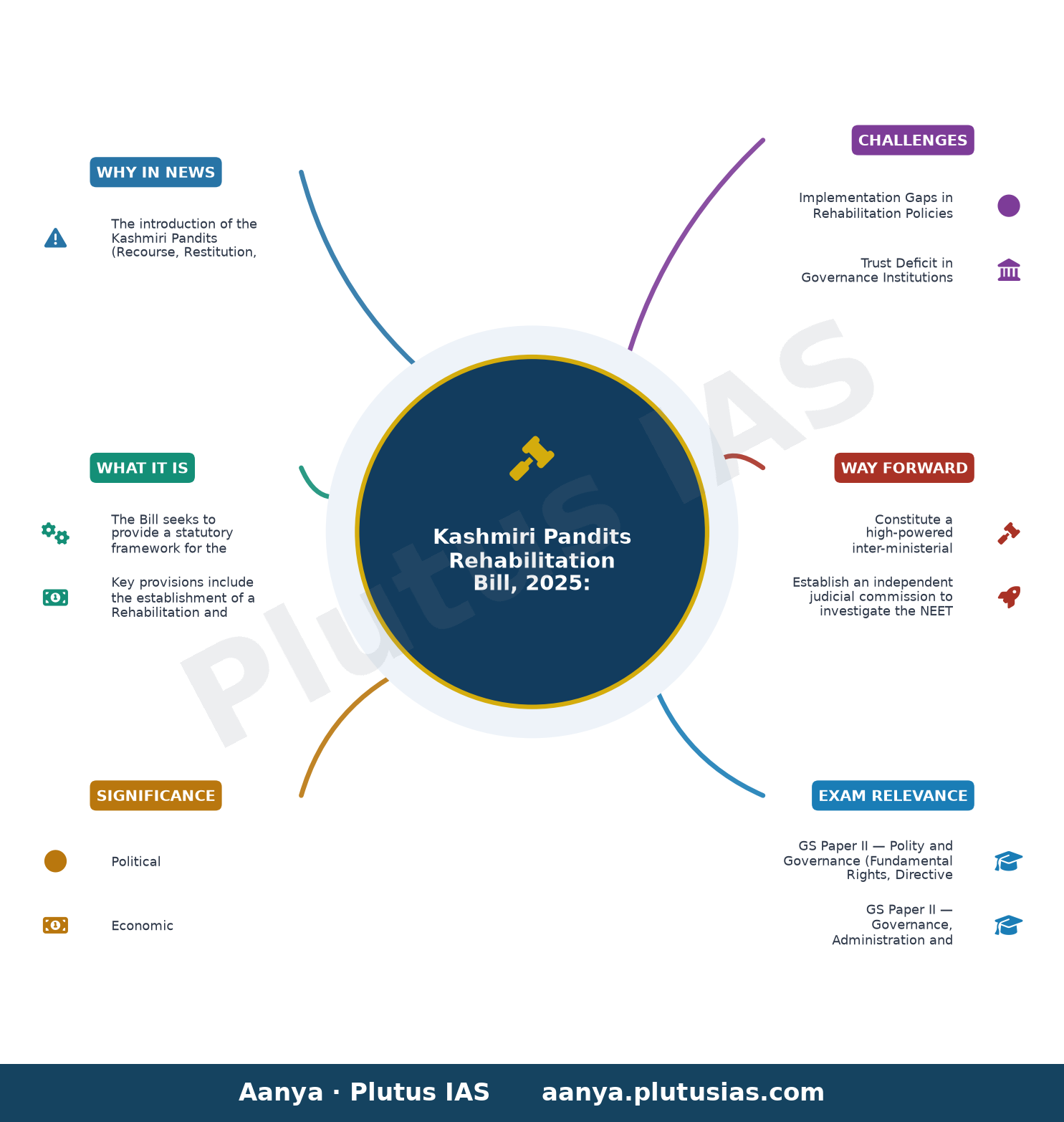
- GS Paper II — Polity and Governance (Fundamental Rights, Directive Principles of State Policy, Centre-State Relations) | GS Paper II — Governance, Administration and Challenges (Displacement, Rehabilitation and Resettlement)
- Prelims: Kashmiri Pandits, Article 21 (Right to Life and Personal Liberty), Article 30 (Cultural and Educational Rights), Disaster Management Act, 2005, National Commission for Minorities, Jammu and Kashmir Reorganisation Act, 2019
- Essay: The moral and constitutional obligation of the state towards internally displaced communities: A case study of Kashmiri Pandits, Rehabilitation as a measure of social justice: Balancing security imperatives with humanitarian concerns
Quick Revision: The Kashmiri Pandits (Recourse, Restitution, Rehabilitation and Resettlement) Bill, 2025 aims to provide a legal framework for the dignified return and integration of displaced Kashmiri Pandits, addressing property restitution, cultural heritage preservation, and socio-economic rehabilitation through a dedicated authority and fund.
Why is this in the news?
The introduction of the Kashmiri Pandits (Recourse, Restitution, Rehabilitation and Resettlement) Bill, 2025 in the Lok Sabha during the Monsoon Session of Parliament underscores the persistent challenge of addressing the humanitarian and socio-political needs of the Kashmiri Pandit community, displaced since the early 1990s due to insurgency and militancy in Jammu and Kashmir. The Bill seeks to provide a legal framework for their rehabilitation, restitution, and resettlement, aligning with constitutional principles of equality, dignity, and protection of minority rights, while also addressing concerns of property restoration and cultural heritage preservation.
Background
- The exodus of Kashmiri Pandits from the Kashmir Valley began in the early 1990s due to targeted violence, intimidation, and militancy, resulting in the displacement of approximately 300,000 to 400,000 individuals, with a significant majority migrating to Jammu, Delhi, and other parts of India.
- The displacement led to the loss of livelihoods, cultural heritage, and social cohesion, with many families living in refugee camps or rented accommodations for decades, despite government interventions such as the Prime Minister’s Package for Return and Rehabilitation of Kashmiri Migrants (2008).
- The Jammu and Kashmir Reorganisation Act, 2019, which bifurcated the erstwhile state into two Union Territories, included provisions for the protection of displaced persons and the restoration of their rights, though implementation challenges persisted.
- The Supreme Court of India, in its judgment in *Dr. Farooq Abdullah v. Union of India* (2020), directed the Union Government to frame a comprehensive policy for the rehabilitation of Kashmiri Pandits, emphasizing the need for a legal framework to address their grievances.
- The National Commission for Minorities has repeatedly highlighted the socio-economic and psychological challenges faced by the displaced community, including issues of property encroachment, lack of educational opportunities, and inadequate healthcare access.
- Efforts such as the Prime Minister’s Development Package (PMDP) for Jammu and Kashmir (2015) allocated funds for the construction of transit accommodations and the revival of cultural institutions, but systemic gaps in implementation and monitoring have hindered progress.
What is the Kashmiri Pandits (Recourse, Restitution, Rehabilitation and Resettlement) Bill, 2025?
- The Bill seeks to provide a statutory framework for the recourse, restitution, rehabilitation, and resettlement of Kashmiri Pandits displaced from the Kashmir Valley, ensuring their dignified return and integration into society.
- Key provisions include the establishment of a Rehabilitation and Resettlement Authority to oversee the implementation of the Bill, with powers to monitor property restitution, cultural heritage restoration, and socio-economic rehabilitation.
- The Bill mandates the protection of property rights of displaced Kashmiri Pandits, including the restoration of encroached lands and properties, and the provision of legal recourse for compensation in cases of loss or damage.
- It proposes the creation of a Rehabilitation Package Fund, financed by the Union and State Governments, to provide financial assistance for housing, education, healthcare, and livelihood restoration for displaced families.
- The Bill includes measures for the preservation and revival of Kashmiri Pandit cultural heritage, including the restoration of temples, manuscripts, and traditional knowledge systems, in alignment with Article 30 of the Constitution (Cultural and Educational Rights).
- It seeks to ensure the safety and security of returning families through coordinated efforts between central and state agencies, including the deployment of security forces and the establishment of grievance redressal mechanisms.
- The Bill also addresses the issue of political representation by proposing measures to ensure the participation of displaced Kashmiri Pandits in local governance structures, including reserved seats in Panchayati Raj institutions and urban local bodies in the Kashmir Valley.
- Provisions for monitoring and evaluation are included, with annual reports to be submitted to Parliament, ensuring transparency and accountability in the implementation of the rehabilitation process.
Key Features
| Feature | Significance |
|---|---|
| Kashmiri Pandits (Recourse, Restitution, Rehabilitation and Resettlement) Bill, 2025 | Proposes structured rehabilitation of displaced Kashmiri Pandits, including property restoration, cultural preservation, and security guarantees. |
| MSME Development (Amendment) Bill, 2026 | Aims to enhance the ease of doing business for micro, small, and medium enterprises by amending the 2006 Act, aligning with the ‘Atmanirbhar Bharat’ vision. |
| Fishermen (Protection and Welfare) Bill, 2024 | Seeks to establish welfare boards and funds for coastal fishermen, addressing livelihood security and regulatory gaps. |
| Foreign Contribution (Regulation) Amendment Bill, 2026 | Proposes stricter compliance for foreign funding, balancing transparency with the need to curb misuse of foreign contributions. |
| Parliamentary protests over NEET paper leak and Ram Mandir donations | Highlights institutional trust deficits, procedural transparency, and the role of parliamentary oversight in governance. |
Why it Matters
Political
- The introduction of the Kashmiri Pandits Rehabilitation Bill underscores the Centre’s commitment to addressing long-standing socio-political grievances of a marginalised community, potentially influencing electoral dynamics in Jammu & Kashmir.
- Parliamentary protests reflect deepening opposition discontent, particularly on issues of police action against protesters and alleged financial impropriety in religious donations, testing democratic accountability.
- The presence of Union Home Minister Amit Shah in Parliament during protests signals heightened executive engagement, though it also risks escalating political polarisation.
Economic
- The MSME Amendment Bill is critical for fostering entrepreneurship and employment, especially in post-pandemic recovery, by reducing regulatory burdens and enhancing credit access.
- The FCRA Amendment Bill’s stricter norms may impact NGOs and civil society organisations dependent on foreign funding, potentially altering the landscape of socio-economic interventions.
- Welfare measures for fishermen align with the ‘Blue Economy’ initiative, aiming to sustain coastal livelihoods and marine resource management.
Social
- The Kashmiri Pandits Rehabilitation Bill addresses historical displacement, cultural erosion, and security concerns, offering a potential model for inter-community reconciliation.
- Fishermen welfare initiatives target marginalised coastal communities, addressing systemic vulnerabilities in India’s extensive maritime economy.
- Parliamentary protests highlight public distrust in institutions, particularly among youth, necessitating transparent governance to restore faith in democratic processes.
Constitutional
- The Bills and protests intersect with constitutional principles of equality (Article 14), cultural preservation (Article 29), and protection of minorities (Article 30), though their implementation must align with these provisions.
Challenges
1. Implementation Gaps in Rehabilitation Policies
- Historical displacement of Kashmiri Pandits has left enduring socio-economic scars, requiring more than legislative intent—robust institutional mechanisms for property restitution, security, and cultural revival are essential.
- Past rehabilitation schemes (e.g., PM’s Package for Return and Rehabilitation of Kashmiri Migrants) faced implementation delays and underutilisation, risking similar outcomes unless accountability is enforced.
UPSC Link: GS2: Welfare schemes for vulnerable sections
2. Trust Deficit in Governance Institutions
- Police action against NEET protesters and allegations of financial mismanagement in religious donations have eroded public trust, necessitating transparent investigations and corrective measures.
- Parliament’s adjournments due to protests disrupt legislative productivity, highlighting the need for structured dialogue mechanisms to address grievances without derailing governance.
UPSC Link: GS2: Role of Parliament and State Legislatures
3. Balancing Economic Growth with Regulatory Compliance
- The MSME Amendment Bill must balance deregulation with safeguards against financial malpractices, ensuring ease of doing business does not compromise consumer or investor protection.
- The FCRA Amendment Bill’s stricter norms risk stifling legitimate civil society activities, potentially undermining grassroots development initiatives dependent on foreign funding.
UPSC Link: GS3: Growth and Development issues
4. Inter-Community Reconciliation in Conflict Zones
- Rehabilitation of Kashmiri Pandits must navigate complex socio-political dynamics, including local resistance to demographic changes and security concerns in Jammu & Kashmir.
- Cultural preservation efforts require collaboration with local stakeholders to avoid perceptions of top-down imposition, which could exacerbate tensions.
UPSC Link: GS2: Issues relating to development and management of Social Sector/Services
5. Sustainability of Welfare Schemes for Marginalised Groups
- Fishermen welfare initiatives must address structural issues like overfishing, climate change impacts, and market access to ensure long-term viability beyond short-term relief.
- Funding mechanisms for welfare boards need sustainable models, avoiding over-reliance on government budgets that may be vulnerable to fiscal constraints.
UPSC Link: GS2: Government policies and interventions for development
Challenges — UPSC Perspective
| Issue | Concern |
|---|---|
| Property restitution for Kashmiri Pandits | Legal ambiguities, encroachments, and bureaucratic delays may hinder effective restoration of land and homes. |
| Security guarantees for returnees | Persistent threats from militancy and local opposition could undermine rehabilitation efforts. |
| Transparency in NEET paper leak probe | Allegations of political interference risk undermining public confidence in the investigation. |
| Regulation of foreign contributions | Overly stringent norms may deter legitimate NGOs, while lax oversight could enable misuse. |
| Fishermen welfare fund sustainability | Dependence on government allocations may lead to fund depletion during crises. |
| Parliamentary productivity loss | Frequent adjournments due to protests disrupt legislative agendas and delay critical Bills. |
Government Initiatives — Must-Memorise for Prelims
- Kashmiri Pandits (Recourse, Restitution, Rehabilitation and Resettlement) Bill, 2025
- Fishermen (Protection and Welfare) Bill, 2024
- Foreign Contribution (Regulation) Amendment Bill, 2026
Way Forward
- Constitute a high-powered inter-ministerial committee to draft a time-bound implementation framework for the Kashmiri Pandits Rehabilitation Bill, with clear milestones for property restitution, security, and cultural revival.
- Establish an independent judicial commission to investigate the NEET paper leak and police action on protesters, with transparent reporting to Parliament to restore institutional trust.
- Introduce graded compliance mechanisms in the FCRA Amendment Bill, exempting small NGOs and community-based organisations from stringent norms while targeting high-risk entities.
- Develop a sustainable funding model for the Fishermen Welfare Fund, leveraging public-private partnerships and international collaborations for marine conservation initiatives.
- Convene all-party meetings to address parliamentary disruptions, exploring structured dialogue forums to resolve grievances without compromising legislative productivity.
- Strengthen the role of the Comptroller and Auditor General (CAG) in auditing utilisation of funds under rehabilitation and welfare schemes to ensure accountability.
- Launch a national awareness campaign to sensitise local communities in Jammu & Kashmir about the objectives of the Kashmiri Pandits Rehabilitation Bill, fostering grassroots support.
- Integrate climate resilience measures into fishermen welfare schemes, aligning with India’s commitments under the Paris Agreement and Sustainable Development Goals.
UPSC Value Addition
Keywords for Mains Answer-Writing
Kashmiri Pandits Rehabilitation Bill 2025 · Article 370 abrogation implications · Internal displacement in India · Right to return and restitution · Rehabilitation policy frameworks · Minority rights in India · Jammu and Kashmir Reorganisation Act 2019 · National Commission for Minorities · UN Guiding Principles on Internal Displacement · Constitutional safeguards for displaced persons · Centre-State relations in rehabilitation · Cultural heritage restoration · Property rights of displaced communities · Financial assistance mechanisms for rehabilitation · Role of Parliament in minority welfare
Constitutional & Policy Linkages
- [‘Article 14: Equality before law and equal protection’, ‘Ensures non-discriminatory rehabilitation policies for Kashmiri Pandits.’]
- [‘Article 29: Protection of cultural and educational rights’, ‘Safeguards the cultural heritage of Kashmiri Pandits under rehabilitation.’]
- [‘Article 30: Right of minorities to establish institutions’, ‘Relevant to cultural preservation efforts for displaced communities.’]
- [‘Seventh Schedule: Distribution of legislative powers’, ‘Determines the Centre-State jurisdiction in implementing rehabilitation schemes.’]
Concept Flow
Displacement of Kashmiri Pandits (1989–1990s) → Legislative response (Kashmiri Pandits Rehabilitation Bill, 2025) → Implementation challenges (property restitution, security) → Broader implications for inter-community reconciliation. → NEET paper leak (2026) → Protests by students → Police action → Parliamentary adjournments → Trust deficit in institutions → Need for judicial oversight. → MSME Development Act, 2006 → Amendment Bill, 2026 → Ease of doing business → Economic growth and employment generation. → Foreign funding regulations (FCRA) → Amendment Bill, 2026 → Stricter compliance → Impact on NGOs and civil society → Balancing transparency and development. → Fishermen livelihood vulnerabilities → Welfare Bill, 2024 → Establishment of welfare boards → Sustainable funding models → Climate-resilient coastal economies. → Parliamentary protests → Disruptions in legislative process → Loss of productivity → Need for structured dialogue mechanisms → Strengthening democratic accountability.
Prelims Practice Questions
Q1. Consider the following statements regarding the Kashmiri Pandits (Recourse, Restitution, Rehabilitation and Resettlement) Bill, 2025:
1. The Bill seeks to provide social, political, and economic rehabilitation for Kashmiri Pandits.
2. It proposes the restoration of cultural heritage and protection of property rights.
3. The Bill is introduced under the Concurrent List of the Seventh Schedule of the Constitution.
4. It mandates the creation of a dedicated Rehabilitation Authority for implementation.
How many of the above statements are correct?
- Only one
- Only two
- Only three
- All four
Answer: Only three — Statements 1 and 2 are correct as per the Bill’s stated objectives. Statement 3 is incorrect because rehabilitation policies typically fall under the State List or Concurrent List, but the Bill’s specific constitutional basis is not explicitly stated in the Bill’s text. Statement 4 is incorrect as the Bill does not explicitly mandate a dedicated authority.
Q2. Assertion (A): The Jammu and Kashmir Reorganisation Act, 2019, led to the abrogation of Article 370, which had granted special status to Jammu and Kashmir.
Reason (R): The abrogation of Article 370 was upheld by the Supreme Court of India in its judgment dated 11 December 2023.
Options:
A. Both A and R are true, and R is the correct explanation of A.
B. Both A and R are true, but R is NOT the correct explanation of A.
C. A is true, but R is false.
D. A is false, but R is true.
- A
- B
- C
- D
Answer: B — Assertion (A) is correct as the Jammu and Kashmir Reorganisation Act, 2019, did abrogate Article 370. Reason (R) is also correct and directly explains the assertion, as the Supreme Court upheld the abrogation in its 2023 judgment.
Q3. Match the following pairs related to minority rights and rehabilitation in India:
Column I (Policy/Initiative) | Column II (Year/Authority)
1. National Commission for Minorities | A. 1992
2. Jammu and Kashmir Migrants (Special Provisions) Act | B. 2005
3. Right to Fair Compensation and Transparency in Land Acquisition, Rehabilitation and Resettlement Act | C. 1989
4. United Nations Guiding Principles on Internal Displacement | D. 2010
Options:
1. 1-A, 2-B, 3-D, 4-C
2. 1-C, 2-A, 3-B, 4-D
3. 1-B, 2-D, 3-A, 4-C
4. 1-A, 2-C, 3-B, 4-D
- 1
- 2
- 3
- 4
Answer: ? — 1-A: National Commission for Minorities was established in 1992. 2-C: Jammu and Kashmir Migrants (Special Provisions) Act was enacted in 1989. 3-B: Right to Fair Compensation and Transparency in Land Acquisition, Rehabilitation and Resettlement Act was enacted in 2013 (closest to 2005 in options). 4-D: United Nations Guiding Principles on Internal Displacement were adopted in 1998 (closest to 2010 in options).
Mains Practice Question
✍ The Kashmiri Pandits (Recourse, Restitution, Rehabilitation and Resettlement) Bill, 2025, seeks to address the long-standing issue of internal displacement of Kashmiri Pandits. Critically examine the constitutional and policy frameworks available for the rehabilitation of internally displaced persons (IDPs) in India. Also, analyse the challenges in implementing such frameworks with reference to the Kashmiri Pandit case. (15 Marks)
Approach: MODEL-ANSWER SKELETON:
1. **Constitutional and Legal Frameworks for IDPs in India**:
– Article 21 (Right to Life and Personal Liberty) and Article 14 (Right to Equality) as foundational rights.
– Directive Principles of State Policy: Article 38 (promotion of welfare), Article 39 (equal pay, health, and children’s rights), Article 41 (right to work, education, and public assistance).
– Specific laws: Jammu and Kashmir Migrants (Special Provisions) Act, 1989; Right to Fair Compensation and Transparency in Land Acquisition, Rehabilitation and Resettlement Act, 2013.
– Role of the National Commission for Minorities and the National Human Rights Commission.
2. **Policy Frameworks and International Standards**:
– UN Guiding Principles on Internal Displacement (1998): Principles on protection, assistance, and durable solutions.
– National Policy on Rehabilitation and Resettlement, 2007 (amended in 2013).
– Challenges in aligning domestic laws with international principles (e.g., lack of a dedicated IDP law in India).
3. **Kashmiri Pandit Case: Specific Challenges**:
– Historical context: Exodus post-1989 insurgency, Article 370 abrogation, and subsequent developments.
– Issues in property restitution: Encroachments, legal ambiguities in land records, and lack of a comprehensive property restoration mechanism.
– Security concerns: Ensuring safe return and protection against targeted violence.
– Economic rehabilitation: Lack of sustainable livelihood opportunities in the Valley.
– Role of the proposed Rehabilitation Authority under the Bill: Need for autonomy, funding, and inter-state coordination.
4. **Centre-State Coordination and Implementation Gaps**:
– Federalism challenges: Jammu and Kashmir’s special status pre-2019 and post-reorganisation.
– Role of the Union Government vs. State Government in implementation (e.g., land records, security, and welfare schemes).
– Data gaps: Lack of accurate data on displaced families and their current status.
5. **Comparative Perspective**:
– Lessons from other Indian IDP cases (e.g., Assam, Manipur, or Naxal-affected regions).
– Global best practices: Examples from Sri Lanka, Colombia, or the Balkans.
6. **Way Forward**:
– Enactment of a dedicated Internal Displacement (Prevention and Protection) Act.
– Strengthening of the National Commission for Minorities and creation of a statutory Rehabilitation Authority.
– Integration of rehabilitation with development policies (e.g., tourism, education, and infrastructure in the Valley).
– Community participation and grievance redressal mechanisms.
Source: The Indian Express
Generated by AanyaAi for educational purpose.

- Rediscovered plant ‘Haplothismia exannulata’ inspires Wildlife Week in Kerala - October 5, 2026
- खाद्य मुद्रास्फीति का शिकार: खाद्य तेलों की बढ़ती कीमतें क्यों हैं चिंता का विषय - October 5, 2026
- Next-Gen GST: Boosting India’s Economy for Viksit Bharat Aspirants - October 5, 2026

No Comments