


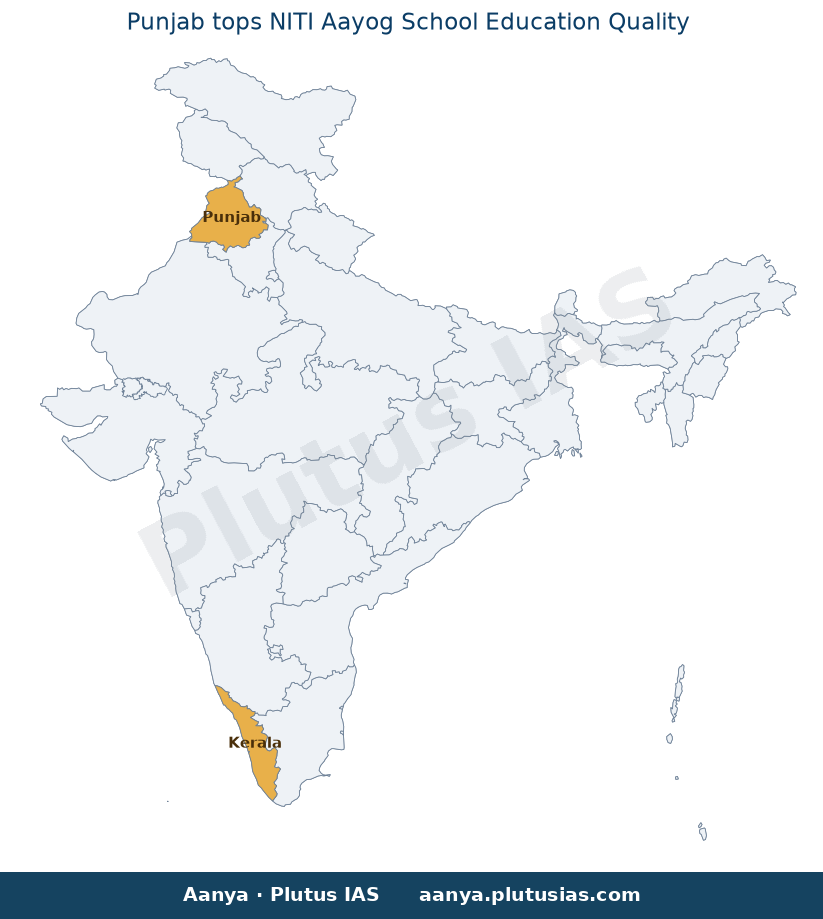
07 Aug Punjab Tops NITI Aayog Education Index 2026, Overtakes Kerala
✎ Punjab’s ascent to the top rank in NITI Aayog’s SEQI 2026 is attributed to its multi-pronged approach: infrastructure upgradation (₹3,638 crore spent), foundational learning reforms (Mission Samarth covering 12 lakh students)…
Subject Relevance — Where This Topic Fits
- GS Paper II — Governance, Transparency and Accountability | GS Paper III — Human Resource Development and Education Policy | GS Paper IV — Ethics in Governance (Citizen Centric Administration)
- Prelims: NITI Aayog School Education Quality Index (SEQI), Mission Samarth, PACE initiative, NEET-UG, Foundational Literacy and Numeracy (FLN), Artificial Intelligence in School Curriculum
- Essay: The Role of State-Led Educational Reforms in National Development, Governance as a Catalyst for Social Equity: Lessons from Punjab’s Education Revolution
Quick Revision: Punjab’s ascent to the top rank in NITI Aayog’s SEQI 2026 is attributed to its multi-pronged approach: infrastructure upgradation (₹3,638 crore spent), foundational learning reforms (Mission Samarth covering 12 lakh students), NEET coaching (PACE initiative increasing government school qualifiers from 80 in 2021 to 882 in 2026), and early integration of Artificial Intelligence in the school curriculum.
Why is this in the news?
On 6 August 2026, Punjab’s Education Minister S. Harjot Singh Bains announced that Punjab had surpassed Kerala to rank first in the NITI Aayog’s School Education Quality Index (SEQI) 2026, marking a significant turnaround in the state’s school education system. This achievement underscores the impact of targeted governance interventions, infrastructure upgradation, and pedagogical reforms in transforming educational outcomes. The development is particularly notable given Punjab’s previously dire state of school infrastructure and learning deficits, which have now been addressed through initiatives such as Mission Samarth, PACE, and the integration of Artificial Intelligence into the school curriculum.
Background
- Kerala has long been a benchmark in India’s school education system, consistently topping national rankings due to its high literacy rates and robust infrastructure.
- In July 2022, Punjab’s school education system faced severe challenges, including the absence of boundary walls in over 8,000 schools, non-functional toilets in 3,200 schools, and approximately 4 lakh children studying without desks or chairs.
- Textbook distribution delays were chronic, with textbooks reaching schools only in October–November, disrupting academic calendars.
- The state’s government schools had produced only 80 NEET-UG qualifiers in 2021, reflecting systemic inefficiencies and low learning outcomes.
- Punjab’s education reforms were initiated under the Aam Aadmi Party (AAP)-led government, which prioritised foundational learning and infrastructure development as key pillars of its governance agenda.
What is the NITI Aayog School Education Quality Index (SEQI)?
- The SEQI is a composite index developed by NITI Aayog to measure the performance of states and union territories in school education, with the objective of fostering a culture of evidence-based policymaking and competitive federalism.
- SEQI serves as a diagnostic tool for states to identify gaps, benchmark progress, and implement targeted interventions to improve educational outcomes.
Key Features
| Feature | Significance |
|---|---|
| NITI Aayog School Education Quality Index (SEQI) 2026 | Provides a comparative assessment of states’ school education systems, enabling evidence-based policymaking and benchmarking. |
| Artificial Intelligence as a core subject (Classes I–XII) | Introduces foundational AI literacy at the school level, aligning with global educational trends and preparing students for future workforce demands. |
| Mission Samarth | A foundational learning programme that groups students by learning ability rather than grade, ensuring mastery of basic literacy and numeracy skills. |
| Punjab Academic Coaching for Excellence (PACE) | A targeted initiative to enhance NEET-UG performance among government school students through structured coaching and mentorship. |
| Infrastructure upgradation (₹3638 crore) | Addressed critical gaps such as boundary walls, functional toilets, and timely textbook distribution, improving the learning environment. |
Why it Matters
Educational Reforms
- Demonstrates the transformative potential of targeted governance in addressing systemic deficiencies in public education systems.
- Highlights the importance of foundational learning programmes in reversing learning deficits among marginalised student cohorts.
- Showcases the role of technology integration (AI) in modernising curricula and preparing students for 21st-century challenges.
Policy Implementation
- Illustrates the impact of hands-on leadership and direct monitoring in achieving measurable outcomes in public service delivery.
- Emphasises the need for data-driven interventions, as evidenced by the shift from anecdotal to quantifiable improvements in student performance.
- Underscores the role of state-led initiatives in complementing or exceeding national benchmarks, challenging the perception of centralised uniformity.
Social Equity
- Reinforces the role of government schools in providing equitable opportunities, particularly for students from humble socio-economic backgrounds.
- Challenges the narrative of private school superiority by showcasing government school students’ success in competitive examinations like NEET-UG.
- Demonstrates how infrastructure and pedagogical reforms can reduce disparities in access to quality education across rural and remote regions.
Economic Implications
- Indirectly contributes to human capital formation by improving educational outcomes, which are critical for long-term economic growth.
- Reduces the economic burden on families by providing high-quality education within government schools, lowering reliance on costly private coaching.
- Enhances employability of students by equipping them with foundational and advanced skills aligned with industry requirements.
Challenges
1. Sustaining Momentum in Foundational Learning
- Ensuring that foundational learning gains are not transient and are embedded within the broader curriculum framework.
- Addressing the risk of regression by maintaining consistent teacher training and resource allocation.
- Scaling Mission Samarth to cover all districts without diluting its effectiveness or quality.
UPSC Link: GS Paper 2: Social Justice – Education
2. Equitable Access to Technology
- Bridging the digital divide to ensure all students, including those in remote areas, benefit from AI integration.
- Providing adequate infrastructure (devices, internet connectivity) to support AI-driven learning without exacerbating inequalities.
- Training teachers to effectively deliver AI-centric curricula, particularly in regions with limited prior exposure.
UPSC Link: GS Paper 2: Governance – Digital Divide
3. Public Perception and Systemic Trust
- Countering entrenched biases against government schools through sustained communication and visible outcomes.
- Ensuring transparency in reporting progress to maintain credibility and public support for reform initiatives.
- Addressing political and ideological opposition that may undermine long-term policy continuity.
UPSC Link: GS Paper 4: Ethics – Public Trust
4. Resource Mobilisation and Fiscal Discipline
- Balancing the high capital expenditure (₹3638 crore) with recurrent costs for maintenance and teacher salaries.
- Avoiding over-reliance on short-term funding models that may jeopardise sustainability.
- Ensuring efficient utilisation of funds to prevent leakages or misallocation in large-scale infrastructure projects.
UPSC Link: GS Paper 3: Economy – Public Finance
5. Assessment and Accountability
- Developing robust evaluation mechanisms to measure the long-term impact of reforms beyond immediate metrics like NEET qualifiers.
- Holding educators and administrators accountable for outcomes while avoiding punitive measures that discourage innovation.
- Integrating third-party audits to validate claims of improvement and ensure objectivity.
UPSC Link: GS Paper 2: Governance – Accountability
Challenges — UPSC Perspective
| Issue | Concern |
|---|---|
| Teacher Capacity Building | Ensuring all educators are adequately trained to implement AI and foundational learning programmes effectively. |
| Curriculum Rigidity | Balancing the integration of AI with traditional subjects without overburdening students or teachers. |
| Rural-Urban Disparities | Addressing gaps in infrastructure and resource availability between urban and remote rural schools. |
| Political Interference | Mitigating the risk of policy reversals due to changes in government or electoral cycles. |
| Data Privacy | Safeguarding student data in AI-driven learning environments while leveraging it for personalised education. |
Government Initiatives — Must-Memorise for Prelims
- Mission Samarth
- Punjab Academic Coaching for Excellence (PACE)
Way Forward
- Institutionalise Mission Samarth by embedding its methodologies within the state’s permanent education policy framework.
- Expand AI integration with phased rollouts, starting from districts with higher digital readiness.
- Establish a state-level monitoring body to track progress and address bottlenecks in real time.
- Launch a public awareness campaign to highlight government school achievements and counter misinformation.
- Develop partnerships with private sector entities to augment teacher training and resource provision.
- Introduce a system of peer learning where high-performing schools mentor others to replicate success.
- Ensure periodic third-party evaluations to validate claims of improvement and identify areas for refinement.
- Strengthen data systems to enable evidence-based policymaking and transparency in reporting.
UPSC Value Addition
Keywords for Mains Answer-Writing
NITI Aayog School Education Quality Index (SEQI) 2026 · State School Education Transformation · Foundational Literacy and Numeracy (FLN) · Mission Samarth (Punjab) · Artificial Intelligence in School Curriculum · Government School Infrastructure Upgradation · NEET-UG Performance in Government Schools · PACE Initiative (Punjab Academic Coaching for Excellence) · Learning Outcome-Based Pedagogy · Public School Enrolment and Equity · State Education Reforms in India · NITI Aayog Composite Index for School Education
Constitutional & Policy Linkages
- [‘Article 45 (DPSP) – Free and Compulsory Education’, ‘Duty of the State to provide education for all children.’]
- [‘Article 21A – Right to Education’, ‘Constitutional guarantee of free and compulsory education for children aged 6–14.’]
- [‘Article 15(3) – Special Provisions for Women and Children’, ‘Empowerment of marginalised groups through education.’]
Concept Flow
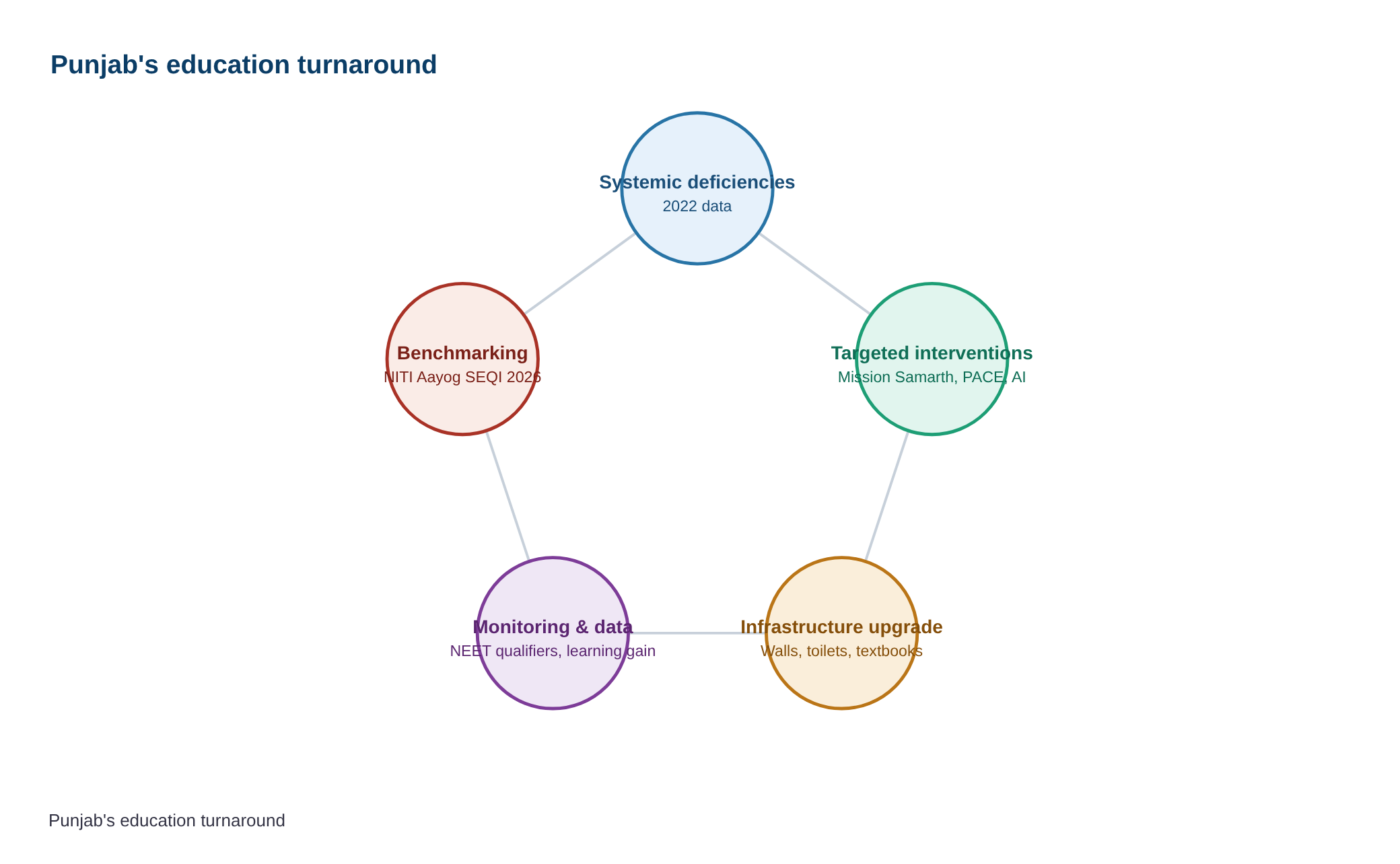
Identification of systemic deficiencies in Punjab’s school education system (2022) → → Formulation of targeted interventions (Mission Samarth, PACE, AI integration) → → Implementation of infrastructure upgradation (boundary walls, toilets, textbooks) → → Monitoring and data-driven adjustments (NEET qualifiers, foundational learning gains) → → Benchmarking against national standards (NITI Aayog SEQI 2026) → → Demonstration of transformative outcomes (Punjab ranks No. 1) → → Replication and scaling of successful models across other states.
Prelims Practice Questions
Q1. Consider the following statements regarding the NITI Aayog School Education Quality Index (SEQI) 2026:
1. The SEQI ranks states based on a composite index covering learning outcomes, equity, and governance.
2. Punjab has been ranked first in SEQI 2026, overtaking Kerala.
3. The SEQI includes parameters such as school infrastructure and teacher-student ratio but excludes foundational literacy metrics.
How many of the above statements are correct?
- Only one
- Only two
- All three
- None
Answer: Only two — Statement 1 is correct as SEQI evaluates states on a composite index. Statement 2 is correct as reported in the news. Statement 3 is incorrect because foundational literacy metrics are explicitly included in SEQI parameters.
Q2. Assertion (A): The ‘Mission Samarth’ initiative in Punjab focuses on grouping students by learning ability rather than grade to ensure foundational skill mastery.
Reason (R): The initiative aims to address learning gaps by providing level-based teaching interventions.
Options:
A. Both A and R are true, and R is the correct explanation of A.
B. Both A and R are true, but R is not the correct explanation of A.
C. A is true, but R is false.
D. A is false, but R is true.
- A
- B
- C
- D
Answer: A — Both Assertion (A) and Reason (R) are true, and R correctly explains A as per the description of Mission Samarth in the news.
Q3. Which of the following initiatives was launched by Punjab to improve academic performance in government schools?
A. Sarva Shiksha Abhiyan
B. Punjab Academic Coaching for Excellence (PACE)
C. Mid-Day Meal Scheme
D. Rashtriya Madhyamik Shiksha Abhiyan
- A
- B
- C
- D
Answer: B — The Punjab Academic Coaching for Excellence (PACE) initiative was specifically mentioned in the news as a measure to improve NEET-UG performance in government schools.
Mains Practice Question
✍ The transformation of Punjab’s government school education system, as highlighted by its top ranking in the NITI Aayog School Education Quality Index (SEQI) 2026, exemplifies a paradigm shift in foundational learning and equity. Critically examine the key policy interventions and structural reforms that enabled this transformation. Also, analyse the broader implications for India’s public education system in addressing learning poverty and ensuring inclusive quality education. (15 Marks)
Approach: MODEL-ANSWER SKELETON:
1. **Introduction (2 Marks)**
– Define the NITI Aayog SEQI and its parameters (learning outcomes, equity, infrastructure, governance).
– Contextualise Punjab’s historic low base (2022: 8,000 schools without boundary walls, 4 lakh children sitting on floors, delayed textbook distribution).
2. **Key Policy Interventions (5 Marks)**
– **Mission Samarth**: Explain the level-based teaching model, grouping students by learning ability, and its alignment with NEP 2020’s foundational literacy and numeracy (FLN) goals.
– **Infrastructure Upgradation**: Highlight the ₹3638 crore expenditure on 19,125 schools, including boundary walls, functional toilets, and early textbook distribution (by March 31).
– **Curriculum Innovation**: Introduction of Artificial Intelligence as a core subject from Classes I–XII (first state in India).
– **PACE Initiative**: Role in improving NEET-UG performance (882 qualifiers from government schools in 2026 vs. 80 in 2021).
3. **Structural Reforms (4 Marks)**
– **Governance Model**: Personal visits by the Education Minister to 2,000+ schools, including border and remote areas.
– **Teacher Engagement**: Involvement of 70,000+ teachers annually in Mission Samarth.
– **Equity Focus**: Case study of Harnoorpreet Kaur (AIR 3140) and district-level success stories (e.g., Majitha, Dinanagar).
4. **Broader Implications (4 Marks)**
– **Learning Poverty**: Link Punjab’s reforms to global and national goals (UN SDG 4, NEP 2020’s FLN mission).
– **Public vs. Private School Divide**: Challenge the narrative of government schools’ inferiority using Punjab’s NEET data.
– **Scalability**: Discuss challenges in replicating Punjab’s model across states (funding, political will, teacher capacity).
– **Policy Lessons**: Emphasise the need for multi-dimensional reforms (infrastructure, pedagogy, equity) over piecemeal interventions.
Source: The Hindu
Generated by AanyaAi for educational purpose.

- यूएनजीए 2026: युद्ध, एआई और सुधार – दुनिया के नेता क्या करेंगे? (UPSC दृष्टिकोण) - September 22, 2026
- 40 दिन बाद भी संसद सत्र अनिर्णीत, महिला आरक्षण विधेयक पर सरकार की तैयारी - September 22, 2026
- Why Parliament Session Still Unprorogued After 40 Days? Women’s Quota Law Buzz Explained - September 22, 2026

No Comments