


07 Aug Lok Sabha Passes MSME Amendment Bill 2026 Without Debate: Key Highlights
✎ The Micro, Small and Medium Enterprises Development (Amendment) Bill, 2026 aims to redefine MSME classification, enhance credit access through a dedicated guarantee fund, and strengthen digital governance via the Udyam…
Subject Relevance — Where This Topic Fits
- GS Paper II — Government Policies and Interventions for Development in various sectors and Issues arising out of their Design and Implementation | GS Paper III — Effects of Liberalisation on the Economy, Changes in Industrial Policy and their Effects on Industrial Growth
- Prelims: MSMED Act 2006, Micro, Small and Medium Enterprises, Udyam Registration, Credit Guarantee Fund Trust for Micro and Small Enterprises (CGTMSE), Priority Sector Lending, Atmanirbhar Bharat Abhiyan, Statutory Liquidity Ratio (SLR), Public Procurement Policy for Micro and Small Enterprises
- Essay: The role of MSMEs in India’s economic transformation: From job creation to global competitiveness, Balancing regulatory ease with fiscal prudence: The challenge of MSME policy in a federal democracy
Quick Revision: The Micro, Small and Medium Enterprises Development (Amendment) Bill, 2026 aims to redefine MSME classification, enhance credit access through a dedicated guarantee fund, and strengthen digital governance via the Udyam Registration portal, while aligning India’s MSME policy with global standards.
Why is this in the news?
The Bill, which amends the MSMED Act, 2006, has been introduced against the backdrop of persistent challenges faced by India’s MSME sector, including access to credit, regulatory compliance burdens, and global competitiveness.
Background
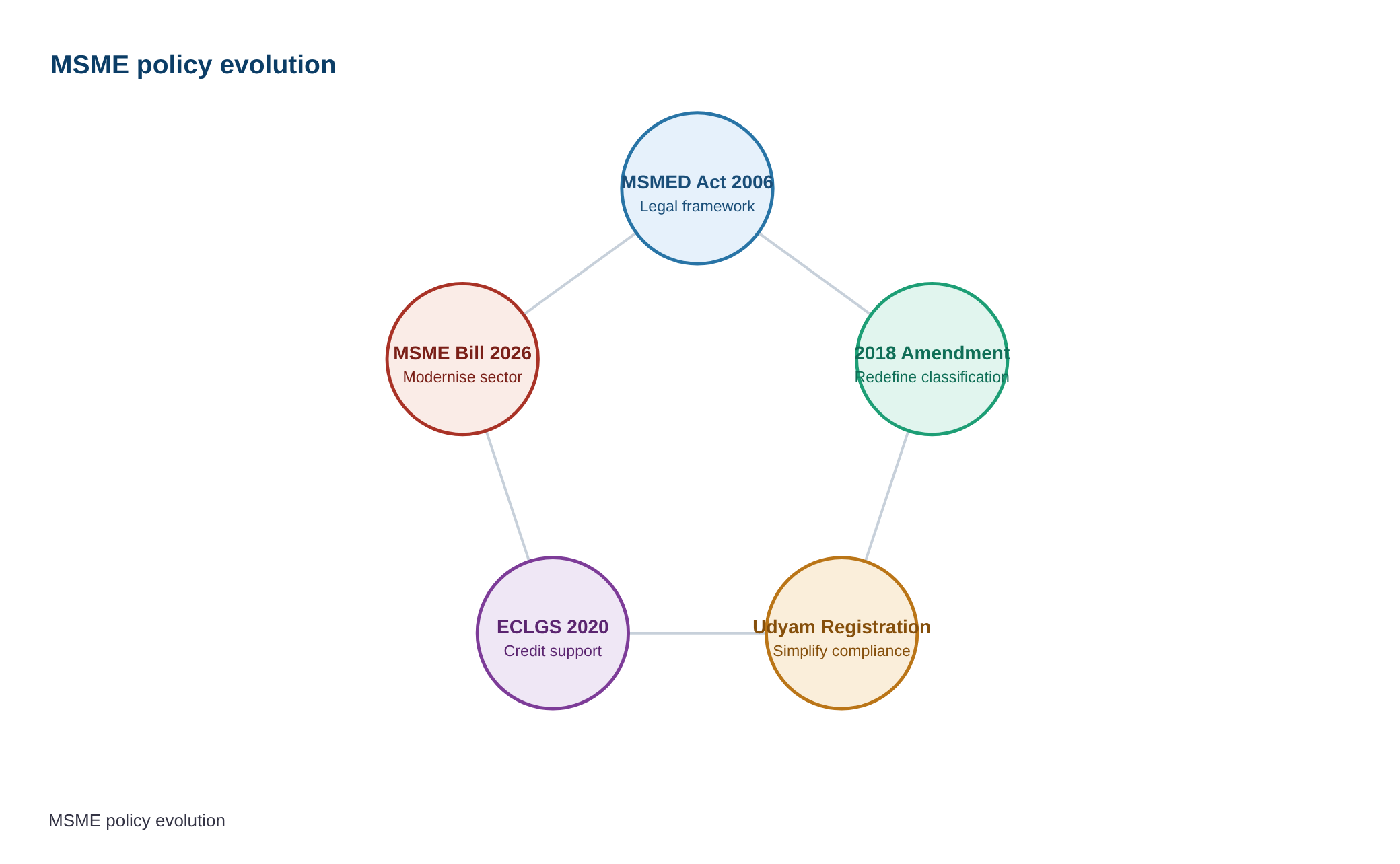
- The Micro, Small and Medium Enterprises Development (MSMED) Act, 2006 was enacted to provide a legal framework for the promotion, development, and enhancement of competitiveness of MSMEs in India, replacing the earlier Small Scale Industries Board and National Small Industries Corporation Act, 1957.
- MSMEs contribute approximately 30% to India’s GDP, account for 45% of manufacturing output, and employ over 110 million people, making them a critical pillar of India’s economic and employment ecosystem.
- The MSME sector has faced persistent challenges such as delayed payments from buyers, limited access to formal credit, regulatory complexity, and technological obsolescence, exacerbated by the COVID-19 pandemic and subsequent economic disruptions.
- The Atmanirbhar Bharat Abhiyan (2020) and the Emergency Credit Line Guarantee Scheme (ECLGS) were introduced to provide fiscal and credit support to MSMEs, reflecting the sector’s systemic importance in India’s economic resilience strategy.
- The MSMED Act, 2006, was amended in 2018 to redefine the classification of MSMEs based on investment and turnover thresholds, and to introduce the Udyam Registration portal to simplify compliance and enhance ease of doing business.
What is the Micro, Small and Medium Enterprises Development (Amendment) Bill, 2026?
- The Bill seeks to amend the Micro, Small and Medium Enterprises Development Act, 2006, to address emerging challenges in the MSME sector, including access to credit, regulatory compliance, and global competitiveness.
- Key proposed amendments include the redefinition of MSME categories to align with global standards, simplification of compliance procedures, and enhancement of digital governance mechanisms such as the Udyam Registration portal.
- The Bill introduces provisions for the establishment of a dedicated Credit Guarantee Fund for MSMEs to mitigate credit risk and improve access to formal financing, particularly for micro and small enterprises in rural and semi-urban areas.
- It proposes to strengthen the role of the National Board for MSMEs (NBMSME) as a statutory body to advise the government on policy formulation, monitoring, and evaluation of MSME development programmes.
- The Bill includes measures to promote innovation and technology adoption among MSMEs, including tax incentives for research and development, and support for digital transformation initiatives.
- It seeks to enhance the effectiveness of the Public Procurement Policy for Micro and Small Enterprises by mandating a minimum procurement threshold from MSMEs in government contracts, thereby boosting demand for MSME products and services.
- The Bill also proposes to streamline the grievance redressal mechanism for MSMEs, including the establishment of a dedicated MSME Facilitation Cell within the Ministry of MSME to address disputes and compliance issues expeditiously.
- The amendments aim to align India’s MSME policy with global best practices, including the adoption of the United Nations Industrial Development Organization (UNIDO) framework for MSME development and the Sustainable Development Goals (SDGs).
Key Features
| Feature | Significance |
|---|---|
| Passage of the MSME Amendment Bill, 2026 | Amends the Micro, Small and Medium Enterprises Development Act, 2006, to address evolving MSME ecosystem needs, enhance ease of doing business, and align with contemporary economic policies. |
| Introduction of the Kashmiri Pandits (Recourse, Restitution, Rehabilitation and Resettlement) Bill, 2025 | Seeks to provide a structured framework for the rehabilitation of Kashmiri Pandits, including property restoration, cultural heritage protection, and safety measures. |
| Fishermen (Protection and Welfare) Bill, 2024 | Proposes the establishment of a Fishermen Welfare Board and Fund to address the socio-economic vulnerabilities of coastal fishing communities. |
| Congress Party’s three-line whip | Demonstrates the party’s strategic focus on parliamentary attendance during critical legislative discussions, reflecting heightened political engagement. |
| Opposition protests over NEET paper leak and Ram Mandir donation controversy | Highlights institutional trust deficits and public grievances, underscoring the need for transparent governance and accountability mechanisms. |
Why it Matters
Legislative and Policy Significance
- The MSME Amendment Bill, 2026, aims to modernise the MSME sector, which contributes approximately 30% to India’s GDP and employs over 110 million people, thereby influencing economic growth and employment generation.
- The Kashmiri Pandits (Recourse, Restitution, Rehabilitation and Resettlement) Bill, 2025, addresses a long-standing humanitarian and constitutional obligation to restore dignity and security to a displaced community.
Political and Institutional Significance
- The Congress Party’s three-line whip signals a strategic move to consolidate opposition unity and exert pressure on the government during the Monsoon Session, particularly on contentious issues.
Social and Governance Significance
- The Fishermen (Protection and Welfare) Bill, 2024, seeks to address the vulnerabilities of coastal communities, who face economic instability due to climate change, overfishing, and policy gaps.
Challenges
1. Trust Deficit in Institutions
- Public perception of institutional bias in police action against protestors, particularly in NEET paper leak case, erodes faith in law enforcement and judicial processes.
- Allegations of mismanagement of Ram Mandir donations further exacerbate concerns over transparency and accountability in public institutions.
UPSC Link: GS-II: Role of Institutions
2. Legislative Gridlock
- Ongoing opposition protests disrupt parliamentary proceedings, delaying critical legislative business and raising questions about the efficacy of parliamentary democracy.
UPSC Link: GS-II: Parliament and State Legislatures
3. Policy Implementation Gaps
- Even if the Kashmiri Pandits Bill is passed, effective implementation will require coordination between central and state governments, as well as grassroots-level monitoring.
UPSC Link: GS-II: Centre-State Relations
4. Economic Vulnerabilities in Coastal Communities
- Fishermen face existential threats from climate change, regulatory gaps, and lack of access to welfare mechanisms, necessitating targeted policy interventions.
UPSC Link: GS-III: Environment and Disaster Management
5. Political Polarisation
- The Ram Mandir donation controversy and NEET paper leak protests highlight deep societal divisions, complicating governance and policy formulation.
UPSC Link: GS-II: Pressure Groups and Political Parties
Challenges — UPSC Perspective
| Issue | Concern |
|---|---|
| NEET Paper Leak Protests | Perceived excessive use of force by police, raising questions about democratic dissent and law enforcement accountability. |
| Ram Mandir Donation Controversy | Allegations of financial mismanagement and lack of transparency in the management of religious donations. |
| Legislative Delays | Disruptions in Parliament due to protests hinder the passage of critical bills, affecting governance and economic reforms. |
| Implementation of Rehabilitation Bills | Risk of inadequate ground-level execution despite legislative intent, particularly for Kashmiri Pandits and fishermen. |
| Political Polarisation | Deepening societal divisions complicate consensus-building on contentious issues, affecting policy stability. |
Way Forward
- Conduct an independent judicial inquiry into the NEET paper leak protests to restore public trust in law enforcement and judicial processes.
- Establish a transparent mechanism for auditing and managing religious donations, including the Ram Mandir fund, to ensure accountability.
- Strengthen parliamentary discipline by enforcing strict time-bound discussions on critical bills to minimise disruptions.
- Accelerate the implementation framework for the Kashmiri Pandits (Recourse, Restitution, Rehabilitation and Resettlement) Bill, 2025, with clear timelines and grievance redressal mechanisms.
- Formulate a national-level policy for coastal community welfare, integrating climate adaptation, economic support, and skill development.
- Enhance inter-state coordination to ensure the Fishermen (Protection and Welfare) Bill, 2024, achieves its intended impact on ground.
- Promote multi-stakeholder dialogues to address societal polarisation and foster consensus on contentious issues like NEET and Ram Mandir controversies.
UPSC Value Addition
Keywords for Mains Answer-Writing
Micro, Small and Medium Enterprises Development (Amendment) Bill, 2026 · MSME Act, 2006 · Parliamentary procedures and whip system · Opposition protests in Parliament · NEET paper leak controversy · Ram Mandir donation controversy · Foreign Contribution (Regulation) Amendment Bill, 2026 · Fisheries sector welfare policies · Kashmiri Pandits rehabilitation · Parliamentary accountability and executive-legislature relations · Role of whips in parliamentary democracy · Parliamentary adjournment and disruption
Concept Flow
NEET paper leak protests → Public outrage over police action → Opposition protests in Parliament → Disruptions in legislative business → Delay in passing critical bills → Erosion of institutional trust → Need for judicial inquiry and transparency → Ram Mandir donation controversy → Allegations of financial mismanagement → Opposition demands for accountability → Political polarisation → Legislative gridlock → Need for transparent auditing mechanisms → Introduction of MSME Amendment Bill → Passage without debate → Focus on economic reforms → Need for alignment with contemporary MSME ecosystem requirements → Kashmiri Pandits Bill introduced → Aimed at rehabilitation → Requires Centre-State coordination → Implementation challenges → Need for structured monitoring → Fishermen Welfare Bill proposed → Addresses coastal vulnerabilities → Requires integrated policy approach → Need for climate adaptation and economic support
Prelims Practice Questions
Q1. Consider the following statements regarding the Micro, Small and Medium Enterprises Development (Amendment) Bill, 2026:
1. The Bill seeks to amend the Micro, Small and Medium Enterprises Development Act, 2006.
2. The Bill was introduced in the Lok Sabha without any debate.
3. The Bill proposes the creation of a Fishermen Welfare Board and a Fishermen Welfare Fund.
How many of the above statements are correct?
- Only one
- Only two
- Only three
- None
Answer: Only two — Statement 1 is correct as the Bill amends the MSME Development Act, 2006. Statement 2 is correct as the Bill was passed without debate. Statement 3 is incorrect as the Fishermen Welfare Board is proposed in a separate bill introduced by Congress MP K C Venugopal.
Q2. Assertion (A): The three-line whip issued by political parties in Parliament mandates the presence of all MPs without fail.
Reason (R): The whip system is constitutionally mandated under Article 102 of the Constitution of India.
- Both A and R are true, and R is the correct explanation of A
- Both A and R are true, but R is not the correct explanation of A
- A is true, but R is false
- A is false, but R is true
Answer: A is true, but R is false — Assertion (A) is true as the three-line whip mandates attendance. Reason (R) is true but incorrect because the whip system is a parliamentary convention, not a constitutional mandate under Article 102.
Q3. Match the following Bills with their respective objectives:
Column I (Bill) | Column II (Objective)
— | —
1. Micro, Small and Medium Enterprises Development (Amendment) Bill, 2026 | A. Provides for the social, political, and economic rehabilitation of Kashmiri Pandits
2. Kashmiri Pandits (Recourse, Restitution, Rehabilitation and Resettlement) Bill, 2025 | B. Amends the MSME Development Act, 2006
3. Fishermen (Protection and Welfare) Bill, 2024 | C. Proposes the creation of a Fishermen Welfare Board and a Fishermen Welfare Fund
4. Foreign Contribution (Regulation) Amendment Bill, 2026 | D. Amends provisions related to foreign contributions to NGOs and associations
- 1-B, 2-A, 3-C, 4-D
- 1-A, 2-B, 3-C, 4-D
- 1-D, 2-A, 3-C, 4-B
- 1-B, 2-D, 3-A, 4-C
Answer: 1-B, 2-A, 3-C, 4-D — The correct matches are: 1-B (MSME Bill amends the 2006 Act), 2-A (Kashmiri Pandits Bill), 3-C (Fishermen Welfare Bill), and 4-D (FCRA Amendment Bill).
Mains Practice Question
✍ The passage of the Micro, Small and Medium Enterprises Development (Amendment) Bill, 2026 without debate in the Lok Sabha reflects a broader trend of legislative bypass in Parliament. Critically examine the implications of such procedural bypasses for parliamentary democracy in India. Also, analyse the role of Opposition protests in ensuring legislative accountability. (15 Marks)
Approach: MODEL-ANSWER SKELETON:
1. **Introduction (2 marks)**: Define the MSME Amendment Bill, 2026 and its significance. Briefly introduce the procedural bypass and its context within the Monsoon Session 2026.
2. **Implications of Legislative Bypass (6 marks)**:
– **Erosion of Deliberative Democracy**: Explain how bypassing debate undermines the core principle of parliamentary democracy—deliberation and scrutiny.
– **Precedent Setting**: Discuss how such actions set a precedent for future legislative bypasses, potentially normalising undemocratic practices.
– **Executive Dominance**: Analyse how this reflects the growing dominance of the executive over the legislature, citing examples like the use of ordinances (e.g., Income-tax Amendment Ordinance, 2026).
– **Constitutional Provisions**: Reference Articles 75(3) (collective responsibility), 105 (freedom of speech in Parliament), and 118 (rules of procedure) to highlight the constitutional safeguards undermined.
3. **Role of Opposition Protests (5 marks)**:
– **Accountability Mechanism**: Explain how Opposition protests serve as a check on executive overreach, citing the NEET paper leak and Ram Mandir donation controversies as examples.
– **Public Awareness**: Discuss how protests amplify public scrutiny and demand transparency, even if they disrupt proceedings.
– **Parliamentary Conventions**: Reference the role of whips (three-line whip in this case) and adjournments as tools for Opposition to force discussions on critical issues.
4. **Balanced View and Way Forward (2 marks)**:
– Acknowledge the government’s argument of legislative efficiency but counter it with the need for democratic legitimacy.
– Suggest reforms such as mandatory standing committees for Bills, time-bound debates, and stricter adherence to parliamentary norms to restore balance.
Source: The Indian Express
Generated by AanyaAi for educational purpose.

- उत्तराखंड में असिस्टेंट प्रोफेसर भर्ती: यूकेपीएससी करेगा चयन, जानिए बदलाव - September 22, 2026
- UKPSC to Recruit Assistant Professors in Uttarakhand Aided Colleges: Draft Policy - September 22, 2026
- हिमाचल में नदियों से रेत-बजरी निकालने पर सरकार ने लगाई रोक, जानिए नए नियम - September 22, 2026

No Comments