


07 Aug DMK’s Key Conditions for Supporting Delimitation Bill in Parliament
✎ The delimitation process in India is governed by constitutional provisions (Articles 82 and 170) and requires a two-thirds majority in Parliament, making it a high-stakes federal and electoral reform issue.
Subject Relevance — Where This Topic Fits
- GS Paper II — Parliament and State Legislatures — Structure, Functioning, Conduct of Business, Powers and Privileges | GS Paper II — Federalism — Issues Arising Out of Federal Structure | GS Paper II — Constitutional Amendments and Judicial Review | GS Paper III — Electoral Reforms and Representation of People’s Act
- Prelims: Delimitation Commission, Constitution (131st Amendment) Bill 2026, Lok Sabha seat freeze (1976-2026), Article 82 and 170 (Constitutional provisions on delimitation), Election Commission of India, Federalism and State representation, Parliamentary procedures for constitutional amendments, INDIA bloc, Two-thirds majority in Parliament
- Essay: Federalism and the balance of power between the Centre and States, Electoral reforms and the need for democratic representation
Quick Revision: The delimitation process in India is governed by constitutional provisions (Articles 82 and 170) and requires a two-thirds majority in Parliament, making it a high-stakes federal and electoral reform issue.
Why is this in the news?
The DMK’s conditional support to the Centre’s delimitation Bill introduces a critical political and constitutional dynamic in Parliament. The Bill, aimed at redistributing Lok Sabha seats based on updated census data, faces opposition from regional parties over concerns of reduced representation. The DMK’s demand for a 25-year extension of the 1976 seat freeze and a 50% blanket increase in Lok Sabha seats reflects broader federal anxieties about demographic shifts and electoral equity. This development is significant as it underscores the procedural and substantive challenges in constitutional amendments, particularly in a fragmented parliamentary landscape where the government lacks a two-thirds majority.
Background
- The Census of India 2021 was postponed due to the COVID-19 pandemic and is now expected to be conducted in 2027, delaying the delimitation exercise.
- The Constitution (131st Amendment) Bill seeks to amend Article 82 and 170 to enable a fresh delimitation exercise, which has been a long-standing demand to reflect population changes since 1971.
- The government’s renewed outreach to Opposition parties, including the DMK, follows the Bill’s defeat on April 17, highlighting the need for cross-party support to secure a two-thirds majority.
- The DMK’s demand for a 50% increase in Lok Sabha seats is rooted in its argument that the current freeze disproportionately benefits northern states with higher population growth, while southern states face underrepresentation.
What is the Delimitation Bill?
- The Constitution (131st Amendment) Bill is a constitutional amendment proposal aimed at redrawing the boundaries of parliamentary and assembly constituencies in India to reflect population changes since the 1971 Census.
- The Bill seeks to amend Articles 82 and 170 of the Constitution, which govern the delimitation process and the number of seats in the Lok Sabha and State Legislative Assemblies, respectively.
- The current delimitation freeze, imposed by the 42nd Amendment Act, 1976, is set to expire after the latest Census that is expected to be completed in 2027, necessitating a new delimitation exercise to ensure equitable representation.
- The Bill proposes a blanket 50% increase in Lok Sabha seats, which the DMK argues is necessary to prevent the southern states from losing political representation despite their lower population growth rates.
- The DMK’s demand for a 25-year extension of the 1976 freeze is intended to provide stability in seat distribution while the new delimitation framework is implemented.
- The Bill requires a two-thirds majority in Parliament and ratification by at least half of the State Legislatures, making it a complex legislative and federal challenge.
- The Election Commission of India is constitutionally mandated to conduct delimitation exercises, but the process is currently frozen, pending the Bill’s passage.
- The Bill’s passage is politically contentious due to the federal implications of seat redistribution, which could alter the balance of power between Centre and States.
Key Features
| Feature | Significance |
|---|---|
| Constitutional freeze on seats (1971 Census) | Ensures stability in seat allocation but may not reflect demographic changes post-1971. |
| 50% blanket increase in Lok Sabha seats | Proposed to accommodate population growth, but raises concerns about federal balance and representation. |
| Schedule of seats per State in legislative package | Provides transparency and predictability in seat distribution, reducing uncertainty. |
| Two-thirds majority requirement for constitutional amendment | Ensures broad consensus but makes passage difficult without Opposition support. |
| Opposition outreach by government (e.g., Kiren Rijiju-Rahul Gandhi talks) | Indicates attempts to build consensus, but success hinges on mutual concessions. |
Why it Matters
Political
- The DMK’s conditions reflect regional aspirations and concerns about federal equity in seat allocation.
- The Bill’s passage hinges on Opposition support, particularly from the INDIA bloc, given the government’s lack of a two-thirds majority.
- Delimitation could alter the balance of power between States, influencing future electoral strategies of national parties.
- The DMK’s stance underscores the need for consensus-building in federal governance, especially on constitutional amendments.
Constitutional
- Delimitation requires a constitutional amendment under Article 82, necessitating a two-thirds majority in Parliament and ratification by half the State Legislatures.
- The 1976 freeze on seat allocation (based on 1971 Census) was extended to 2026, but the DMK seeks further extension to 2051, raising questions about democratic representation.
- A blanket 50% increase in seats may violate the principle of proportional representation, as it does not account for differential population growth across States.
Administrative
- Delimitation is a decadal exercise to redraw electoral boundaries based on the latest Census, ensuring fair representation.
- The delay in Census completion (expected 2027) complicates timely delimitation, necessitating interim measures like freezing seats.
- The government’s outreach to Opposition parties highlights the administrative challenge of securing legislative consensus for constitutional amendments.
Challenges
1. Lack of two-thirds majority for constitutional amendment
- The government lacks the required numerical strength (360 MPs) to pass the Bill unilaterally, necessitating Opposition support.
- The INDIA bloc’s opposition to the Bill, led by the Congress, complicates passage, as seen in the April 2026 defeat of the 131st Amendment Bill.
- Abstentions or cross-voting could further reduce the government’s chances of securing the required majority.
UPSC Link: Parliament and State Legislatures – constitutional amendments
2. Federal imbalance in seat allocation
- A blanket 50% increase in seats may disproportionately benefit States with higher population growth, altering the federal balance.
- Southern States, including Tamil Nadu, fear reduced representation if seat allocation is not adjusted proportionally to population changes.
- The DMK’s demand for a freeze extension reflects concerns about losing political influence in a rapidly growing northern States.
UPSC Link: Federalism – Centre-State relations
3. Delay in Census completion and its implications
- The Census, expected in 2027, is delayed, complicating the delimitation process and necessitating interim measures like freezing seats.
- Delays in Census data could lead to outdated seat allocations, undermining the principle of fair representation.
- The government may need to rely on projected data, raising questions about the accuracy and legitimacy of delimitation.
UPSC Link: Constitutional provisions – Census and Delimitation
4. Opposition disunity and consensus-building
- The INDIA bloc’s opposition to the Bill is not uniform, with parties like the DMK and Congress having differing priorities and demands.
- The government’s outreach to Opposition leaders (e.g., Rahul Gandhi) highlights the challenge of building a cohesive consensus.
- Regional parties like the DMK may prioritise regional interests over national consensus, complicating the passage of the Bill.
UPSC Link: Role of Opposition in Parliament
Challenges — UPSC Perspective
| Issue | Concern |
|---|---|
| Two-thirds majority requirement | Government lacks numerical strength to pass the Bill unilaterally, necessitating Opposition support. |
| Federal imbalance in seat allocation | Blanket increase in seats may alter the balance of power between States, raising concerns about fair representation. |
| Delay in Census completion | Outdated seat allocations and reliance on projected data could undermine the legitimacy of delimitation. |
| Opposition disunity | Lack of cohesive consensus among Opposition parties complicates the passage of the Bill. |
| Regional party demands (e.g., DMK) | Regional aspirations may conflict with national priorities, making consensus-building difficult. |
| Constitutional amendment process | Requires broad consensus, including ratification by half the State Legislatures, making passage uncertain. |
Way Forward
- The government must engage in structured, formal negotiations with the DMK and other Opposition parties to address their concerns about seat allocation and federal balance.
- A compromise could involve a phased increase in seats, rather than a blanket 50% hike, to ensure proportional representation and reduce federal tensions.
- The government should expedite the Census process to ensure timely delimitation, while exploring interim measures to address representation gaps.
- Parliamentary Affairs Minister Kiren Rijiju should continue outreach to Opposition leaders to build consensus, leveraging personal and institutional channels.
- Regional parties like the DMK should be assured that their concerns about representation are addressed, possibly through guarantees on seat allocation in the legislative package.
- The government could consider forming a joint parliamentary committee to deliberate on the Bill, ensuring transparency and stakeholder input.
- Educational campaigns should be launched to explain the necessity of delimitation and its impact on democratic representation, reducing misinformation and political posturing.
- The government should explore constitutional safeguards to prevent future disputes over seat allocation, such as periodic reviews tied to Census data.
UPSC Value Addition
Keywords for Mains Answer-Writing
Delimitation Commission · Constitution (131st Amendment) Bill · Lok Sabha seat increase · 1971 Census freeze · Federalism and Centre-State relations · Dravida Munnetra Kazhagam (DMK) demands · Parliamentary procedures for constitutional amendments · Political consensus in delimitation · Representation of States in Lok Sabha · Two-thirds majority requirement for constitutional amendments
Constitutional & Policy Linkages
- {‘Article 82’: ‘Readjustment of seats in the House of the People.’}
- {‘Article 170’: ‘Composition of Legislative Assemblies in States.’}
- {‘Article 324’: ‘Superintendence, direction and control of elections vested in the Election Commission.’}
- {‘Seventh Schedule’: ‘Division of powers between Union and States, including delimitation.’}
- {‘Article 368’: ‘Procedure for amendment of the Constitution.’}
Concept Flow
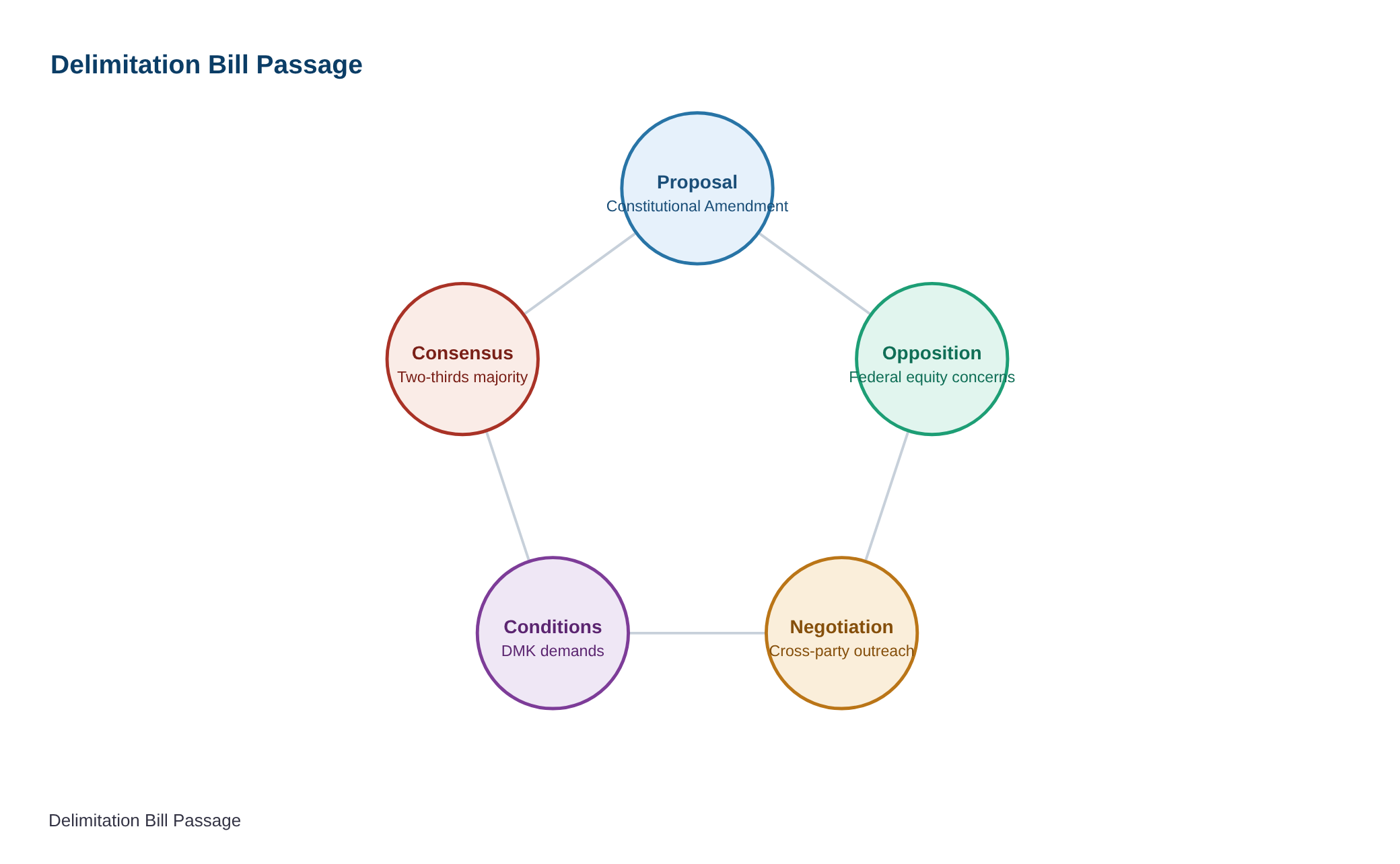
Government proposes delimitation Bill to redraw electoral boundaries based on Census data → → DMK and Opposition parties raise concerns about federal imbalance and seat allocation → → Government lacks two-thirds majority to pass the Bill unilaterally → → Government engages in outreach to Opposition, but formal negotiations remain pending → → DMK lays down conditions (freeze extension, seat schedule, 50% increase) to support the Bill → → Passage of the Bill hinges on consensus-building and constitutional compliance → → Delimitation exercise proceeds only if Bill is passed with required majority and ratification.
Prelims Practice Questions
Q1. Consider the following statements regarding the delimitation process in India:
1. The current freeze on Lok Sabha seats is based on the 1971 Census.
2. The Constitution (131st Amendment) Bill seeks to increase the total number of Lok Sabha seats by 50%.
3. The delimitation process is conducted by the Election Commission of India.
4. A constitutional amendment to alter the delimitation process requires a two-thirds majority in Parliament.
How many of the above statements are correct?
- Only one
- Only two
- Only three
- All four
Answer: Only three — Statement 1 is correct as the freeze on seats is based on the 1971 Census. Statement 2 is correct as the Bill proposes a 50% increase in Lok Sabha seats. Statement 3 is incorrect because the delimitation process is conducted by the Delimitation Commission, not the Election Commission. Statement 4 is correct as a constitutional amendment requires a two-thirds majority in Parliament.
Q2. Assertion (A): The delimitation process in India is aimed at ensuring equitable representation of States in the Lok Sabha.
Reason (R): The 1971 Census freeze was introduced to prevent frequent changes in the allocation of seats among States.
Options:
A. Both A and R are true, and R is the correct explanation of A.
B. Both A and R are true, but R is not the correct explanation of A.
C. A is true, but R is false.
D. A is false, but R is true.
Answer: ? — Assertion (A) is true as the delimitation process aims to ensure equitable representation. Reason (R) is also true and correctly explains the purpose of the 1971 Census freeze, which was to prevent frequent changes in seat allocation.
Q3. Match the following columns regarding the delimitation process in India:
Column I (Entity)
1. Delimitation Commission
2. Election Commission of India
3. Parliament
4. State Legislatures
Column II (Role)
a. Conducts elections and oversees electoral rolls
b. Conducts delimitation exercises
c. Approves constitutional amendments related to delimitation
d. Provides input on seat allocation for States
- 1-b, 2-a, 3-c, 4-d
- 1-a, 2-b, 3-c, 4-d
- 1-c, 2-a, 3-b, 4-d
- 1-d, 2-b, 3-c, 4-a
Answer: 1-b, 2-a, 3-c, 4-d — 1-b: The Delimitation Commission conducts delimitation exercises. 2-a: The Election Commission of India conducts elections and oversees electoral rolls. 3-c: Parliament approves constitutional amendments related to delimitation. 4-d: State Legislatures provide input on seat allocation for States.
Mains Practice Question
✍ The Constitution (131st Amendment) Bill, 2026, seeks to amend the delimitation process in India by introducing a 50% blanket increase in Lok Sabha seats and extending the 1971 Census freeze for another 25 years. Critically examine the constitutional, federal, and political implications of this Bill. (15 Marks)
Approach: MODEL-ANSWER SKELETON:
1. **Constitutional Implications**:
– Article 82 and 170(3) of the Constitution empower Parliament to readjust seats after each Census.
– The Bill proposes a constitutional amendment, requiring a two-thirds majority in Parliament and ratification by at least half of the State Legislatures (Art. 368).
– The extension of the 1971 Census freeze for 25 years would require a constitutional amendment, as the freeze is currently based on the 42nd Amendment Act, 1976.
2. **Federal Implications**:
– Delimitation affects the representation of States in the Lok Sabha, a critical aspect of federalism.
– The DMK’s demand for a 50% blanket increase and extension of the freeze reflects concerns over the balance of power between States, particularly southern States.
– The principle of ‘one person, one vote’ (Art. 81) must be balanced with the need for equitable representation of States.
3. **Political Implications**:
– The Bill’s success depends on political consensus, particularly from Opposition parties like the DMK and Congress.
– The numerical strength of the INDIA bloc and the DMK’s support (22 MPs) are crucial for achieving the two-thirds majority.
– The Bill could alter the political landscape by increasing the number of seats, potentially benefiting certain States or parties.
4. **Critique and Counterarguments**:
– Critics argue that extending the freeze without a fresh Census could lead to disproportionate representation.
– The blanket 50% increase may not address regional imbalances, particularly in States with rapid population growth.
– The Bill’s political timing and lack of formal outreach to Opposition parties raise questions about its intent and feasibility.
5. **Conclusion**:
– The Bill’s constitutional validity and federal balance must be carefully weighed against its political implications.
– A more nuanced approach, such as phased seat increases or State-specific adjustments, may be necessary to address concerns.
Source: The Hindu
Generated by AanyaAi for educational purpose.


No Comments