


07 Aug CPI(M) opposes linking women’s quota with delimitation, urges Centre to act
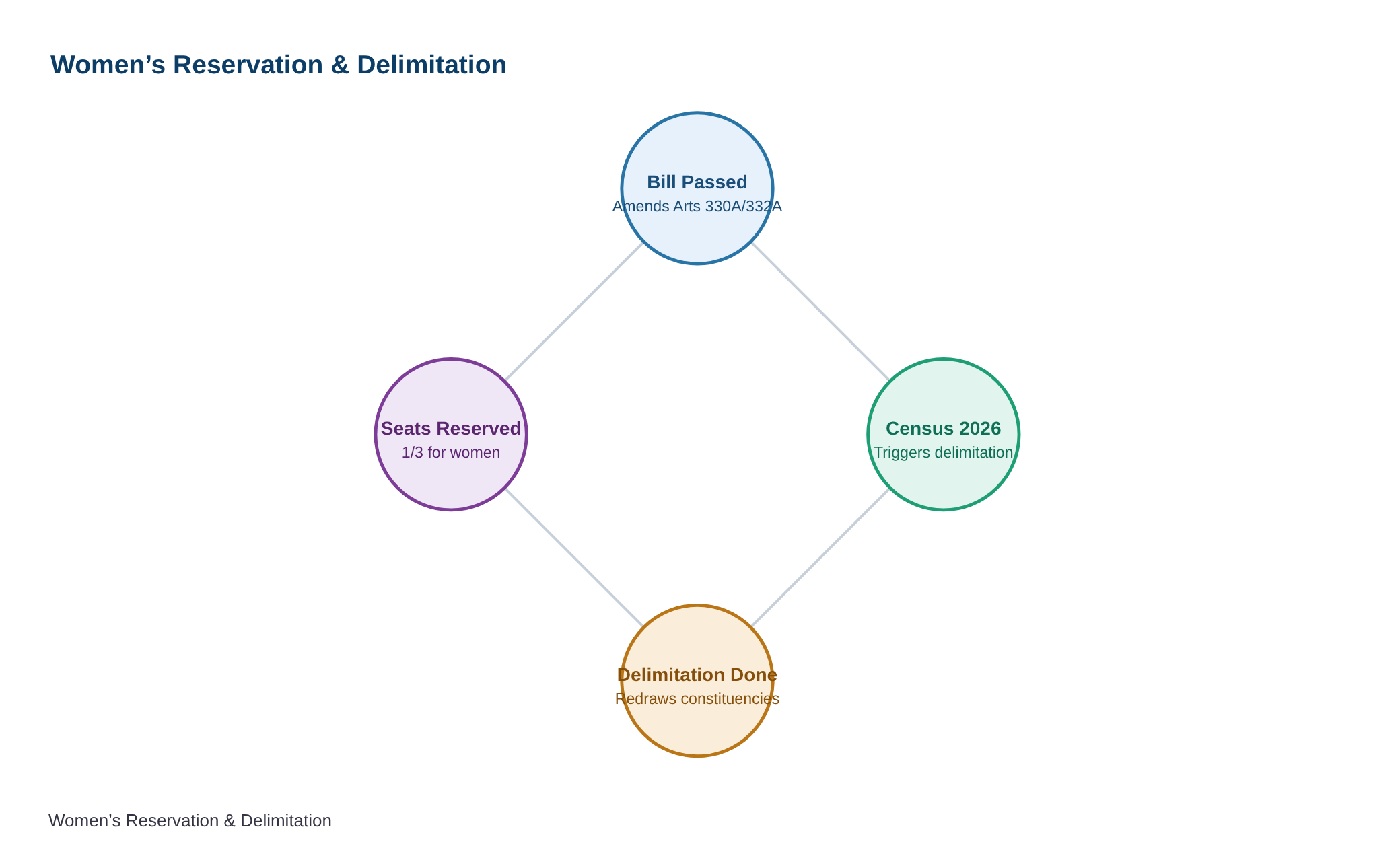
✎ The Women’s Reservation Bill reserves one-third of seats in the Lok Sabha and State Legislative Assemblies for women, but its implementation is contingent upon the delimitation exercise, which is constitutionally mandated to…
Subject Relevance — Where This Topic Fits
- GS Paper II — Polity and Governance (Constitutional Provisions, Parliament, Federalism) | GS Paper III — Social Justice (Reservation Policies, Gender Justice)
- Prelims: Women’s Reservation Bill, Delimitation Commission, Article 334A, EWS quota, 103rd Constitutional Amendment Act, 106th Constitutional Amendment Act, Article 82, Article 330A
- Essay: Women Empowerment: Bridging the Gender Divide in India, Federalism in India: Balancing Centre-State Relations in Constitutional Reforms
Quick Revision: The Women’s Reservation Bill reserves one-third of seats in the Lok Sabha and State Legislative Assemblies for women, but its implementation is contingent upon the delimitation exercise, which is constitutionally mandated to occur after the 2026 census.
Why is this in the news?
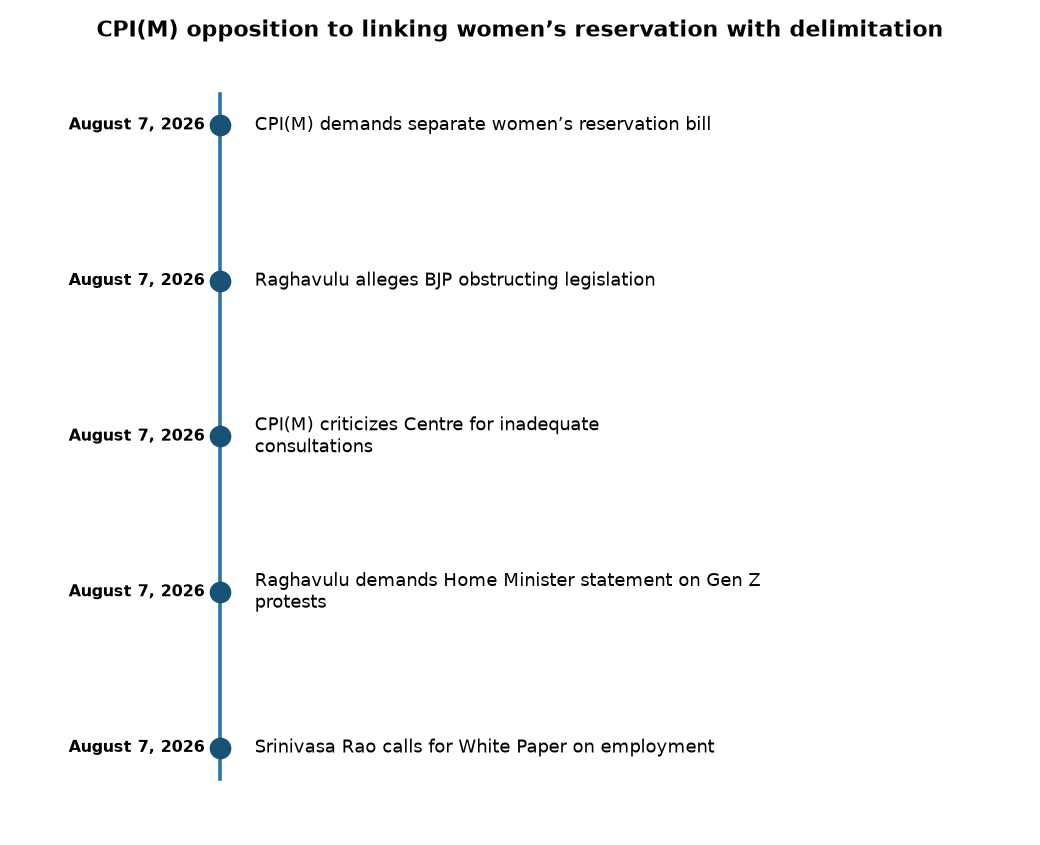
The CPI(M) has publicly opposed the Centre’s proposal to link the Women’s Reservation Bill with the delimitation exercise, arguing that the two issues are constitutionally distinct and that the government has not consulted opposition parties adequately on delimitation. The party’s stance underscores broader debates on federalism, parliamentary procedures, and the procedural fairness of constitutional amendments, particularly in the context of gender justice and electoral representation.
Background
- The Women’s Reservation Bill reserves one-third of seats in the Lok Sabha and State Legislative Assemblies for women. However, its implementation is contingent upon delimitation, which is constitutionally mandated to be undertaken after the first census following 2026.
- Delimitation refers to the process of redrawing the boundaries of electoral constituencies to reflect population changes, as per Article 82 of the Constitution. The last delimitation was conducted in 2002, and the next is expected post-2026 census.
- The CPI(M) has historically advocated for social justice, including gender and caste-based reservations, but has criticised the BJP-led Centre for attempting to conflate the Women’s Reservation Bill with delimitation, which it views as a tactic to delay or dilute the implementation of women’s reservation.
- The opposition’s concerns also stem from the lack of consensus on delimitation, with parties like the CPI(M) arguing that the Centre has not engaged in sufficient consultations with the Opposition on the delimitation process.
- The CPI(M) has also raised issues related to the Gen Z protests in New Delhi, alleging excessive police action and demanding accountability from the Union Home Minister.
- In Andhra Pradesh, the CPI(M) has criticised the state government’s employment generation claims and demanded a White Paper to verify job creation figures, highlighting discrepancies in official data.
Women’s Reservation Bill and Delimitation: Constitutional and Procedural Context
- The Women’s Reservation Bill reserves one-third of seats in the Lok Sabha and State Legislative Assemblies for women. This amendment inserts Article 334A into the Constitution, which stipulates that the reservation shall come into effect after the delimitation exercise is completed.
- Delimitation is governed by Article 82 of the Constitution, which mandates that the boundaries of electoral constituencies be redrawn based on the first census conducted after 2026. The Delimitation Commission, a statutory body, is responsible for this process.
- The linkage between the Women’s Reservation Bill and delimitation arises from the constitutional requirement that the reservation of seats for women cannot be implemented until the delimitation process is finalised. This is because the number of reserved seats must be determined based on the population data from the census.
- The opposition’s stance, as articulated by the CPI(M), reflects concerns over federalism and the Centre’s approach to constitutional amendments. The party argues that linking women’s reservation with delimitation is an attempt to delay the implementation of gender justice, as delimitation is a contentious and politically sensitive issue.
- The CPI(M) has also highlighted the lack of consensus on delimitation, pointing to the absence of adequate consultations with opposition parties. This raises questions about the procedural fairness of constitutional amendments and the role of parliamentary democracy in such reforms.
- The debate also intersects with broader issues of social justice, including caste-based discrimination, as highlighted by the CPI(M) in its recent publication, ‘Caste Eradication: A Marxist Perspective’. The party argues that eliminating caste-based discrimination is essential for achieving gender justice and social equality.
- The procedural linkage between the Women’s Reservation Bill and delimitation underscores the importance of constitutional timelines and the need for consensus-building in democratic governance. It also raises questions about the Centre’s commitment to gender justice and its approach to parliamentary procedures.
Key Features
| Feature | Significance |
|---|---|
| Proposed Women’s Reservation Legislation | Aims to reserve one-third of seats in the Lok Sabha and State Legislative Assemblies for women, addressing gender disparity in political representation. |
| Delimitation Exercise | Process of redrawing electoral boundaries based on the latest census data to ensure equitable representation, though currently contentious due to lack of consensus. |
| Opposition’s Stand on Linkage | CPI(M) opposes the Centre’s attempt to link women’s reservation with delimitation, arguing that the two issues should be addressed independently to ensure timely implementation of the reservation. |
| Consultation Deficit | Allegation that the Centre has not held adequate consultations with opposition parties on delimitation, undermining cooperative federalism and democratic consensus-building. |
| Gen Z Protests in New Delhi | Recent student-led protests highlight issues of police excesses and government response, reflecting broader discontent with governance and policy implementation. |
Why it Matters
Political Significance
- The linkage of women’s reservation with delimitation risks delaying the implementation of a long-pending constitutional provision, potentially diluting the urgency of gender representation in governance.
- The Centre’s reluctance to engage in bipartisan consultations on delimitation undermines the spirit of cooperative federalism, as enshrined in the Constitution.
- Opposition parties’ resistance to the linkage demonstrates a commitment to gender justice, but also reflects broader political tensions over the Centre’s legislative priorities.
- The CPI(M)’s stance underscores the need for legislative autonomy in addressing social justice issues without conditionalities tied to contentious processes like delimitation.
Constitutional and Legal Significance
- The Women’s Reservation Bill, if passed, would amend Articles 330A and 332A of the Constitution to reserve seats for women in Parliament and State Legislatures.
- Delimitation is governed by Articles 81, 82, and 330 of the Constitution, which mandate periodic redrawing of electoral boundaries based on census data.
- The Constitution does not explicitly link women’s reservation with delimitation, leaving the Centre’s decision open to political and legal scrutiny.
- The principle of ‘one person, one vote’ (enshrined in the Constitution) is indirectly implicated in delimitation, as unequal boundary adjustments can distort electoral fairness.
Social Significance
- Gender representation in politics remains a critical issue for social justice, with women constituting nearly 50% of the population but holding less than 15% of parliamentary seats.
- The linkage of women’s reservation with delimitation risks deprioritizing gender equality in favor of a contentious and politically fraught process.
- Student protests in New Delhi highlight broader societal discontent with governance, particularly regarding police action and policy responsiveness.
- Caste eradication, as emphasized by CPI(M), remains a foundational challenge for social equity, intersecting with gender justice in political representation.
Challenges
1. Political Polarization Over Legislative Priorities
- The Centre’s attempt to link women’s reservation with delimitation risks deepening political divides, as opposition parties view it as a tactic to delay the reservation.
- Failure to build consensus on delimitation could further erode trust between the Centre and opposition parties, complicating future legislative efforts.
- The BJP’s alleged attempt to frame opposition parties as obstructing women’s reservation could polarize the debate along partisan lines, undermining bipartisan support.
UPSC Link: GS-II: Parliament and State Legislatures
2. Lack of Consensus on Delimitation
- Delimitation requires a constitutional amendment (Article 82) and consensus among political parties, which is currently lacking due to disputes over methodology and fairness.
- The absence of a White Paper on delimitation, as demanded by opposition parties, exacerbates mistrust and delays the process.
- Regional parties, particularly in states like Andhra Pradesh, may resist delimitation if it disproportionately affects their electoral prospects.
UPSC Link: GS-II: Federalism and Centre-State Relations
3. Police Excesses and Governance Deficits
- The use of excessive force against Gen Z protesters in New Delhi raises concerns about the government’s commitment to democratic dissent and civil liberties.
- Failure to address the root causes of student unrest—such as unemployment, policy unresponsiveness, and police brutality—risks escalating social tensions.
- The allegation that the Prime Minister should respect student sentiments reflects broader public dissatisfaction with governance and policy implementation.
UPSC Link: GS-II: Government Policies and Interventions
4. Economic Discontent and Employment Crisis
- The CPI(M)’s claim that local employment opportunities in Andhra Pradesh remain limited despite government claims of job creation highlights a disconnect between policy rhetoric and ground reality.
- Job losses in sectors like steel, textiles, and dairy underscore the need for targeted economic policies to support local industries and workforce.
- The demand for a White Paper on employment generation reflects a demand for transparency and accountability in economic governance.
UPSC Link: GS-III: Indian Economy and Employment
5. Intersection of Caste and Gender Justice
- The CPI(M)’s emphasis on caste eradication alongside women’s reservation highlights the intersectional nature of social justice, where multiple forms of discrimination must be addressed simultaneously.
- Failure to address caste-based discrimination risks undermining the effectiveness of gender reservation, as caste dynamics often dictate political representation.
UPSC Link: GS-II: Social Justice and Welfare
Challenges — UPSC Perspective
| Issue | Concern |
|---|---|
| Linkage of Women’s Reservation with Delimitation | Risks delaying gender representation in governance and politicizing a constitutional provision. |
| Lack of Consensus on Delimitation | Undermines cooperative federalism and delays a constitutionally mandated process. |
| Police Excesses Against Protesters | Erodes public trust in institutions and highlights governance deficits. |
| Employment Crisis in States | Disconnect between government claims and ground reality undermines economic governance. |
| Caste and Gender Intersectionality | Failure to address caste-based discrimination risks diluting the impact of women’s reservation. |
Way Forward
- The Centre should introduce the Women’s Reservation Bill as a standalone legislation, decoupling it from the delimitation process to ensure timely implementation.
- Convene all-party meetings to build consensus on delimitation, ensuring transparency and inclusivity in the process.
- Establish an independent commission to investigate allegations of police excesses during the Gen Z protests and recommend corrective measures.
- Publish a White Paper on employment generation, detailing job creation metrics, sectoral growth, and policy interventions to address local employment challenges.
- Strengthen mechanisms for social audits of economic policies to ensure accountability and alignment with ground realities.
- Encourage inter-sectional policy approaches that address both caste-based and gender-based discrimination in political representation.
- Enhance public consultation mechanisms for major legislative and policy initiatives to foster trust and democratic legitimacy.
UPSC Value Addition
Keywords for Mains Answer-Writing
Women’s Reservation Bill 2023 · Constitution (One Hundred and Twenty-Eighth Amendment) Bill, 2023 · Delimitation Commission · Article 334A of the Constitution · Women’s Reservation Act, 2023 · Parliamentary form of government · Federalism and Centre-State relations · Political consensus and legislative process · Constitutional amendments and their implications · Gender justice and representation · Opposition parties and legislative obstruction · Constitutional morality and democratic principles
Constitutional & Policy Linkages
- Article 15(3) – Empowers the State to make special provisions for women and children.
- Article 330A – Provides for reservation of seats for women in the Lok Sabha.
- Article 332A – Provides for reservation of seats for women in State Legislative Assemblies.
- Article 81 – Deals with the composition of the Lok Sabha and requires delimitation.
- Article 82 – Mandates delimitation after each census.
Concept Flow
Women’s Reservation Bill introduced in Parliament → Opposition parties demand standalone passage → Centre links Bill with delimitation → CPI(M) and others oppose linkage → Delimitation process stalls due to lack of consensus → Social and political tensions escalate → Gen Z protests emerge → Government accused of police excesses → Broader governance deficits highlighted → Need for bipartisan consensus on both issues reaffirmed.
Prelims Practice Questions
Q1. Consider the following statements regarding the Women’s Reservation Bill, 2023:
1. The Bill seeks to reserve one-third of the seats for women in the Lok Sabha and State Legislative Assemblies.
2. The reservation will be implemented immediately after the Bill is passed by Parliament.
3. The reservation will be operationalised only after the delimitation exercise is completed.
4. The Bill amends Article 334 of the Constitution to extend the reservation for women for a period of 15 years from the date of its commencement.
How many of the above statements are correct?
- Only one
- Only two
- Only three
- All four
Answer: Only three — Statements 1 and 3 are correct. Statement 2 is incorrect as the reservation will be implemented after the delimitation exercise. Statement 4 is incorrect as the Bill amends Article 334A to provide for reservation, and the duration is not explicitly limited to 15 years in the Bill.
Q2. Assertion (A): The Women’s Reservation Bill, 2023, links women’s reservation with the delimitation exercise to ensure equitable representation across constituencies.
Reason (R): Delimitation is a constitutional process to redraw electoral boundaries based on the latest census data, which is necessary to implement reservation without disrupting existing electoral dynamics.
In the context of the above two statements, which one of the following is correct?
- Both A and R are true, and R is the correct explanation of A
- Both A and R are true, but R is not the correct explanation of A
- A is true, but R is false
- A is false, but R is true
Answer: ? — Assertion (A) is false because the Bill does not explicitly link women’s reservation with delimitation; rather, it provides for reservation to be implemented after delimitation. Reason (R) is true as delimitation is a constitutional process based on census data.
Q3. Match the following provisions of the Constitution with their respective Articles:
Column I (Provision) | Column II (Article)
————————————————–|———————-
1. Reservation of seats for women in Panchayats | A. Article 243D
2. Reservation of seats for women in Municipalities | B. Article 243T
3. Reservation of seats for SCs and STs in Lok Sabha| C. Article 330
4. Reservation of seats for women in Legislative Assemblies | D. Article 334A
Select the correct match:
- 1-A, 2-B, 3-C, 4-D
- 1-B, 2-A, 3-D, 4-C
- 1-D, 2-C, 3-B, 4-A
- 1-C, 2-D, 3-A, 4-B
Answer: 1-A, 2-B, 3-C, 4-D — The correct matches are: 1-A (Article 243D), 2-B (Article 243T), 3-C (Article 330), and 4-D (Article 334A).
Mains Practice Question
✍ Critically examine the contention that linking women’s reservation with delimitation is constitutionally sound and politically expedient. Also, analyse the implications of such linkage for federalism and gender justice in India. (15 Marks)
Approach: MODEL-ANSWER SKELETON:
1. **Constitutional Framework and Women’s Reservation Bill, 2023**
– Briefly outline the provisions of the Women’s Reservation Bill, 2023, and its objective to reserve one-third of seats for women in the Lok Sabha and State Legislative Assemblies.
– Highlight the constitutional amendment required (Article 334A) and the need for a delimitation exercise as per Article 82 and the Delimitation Act, 2002.
2. **Arguments in Favour of Linking Women’s Reservation with Delimitation**
– **Constitutional Soundness**: Delimitation ensures equitable representation by redrawing constituencies based on population data (e.g., Census 2021). Linking reservation with delimitation ensures that reserved seats are distributed proportionally across regions, preventing concentration in specific areas.
– **Political Expediency**: Delimitation is a neutral, technical process conducted by the Delimitation Commission, which reduces political interference and ensures fairness in seat allocation.
– **Federal Balance**: Delimitation is conducted at the national level, ensuring uniformity in reservation across states, which upholds the principle of federalism.
3. **Arguments Against Linking Women’s Reservation with Delimitation**
– **Delay in Implementation**: The linkage may delay the implementation of women’s reservation, as delimitation is a time-consuming process and subject to legal and political challenges (e.g., disputes over census data or judicial interventions).
– **Political Consensus**: Opposition parties, including the CPI(M), argue that the linkage is a tactic to defer the implementation of women’s reservation, as there is no consensus on the delimitation process.
– **Gender Justice Concerns**: Delaying reservation undermines the urgency of addressing gender imbalances in representation, which is a constitutional imperative under Articles 14, 15, and 16.
4. **Implications for Federalism and Gender Justice**
– **Federalism**: The linkage may strain Centre-State relations if states perceive the delimitation process as imposed by the Centre without adequate consultation (e.g., as alleged by the CPI(M) regarding the lack of consultations with opposition parties).
– **Gender Justice**: The linkage risks diluting the transformative potential of women’s reservation by postponing its implementation, thereby delaying the achievement of substantive gender equality in political representation.
5. **Conclusion and Way Forward**
– Suggest that the Centre should prioritise the passage of the Women’s Reservation Bill independently, with a clear timeline for its implementation, while simultaneously expediting the delimitation process through transparent consultations with all stakeholders.
– Emphasise the need for political consensus to ensure the Bill’s smooth passage and implementation, in line with constitutional morality and democratic principles.
Source: The Hindu
Generated by AanyaAi for educational purpose.

- केरल लोक सेवा आयोग ने उच्च न्यायालय में दायर किया मामला, सदस्यों के खिलाफ मामला रद्द करने की मांग - September 23, 2026
- KPSC Challenges Prosecution Sanction in Kerala High Court: Key UPSC Polity Insight - September 23, 2026
- केरल में एंटीमाइक्रोबियल रेजिस्टेंस: सरकारी रिपोर्ट में चौंकाने वाले आँकड़े सामने - September 23, 2026

No Comments