


07 Aug MSME Amendment Bill 2026 Passed in Lok Sabha: Key UPSC Polity Updates
✎ The MSME Amendment Bill, 2026 seeks to amend the MSME Development Act, 2006 to enhance the regulatory framework for micro, small, and medium enterprises.
Subject Relevance — Where This Topic Fits
- GS Paper II — Polity and Governance — Parliament and State Legislatures | GS Paper III — Economy — MSME Sector and Regulatory Frameworks
- Prelims: MSME Development Act, 2006, Foreign Contribution (Regulation) Act, 2010, Three-line whip, Parliamentary adjournment, FCRA Amendment Bill, 2026, NEET paper leak, Ram Mandir donation controversy
- Essay: The Role of Parliamentary Whips in Democratic Governance, Balancing Economic Reforms and Social Justice: A Study of Legislative Priorities in India
Quick Revision: The MSME Amendment Bill, 2026 seeks to amend the MSME Development Act, 2006 to enhance the regulatory framework for micro, small, and medium enterprises.
Why is this in the news?
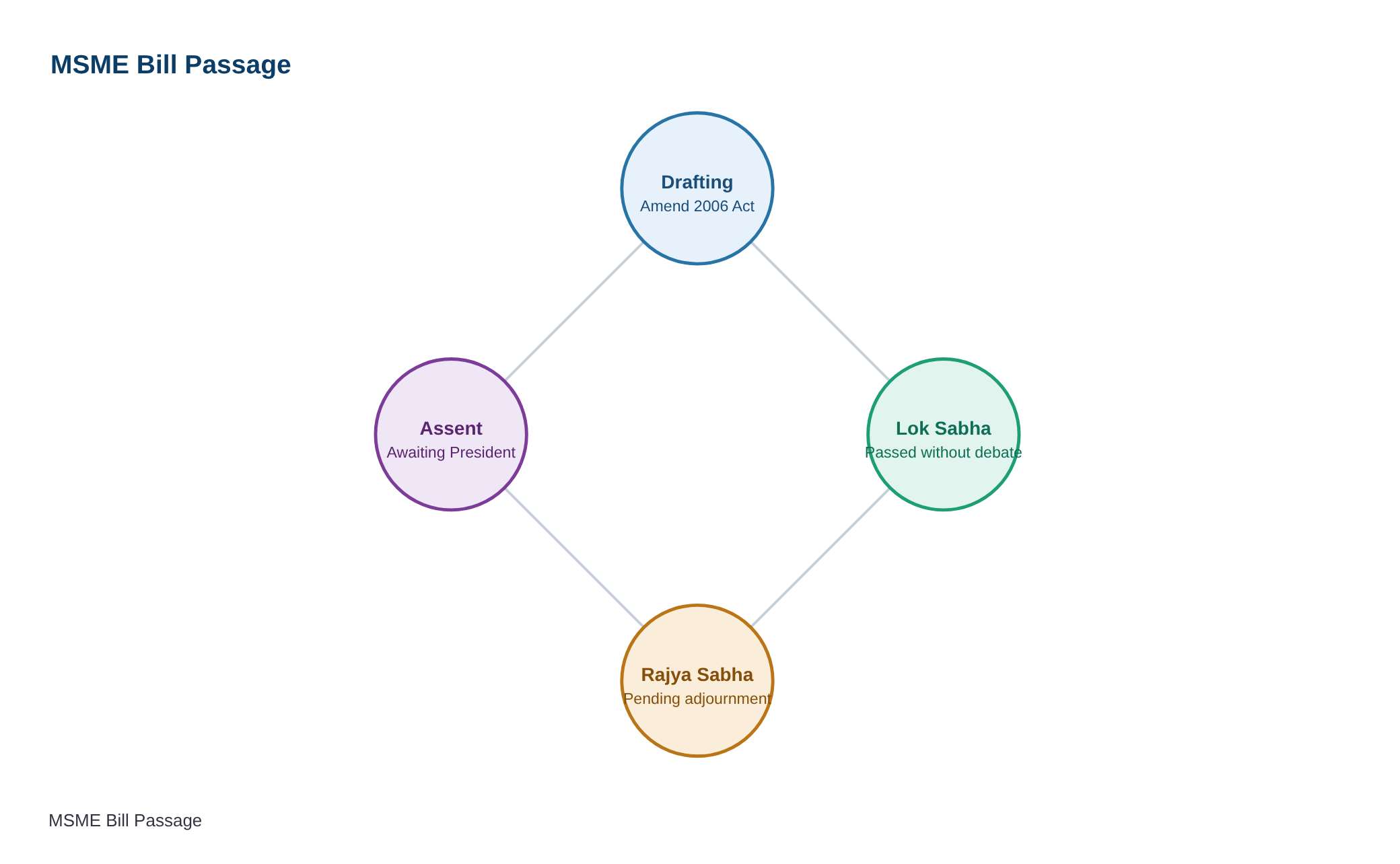
The fourteenth day of the Monsoon Session of Parliament in 2026 witnessed significant legislative activity, including the Micro, Small and Medium Enterprises (MSME) Amendment Bill, 2026 being scheduled for consideration and passing in the Lok Sabha without debate, alongside ongoing opposition protests over the NEET paper leak and alleged misappropriation of Ram Mandir donations. The Congress party issued a three-line whip to ensure its MPs’ presence, signalling the introduction of critical bills such as the Kashmiri Pandits (Recourse, Restitution, Rehabilitation and Resettlement) Bill, 2025 and the Fishermen (Protection and Welfare) Bill, 2024, while the FCRA Amendment Bill is likely to be discussed on August 12, 2026.
Background
- The Monsoon Session of Parliament in 2026 has been marked by disruptions and protests, particularly over the July 20 police action against NEET paper leak protesters in Delhi and the alleged theft of donations at the Ram Mandir in Ayodhya.
- The Congress party, through its Parliamentary Party, issued a three-line whip directing all its Lok Sabha MPs to remain present in the House from 11:00 am until adjournment on August 10, 11, and 12, 2026, indicating the introduction of significant legislative and policy discussions.
- The MSME Amendment Bill, 2026 seeks to amend the Micro, Small and Medium Enterprises Development Act, 2006, reflecting the government’s focus on enhancing the regulatory framework for MSMEs, which constitute a critical segment of India’s industrial base.
- Opposition protests have centred on allegations of excessive police action against student protesters and the alleged misappropriation of funds collected for the construction of the Ram Mandir in Ayodhya, reflecting broader concerns over governance and transparency.
Key Legislative and Procedural Developments in the Monsoon Session 2026
- The Micro, Small and Medium Enterprises (MSME) Amendment Bill, 2026 aims to amend the MSME Development Act, 2006, with the objective of enhancing the ease of doing business for micro, small, and medium enterprises by introducing provisions for faster dispute resolution, simplified compliance, and improved access to credit.
- The Kashmiri Pandits (Recourse, Restitution, Rehabilitation and Resettlement) Bill, 2025, introduced by Congress MP Shashi Tharoor, proposes comprehensive measures for the social, political, and economic rehabilitation of Kashmiri Pandits, including the restoration of their cultural heritage and protection of their property rights.
- The Fishermen (Protection and Welfare) Bill, 2024, introduced by Congress MP K C Venugopal, aims to establish a Fishermen Welfare Board and a Fishermen Welfare Fund to address the socio-economic challenges faced by fishermen in coastal states and Union Territories, including issues related to livelihood security and disaster resilience.
- The Taxation and Other Laws (Amendment) Bill, 2026, which has already been passed by the Lok Sabha, introduces amendments to the Payment and Settlement Systems Act, 2007, the Income-tax Act, 2025, and the Finance Act, 2026, with the objective of boosting investment, supporting manufacturing, and providing tax certainty.
- Parliamentary whips, such as the three-line whip issued by the Congress party, are formal directives issued by political parties to their members to ensure their presence and participation in legislative proceedings, particularly during critical debates or voting sessions.
- Opposition protests during the Monsoon Session 2026 have centred on allegations of police brutality against NEET paper leak protesters and the alleged misappropriation of funds collected for the Ram Mandir in Ayodhya, highlighting issues of governance, transparency, and accountability.
Key Features
| Feature | Significance |
|---|---|
| Passage of the Micro, Small and Medium Enterprises Development (Amendment) Bill, 2026 | Enhances the regulatory framework for MSMEs by amending the MSMED Act, 2006, to address contemporary challenges in credit access, ease of doing business, and digitalisation, thereby fostering entrepreneurship and employment generation. |
| Introduction of the Kashmiri Pandits (Recourse, Restitution, Rehabilitation and Resettlement) Bill, 2025 | Proposes a structured rehabilitation package for Kashmiri Pandits, including property restoration, cultural heritage protection, and safety measures, aligning with the constitutional directive of ensuring social justice and equity. |
| Fishermen (Protection and Welfare) Bill, 2024 | Aims to institutionalise welfare mechanisms for coastal fishermen through a dedicated board and fund, addressing livelihood vulnerabilities and aligning with the Directive Principles of State Policy under Article 48. |
| Congress’s three-line whip for Lok Sabha MPs | Demonstrates the Opposition’s strategy to ensure quorum and participation in critical discussions, reflecting the procedural dynamics of parliamentary democracy and the role of whips in maintaining party discipline. |
| Ongoing Opposition protests over NEET paper leak and Ram Mandir donation controversy | Highlights the intersection of public grievances, institutional accountability, and parliamentary functioning, underscoring the need for transparency and responsive governance. |
Why it Matters
Economic Implications
- The MSME Amendment Bill, 2026, is pivotal for India’s economic growth, as MSMEs contribute ~29% to GDP and employ ~110 million people; amendments may streamline compliance, improve credit availability, and integrate digital tools to enhance competitiveness.
- The Fishermen (Protection and Welfare) Bill, 2024, addresses the socio-economic vulnerabilities of India’s 1.5 million coastal fishermen, whose livelihoods are threatened by climate change, overfishing, and policy gaps.
- Taxation and Other Laws (Amendment) Bill, 2026, aims to provide tax certainty and boost investment, which is critical for sustaining India’s manufacturing push under the ‘Make in India’ initiative.
Social and Political Dynamics
- The Kashmiri Pandits (Recourse, Restitution, Rehabilitation and Resettlement) Bill, 2025, reflects the state’s commitment to address historical injustices and restore communal harmony, a key aspect of India’s pluralistic ethos.
- Ongoing protests over the NEET paper leak and Ram Mandir donation controversy highlight the tension between institutional accountability and public trust, necessitating transparent investigations and corrective measures.
- The Opposition’s use of a three-line whip underscores the procedural rigour of Parliament, while also reflecting the adversarial nature of Indian politics, where legislative business often intersects with political contestation.
Institutional and Procedural Aspects
- The passage of the MSME Bill without debate raises questions about the quality of legislative scrutiny, particularly in the context of the Rajya Sabha’s prior approval, which may indicate procedural efficiency or a lack thereof.
- The adjournment of both Houses due to protests disrupts the legislative agenda, demonstrating the impact of extra-parliamentary pressures on parliamentary functioning.
Challenges
1. Legislative Scrutiny and Debate
- The passage of the MSME Amendment Bill without debate in the Lok Sabha raises concerns about the depth of parliamentary scrutiny, particularly given the Bill’s potential to impact millions of MSMEs and the broader economy.
- The absence of structured debate may undermine the Bill’s legitimacy and delay its effective implementation, as stakeholders remain unaware of the amendments’ implications.
UPSC Link: Parliamentary procedures and legislative scrutiny
2. Institutional Accountability and Public Trust
- The protests over the NEET paper leak and Ram Mandir donation controversy reflect a crisis of institutional trust, where public perception of fairness and transparency in governance is at stake.
- The demand for Amit Shah’s resignation or apology over police action against student protesters highlights the need for accountable law enforcement and adherence to constitutional principles of proportionality and restraint.
UPSC Link: Role of institutions in democracy
3. Policy Coherence and Implementation Gaps
- The introduction of multiple Bills—MSME, Kashmiri Pandits, and Fishermen—without accompanying policy frameworks raises concerns about implementation feasibility and resource allocation.
- The Fishermen (Protection and Welfare) Bill, 2024, while commendable, may face challenges in funding, inter-state coordination, and addressing the root causes of fishermen’s vulnerabilities.
UPSC Link: Policy implementation challenges
4. Political Polarisation and Parliamentary Functioning
- The Opposition’s use of a three-line whip and protests over contentious issues (NEET, Ram Mandir) reflects deep political polarisation, which can disrupt legislative business and delay critical reforms.
- The adjournment of Parliament due to protests underscores the need for mechanisms to balance dissent with legislative productivity, such as structured discussions or select committees.
UPSC Link: Parliamentary functioning and political dynamics
5. Constitutional and Ethical Dilemmas
- The Ram Mandir donation controversy raises ethical questions about the management of religious donations and the state’s role in ensuring transparency and accountability in such matters.
- The Kashmiri Pandits Bill, while addressing historical injustices, must ensure that rehabilitation efforts do not inadvertently exacerbate communal tensions or violate the rights of other communities.
UPSC Link: Constitutional morality and ethical governance
Challenges — UPSC Perspective
| Issue | Concern |
|---|---|
| Lack of Debate on MSME Bill | Undermines parliamentary scrutiny and may lead to unintended consequences for MSMEs and the economy. |
| NEET Paper Leak Protests | Erodes public trust in institutional examinations and highlights systemic failures in governance. |
| Ram Mandir Donation Controversy | Raises questions about transparency in religious fund management and state neutrality in religious matters. |
| Fishermen Welfare Bill Implementation | Potential funding gaps and inter-state coordination challenges may limit the Bill’s effectiveness. |
| Political Polarisation in Parliament | Disrupts legislative business and delays critical reforms, affecting governance. |
| Police Action on Protesters | Allegations of disproportionate force undermine public confidence in law enforcement and state institutions. |
Government Initiatives — Must-Memorise for Prelims
- Micro, Small and Medium Enterprises Development (Amendment) Bill, 2026
- Kashmiri Pandits (Recourse, Restitution, Rehabilitation and Resettlement) Bill, 2025
- Fishermen (Protection and Welfare) Bill, 2024
Way Forward
- Conduct structured debates and select committee reviews for Bills like the MSME Amendment Bill to ensure thorough scrutiny and stakeholder consultations.
- Establish an independent task force to investigate the NEET paper leak and recommend systemic reforms to prevent future malpractices in competitive examinations.
- Formulate a transparent framework for managing religious donations, including audits and public disclosures, to address concerns over the Ram Mandir donation controversy.
- Allocate dedicated funds and inter-state coordination mechanisms for the Fishermen (Protection and Welfare) Bill to ensure effective implementation and address livelihood vulnerabilities.
- Strengthen parliamentary protocols to balance dissent with legislative productivity, such as time-bound discussions or joint committees for contentious issues.
- Enhance police accountability through independent oversight bodies and training on proportionality and restraint in crowd control, particularly during protests.
- Promote public awareness campaigns to educate stakeholders about the implications of Bills like the MSME Amendment Bill and the Kashmiri Pandits Bill to ensure informed participation.
- Encourage bipartisan dialogues on contentious issues to reduce political polarisation and foster a collaborative legislative environment.
UPSC Value Addition
Keywords for Mains Answer-Writing
Micro, Small and Medium Enterprises Development (Amendment) Bill, 2026 · MSME sector reforms · Parliamentary procedures · three-line whip · Opposition protests in Parliament · FCRA Amendment Bill, 2026 · NEET paper leak protests · Ram Mandir donation controversy · Parliamentary Affairs Minister Kiren Rijiju · Amit Shah’s role in Parliament · Kashmiri Pandits (Recourse, Restitution, Rehabilitation and Resettlement) Bill, 2025 · Fishermen (Protection and Welfare) Bill, 2024 · Parliament Monsoon Session 2026 · Parliamentary discipline and adjournments · Constitution of India and parliamentary functioning
Concept Flow
Opposition protests over NEET paper leak and Ram Mandir donation controversy → Adjournment of Parliament → Disruption of legislative agenda → Passage of MSME Bill without debate → Questions over parliamentary scrutiny and institutional accountability → Public grievances over institutional failures → Demand for transparency and accountability → Political polarisation in Parliament → Use of three-line whip by Opposition → Impact on legislative functioning → Introduction of multiple welfare Bills (MSME, Kashmiri Pandits, Fishermen) → Potential policy coherence gaps → Challenges in implementation and resource allocation → Need for structured policy frameworks and inter-state coordination → Allegations of disproportionate police action → Erosion of public trust → Demand for institutional reforms → Need for police accountability and adherence to constitutional principles of proportionality → Legislative business disrupted by protests → Delay in critical reforms → Impact on economic growth and social welfare → Urgency for mechanisms to balance dissent and productivity
Prelims Practice Questions
Q1. Consider the following statements regarding the Micro, Small and Medium Enterprises Development (Amendment) Bill, 2026:
1. The Bill seeks to amend the Micro, Small and Medium Enterprises Development Act, 2006.
2. It was passed by the Lok Sabha without debate during the Monsoon Session of Parliament.
3. The Bill introduces provisions for the social, political, and economic rehabilitation of Kashmiri Pandits.
How many of the above statements are correct?
- Only one
- Only two
- All three
- None
Answer: Only two — Statements 1 and 2 are correct. Statement 3 is incorrect as the Kashmiri Pandits (Recourse, Restitution, Rehabilitation and Resettlement) Bill, 2025 is a separate legislative proposal and not part of the MSME Amendment Bill.
Q2. Assertion (A): The Foreign Contribution (Regulation) Amendment Bill, 2026 aims to regulate foreign donations to non-governmental organizations in India.
Reason (R): The Bill seeks to amend the Foreign Contribution (Regulation) Act, 2010 to enhance transparency and accountability in the receipt and utilisation of foreign contributions.
- Both A and R are true, and R is the correct explanation of A
- Both A and R are true, but R is not the correct explanation of A
- A is true, but R is false
- A is false, but R is true
Answer: Both A and R are true, but R is not the correct explanation of A — Both the Assertion and Reason are true. The Foreign Contribution (Regulation) Amendment Bill, 2026 indeed seeks to amend the FCRA, 2010 to enhance transparency in foreign contributions, making R the correct explanation of A.
Q3. Match the following Bills with their respective objectives:
Column I (Bill) | Column II (Objective)
——————————————–|—————————————-
A. Micro, Small and Medium Enterprises | 1. Regulates foreign contributions to NGOs
Development (Amendment) Bill, 2026 |
B. Foreign Contribution (Regulation) | 2. Provides for rehabilitation of Kashmiri Pandits
Amendment Bill, 2026 |
C. Kashmiri Pandits (Recourse, Restitution, | 3. Amends the MSME Development Act, 2006
Rehabilitation and Resettlement) Bill, 2025 |
D. Fishermen (Protection and Welfare) Bill, | 4. Establishes a welfare board and fund for fishermen
2024 |
Answer: ? — A-3, B-1, C-2, D-4. The MSME Amendment Bill amends the MSME Development Act, 2006; the FCRA Amendment Bill regulates foreign contributions; the Kashmiri Pandits Bill provides for their rehabilitation; and the Fishermen Bill establishes a welfare board and fund.
Mains Practice Question
✍ Critically examine the significance of the Micro, Small and Medium Enterprises Development (Amendment) Bill, 2026 in the context of India’s economic policy and parliamentary functioning. How far does the Bill address the structural challenges faced by the MSME sector? Also, analyse the implications of the Bill being passed without debate in the Lok Sabha. (15 Marks)
Approach: MODEL-ANSWER SKELETON:
1. **Introduction (2 marks)**
– Define MSMEs and their role in India’s economy (employment, GDP contribution, export potential).
– Contextualise the MSME Development Act, 2006 and its amendments.
2. **Key Provisions of the MSME Amendment Bill, 2026 (4 marks)**
– Highlight the proposed amendments (e.g., definition changes, credit facilitation, ease of doing business, digitalisation, grievance redressal mechanisms).
– Reference the Rajya Sabha’s prior passage and Lok Sabha’s approval without debate.
3. **Structural Challenges Addressed (4 marks)**
– Credit constraints: Collateral issues, high interest rates, and the role of the Credit Guarantee Fund Trust for Micro and Small Enterprises (CGTMSE).
– Regulatory bottlenecks: Compliance burdens, GST complexities, and labour laws.
– Technology adoption: Digital infrastructure gaps and the need for formalisation.
– Market access: Export promotion, cluster development, and global value chains.
4. **Parliamentary Functioning and Democratic Concerns (3 marks)**
– Analyse the implications of passing a significant economic reform bill without debate (e.g., lack of scrutiny, bypassing parliamentary discourse, erosion of opposition role).
– Reference Article 105 (freedom of speech in Parliament) and Article 118 (rules of procedure).
– Discuss the role of the Opposition in ensuring accountability and the ethical dimensions of parliamentary discipline.
5. **Conclusion (2 marks)**
– Summarise the Bill’s potential impact on MSME growth and employment.
– Emphasise the need for robust parliamentary debate and stakeholder consultations in future legislative processes.
Source: The Indian Express
Generated by AanyaAi for educational purpose.

- दिल्ली हाईकोर्ट ने बदले ‘वरिष्ठ अधिवक्ता’ के नियम, 100-प्वाइंट प्रणाली हुई खत्म - September 22, 2026
- Delhi HC Drops 100-Point System for Senior Advocate Designations - September 22, 2026
- यूपी हाईकोर्ट ने स्कूल बस सुरक्षा पर दिया सख्त आदेश, डीएम को 1 माह में रिपोर्ट देने का निर्देश - September 22, 2026

No Comments