


07 Aug DMK’s Key Conditions for Supporting Delimitation Bill: UPSC Analysis
✎ The delimitation freeze, introduced in 1976 and extended in 2001, is based on the 1971 Census, and any amendment to it requires a two-thirds majority in Parliament and ratification by State Legislatures, making consensus-building…
Subject Relevance — Where This Topic Fits
- GS Paper II — Parliament and State Legislatures — Structure, Functioning, Conduct of Business, Powers & Privileges and Issues Arising out of these | GS Paper II — Federalism — Issues and Challenges Pertaining to Federal Structure, Devolution of Powers and Finances up to Local Levels and Challenges Therein | GS Paper III — Role of Parliament in Democratic Processes and Electoral Reforms
- Prelims: Delimitation Commission, Constitution (131st Amendment) Bill, 1976 Constitutional Amendment (Freeze on Delimitation), 1971 Census (Freeze Basis), Lok Sabha Seat Allocation, Federalism and Centre-State Relations, Two-Thirds Majority in Parliament, INDIA Bloc, Parliamentary Affairs Minister, Rajya Sabha vs Lok Sabha Majority
- Essay: Electoral Reforms and Democratic Accountability: Balancing Representation and Federalism, Federalism in India: Challenges of Constitutional Amendments and Political Consensus
Quick Revision: The delimitation freeze, introduced in 1976 and extended in 2001, is based on the 1971 Census, and any amendment to it requires a two-thirds majority in Parliament and ratification by State Legislatures, making consensus-building critical for the Constitution (131st Amendment) Bill.
Why is this in the news?
The Government of India is considering a constitutional amendment Bill to initiate a fresh delimitation exercise, which has historically been a contentious issue due to its implications for federalism, representation, and political power distribution. The Dravida Munnetra Kazhagam (DMK), a key regional party from Tamil Nadu, has articulated specific conditions for supporting the Bill, including a 25-year extension of the current freeze on seat redistribution based on the 1971 Census and a blanket 50% increase in Lok Sabha seats. The Centre’s outreach to Opposition parties, including the Congress, underscores the Bill’s significance, as the government lacks the requisite two-thirds majority in the Lok Sabha but may secure it with DMK’s support. This development highlights the interplay between constitutional amendments, federalism, and political bargaining in India’s parliamentary democracy.
Background
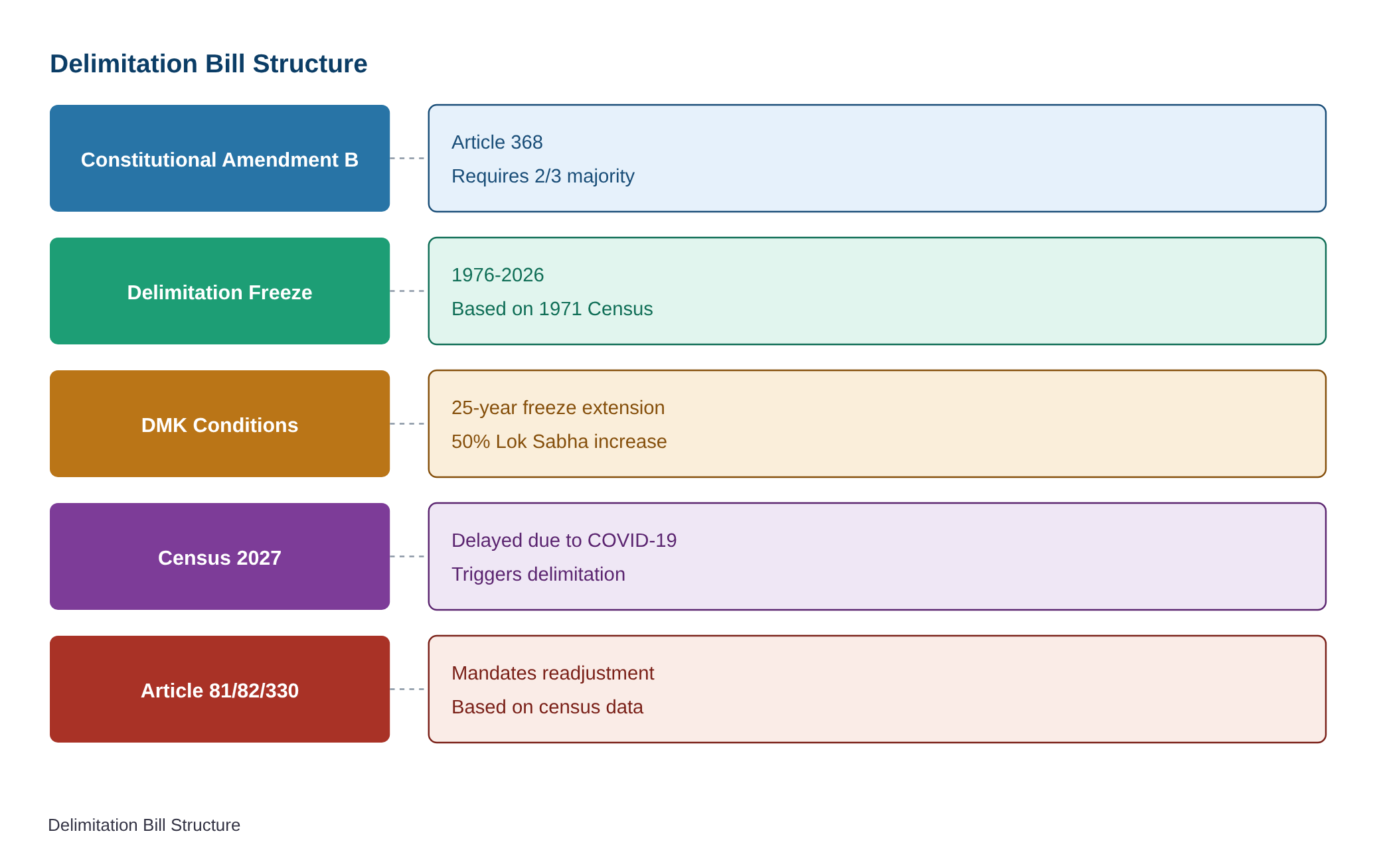
- The current delimitation freeze, based on the 1971 Census, was introduced through the 42nd Constitutional Amendment in 1976 and extended by the 84th Amendment in 2001, freezing Lok Sabha and Assembly seat allocations until the first Census after 2026.
- The Census of 2021 was delayed due to the COVID-19 pandemic and is now expected to be completed in 2027, triggering discussions on delimitation.
- The DMK’s demand for a 25-year extension of the freeze and a 50% blanket increase in Lok Sabha seats reflects its concerns about potential loss of political representation for southern states, where population growth has been relatively slower.
- The Centre’s renewed outreach to Opposition parties, including the Congress and DMK, indicates an attempt to build consensus, though the INDIA bloc has reiterated opposition to constitutional amendments for delimitation.
What is Delimitation and Why is it Contentious?
- Delimitation is the process of redrawing the boundaries of parliamentary and assembly constituencies to reflect changes in population distribution, as mandated by the Constitution.
- Article 82 of the Constitution empowers Parliament to readjust the number of seats in the Lok Sabha and State Legislative Assemblies after each Census, subject to constitutional amendments.
- The current freeze on delimitation, introduced in 1976 and extended in 2001, is based on the 1971 Census, which has led to disproportionate representation, with southern states arguing that their share of seats has eroded despite lower population growth.
- The 42nd Constitutional Amendment (1976) and the 84th Amendment (2001) froze seat allocations until the first Census after 2026, deferring the issue to avoid political contention during the Emergency and subsequent decades.
- A fresh delimitation exercise could reallocate seats based on the 2027 Census, potentially increasing seats for states with higher population growth, such as Uttar Pradesh, Bihar, and Rajasthan, while reducing the relative share of southern states like Tamil Nadu, Kerala, and Karnataka.
- The DMK’s demand for a 50% blanket increase in Lok Sabha seats is rooted in the principle of proportional representation, aiming to offset the perceived underrepresentation of southern states in the current framework.
- The Constitution (131st Amendment) Bill seeks to amend Article 82 to enable delimitation, but it requires a two-thirds majority in Parliament and ratification by at least half of the State Legislatures, making consensus-building essential.
- Federal tensions arise as delimitation is perceived as a Centre-driven process that could alter the balance of power between states, particularly in the context of the ‘One Nation, One Election’ debate and electoral reforms.
Key Features
| Feature | Significance |
|---|---|
| Constitutional freeze on delimitation (1976 amendment) | Prevents reallocation of Lok Sabha seats based on population changes, ensuring equitable representation across states for a fixed period. |
| 50% blanket increase in Lok Sabha seats | Proposed expansion of the Lok Sabha from 543 to 814 seats, aiming to address population growth while maintaining federal balance. |
| DMK’s demand for a Schedule of seats per State | Ensures transparency in seat allocation and prevents arbitrary distribution, aligning with federal principles. |
| Government’s outreach to Opposition parties | Demonstrates attempts to secure consensus on a contentious constitutional amendment, highlighting parliamentary diplomacy. |
| Two-thirds majority requirement in Parliament | Mandates broad consensus for constitutional amendments, reflecting the rigidity of the amendment process under Article 368. |
Why it Matters
Constitutional and Legal
- The delimitation exercise is governed by Articles 81, 82, and 330 of the Constitution, which mandate periodic readjustment of parliamentary and assembly constituencies based on census data.
- A constitutional amendment (Article 368) is required to alter the freeze on delimitation, underscoring the federal nature of such decisions.
- The proposed 50% increase in Lok Sabha seats would necessitate a constitutional amendment, as it alters the total number of seats beyond the current limit of 550 (Article 81).
Political and Governance
- The DMK’s conditions highlight the tension between populous and less populous states in seat allocation, a recurring theme in Indian federalism.
- The government’s outreach to Opposition parties, including the Congress and DMK, reflects the need for broad consensus in constitutional amendments, a hallmark of India’s parliamentary democracy.
- The numerical strength of the INDIA bloc has increased since April 2026, altering the political calculus for the government in securing the required two-thirds majority.
Federalism and Representation
- The freeze on delimitation since 1976 has disproportionately benefited southern states with lower population growth, raising questions about equitable representation.
- The proposed seat increase aims to balance representation but risks exacerbating regional disparities if not calibrated carefully.
- Federal principles (Article 1) require that any change in seat allocation respects the diversity and demographic realities of states.
Administrative and Procedural
- The completion of the 2027 Census is critical for any delimitation exercise, as it forms the basis for seat reallocation under Article 82.
- The government’s delay in approaching the DMK formally underscores the challenges in consensus-building for constitutional amendments.
- The Lok Sabha’s current strength of 540 members (with 2 vacant seats) and the Rajya Sabha’s 245 members create distinct thresholds for passing amendments.
Challenges
1. Constitutional Rigidity in Amendments
- The requirement of a two-thirds majority in both Houses of Parliament (Article 368) makes constitutional amendments difficult, necessitating extensive negotiations with Opposition parties.
- The government’s lack of a two-thirds majority in the current Lok Sabha (346 seats with DMK support) highlights the fragility of its position.
- Abstentions or cross-voting could further complicate the passage of the Bill, as seen in the April 2026 defeat of the 131st Amendment Bill.
UPSC Link: GS-II: Constitutional Amendments
2. Federal Disparities in Seat Allocation
- The freeze on delimitation since 1976 has led to overrepresentation of southern states with lower population growth, while northern states with higher growth remain underrepresented.
- The DMK’s demand for a 50% blanket increase risks exacerbating these disparities if not accompanied by a fair formula for seat allocation.
- States like Uttar Pradesh and Bihar, with higher population growth, may demand a larger share of seats, complicating negotiations.
UPSC Link: GS-II: Federalism
3. Political Consensus and Opposition Resistance
- The Congress and other Opposition parties have reiterated their opposition to the delimitation Bill, citing concerns over federal equity and procedural fairness.
- The INDIA bloc’s increased numerical strength since April 2026 has strengthened its bargaining power, making consensus-building more challenging.
- The government’s failure to approach the DMK formally or informally suggests a lack of strategic planning in securing support.
UPSC Link: GS-II: Parliamentary Procedures
4. Administrative Delays and Census Dependency
- The 2027 Census is critical for any delimitation exercise, but delays in its completion could postpone the process indefinitely.
- The government’s urgency in passing the Bill before the Census completion may lead to rushed or poorly calibrated amendments.
- The lack of a formal approach to the DMK highlights administrative inefficiencies in consensus-building.
UPSC Link: GS-II: Census and Representation
5. Legal and Procedural Ambiguities
- The absence of a clear Schedule for seat allocation per State in the Bill creates ambiguity and potential disputes over representation.
- The DMK’s demand for a Schedule reflects concerns over arbitrary seat distribution, which could be challenged in the Supreme Court under Article 137.
UPSC Link: GS-II: Judicial Review
Challenges — UPSC Perspective
| Issue | Concern |
|---|---|
| Two-thirds majority requirement | The government lacks the necessary numbers in the Lok Sabha, making consensus-building with Opposition parties essential but challenging. |
| Federal disparities in representation | Southern states benefit from the current freeze, while northern states seek greater representation, creating a contentious balance. |
| Opposition resistance to constitutional amendments | The Congress and INDIA bloc oppose the Bill, citing concerns over federal equity and procedural fairness. |
| Administrative delays in Census completion | The 2027 Census is critical for delimitation, but delays could derail the entire process. |
| Lack of formal Opposition outreach | The government’s failure to approach the DMK formally or informally reflects poor strategic planning and consensus-building. |
Way Forward
- The government must formally engage with the DMK and other Opposition parties to address their concerns and secure a consensus on the delimitation Bill.
- A transparent formula for seat allocation, incorporating population growth and federal equity, should be developed and shared with all stakeholders.
- The government should expedite the completion of the 2027 Census to ensure timely and accurate data for any delimitation exercise.
- Parliamentary Affairs Minister Kiren Rijiju should continue high-level parleys with the Congress and other Opposition leaders to bridge ideological gaps.
- A joint parliamentary committee should be constituted to examine the Bill and propose amendments that address federal disparities and procedural fairness.
- The government must clarify the legal and procedural ambiguities in the Bill, including the absence of a Schedule for seat allocation per State.
- State governments, particularly those with high population growth, should be consulted to ensure their representation concerns are addressed.
- The Supreme Court’s role in adjudicating disputes over seat allocation should be preemptively considered to avoid legal challenges.
UPSC Value Addition
Keywords for Mains Answer-Writing
Delimitation Commission · Constitution (131st Amendment) Bill · Lok Sabha seat increase · Constitutional freeze on seats · DMK political conditions · Federalism and Centre-State relations · Parliamentary procedures for constitutional amendments · Opposition unity and INDIA bloc · Representation of States in Parliament · Constitutional amendments and political consensus
Constitutional & Policy Linkages
- Article 81 (Composition of the Lok Sabha)
- Article 82 (Readjustment after each census)
- Article 330 (Reservation of seats for Scheduled Castes and Scheduled Tribes)
- Article 368 (Amendment of the Constitution)
- Article 1 (Federal structure of India)
Concept Flow
Delimitation freeze since 1976 → Overrepresentation of southern states → Northern states demand greater representation → Government proposes 50% seat increase → DMK demands 25-year freeze extension and seat Schedule → Opposition resistance and lack of consensus → Constitutional amendment required → Two-thirds majority hurdle → Administrative delays in Census → Political negotiations and outreach → Potential judicial review
Prelims Practice Questions
Q1. Consider the following statements regarding the Delimitation Commission in India:
1. The Delimitation Commission is a statutory body established under the Delimitation Act, 2002.
2. The primary function of the Delimitation Commission is to readjust the division of territorial constituencies in India.
3. The Delimitation Commission can only be constituted by the President of India.
4. The Delimitation Commission’s orders come into force immediately upon publication in the Gazette of India.
How many of the above statements are correct?
- Only one
- Only two
- Only three
- All
Answer: Only three — Statements 2 and 3 are correct. The Delimitation Commission is indeed a statutory body under the Delimitation Act, 2002, and is constituted by the President. Statements 1 and 4 are incorrect: the Commission is not established under the 2002 Act alone, and its orders require presidential assent to become effective.
Q2. Assertion (A): The Constitution of India provides for a freeze on the total number of seats in the Lok Sabha and State Legislative Assemblies until the first census after 2026.
Reason (R): This freeze was introduced to ensure stable representation and avoid frequent changes in electoral boundaries due to population shifts.
Options:
A. Both A and R are true, and R is the correct explanation of A.
B. Both A and R are true, but R is NOT the correct explanation of A.
C. A is true, but R is false.
D. A is false, but R is true.
Answer: ? — Assertion (A) is true: the freeze on seats is based on the 1976 constitutional amendment, which extended the freeze until the first census after 2026. Reason (R) correctly explains the rationale behind the freeze, which is to maintain stability in representation.
Q3. Match the following constitutional provisions with their correct descriptions:
Column I (Provision)
A. Article 82
B. Article 170
C. Article 330
D. Article 332
Column II (Description)
1. Reservation of seats for Scheduled Castes and Scheduled Tribes in the Lok Sabha.
2. Composition of the Legislative Assemblies of the States.
3. Readjustment of seats after each census.
4. Reservation of seats for Scheduled Castes and Scheduled Tribes in the Legislative Assemblies of the States.
Options:
A – 3, B – 2, C – 1, D – 4
A – 1, B – 2, C – 3, D – 4
A – 2, B – 1, C – 4, D – 3
A – 3, B – 4, C – 1, D – 2
Answer: ? — Correct matches: A (Article 82) – 3 (Readjustment of seats after each census), B (Article 170) – 2 (Composition of State Legislative Assemblies), C (Article 330) – 1 (Reservation in Lok Sabha), D (Article 332) – 4 (Reservation in State Legislative Assemblies).
Mains Practice Question
✍ The DMK’s conditional support to the Constitution (131st Amendment) Bill on delimitation reflects deeper federal tensions in India’s parliamentary democracy. Critically analyse the constitutional, political, and federal dimensions of the delimitation process, with particular reference to the proposed changes and the DMK’s demands. (15 Marks)
Approach: MODEL-ANSWER SKELETON:
1. **Constitutional Framework of Delimitation** (3 points):
– Article 82 and Article 170: Readjustment of seats after each census and composition of State Legislative Assemblies.
– Delimitation Commission: Statutory body under Delimitation Act, 2002, constituted by the President; orders require presidential assent (Art. 327-329).
– Freeze on seats: Constitutional amendment in 1976 froze seats based on 1971 Census until the first census after 2026.
2. **Proposed Changes in the Bill** (3 points):
– Blanket 50% increase in Lok Sabha seats: Proposed by the government to address under-representation of certain states.
– Extension of freeze: DMK demands freezing seats for another 25 years based on the 1976 amendment.
– Schedule of seats: DMK seeks a pre-committed allocation of seats for each State in the legislative package.
3. **Federal Dimensions and DMK’s Demands** (4 points):
– Representation principle: Federalism requires equitable representation of States in Parliament (e.g., Rajya Sabha’s federal character).
– Southern states’ concerns: Fear of reduced share in Lok Sabha due to demographic shifts in northern states.
– DMK’s conditions: Reflect demand for stability in representation and protection of southern states’ political voice.
– Centre-State relations: Delimitation as a tool for political bargaining; potential erosion of federal trust if Centre overrides State concerns.
4. **Political and Procedural Challenges** (3 points):
– Two-thirds majority requirement: Government lacks numbers in Lok Sabha; needs Opposition support (e.g., DMK’s 22 MPs).
– Opposition unity: INDIA bloc’s stance against constitutional amendments for delimitation; political realignment post-2024 elections.
– Procedural hurdles: Need for consensus to amend Articles 81, 82, and 170; potential judicial review if amendments violate federal principles.
5. **Conclusion** (2 points):
– Balancing representation and federalism: Delimitation must reconcile demographic realities with constitutional federalism.
– Path forward: Requires political consensus, transparency, and adherence to federal principles to avoid constitutional crises.
Source: The Hindu
Generated by AanyaAi for educational purpose.

- हिमाचल में आयुष चिकित्सा का बढ़ता प्रचलन: 57.2% लोगों ने अपनाई आयुष पद्धतियाँ, जानें कारण - September 23, 2026
- Himachal Pradesh Leads in Ayush Adoption: 57.2% Households Embrace Traditional Medicine - September 23, 2026
- आपातकाल में ‘गायब’ शाह आयोग रिपोर्ट का रहस्यमयी पुनर्प्राप्ति - September 23, 2026

No Comments