


07 Aug UPSC Alert: PLI Scheme Boosts Pharma Sector with ₹6,659 Crore Incentives
✎ The PLI Scheme for pharmaceuticals disburses incentives post-facto based on incremental sales of domestically manufactured drugs and bulk drugs, with ₹6,659 crore already released under the Drugs PLI Scheme and ₹87.70 crore under…
Subject Relevance — Where This Topic Fits
- GS Paper III — Indian Economy: Issues relating to Planning, Mobilization of Resources, Growth, Development and Employment | GS Paper III — Effects of Liberalization on the Economy, Changes in Industrial Policy and their Effects on Industrial Growth
- Prelims: Production-Linked Incentive (PLI) Scheme, Pharmaceutical Sector, Fermentation-based bulk drugs, Land Acquisition Act, 2013, Environmental Clearances under EIA Notification 2006
- Essay: The Role of Government Incentives in Fostering Industrial Competitiveness, Self-Reliance in Critical Sectors: Lessons from India’s Pharmaceutical PLI Scheme
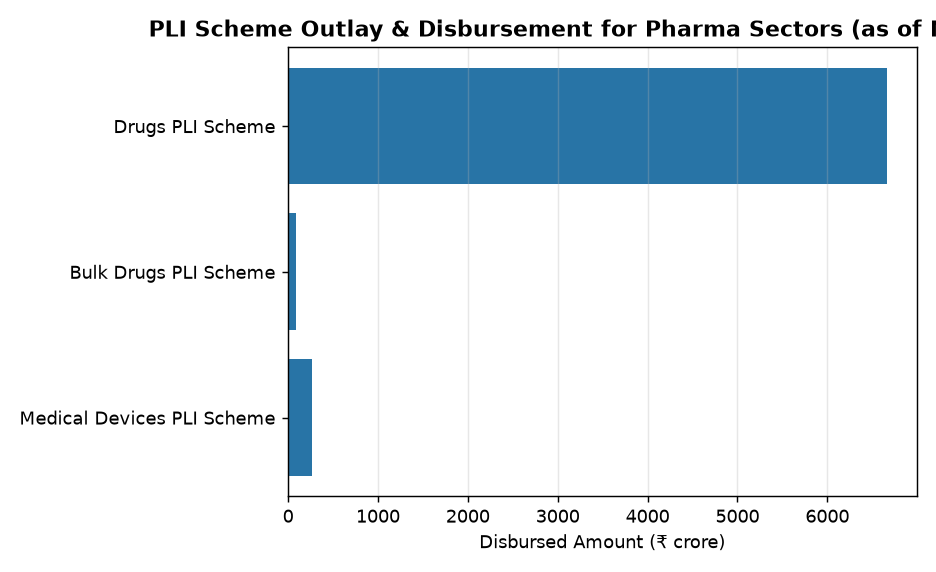
Quick Revision: The PLI Scheme for pharmaceuticals disburses incentives post-facto based on incremental sales of domestically manufactured drugs and bulk drugs, with ₹6,659 crore already released under the Drugs PLI Scheme and ₹87.70 crore under the Bulk Drugs PLI Scheme by March 2026.
Why is this in the news?
On 7 August 2026, the Department of Pharmaceuticals, Government of India, released an official statement via the Press Information Bureau highlighting the progress of the Production-Linked Incentive (PLI) Scheme for the pharmaceutical sector. The update underscored the disbursement of ₹6,659 crore under the Drugs PLI Scheme and ₹87.70 crore under the Bulk Drugs PLI Scheme by March 2026, while also acknowledging implementation challenges such as land acquisition delays, environmental clearances, and the inherent biological constraints of fermentation-based drug manufacturing.
Background
- The pharmaceutical sector is a critical component of India’s healthcare ecosystem, contributing significantly to both domestic supply and global exports, with a market size of approximately ₹3.5 lakh crore in 2023.
- India is the world’s largest supplier of generic medicines, meeting over 50% of the global demand for vaccines and 20% of generic formulations.
- The PLI Scheme for pharmaceuticals aims to incentivize domestic production of high-value, high-technology drugs and bulk drugs, reducing import dependence and strengthening supply chain resilience.
- The scheme operates alongside other PLI schemes for sectors such as electronics, automobiles, and medical devices, reflecting a broader industrial policy shift towards outcome-based fiscal support.
- The Drugs PLI Scheme has a total financial outlay of ₹15,000 crore, while the Bulk Drugs PLI Scheme has an outlay of ₹6,940 crore.
What is the Production-Linked Incentive Scheme for the Pharmaceutical Sector?
- The PLI Scheme for pharmaceuticals is a performance-based fiscal incentive mechanism designed to promote large-scale domestic manufacturing of critical drugs and bulk drugs by offering financial incentives tied to incremental sales and production.
- The scheme covers two sub-schemes: (i) PLI Scheme for Drugs, aimed at incentivizing the production of formulations, and (ii) PLI Scheme for Bulk Drugs, focused on the production of active pharmaceutical ingredients (APIs) and key starting materials (KSMs).
- Incentives are released post-facto, i.e., after the actual production and sale of eligible products, ensuring that the government’s fiscal support is directly linked to measurable outcomes.
- The PLI Scheme for pharmaceuticals is aligned with India’s broader industrial policy goals, including the promotion of self-reliance (Atmanirbhar Bharat), reduction of import dependence, and enhancement of export competitiveness in high-value pharmaceutical segments.
Key Features
| Feature | Significance |
|---|---|
| Financial Outlay | A total outlay of ₹15,000 crore for the Pharmaceutical PLI Scheme (2022-23) and ₹6,940 crore for the Bulk Drugs PLI Scheme, demonstrating the government’s commitment to self-reliance in critical pharmaceutical inputs. |
| Incentive Disbursement | ₹6,659 crore disbursed under the Pharmaceutical PLI Scheme and ₹87.70 crore under the Bulk Drugs PLI Scheme by March 2026, reflecting partial progress in achieving production-linked incentives. |
| Sectoral Coverage | Includes pharmaceuticals, bulk drugs, and medical devices, with the latter receiving ₹266.64 crore in incentives, indicating a diversified approach to incentivise high-value manufacturing. |
| Implementation Challenges | Delays in land acquisition, environmental clearances, and high utility costs have impeded the timely execution of bulk drug projects, particularly those reliant on fermentation processes. |
| Incentive Structure | Relies on sales-based disbursement of incentives, which has been constrained by project delays, leading to slower fund utilisation and reduced immediate impact. |
Why it Matters
Economic
- Enhances domestic manufacturing capacity in critical pharmaceutical segments, reducing import dependence for essential drugs and bulk chemicals.
- Stimulates investment in high-tech pharmaceutical production, aligning with the ‘Atmanirbhar Bharat’ initiative to bolster self-sufficiency.
- Promotes job creation in the pharmaceutical sector, particularly in high-skill areas such as fermentation-based drug manufacturing.
- Encourages R&D and innovation in drug development by incentivising large-scale production of high-value pharmaceuticals.
- Supports the growth of ancillary industries, including logistics, packaging, and raw material suppliers, through backward linkages.
Strategic
- Reduces vulnerability to global supply chain disruptions by strengthening domestic production of bulk drugs and critical pharmaceuticals.
- Enhances India’s strategic autonomy in the pharmaceutical sector, particularly in the context of geopolitical uncertainties and trade restrictions.
- Facilitates the development of a robust pharmaceutical ecosystem, positioning India as a global leader in generic and bulk drug manufacturing.
- Supports the production of essential drugs during public health emergencies, ensuring timely availability and affordability.
Policy
- Demonstrates the government’s commitment to long-term industrial policy reforms aimed at incentivising high-value manufacturing sectors.
- Highlights the importance of production-linked incentives as a tool for achieving industrial growth and reducing import dependence.
- Showcases the challenges in implementing PLI schemes, particularly in sectors with complex regulatory and operational requirements, such as fermentation-based bulk drug production.
- Illustrates the need for synchronised policy interventions, including streamlined approval processes and infrastructure development, to maximise the impact of such schemes.
Challenges
1. Regulatory and Approval Delays
- Prolonged land acquisition processes due to bureaucratic hurdles and land-use regulations.
- Environmental clearances remain a significant bottleneck, particularly for projects involving large-scale industrial activity.
- High utility costs, including electricity and water, increase the operational burden on pharmaceutical manufacturers.
- Delays in obtaining necessary permits and approvals disrupt project timelines and inflate capital expenditure.
UPSC Link: GS3: Industrial Policy and Ease of Doing Business
2. Technological and Operational Constraints
- Fermentation-based bulk drug production relies on slow-growing biological processes, leading to extended manufacturing cycles.
- High capital intensity and specialised infrastructure requirements limit participation to large firms, excluding smaller players.
- Dependence on imported raw materials for certain fermentation processes increases vulnerability to global supply chain disruptions.
- Limited availability of skilled labour for advanced fermentation and bioprocessing technologies.
UPSC Link: GS3: Science and Technology in Industrial Development
3. Incentive Disbursement Mechanism
- Sales-based disbursement of incentives creates a lag in fund utilisation, as payments are contingent on product sales rather than project milestones.
- Project delays directly impact the pace of incentive disbursement, reducing the scheme’s immediate economic impact.
- Complex compliance requirements and documentation hurdles deter smaller firms from availing incentives.
UPSC Link: GS3: Government Budgeting and Fiscal Policy
4. Market and Competitive Challenges
- Global competition from countries like China and South Korea in bulk drug manufacturing poses a threat to domestic players.
- Price fluctuations in raw materials and energy costs affect profitability and long-term sustainability of projects.
- Limited export competitiveness due to higher domestic production costs compared to international benchmarks.
UPSC Link: GS3: Foreign Trade and Balance of Payments
5. Sectoral Fragmentation
- Divergence in incentives between pharmaceuticals, bulk drugs, and medical devices complicates implementation and reduces coherence.
- Lack of integration between PLI schemes and other industrial policies, such as the Pharma Vision 2024, limits synergistic benefits.
- Inadequate coordination between central and state governments in addressing regional disparities in industrial infrastructure.
UPSC Link: GS3: Cooperative Federalism in Economic Development
Challenges — UPSC Perspective
| Issue | Concern |
|---|---|
| Land Acquisition | Prolonged processes due to bureaucratic hurdles and regulatory complexities. |
| Environmental Clearances | Delays in obtaining necessary approvals for industrial projects. |
| Utility Costs | High electricity and water costs increase operational expenses for manufacturers. |
| Fermentation Process Constraints | Slow biological growth rates extend manufacturing cycles and project timelines. |
| Incentive Disbursement Lag | Sales-based payments delay fund utilisation and reduce immediate economic impact. |
| Global Competition | Domestic players face stiff competition from low-cost bulk drug producers in China and South Korea. |
Government Initiatives — Must-Memorise for Prelims
- Production-Linked Incentive (PLI) Scheme for Medical Devices
Way Forward
- Streamline land acquisition and environmental clearance processes through single-window clearance mechanisms to reduce project timelines.
- Introduce performance-based disbursement of incentives to decouple payments from sales and align them with project milestones.
- Enhance infrastructure support, including reliable power supply and water availability, to reduce operational costs for manufacturers.
- Promote R&D in fermentation-based processes through targeted subsidies and partnerships with academic institutions.
- Strengthen export promotion initiatives to enhance the global competitiveness of domestic bulk drug manufacturers.
- Establish a dedicated nodal agency to monitor and expedite the implementation of PLI schemes across pharmaceutical segments.
- Encourage public-private partnerships to develop shared infrastructure, such as fermentation plants and testing facilities.
- Conduct periodic reviews of PLI schemes to assess their effectiveness and introduce course corrections based on ground realities.
UPSC Value Addition
Keywords for Mains Answer-Writing
Production Linked Incentive Scheme (PLI) for Pharmaceuticals · Pharmaceutical Sector in India · Bulk Drugs PLI Scheme · Fermentation-based Bulk Drugs · Land Acquisition for Industrial Projects · Environmental Clearances in India · Component-Linked Incentive (CLI) · Medical Devices PLI Scheme · Atmanirbhar Bharat in Pharmaceuticals · Drug Manufacturing in India · Biological Activity in Fermentation · Public Sector Undertakings in Pharmaceuticals · Union Budget Allocations for Pharmaceutical PLI · Regulatory Bottlenecks in Industrial Growth
Concept Flow
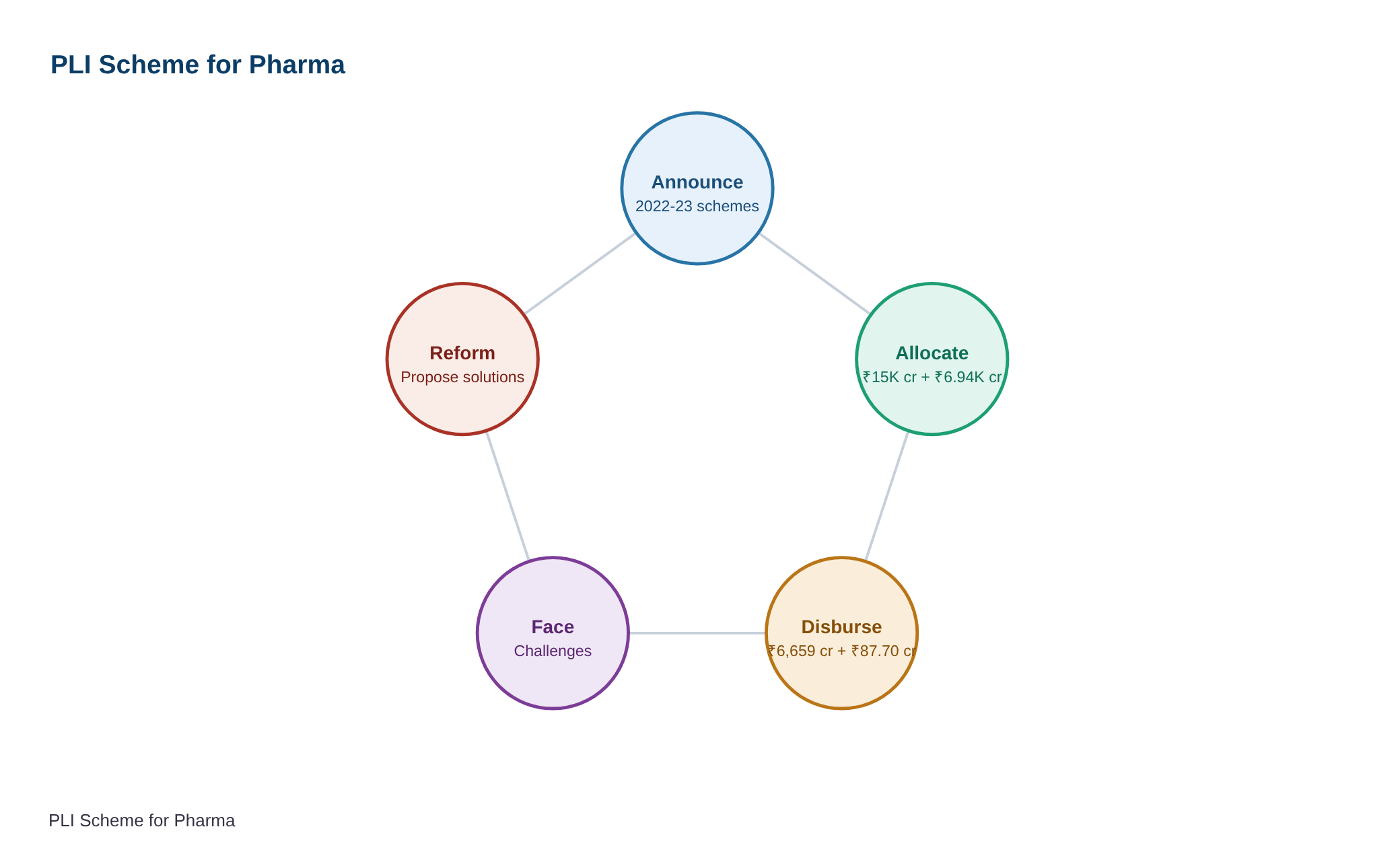
Government announces PLI schemes for pharmaceuticals, bulk drugs, and medical devices (2022-23) → → Allocation of financial outlays and disbursement of incentives based on sales and project milestones → → Implementation challenges arise due to regulatory delays, high utility costs, and fermentation process constraints → → Slower-than-expected progress in bulk drug projects affects incentive disbursement and sectoral growth → → Government and stakeholders identify bottlenecks and propose reforms to enhance scheme effectiveness → → Reforms include streamlined approvals, performance-based incentives, and infrastructure support → → Improved implementation leads to increased domestic production, reduced import dependence, and enhanced self-reliance in pharmaceuticals.
Prelims Practice Questions
Q1. With reference to the Production Linked Incentive (PLI) Scheme for the Pharmaceutical sector, consider the following statements:
1. The PLI Scheme for Pharmaceuticals was launched in the financial year 2022-23.
2. The total financial outlay for the PLI Scheme for Pharmaceuticals is ₹15,000 crore.
3. The PLI Scheme for Bulk Drugs has faced delays due to fermentation-based production processes.
How many of the above statements are correct?
- Only one
- Only two
- All three
- None
Answer: All three — Statements 1 and 2 are correct as per the PIB release. Statement 3 is also correct because fermentation-based bulk drugs require longer manufacturing periods due to biological growth constraints, leading to delays in project implementation.
Q2. Assertion (A): The Component-Linked Incentive (CLI) framework is being considered for integration with the PLI Scheme for Medical Devices to attract more manufacturing firms.
Reason (R): The current PLI Scheme for Medical Devices follows a pure PLI framework without any component-linked incentives.
In the context of the above two statements, which one of the following is correct?
- Both A and R are true and R is the correct explanation of A
- Both A and R are true but R is NOT the correct explanation of A
- A is true but R is false
- A is false but R is true
Answer: ? — The assertion is false because the PIB release explicitly states that no such reform is planned for the Medical Devices PLI Scheme. The reason is true as the scheme currently follows a pure PLI framework.
Q3. Match the following schemes with their respective financial outlays as per the PIB release dated August 7, 2026:
Column I (Scheme) | Column II (Financial Outlay in ₹ Crore)
——————————————–|—————————————-
A. PLI Scheme for Pharmaceuticals | 1. ₹15,000
B. PLI Scheme for Bulk Drugs | 2. ₹6,940
C. PLI Scheme for Medical Devices | 3. ₹15,000
D. Component-Linked Incentive (CLI) | 4. Not mentioned in the release
Answer: ? —
Mains Practice Question
✍ Critically examine the efficacy of the Production Linked Incentive (PLI) Scheme for the Pharmaceutical sector in achieving the objectives of Atmanirbhar Bharat. Also, analyse the challenges faced by the Bulk Drugs PLI Scheme in implementation, particularly in the context of fermentation-based production processes. (15 Marks)
Approach: MODEL-ANSWER SKELETON:
1. **Introduction (2 Marks)**
– Define the PLI Scheme and its objectives under Atmanirbhar Bharat for the pharmaceutical sector.
– Mention the financial outlays: ₹15,000 crore for Pharmaceuticals PLI, ₹6,940 crore for Bulk Drugs PLI.
– Highlight the progress: ₹6,659 crore disbursed for Pharmaceuticals PLI, ₹87.70 crore for Bulk Drugs PLI by March 2026.
2. **Efficacy of PLI Scheme in Achieving Atmanirbhar Bharat (6 Marks)**
– **Strengths**:
– Incentivises domestic manufacturing, reduces import dependence, and promotes self-reliance in critical drugs and bulk drugs.
– Encourages investment in high-cost, long-gestation projects (e.g., fermentation-based drugs).
– Aligns with the National Pharmaceutical Pricing Authority (NPPA) and Drug Price Control Order (DPCO) frameworks.
– **Limitations**:
– Slow disbursement of funds due to project delays (e.g., land acquisition, environmental clearances).
– Fermentation-based production faces biological constraints (slow cell growth), leading to delays in achieving scale.
– Limited impact on export competitiveness compared to global pharma giants.
– **Comparative Analysis**:
– Contrast with China’s pharmaceutical sector growth, where state-backed incentives and infrastructure support accelerated development.
– Reference to the Jan Aushadhi Scheme as a complementary measure for affordability.
3. **Challenges in Bulk Drugs PLI Scheme (5 Marks)**
– **Biological Constraints**:
– Fermentation-based production relies on living cells, whose growth is inherently slower than chemical synthesis.
– Longer manufacturing cycles delay revenue generation, impacting PLI disbursement tied to sales.
– **Regulatory and Infrastructure Bottlenecks**:
– Land acquisition delays, environmental clearances, and high utility costs.
– Lack of integrated industrial corridors for bulk drug manufacturing.
– **Market Dynamics**:
– Price controls under DPCO limit profitability, disincentivizing investment in bulk drug production.
– Competition from imported bulk drugs due to lower costs and established supply chains.
4. **Way Forward (2 Marks)**
– Streamline regulatory processes (e.g., single-window clearances for bulk drug parks).
– Promote public-private partnerships (PPP) for shared infrastructure (e.g., fermentation facilities).
– Expand the scope of PLI to include component-linked incentives for medical devices to diversify manufacturing.
– Strengthen R&D support for fermentation-based production technologies.
**Balanced View**: The PLI Scheme is a step in the right direction but requires addressing structural bottlenecks to fully realize its potential in achieving self-reliance in pharmaceuticals.
Source: PIB (Press Information Bureau)
Generated by AanyaAi for educational purpose.

- Rediscovered plant ‘Haplothismia exannulata’ inspires Wildlife Week in Kerala - October 5, 2026
- खाद्य मुद्रास्फीति का शिकार: खाद्य तेलों की बढ़ती कीमतें क्यों हैं चिंता का विषय - October 5, 2026
- Next-Gen GST: Boosting India’s Economy for Viksit Bharat Aspirants - October 5, 2026

No Comments