


07 Aug Bombay HC Allows Felling 847 Mangroves for Bullet Train: Key UPSC Polity Insights
✎ Compensatory afforestation, as mandated under the Forest Conservation Act, 1980, must prioritise ecological restoration over numerical replacement, and distant plantations cannot offset local ecological loss, as reiterated by the…
Subject Relevance — Where This Topic Fits
- GS Paper II — Governance, Constitution, Polity, Social Justice and International Relations (Judicial Review and Environmental Governance) | GS Paper III — Environment, Biodiversity, Climate Change and Disaster Management (Compensatory Afforestation, Forest Conservation Act, 1980)
- Prelims: Mangrove ecosystems, Bombay High Court, Forest Conservation Act 1980, Compensatory Afforestation Fund Management and Planning Authority (CAMPA), MC Mehta v. Union of India (1996), National Green Tribunal (NGT), Mumbai-Ahmedabad High-Speed Rail Corridor, MahaTransco, Palghar district, Solapur district, 132 kV transmission line, land-use diversion, ecological restoration
- Essay: The tension between developmental imperatives and environmental conservation: A case study of judicial interventions in India, Can compensatory afforestation truly offset ecological loss? Lessons from the Bombay High Court’s ruling on the Mumbai-Ahmedabad bullet train project
Quick Revision: Compensatory afforestation, as mandated under the Forest Conservation Act, 1980, must prioritise ecological restoration over numerical replacement, and distant plantations cannot offset local ecological loss, as reiterated by the Bombay High Court in the Mumbai-Ahmedabad bullet train project case.
Why is this in the news?
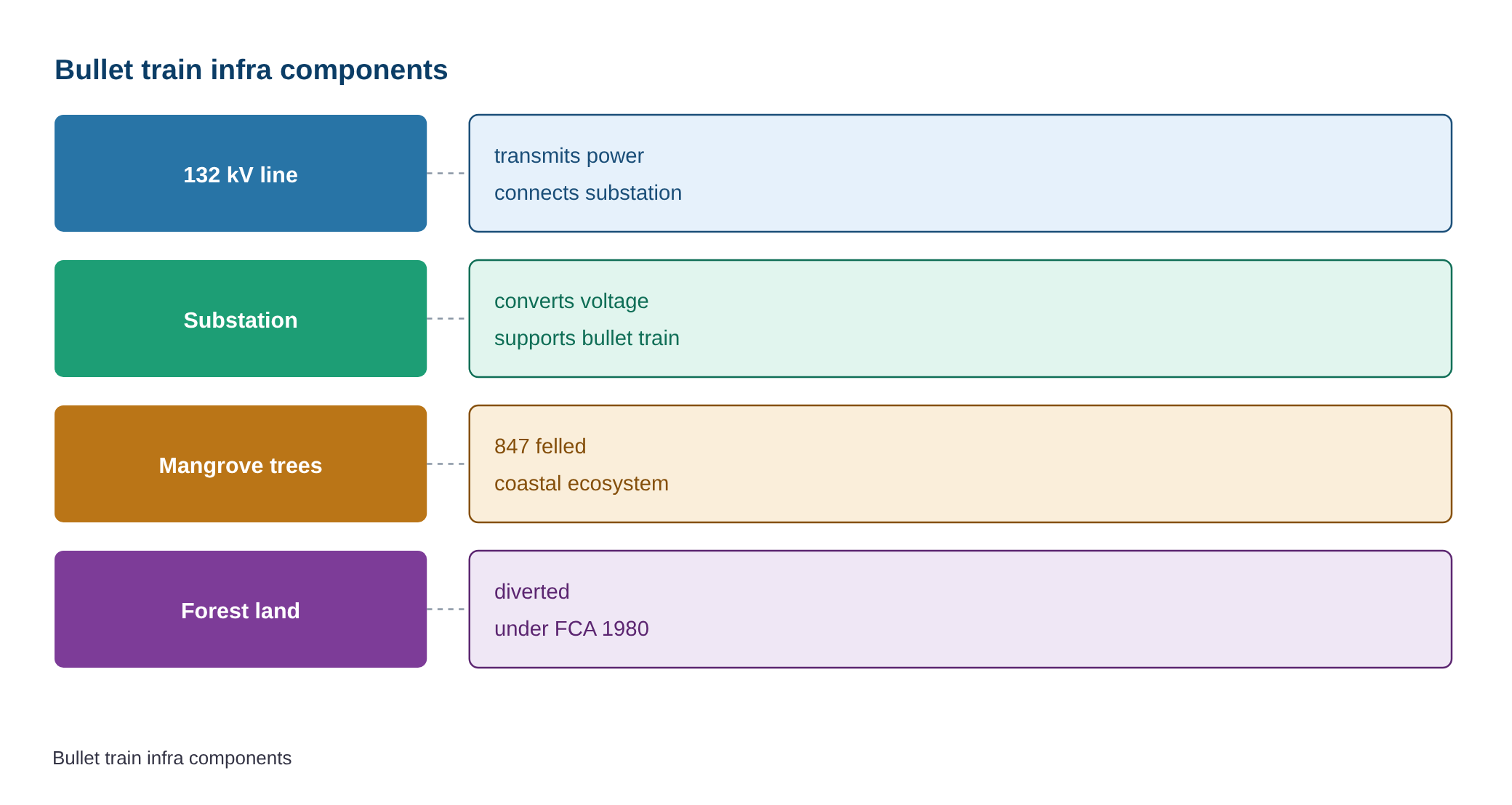
The Bombay High Court’s recent order permitting the felling of 847 mangrove trees for a 132 kV transmission line and substation integral to the Mumbai-Ahmedabad bullet train project has generated significant legal and environmental discourse. The court’s conditional clearance, while permitting the project, underscored the inadequacy of compensatory afforestation when undertaken far from the affected site and criticised the Maharashtra government’s failure to implement reforms in compensatory afforestation mechanisms. This ruling is noteworthy for its emphasis on ecological restoration over numerical replacement and its warning against treating compensatory afforestation as a mere statistical exercise.
Background
- The Mumbai-Ahmedabad High-Speed Rail Corridor is a flagship infrastructure project under the National High-Speed Rail Corporation Limited (NHSRCL), aimed at connecting India’s financial capital with Ahmedabad via high-speed rail.
- The project requires diversion of forest land, including mangrove ecosystems, for transmission infrastructure such as substations and power lines, necessitating compliance with environmental laws like the Forest Conservation Act, 1980.
- The Forest Conservation Act, 1980, mandates compensatory afforestation for any diversion of forest land, with the goal of restoring ecological balance rather than merely replacing the number of trees felled.
- The National Green Tribunal (NGT) and state-level green bodies frequently adjudicate disputes over compensatory afforestation, with a focus on ensuring ecological equivalence between the lost and restored sites.
- The Maharashtra government’s failure to implement reforms in compensatory afforestation, as directed by the Bombay High Court in September 2025, reflects systemic challenges in translating legal directives into administrative action.
What is Compensatory Afforestation, and Why Does It Matter?
- Compensatory afforestation is a statutory mechanism under the Forest Conservation Act, 1980, requiring project proponents to afforest an area equivalent to or greater than the forest land diverted for non-forest use, to mitigate ecological loss.
- The primary objective of compensatory afforestation is ecological restoration, not merely the replacement of trees. This includes restoring biodiversity, soil health, water retention, and carbon sequestration functions of the original ecosystem.
- The Supreme Court in *MC Mehta v. Union of India* clarified that compensatory afforestation must restore the ecological functions of the affected area, not just the number of trees. Plantations far from the site of loss are inadequate for this purpose.
- Compensatory afforestation is often criticised for its implementation challenges, including delays, lack of ecological equivalence, and administrative apathy, as highlighted by the Bombay High Court in this case.
- The National Green Tribunal (NGT) plays a crucial role in adjudicating disputes related to compensatory afforestation, ensuring compliance with environmental laws and ecological restoration goals.
- Mangrove ecosystems are particularly ecologically significant due to their role in coastal protection, carbon sequestration, biodiversity support, and storm surge mitigation, making their loss irreplaceable through distant afforestation.
- The Bombay High Court’s ruling underscores the need for compensatory afforestation to be ecologically meaningful, with a preference for afforestation in or near the affected area to restore local ecological functions.
Key Features
| Feature | Significance |
|---|---|
| Mangrove Ecosystem | Mangroves provide critical ecological services including coastal protection, carbon sequestration, and biodiversity support; their loss disrupts local hydrology and fishery-dependent livelihoods. |
| Compensatory Afforestation | A statutory mechanism under the Forest Conservation Act, 1980, aimed at offsetting ecological loss through equivalent tree planting, though its ecological efficacy remains contested. |
| Judicial Scrutiny | The Bombay High Court exercised judicial review over executive action, emphasizing ecological restoration over numerical replacement in compensatory afforestation. |
| National Importance Clause | Projects designated ‘of national importance’ receive expedited clearance but remain subject to environmental safeguards and judicial oversight. |
| Forest Land Diversion | The legal process under the Forest Rights Act, 2006, requires approval for diversion of forest land for non-forest purposes, balancing development and conservation. |
| Transmission Infrastructure | High-voltage transmission lines and substations are critical for energy distribution but often intersect with ecologically sensitive zones, necessitating careful siting. |
Why it Matters
Ecological
- The court’s ruling underscores the limitations of compensatory afforestation when applied to mangroves, which are irreplaceable in their local ecological functions.
- Mangrove loss in Palghar district threatens coastal resilience, biodiversity, and the livelihoods of fishing communities dependent on mangrove-associated fisheries.
- The judgment reinforces the principle that ecological restoration must prioritize functional equivalence over mere numerical replacement of trees.
Judicial
- The High Court’s decision demonstrates the judiciary’s role in environmental governance, ensuring that executive actions comply with constitutional and statutory environmental safeguards.
- The court’s insistence on local compensatory afforestation (Thane) over distant plantations (Solapur) sets a precedent for future cases involving mangrove ecosystems.
- Judicial scrutiny of compensatory afforestation mechanisms highlights systemic gaps in implementation, particularly in transparency and ecological monitoring.
Administrative
- The court’s criticism of Maharashtra’s delayed compliance with afforestation reforms exposes administrative inertia in implementing environmental safeguards.
- The directive to the Chief Secretary to establish afforestation land banks and monitoring mechanisms within four weeks reflects judicial impatience with bureaucratic delays.
- The judgment signals the need for institutional reforms in compensatory afforestation, including real-time data tracking and third-party audits.
Economic
- The Mumbai-Ahmedabad bullet train project, a flagship infrastructure initiative, relies on uninterrupted power supply, necessitating the transmission infrastructure in question.
- Ecological disruptions, such as mangrove loss, can impose long-term economic costs through reduced coastal protection, fishery declines, and climate vulnerability.
Strategic
- The project’s designation as ‘of national importance’ reflects India’s focus on high-speed rail as a strategic infrastructure to enhance connectivity and economic integration.
- The court’s exception for this project, while emphasizing its uniqueness, underscores the tension between developmental imperatives and environmental conservation in national planning.
Challenges
1. Ecological Irreversibility of Mangrove Loss
- Mangroves are highly localized ecosystems; their ecological functions (e.g., storm surge attenuation, carbon storage, nursery habitats) cannot be replicated by distant plantations.
- The loss of 847 mangrove trees in Palghar disrupts coastal biodiversity and fishery-dependent livelihoods, with long-term ecological and economic consequences.
- Compensatory afforestation in Solapur, 400 km away, fails to restore the ecological services lost in Palghar, highlighting the inadequacy of numerical replacement.
UPSC Link: Forest Conservation Act, 1980
2. Administrative Delays in Afforestation Reforms
- The Maharashtra government’s failure to comply with the High Court’s September 2025 directives on afforestation land banks and monitoring mechanisms reflects systemic bureaucratic inertia.
- Delayed implementation of reforms undermines the efficacy of compensatory afforestation, reducing it to a theoretical exercise rather than a practical ecological restoration tool.
- The court’s four-week deadline for compliance underscores the urgency of administrative reforms to align with judicial and statutory mandates.
UPSC Link: Compensatory Afforestation Fund Management and Planning Authority (CAMPA)
3. Judicial Balancing of Development and Conservation
- The court’s decision to allow the project despite ecological concerns reflects the judiciary’s role in balancing developmental imperatives with environmental safeguards.
- The judgment emphasizes that ‘exceptional measures’ should not set precedents, cautioning against the normalization of ecological trade-offs for infrastructure projects.
- The court’s insistence on local compensatory afforestation (Thane) over distant plantations (Solapur) signals a shift toward more ecologically meaningful restoration.
UPSC Link: Article 21 (Right to Life) and Environmental Jurisprudence
4. Legal Ambiguity in Compensatory Afforestation
- The case highlights the lack of clarity in defining ‘ecological equivalence’ in compensatory afforestation, particularly for mangroves and other specialized ecosystems.
- The Supreme Court’s ruling in the MC Mehta case (1996) is cited to emphasize that compensatory afforestation must restore ecosystems, not merely replace trees numerically.
- The judgment underscores the need for statutory amendments to define ecological restoration standards, including species selection, proximity, and functional equivalence.
UPSC Link: Forest Rights Act, 2006
5. Inter-Jurisdictional Coordination Gaps
- The case involves multiple agencies (MahaTransco, Maharashtra Forest Department, CAMPA) and jurisdictions (Palghar, Solapur, Thane), highlighting coordination gaps in environmental governance.
- The failure to establish afforestation land banks and monitoring mechanisms reflects a lack of inter-departmental coordination and data sharing.
- The court’s directive to the Chief Secretary to ensure compliance within four weeks underscores the need for stronger inter-jurisdictional coordination mechanisms.
UPSC Link: Environmental Impact Assessment (EIA) Notification, 2006
6. Public Participation and Environmental Justice
- Environmental groups like the Bombay Environmental Action Group played a critical role in challenging the project, highlighting the importance of public participation in environmental governance.
- The case demonstrates the need for stronger mechanisms to ensure that local communities, particularly those dependent on mangroves, are included in decision-making processes.
- The judgment reinforces the principle that environmental justice must prioritize the rights and livelihoods of affected communities over numerical or statistical compliance.
UPSC Link: Public Trust Doctrine
Challenges — UPSC Perspective
| Issue | Concern |
|---|---|
| Mangrove Ecosystem Loss | Irreversible ecological damage due to the localized and specialized nature of mangrove functions, which cannot be replicated by distant plantations. |
| Compensatory Afforestation Gaps | Failure of compensatory afforestation to restore ecological services, as seen in the distant plantation in Solapur versus local mangrove loss in Palghar. |
| Administrative Inertia | Delayed compliance with judicial directives on afforestation reforms, highlighting systemic bureaucratic delays in environmental governance. |
| Judicial Balancing Act | The challenge of balancing developmental imperatives with environmental safeguards, particularly in cases involving projects of ‘national importance’. |
| Legal Ambiguity | Lack of clear statutory definitions for ‘ecological equivalence’ in compensatory afforestation, leading to disputes over restoration standards. |
| Inter-Jurisdictional Coordination | Gaps in coordination between multiple agencies and jurisdictions, resulting in delayed and ineffective implementation of environmental safeguards. |
Way Forward
- Strengthen the definition of ‘ecological equivalence’ in compensatory afforestation by amending the Forest Conservation Act, 1980, to include standards for species selection, proximity, and functional restoration.
- Establish a real-time monitoring mechanism for compensatory afforestation projects, including third-party audits and public disclosure of plantation data.
- Create afforestation land banks in ecologically similar regions to ensure that compensatory afforestation is ecologically meaningful and locally relevant.
- Enhance inter-departmental coordination by mandating the establishment of a unified environmental governance platform for projects involving forest land diversion.
- Incorporate public participation mechanisms in environmental impact assessments, particularly for projects affecting mangrove ecosystems and local livelihoods.
- Develop a national framework for mangrove conservation, including restoration guidelines, community-based management, and legal protections for mangrove-dependent communities.
- Implement judicial reforms to expedite environmental cases while ensuring rigorous scrutiny of ecological trade-offs in infrastructure projects.
- Promote research on mangrove ecology and restoration techniques to improve the efficacy of compensatory afforestation in specialized ecosystems.
UPSC Value Addition
Keywords for Mains Answer-Writing
Bombay High Court · Mumbai-Ahmedabad bullet train project · Mangrove conservation · Compensatory afforestation · Ecological restoration · Forest (Conservation) Act, 1980 · National Green Tribunal (NGT) · Maharashtra State Electricity Transmission Company Ltd. (MahaTransco) · Environmental Impact Assessment (EIA) 2006 · Supreme Court judgment in M.C. Mehta case · Forest land diversion · Afforestation land banks · Ecological functions of mangroves
Concept Flow
Mumbai-Ahmedabad bullet train project requires transmission infrastructure → Diversion of 3.35 hectares of forest land, including mangroves → Bombay High Court reviews project under Forest Conservation Act, 1980 → Court examines compensatory afforestation proposal (distant plantations vs. local restoration) → Judgment emphasizes ecological restoration over numerical replacement → Court allows project with conditions (local mangrove saplings in Thane) → Criticizes administrative delays in afforestation reforms → Directs Chief Secretary to implement reforms within four weeks → Ruling sets precedent for future cases involving mangrove ecosystems
Prelims Practice Questions
Q1. Consider the following statements regarding the Bombay High Court’s recent order on mangrove felling for the Mumbai-Ahmedabad bullet train project:
1. The court permitted felling of 847 mangrove trees under an “exceptional measure” but cautioned against treating it as a precedent.
2. The court directed the Maharashtra government to establish afforestation land banks within four weeks.
3. The court approved compensatory afforestation by planting 7,457 non-mangrove trees 400 km away in Solapur district.
4. The court emphasized that compensatory afforestation must restore ecological functions, not merely replace the number of trees felled.
How many of the above statements are correct?
- Only one
- Only two
- Only three
- All
Answer: Only three — Statements 1, 2, and 4 are correct. Statement 3 is incorrect because the court rejected compensatory afforestation at a distant location (400 km away) and instead directed closer planting of mangrove saplings near Thane.
Q2. Assertion (A): The Bombay High Court allowed the felling of 847 mangrove trees for the Mumbai-Ahmedabad bullet train project despite ecological concerns.
Reason (R): The court ruled that compensatory afforestation must restore ecological functions, not merely replace the number of trees felled.
Options:
A. Both A and R are true, and R is the correct explanation of A.
B. Both A and R are true, but R is not the correct explanation of A.
C. A is true, but R is false.
D. A is false, but R is true.
- A
- B
- C
- D
Answer: B — Both the assertion (A) and reason (R) are true. The court permitted felling under exceptional circumstances but emphasized that compensatory afforestation must restore ecological functions, making R the correct explanation of A.
Q3. Match the following environmental laws/regulations with their key provisions:
Column I (Law/Regulation)
A. Forest (Conservation) Act, 1980
B. Environmental Impact Assessment (EIA) Notification, 2006
C. Compensatory Afforestation Fund Act, 2016
D. National Green Tribunal Act, 2010
Column II (Key Provision)
1. Mandates prior environmental clearance for projects involving forest land diversion.
2. Establishes a fund for afforestation and compensatory plantation.
3. Provides for the establishment of a specialised tribunal for environmental disputes.
4. Regulates the diversion of forest land for non-forest purposes.
Options:
A-1, B-4, C-2, D-3
A-4, B-1, C-2, D-3
A-2, B-3, C-1, D-4
A-3, B-2, C-4, D-1
- A
- B
- C
- D
Answer: B — A matches with 4 (Forest (Conservation) Act, 1980 regulates forest land diversion). B matches with 1 (EIA Notification, 2006 mandates environmental clearance). C matches with 2 (Compensatory Afforestation Fund Act, 2016 establishes a fund for afforestation). D matches with 3 (National Green Tribunal Act, 2010 establishes a tribunal for environmental disputes).
Mains Practice Question
✍ Critically examine the Bombay High Court’s recent order permitting the felling of 847 mangrove trees for the Mumbai-Ahmedabad bullet train project. In your answer, discuss the legal and ecological principles governing compensatory afforestation, and evaluate the court’s approach in balancing developmental imperatives with environmental conservation. (15 Marks)
Approach: MODEL-ANSWER SKELETON:
1. **Legal Framework Governing Forest Land Diversion and Compensatory Afforestation:**
– Forest (Conservation) Act, 1980: Provisions for diversion of forest land and conditions for compensatory afforestation.
– Environmental Impact Assessment (EIA) Notification, 2006: Requirement of prior environmental clearance for projects involving forest land.
– Compensatory Afforestation Fund Act, 2016: Establishment of the Compensatory Afforestation Fund Management and Planning Authority (CAMPA) and its role in afforestation.
– Supreme Court’s judgment in *M.C. Mehta v. Union of India* (2018): Emphasis on ecological restoration rather than numerical replacement of trees.
2. **Ecological Significance of Mangroves:**
– Mangroves as critical coastal ecosystems providing storm protection, carbon sequestration, and biodiversity support.
– Unique ecological functions of mangroves that cannot be replicated by distant compensatory plantations.
3. **Bombay High Court’s Order: Key Observations and Directions:**
– The court’s classification of the project as of “national importance” and its decision to permit felling under exceptional circumstances.
– Critique of compensatory afforestation at distant locations (e.g., Solapur) and the court’s insistence on ecological restoration.
– Directions to the Maharashtra government to establish afforestation land banks and publish plantation data within four weeks.
4. **Balancing Development and Environmental Conservation:**
– The court’s approach in granting an exception based on categorical assurances by MahaTransco, including closer mangrove plantation near Thane.
– The need for a nuanced balance between developmental projects and environmental safeguards.
5. **Critique and Way Forward:**
– The court’s emphasis on not treating the order as a precedent and its warning against administrative apathy in implementing afforestation reforms.
– The role of the National Green Tribunal (NGT) and other institutions in ensuring compliance with environmental laws.
6. **Conclusion:**
– The court’s order reflects a pragmatic yet principled approach, prioritising ecological restoration while acknowledging developmental imperatives. However, systemic reforms in compensatory afforestation and forest land management remain critical.
Source: The Indian Express
Generated by AanyaAi for educational purpose.

- सर्वोच्च न्यायालय ने सीईसी और ईसी की नियुक्ति संबंधी कानून को पांच न्यायाधीशों की संविधान पीठ को भेजा - September 23, 2026
- Supreme Court to Hear Plea on CEC, ECs Appointment Law 2023 - September 23, 2026
- बेंगलुरु की रक्षा फर्म ने 100 घंटे की उड़ान परीक्षण पूरी की: देश का पहला AI-संचालित लड़ाकू विमान - September 23, 2026

No Comments