


07 Aug DMK’s Key Demands for Supporting Delimitation Bill: What UPSC Aspirants Must Know
✎ The Delimitation Bill’s passage hinges on a two-thirds majority in Parliament, with the DMK’s conditional support contingent on a 25-year freeze extension and a 50% Lok Sabha seat increase, reflecting federal tensions and…
Subject Relevance — Where This Topic Fits
- GS Paper II — Polity and Governance: Constitutional Amendments, Federalism, and Parliamentary Procedures | GS Paper III — Economic and Social Development: Demographic Changes and Representation
- Prelims: Delimitation Commission, Constitutional (131st) Amendment Bill, 1971 Census freeze, Lok Sabha seat increase, Federalism and State representation, Parliamentary majority thresholds, INDIA bloc dynamics, Anti-defection law (Tenth Schedule)
- Essay: Federalism in India: Balancing Centre-State Relations in Constitutional Amendments, Representation and Democracy: The Case for Delimitation in a Changing Demographic Landscape
Quick Revision: The Delimitation Bill’s passage hinges on a two-thirds majority in Parliament, with the DMK’s conditional support contingent on a 25-year freeze extension and a 50% Lok Sabha seat increase, reflecting federal tensions and demographic realities.
Why is this in the news?
The Dravida Munnetra Kazhagam (DMK) has articulated conditional support for the Centre’s proposed Delimitation Bill, which seeks to redraw parliamentary constituencies based on updated census data. The party’s demands—including a 25-year extension of the 1976 freeze on seat allocation and a blanket 50% increase in Lok Sabha seats—highlight the intersection of constitutional amendments, federalism, and political bargaining in India’s parliamentary democracy. The Centre’s outreach to Opposition parties, including the Congress, underscores the Bill’s contested nature, particularly amid shifting numerical strengths in the Lok Sabha and the absence of a two-thirds majority for the government.
Background
- The current delimitation freeze, imposed by the 42nd Constitutional Amendment (1976), is based on the 1971 Census and is set to expire after the completion of the 2021 Census (now expected in 2027).
- The DMK’s conditions reflect regional apprehensions about potential loss of representation for southern states, given their lower population growth rates compared to northern states.
- The Bill’s passage requires a two-thirds majority in both Houses of Parliament, a threshold the government currently lacks without Opposition support.
- The INDIA bloc’s numerical strength has increased since the Bill’s initial defeat in April 2026, altering the political calculus for the government.
- Parliamentary Affairs Minister Kiren Rijiju’s outreach to Opposition leaders, including Rahul Gandhi, signals renewed attempts to secure consensus on the Bill.
What is the Delimitation Bill and the DMK’s Conditional Support?
- The **Delimitation Bill** seeks to redraw parliamentary and assembly constituencies based on updated census data, a process governed by Articles 81 and 82 of the Constitution and the Delimitation Act, 2002.
- The **1976 freeze** (42nd Amendment) halted delimitation based on the 1971 Census to prevent frequent changes in seat allocation, which could destabilise political representation.
- The **DMK’s demands** include: (a) extending the 1976 freeze for 25 more years; (b) a blanket 50% increase in Lok Sabha seats to accommodate population growth; and (c) a schedule specifying seat allocations for each state in the legislative package.
- The 50% blanket increase was verbally promised by Home Minister Amit Shah when the legislative package aimed at bringing about delimitation was brought in Parliament in April.
- The **federal dimension** of the Bill is contentious, as southern states (e.g., Tamil Nadu) fear reduced representation due to lower population growth, while northern states may gain seats.
- The **political dynamics** have shifted since April 2026, with the INDIA bloc gaining strength, altering the government’s ability to secure the Bill’s passage.
- The **Delimitation Commission**, a statutory body, is responsible for redrawing boundaries, but its composition and terms are subject to parliamentary approval.
Key Features
| Feature | Significance |
|---|---|
| Constitutional freeze on seat allocation (1976 amendment) | Prevents reallocation of Lok Sabha seats based on population changes, ensuring stability in representation until 2027. |
| 50% blanket increase in Lok Sabha seats | Proposed expansion of Parliament to accommodate demographic growth while maintaining proportional representation. |
| DMK’s demand for a published schedule of seats | Ensures transparency and prevents ad-hoc seat distribution, aligning with federal principles. |
| Government’s outreach to Opposition parties | Attempts to secure two-thirds majority for constitutional amendment amid shifting political dynamics. |
| INDIA bloc’s opposition to delimitation | Reflects ideological resistance to altering seat allocation formulas, particularly in southern states. |
Why it Matters
Political
- The DMK’s conditional support highlights federal tensions, as southern states fear loss of relative political weight due to population-based seat adjustments.
- A delimitation exercise could alter the balance of power between northern and southern states, given differential population growth rates.
- The government’s outreach to Opposition parties underscores the need for consensus in constitutional amendments, a rarity in recent parliamentary sessions.
- The INDIA bloc’s unified opposition signals a potential realignment of Opposition politics against the ruling dispensation.
Constitutional
- Delimitation is constitutionally mandated under Article 82, but requires a freeze on seat allocation to prevent frequent changes that disrupt electoral cycles.
- The 1976 amendment (42nd Constitution Amendment Act) extended the freeze until 2001, later extended to 2026; a further extension would require another constitutional amendment.
- The proposed 50% increase in seats necessitates a constitutional amendment, as the total number of seats is fixed under Article 81.
Electoral
- Delimitation could reallocate seats to reflect current demographic realities, potentially benefiting states with higher population growth rates.
- The DMK’s demand for a published schedule aims to prevent arbitrary seat distribution, which could otherwise lead to political disputes.
- A successful delimitation would require simultaneous adjustments in state legislative assemblies to maintain parity under Article 170.
Federalism
- Southern states, including Tamil Nadu, oppose delimitation due to fears of reduced political representation relative to northern states with higher population growth.
- The DMK’s stance reflects a broader regional assertion of political autonomy within the Union of India.
- Federal principles are tested when constitutional amendments disproportionately impact certain states, raising questions of equity.
Challenges
1. Political Consensus Deficit
- The government lacks a two-thirds majority in the Lok Sabha, requiring cross-party support for the constitutional amendment.
- Opposition parties, including the Congress and the INDIA bloc, have expressed strong reservations, complicating negotiations.
- Regional parties like the DMK hold pivotal votes, making their support contingent on specific demands that may not align with national priorities.
UPSC Link: GS Paper 2: Parliament and State Legislatures
2. Federal Disputes Over Representation
- Southern states argue that delimitation would dilute their political influence due to lower population growth compared to northern states.
- The DMK’s demand for a 50% blanket increase in seats is seen as an attempt to offset potential losses in relative representation.
- Federal tensions may escalate if the Centre unilaterally proceeds with delimitation without accommodating regional concerns.
UPSC Link: GS Paper 2: Federalism
3. Constitutional and Legal Hurdles
- Any delimitation exercise requires a constitutional amendment, which must be passed by a two-thirds majority in both Houses of Parliament.
- The freeze on seat allocation, currently based on the 1971 Census, expires after the 2027 Census, creating a time-sensitive window for action.
- Legal challenges may arise if the delimitation process is perceived as violating the principle of proportional representation.
UPSC Link: GS Paper 2: Constitutional Amendments
4. Operational and Logistical Challenges
- The delimitation process involves complex data collection, including the latest Census data, which is still being compiled.
- Simultaneous adjustments in state legislative assemblies are required to maintain parity, adding to the logistical burden.
- The lack of formal or informal government outreach to the DMK suggests potential delays in consensus-building.
UPSC Link: GS Paper 2: Parliament and State Legislatures
5. Public Perception and Political Risks
- Delimitation could be perceived as a politically motivated move to alter electoral outcomes, particularly if it benefits certain states over others.
- Regional parties may mobilize public opinion against the Centre, leading to protests or electoral backlash in southern states.
- The government’s inability to secure Opposition support may erode its credibility on constitutional amendments.
UPSC Link: GS Paper 2: Pressure Groups and Associations
Challenges — UPSC Perspective
| Issue | Concern |
|---|---|
| Lack of two-thirds majority | Government cannot pass the constitutional amendment without Opposition support, risking legislative gridlock. |
| Regional disparities in seat allocation | Southern states fear loss of political influence, leading to federal tensions and potential legal challenges. |
| Opposition unity against delimitation | The INDIA bloc’s unified stance complicates consensus-building and increases political risks for the government. |
| Time-sensitive Census data | The 2027 Census completion deadline pressures the government to act swiftly, but delays in data collection may hinder the process. |
| Public perception of political manipulation | Perceived bias in seat allocation could fuel regional discontent and electoral backlash. |
| Logistical complexity of simultaneous adjustments | Delimitation requires coordination across Parliament and state legislatures, increasing operational challenges. |
Way Forward
- The government must initiate formal consultations with the DMK and other Opposition parties to address their concerns and secure conditional support for the Bill.
- A transparent schedule of proposed seat allocations should be published to build trust and mitigate federal disputes.
- Parliamentary Affairs Minister Kiren Rijiju should intensify outreach to Opposition leaders, including Rahul Gandhi, to bridge the consensus gap.
- The government should consider a phased approach to delimitation, starting with states where population growth is most pronounced, to reduce regional resistance.
- Legal experts should review the constitutional feasibility of the DMK’s demands, particularly the 50% blanket increase in seats, to ensure compliance with federal principles.
- State governments, especially in southern India, should be engaged in pre-legislative consultations to address concerns about representation and equity.
- The government must clarify the timeline for Census data collection and delimitation implementation to avoid delays and legal ambiguities.
- Political messaging should emphasize the need for demographic representation while reassuring states about their relative political weight.
UPSC Value Addition
Keywords for Mains Answer-Writing
Delimitation Commission · Constitutional Amendment · Lok Sabha seat increase · Article 82 · Article 170 · Census freeze · Federalism · Dravidian parties · Parliamentary procedures · Constitutional morality · Federal balance · Opposition consensus
Constitutional & Policy Linkages
- Article 81: Total number of seats in the Lok Sabha and their allocation among States.
- Article 82: Readjustment of seats in the Lok Sabha after each Census.
- Article 170: Total number of seats in State Legislative Assemblies and their allocation.
- Article 46: Promotion of educational and economic interests of Scheduled Castes and Scheduled Tribes, relevant in seat allocation debates.
Concept Flow
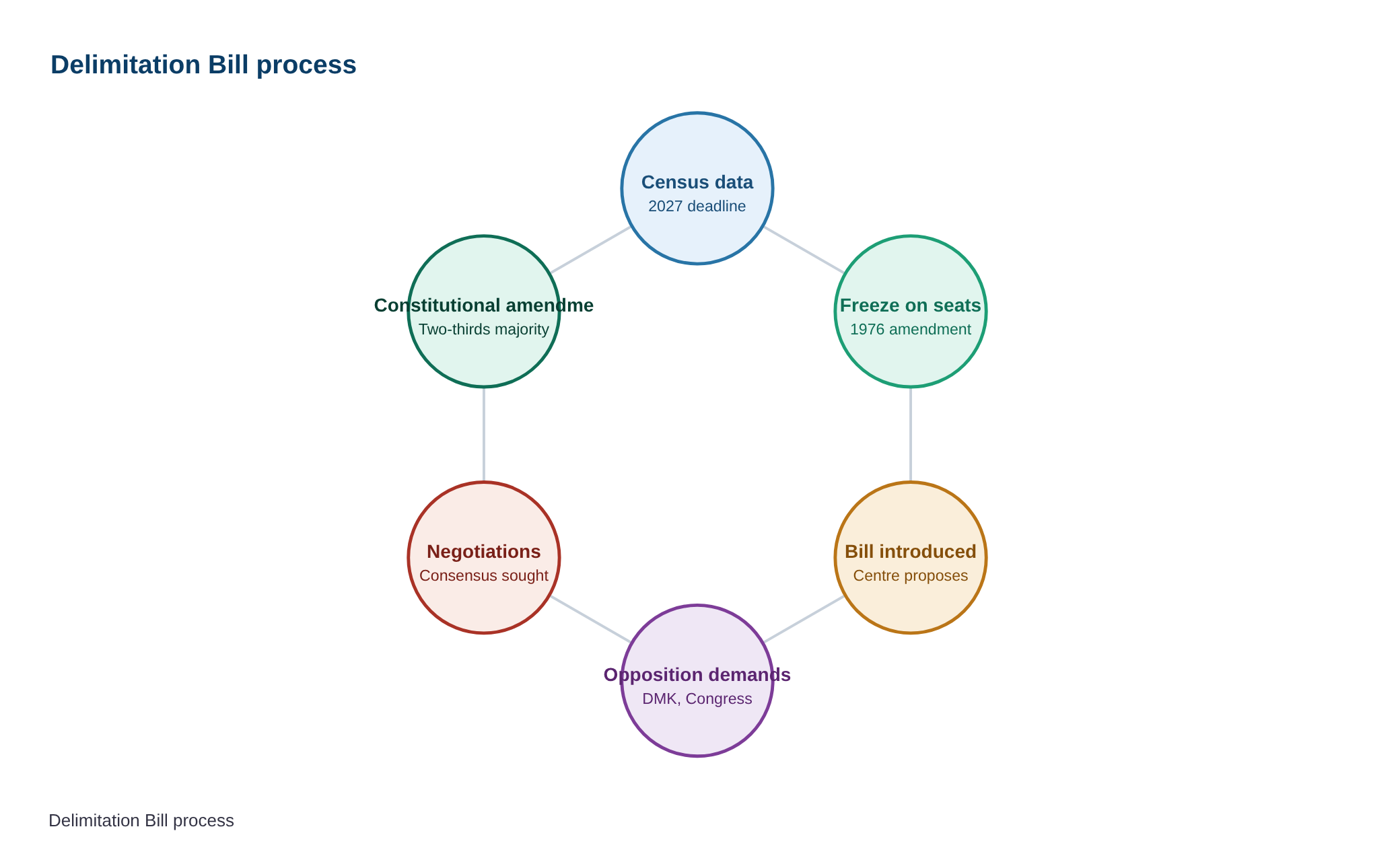
Census data collection (2027 deadline) → Constitutional freeze on seat allocation (1976 amendment) → Government introduces Delimitation Bill → DMK and Opposition demand revisions → Negotiations for consensus → Constitutional amendment passed (if supported) → Delimitation exercise conducted → New seat allocations finalized → State Legislative Assemblies adjusted accordingly
Prelims Practice Questions
Q1. Consider the following statements regarding the delimitation process in India:
1. The current freeze on Lok Sabha seats is based on the 1971 Census.
2. The Delimitation Commission is a statutory body established under Article 82 of the Constitution.
3. The 104th Constitutional Amendment Act extended the freeze on the delimitation of Assembly seats in certain states until 2030.
How many of the above statements are correct?
- Only one
- Only two
- Only three
- None
Answer: Only three — Statement 1 is correct (freeze based on 1971 Census). Statement 2 is incorrect (Delimitation Commission is established under the Delimitation Act, 2002, not Article 82). Statement 3 is correct (104th Amendment extended the freeze).
Q2. Assertion (A): The delimitation process in India is aimed at ensuring equitable representation in the Lok Sabha and State Legislative Assemblies.
Reason (R): The Constitution mandates that the Delimitation Commission must be constituted after every Census to redraw constituency boundaries.
Options:
A. Both A and R are true, and R is the correct explanation of A.
B. Both A and R are true, but R is not the correct explanation of A.
C. A is true, but R is false.
D. A is false, but R is true.
- A
- B
- C
- D
Answer: C — Assertion (A) is true (delimitation aims for equitable representation). Reason (R) is false (the Delimitation Commission is constituted as per the Delimitation Act, 2002, not mandated by the Constitution to be formed after every Census).
Q3. Match the following provisions with their respective constitutional articles:
Column I (Provision)
1. Freeze on delimitation of Assembly seats in certain states
2. Procedure for delimitation of constituencies
3. Allocation of seats in the Lok Sabha
Column II (Article)
A. Article 82
B. Article 334
C. Article 170
Select the correct match:
- 1-A, 2-B, 3-C
- 1-B, 2-A, 3-C
- 1-C, 2-A, 3-B
- 1-B, 2-C, 3-A
Answer: 1-B, 2-A, 3-C — 1-B (Article 334 provides for the freeze on delimitation of Assembly seats in certain states). 2-A (Article 82 empowers Parliament to determine the delimitation of constituencies). 3-C (Article 170 deals with the composition of State Legislative Assemblies, including seat allocation).
Mains Practice Question
✍ Critically examine the constitutional and political implications of the proposed delimitation exercise in India, particularly in the context of the DMK’s conditions for supporting the Bill. Also, analyse how this exercise could impact the federal balance and representation in the Lok Sabha. (15 Marks)
Approach: MODEL-ANSWER SKELETON:
1. **Constitutional Framework of Delimitation**:
– Reference to Articles 82 (read with the Delimitation Act, 2002) and 170 (composition of State Legislative Assemblies).
– Role of the Delimitation Commission: composition, powers, and limitations.
– Historical context: Freeze on delimitation based on the 1971 Census (42nd Amendment, 1976) and its extension via the 104th Amendment (2019).
2. **DMK’s Conditions and Their Implications**:
– **50% blanket increase in Lok Sabha seats**: Constitutional feasibility under Article 82; political rationale (addressing population growth and regional representation).
– **25-year extension of the 1976 freeze**: Legal and federal concerns (e.g., impact on states with declining population growth vs. those with high growth).
– **Schedule of seats per state**: Demand for transparency and predictability in seat allocation.
3. **Federal Balance and Representation**:
– **Impact on Southern States**: Potential dilution of their relative share in the Lok Sabha due to population dynamics (e.g., Tamil Nadu, Kerala).
– **Northern States’ Advantage**: High population growth in states like Uttar Pradesh and Bihar could lead to an increase in their seat share.
– **Constitutional Morality vs. Political Expediency**: Debate over whether delimitation should prioritise population or equity in representation.
4. **Political and Procedural Challenges**:
– **Opposition Consensus**: Role of the INDIA bloc (Congress, DMK, etc.) in opposing or negotiating the Bill.
– **Parliamentary Procedures**: Need for a two-thirds majority in both Houses; role of the Rajya Sabha.
– **Recent Political Developments**: Changes in the numerical strength of the Opposition since the Bill’s introduction in April 2026.
5. **Conclusion**:
– Weigh the constitutional validity of the DMK’s demands against the principles of federalism and democratic representation.
– Assess whether the proposed exercise aligns with the spirit of the Constitution or risks exacerbating regional disparities.
Source: The Hindu
Generated by AanyaAi for educational purpose.

- ‘इंडिया केम-2026’ मुंबई में संपन्न: वैश्विक रसायन केंद्र बनने की ओर भारत - October 24, 2026
- UPSC Focus: Labour Codes & Social Security in UP’s Two-Day Dialogue - October 24, 2026
- मध्य प्रदेश में नर्मदा माइक्रो सिंचाई परियोजना: 72 हजार किसानों को मिलेगा लाभ - October 24, 2026

No Comments