


07 Aug PLI Scheme for Pharma Sector: Key Facts for UPSC & State PCS Aspirants
✎ The PLI scheme for pharmaceuticals is a performance-linked subsidy mechanism designed to enhance domestic manufacturing capacity, reduce import dependence, and promote self-reliance in critical healthcare inputs.
Subject Relevance — Where This Topic Fits
- GS Paper III — Indian Economy: Issues Relating to Planning, Mobilisation of Resources, Growth, Development and Employment | GS Paper III — Government Budgeting and Fiscal Policy | GS Paper III — Effects of Liberalisation on the Economy
- Prelims: Production-Linked Incentive (PLI) Scheme, Pharmaceutical Sector, Fermentation-based bulk drugs, Land Acquisition, Environmental Clearances
- Essay: India’s Pharmaceutical Sector: Self-Reliance and Global Competitiveness, Role of Production-Linked Incentives in Industrial Policy and Economic Growth
Quick Revision: The PLI scheme for pharmaceuticals is a performance-linked subsidy mechanism designed to enhance domestic manufacturing capacity, reduce import dependence, and promote self-reliance in critical healthcare inputs.
Why is this in the news?
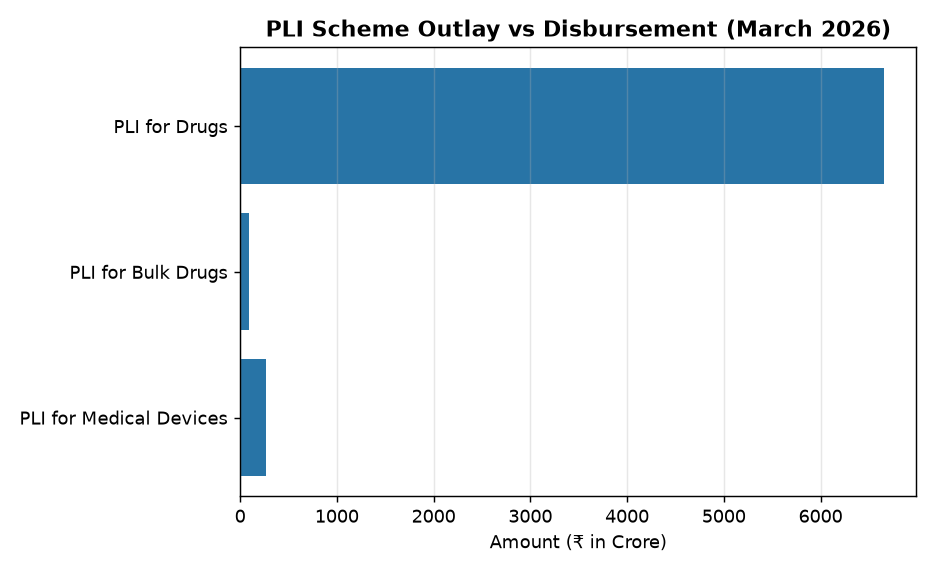
The Press Information Bureau (PIB) released a written reply in the Lok Sabha on 7 August 2026, detailing the progress and challenges of the Production-Linked Incentive (PLI) Scheme for the pharmaceutical sector. The data reveals significant disbursements under the scheme for drugs and medical devices, while highlighting delays in the implementation of bulk drug projects due to inherent biological constraints in fermentation-based production and regulatory hurdles such as land acquisition and environmental clearances.
Background
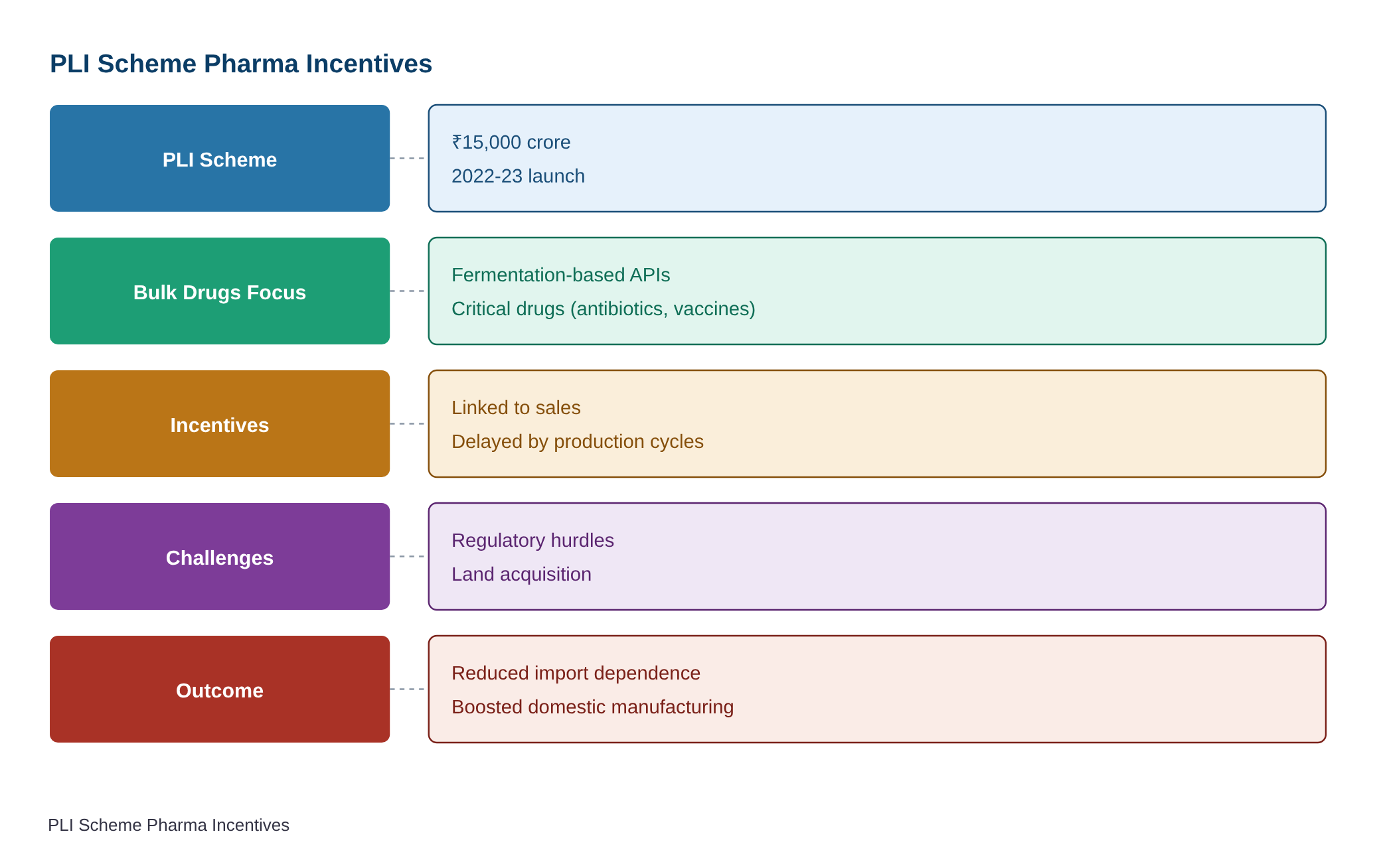
- The PLI scheme was launched in FY 2022-23 as part of India’s broader strategy to enhance domestic manufacturing and reduce import dependence in critical sectors, including pharmaceuticals.
- The scheme aims to incentivise large-scale production of high-value drugs, bulk drugs, and medical devices by providing financial incentives linked to incremental sales over a base year.
- India is a global leader in generic drug manufacturing but remains heavily dependent on imports for key active pharmaceutical ingredients (APIs) and bulk drugs, particularly those produced via fermentation processes.
- The PLI scheme for bulk drugs was designed with a financial outlay of ₹6,940 crore to boost domestic production of fermentation-based APIs, which are essential for critical drugs such as antibiotics and vaccines.
- Regulatory and operational challenges, including delays in land acquisition, environmental clearances, and high utility costs, have impeded the timely execution of bulk drug projects under the PLI scheme.
- The fermentation process, unlike chemical synthesis, relies on the slow growth of living cells, leading to longer production cycles and delayed realization of incentives tied to sales.
What is the Production-Linked Incentive (PLI) Scheme for Pharmaceuticals?
- The PLI scheme for pharmaceuticals is a government initiative to promote domestic manufacturing of drugs, bulk drugs (APIs), and medical devices by offering financial incentives based on incremental sales over a base year.
- The scheme operates under a multi-year framework with a total financial outlay of ₹15,000 crore.
- Incentives are disbursed annually to eligible manufacturers based on verified sales data, ensuring that subsidies are performance-linked and outcome-oriented.
- The scheme covers a wide range of pharmaceutical products, including critical care drugs, biopharmaceuticals, and fermentation-based bulk drugs such as penicillin and other antibiotics.
- For bulk drugs, the PLI scheme aims to reduce India’s import dependence by incentivising large-scale production of fermentation-based APIs, which are essential for the manufacture of essential medicines.
- The scheme is administered by the Department of Pharmaceuticals under the Ministry of Chemicals and Fertilizers, with oversight from the Empowered Group of Secretaries (EGoS).
- Eligibility for incentives is determined by the applicant’s commitment to invest in plant and machinery, employment generation, and adherence to environmental and regulatory norms.
- The PLI scheme for medical devices, though distinct, operates under a similar framework to encourage domestic manufacturing of high-value medical equipment such as stents, orthopaedic implants, and diagnostic kits.
Key Features
| Feature | Significance |
|---|---|
| Production-Linked Incentive (PLI) Scheme for Pharmaceuticals | Aims to enhance domestic manufacturing capacity, reduce import dependence, and promote self-reliance in critical pharmaceutical products. |
| Total Financial Outlay: ₹15,000 crore | Provides financial incentives to eligible pharmaceutical manufacturers based on incremental sales of domestically produced goods. |
| Allocation for Bulk Drugs: ₹6,940 crore | Specifically targets bulk drug production, addressing vulnerabilities in the supply chain of active pharmaceutical ingredients (APIs). |
| Disbursement Mechanism: Incremental Sales-Based | Incentives are released only upon actual sales of eligible products, ensuring fiscal prudence and accountability. |
| Coverage of Medical Devices: Separate PLI Scheme | Extends incentives to medical device manufacturers, fostering innovation and reducing import reliance in high-tech healthcare equipment. |
Why it Matters
Economic
- Boosts domestic pharmaceutical manufacturing, reducing reliance on imports for critical drugs and APIs, thereby improving trade balance.
- Enhances competitiveness of Indian pharmaceutical firms in global markets by incentivizing scale and efficiency.
- Stimulates ancillary industries such as packaging, logistics, and R&D, creating employment and economic multiplier effects.
Strategic
- Strengthens India’s position as a global pharmacy hub by promoting high-value drug manufacturing domestically.
- Reduces vulnerabilities in supply chains exposed during geopolitical disruptions or public health emergencies.
- Supports the vision of ‘Atmanirbhar Bharat’ by fostering self-sufficiency in essential pharmaceutical products.
Healthcare System
- Ensures a stable supply of affordable medicines by incentivizing domestic production of bulk drugs and formulations.
- Facilitates the development of advanced medical devices, improving healthcare infrastructure and access.
- Promotes innovation in pharmaceutical R&D, leading to the development of novel therapies and treatments.
Challenges
1. Operational Delays in Bulk Drug Projects
- Land acquisition and regulatory approvals (e.g., environmental clearances) cause significant delays in project implementation.
- High utility costs and infrastructure bottlenecks (e.g., power, water) increase operational expenses, reducing profitability.
- Fermentation-based bulk drug production involves biological processes with inherently slow growth rates, extending manufacturing timelines.
UPSC Link: GS-III: Industrial Policy
2. Disbursement Lag Due to Sales-Based Incentives
- Incentives are contingent on actual sales, which may be delayed due to market dynamics or regulatory hurdles.
- Projects with longer gestation periods (e.g., fermentation-based drugs) face cash-flow constraints, hindering reinvestment.
- Mismatch between disbursement schedules and project cash requirements may deter participation from smaller firms.
UPSC Link: GS-III: Public Finance
3. Limited Adoption in Medical Devices Sector
- The PLI framework for medical devices has not adopted a component-linked incentive model, unlike other sectors (e.g., electronics).
- Lack of a hybrid incentive structure may reduce attractiveness for firms specializing in high-value components.
- Competition from established global players in medical devices poses a challenge for domestic manufacturers.
UPSC Link: GS-III: Technology & Innovation
Challenges — UPSC Perspective
| Issue | Concern |
|---|---|
| Regulatory Approvals | Delays in environmental clearances and land acquisition slow project execution. |
| High Utility Costs | Increased operational expenses due to power, water, and other infrastructure challenges. |
| Biological Production Constraints | Fermentation-based bulk drugs require longer manufacturing cycles, delaying incentives. |
| Sales-Dependent Disbursement | Incentives are tied to sales, creating cash-flow gaps for new projects. |
| Limited Incentive Flexibility | Medical devices sector lacks component-linked incentives, reducing attractiveness for niche manufacturers. |
Government Initiatives — Must-Memorise for Prelims
- Production-Linked Incentive (PLI) Scheme for Pharmaceuticals
- Production-Linked Incentive (PLI) Scheme for Bulk Drugs
- Production-Linked Incentive (PLI) Scheme for Medical Devices
Way Forward
- Streamline regulatory processes, particularly environmental clearances and land acquisition, to expedite project implementation.
- Explore hybrid incentive models (e.g., component-linked incentives) for the medical devices sector to enhance participation.
- Enhance infrastructure support (e.g., reliable power, water supply) to reduce operational costs for bulk drug manufacturers.
- Introduce staggered disbursement mechanisms or advance payments for projects with longer gestation periods to address cash-flow constraints.
- Strengthen R&D linkages between academia and industry to accelerate innovation in fermentation-based drug production.
- Monitor and evaluate the impact of PLI schemes to identify bottlenecks and refine incentive structures for better outcomes.
- Promote skill development programs to build a workforce capable of handling advanced pharmaceutical manufacturing processes.
UPSC Value Addition
Keywords for Mains Answer-Writing
Production Linked Incentive (PLI) Scheme · Pharmaceutical sector · Bulk drugs · Fermentation-based pharmaceuticals · Land acquisition bottlenecks · Environmental clearances · Component-Linked Incentive (CLI) · Drugs and Medical Devices Department · Chemicals and Fertilizers Ministry · Production-based incentives · Manufacturing delays in pharmaceuticals · Public sector undertakings in pharma · Industrial policy and incentives · Biological manufacturing processes
Concept Flow
Government announces PLI Scheme for Pharmaceuticals (2022-23) → → Allocation of ₹15,000 crore to incentivize domestic manufacturing → → Focus on bulk drugs and medical devices to reduce import dependence → → Implementation faces regulatory, operational, and biological constraints → → Disbursement of incentives tied to sales, causing delays in funding → → Challenges in medical devices sector due to lack of hybrid incentives → → Way forward: Regulatory reforms, infrastructure support, and incentive restructuring
Prelims Practice Questions
Q1. Consider the following statements regarding the Production Linked Incentive (PLI) Scheme for the pharmaceutical sector:
1. The PLI Scheme for pharmaceuticals was launched in the financial year 2022-23.
2. The total financial outlay for the PLI Scheme for pharmaceuticals is ₹15,000 crore.
3. The PLI Scheme for bulk drugs has a financial outlay of ₹6,940 crore.
4. The PLI Scheme for medical devices follows a component-linked incentive (CLI) framework exclusively.
How many of the above statements are correct?
- Only one
- Only two
- Only three
- All four
Answer: Only three — Statements 1, 2, and 3 are correct. Statement 4 is incorrect as the PLI Scheme for medical devices does not follow an exclusive CLI framework; it continues under the PLI structure without adopting a mixed format.
Q2. Assertion (A): Fermentation-based pharmaceutical manufacturing processes are inherently slower than chemical synthesis due to their dependence on the growth rate of living cells.
Reason (R): The growth rate of living cells in fermentation is governed by biological processes, which are naturally slower than chemical reactions.
Options:
A. Both A and R are true, and R is the correct explanation of A.
B. Both A and R are true, but R is not the correct explanation of A.
C. A is true, but R is false.
D. A is false, but R is true.
Answer: ? — Both Assertion (A) and Reason (R) are true, and Reason (R) correctly explains Assertion (A). Fermentation relies on the biological activity of living cells, whose growth is naturally slower than chemical synthesis processes.
Mains Practice Question
✍ The Production Linked Incentive (PLI) Scheme for the pharmaceutical sector was introduced to enhance domestic manufacturing and reduce import dependence. Critically examine the challenges faced in the implementation of the PLI Scheme for bulk drugs, particularly those related to fermentation-based pharmaceuticals. Also, discuss the implications of these challenges on the efficacy of the scheme. (15 Marks)
Approach: MODEL-ANSWER SKELETON:
1. **Introduction (2 Marks)**: Briefly define the PLI Scheme and its objectives in the pharmaceutical sector, highlighting the importance of bulk drugs and fermentation-based manufacturing.
2. **Challenges in Implementation (6 Marks)**:
– **Land Acquisition and Regulatory Bottlenecks**: Discuss delays due to land acquisition, environmental clearances, and utility costs.
– **Biological Process Constraints**: Explain the inherent slowness of fermentation-based manufacturing due to the dependence on living cell growth, contrasting it with chemical synthesis.
– **Fund Disbursement Mechanism**: Highlight the impact of delayed project implementation on the disbursement of incentives, which are linked to sales.
3. **Data and Performance (3 Marks)**: Cite the financial outlay (₹6,940 crore) and the amount disbursed (₹87.70 crore by March 2026) to illustrate the gap between targets and ground realities.
4. **Implications for Scheme Efficacy (4 Marks)**:
– Discuss how these challenges undermine the scheme’s goal of boosting domestic bulk drug production.
– Evaluate whether the current framework requires structural reforms, such as faster clearances or alternative incentive models (e.g., upfront grants for fermentation-based projects).
5. **Conclusion (2 Marks)**: Summarize the critical need for addressing these bottlenecks to ensure the PLI Scheme achieves its intended outcomes in reducing import dependence and strengthening the pharmaceutical supply chain.
Source: PIB (Press Information Bureau)
Generated by AanyaAi for educational purpose.

- महाराष्ट्र में त्योहार जुलूसों पर बॉम्बे हाईकोर्ट का बड़ा फैसला: पटाखे, लेजर और संगीत पर रोक - September 24, 2026
- Bombay HC Bans Firecrackers, Music in Maharashtra Processions: Key UPSC Analysis - September 24, 2026
- तमिलनाडु में महिला कर्मचारियों के लिए सवैतनिक माहवारी अवकाश नीति पर HC का आदेश - September 24, 2026

No Comments