


07 Aug Lok Sabha Passes MSME Bill 2024: Key Features & UPSC Exam Relevance
✎ MSME Bill 2024 aims to curb payment delays and expedite dispute resolution for MSMEs.
Relevance for UPSC & State PCS: Polity
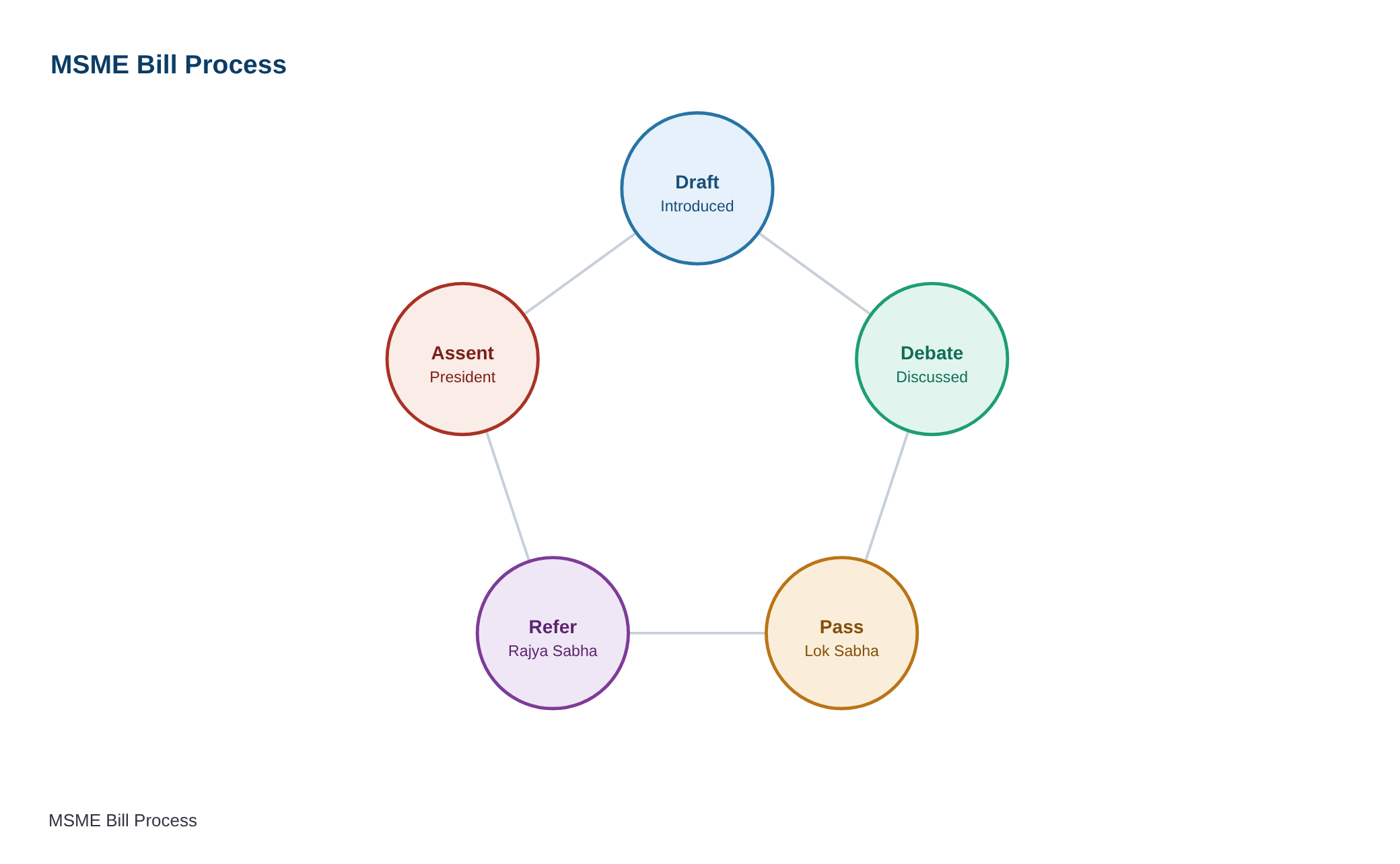
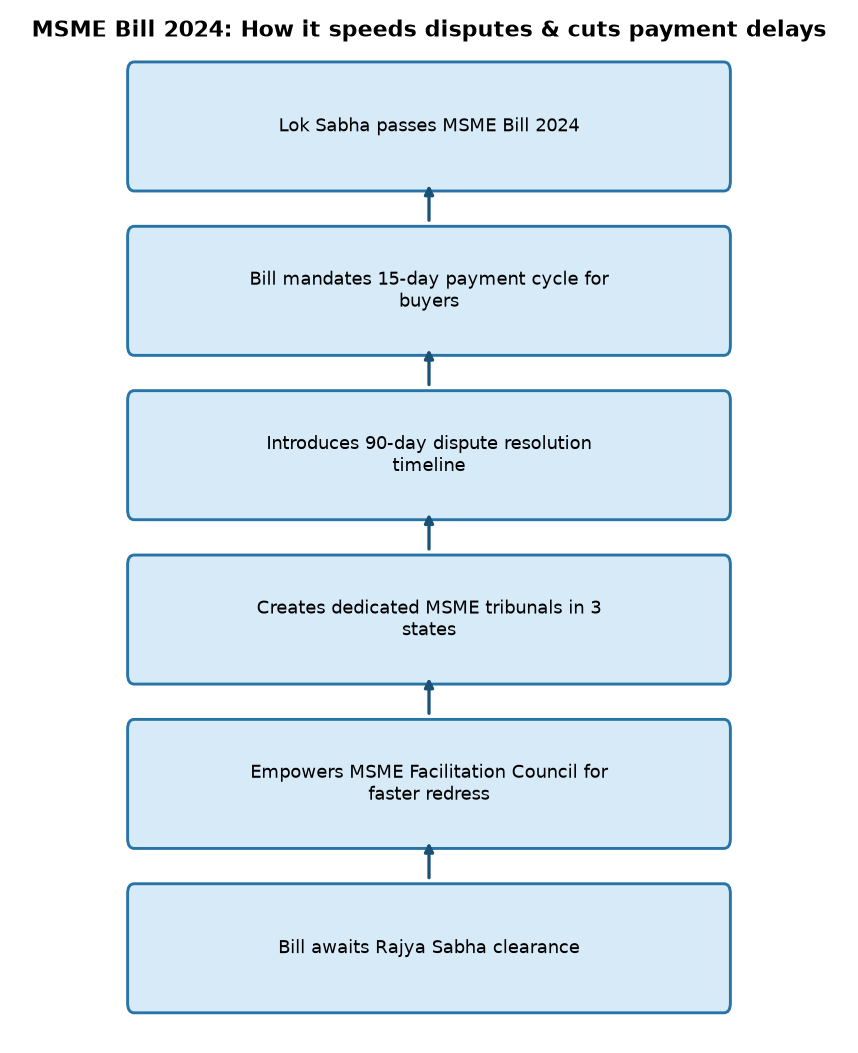
The Lok Sabha recently passed the Micro, Small and Medium Enterprises (MSME) Development (Amendment) Bill, 2024, aimed at addressing systemic issues plaguing the sector, particularly delayed payments and prolonged dispute resolution. The Bill introduces stricter timelines for settling dues owed to MSMEs by larger enterprises, mandating payments within 45 days of invoice receipt—a significant reduction from the existing 120-day limit under the MSMED Act, 2006. It also empowers the Micro and Small Enterprises Facilitation Council (MSEFC) to impose penalties on buyers for non-compliance, ensuring accountability. Additionally, the Bill seeks to expedite dispute resolution by mandating that MSEFCs dispose of cases within 90 days, addressing a long-standing grievance of MSMEs struggling with bureaucratic delays.
For UPSC and State PCS aspirants, this legislation holds critical relevance as it intersects with broader themes of economic governance, ease of doing business, and social justice. The Bill’s focus on payment discipline reflects the government’s commitment to fostering a conducive environment for MSMEs, which contribute nearly 30% to India’s GDP and employ over 110 million people. From a polity perspective, it underscores the role of Parliament in amending sector-specific laws to align with contemporary economic realities, a recurring theme in UPSC’s syllabus on governance and constitutional amendments. The emphasis on timely payments also ties into the broader discourse on financial inclusion and the informal sector’s integration into the formal economy.
The dispute resolution mechanism introduced by the Bill is equally significant for aspirants preparing for State PCS examinations, where questions on state-level implementation of central schemes often feature. The amendment’s provision for MSEFCs to function as quasi-judicial bodies highlights the devolution of administrative authority to state institutions, a key aspect of India’s federal structure. Aspirants should note how such amendments can influence state policies, particularly in states with a high concentration of MSMEs, such as Gujarat, Tamil Nadu, and Maharashtra. The Bill also raises questions about the balance between regulatory oversight and ease of business, a topic frequently probed in mains answer writing.
From an examination standpoint, the MSME Bill serves as a case study for understanding the interplay between legislative intent and ground-level implementation. UPSC often tests candidates on the practical challenges of enforcing such laws, including the capacity of state institutions to enforce penalties and the potential for litigation by defaulters. For State PCS aspirants, the Bill’s provisions on MSEFCs could be linked to questions on state-level grievance redressal mechanisms, such as the role of district-level committees in resolving disputes. The amendment also provides an opportunity to discuss the role of the judiciary in interpreting payment-related disputes, a topic that has seen judicial activism in recent years, such as the Supreme Court’s rulings on insolvency
Source: ndtv.com
Practice Questions
Q1. What is the primary objective of the MSME Bill recently passed by the Lok Sabha?
- To provide financial subsidies to MSMEs for expansion
- To tackle payment delays and speed up dispute resolution for MSMEs
- To increase the tax exemptions for MSMEs
- To mandate a minimum wage for all MSME employees
Answer
To tackle payment delays and speed up dispute resolution for MSMEs — The MSME Bill passed by the Lok Sabha aims to address payment delays faced by Micro, Small, and Medium Enterprises (MSMEs) and expedite the resolution of disputes related to payments.
Q2. Which of the following issues is the MSME Bill primarily designed to address?
- Environmental compliance by MSMEs
- Payment delays and dispute resolution for MSMEs
- Export quotas for MSMEs
- Labor union disputes in MSMEs
Answer
Payment delays and dispute resolution for MSMEs — The bill focuses on resolving payment delays and disputes, which are critical challenges for MSMEs in India.
Generated by AanyaAi for educational purpose.

- एनजीटी ने आगरा के प्रदूषित तालाबों पर 10 सप्ताह में रिपोर्ट मांगी, अतिक्रमण हटाने के निर्देश - September 22, 2026
- NGT Orders Probe into Agra’s Encroached & Polluted Water Bodies in 10 Weeks - September 22, 2026
- यूएनजीए 2026: युद्ध, एआई और सुधार – दुनिया के नेता क्या करेंगे? (UPSC दृष्टिकोण) - September 22, 2026

No Comments