


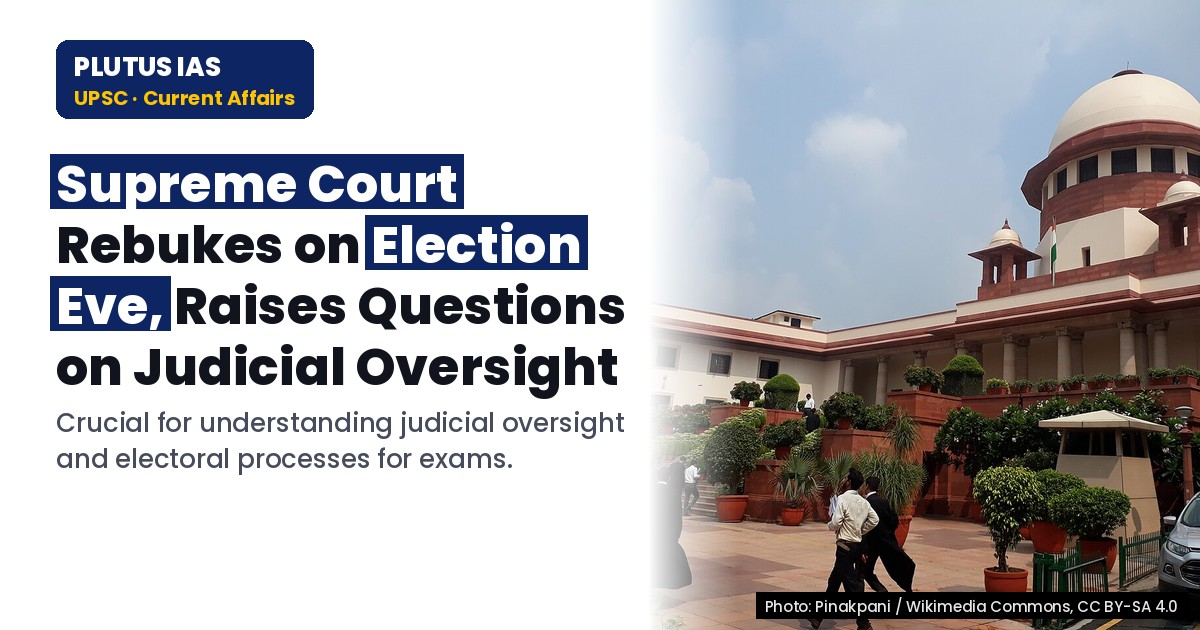
07 Nov Supreme Court’s Election Eve Rebuke: Polity Implications
Relevance for UPSC & State PCS: Polity
The Supreme Court’s recent scathing remarks, delivered on the eve of elections, hold significant weight for UPSC and State PCS aspirants, particularly in understanding the nuances of judicial activism and its impact on the democratic process. The Court’s merciless rebuke, even without direct intervention in the electoral process, sends a powerful message about the judiciary’s role as a watchdog, emphasizing accountability and adherence to constitutional principles. This incident highlights the delicate balance between the executive, legislative, and judicial branches, demonstrating how the judiciary, through its pronouncements, can influence public discourse and potentially shape voter perception, even when not issuing binding orders.
For aspirants, this scenario underscores the critical importance of judicial independence and the judiciary’s power to uphold the rule of law, even against powerful political entities. The timing of the rebuke, just before elections, amplifies its impact, forcing a public reckoning with the issues raised. It illustrates how the Court, by vocally expressing its displeasure, can exert moral authority and pressure on the system, compelling a closer examination of governance and administrative actions. This is a prime example of how the judiciary, without overstepping its bounds into direct policy-making, can still play a crucial role in maintaining democratic health and ensuring transparency.
Furthermore, this event provides a rich case study for understanding the concept of judicial review and the Court’s inherent duty to scrutinize governmental actions. The “merciless rebuke” signifies a strong judicial stance against perceived impropriety or inaction, reinforcing the idea that no institution is above scrutiny. Aspirants should analyze how such judicial pronouncements contribute to strengthening democratic institutions, fostering a culture of accountability, and ultimately safeguarding the constitutional framework. It’s a vivid illustration of how the judiciary, through its pronouncements, acts as a guardian of the constitution, ensuring that the spirit of democracy is upheld, even in politically charged environments.
Source: nytimes.com
Practice Questions
Q1. Which of the following best describes the ‘Supreme Court Rebuke’ mentioned in the context of ‘Election Eve’?
- A judicial order to postpone elections due to irregularities.
- A strong criticism by the Supreme Court regarding a specific action or inaction of an authority.
- A directive from the Supreme Court to increase voter turnout.
- A ruling by the Supreme Court on the validity of election results.
Answer
A strong criticism by the Supreme Court regarding a specific action or inaction of an authority. — The term ‘rebuke’ implies a sharp expression of disapproval or criticism. In a legal context, especially from a high court like the Supreme Court, it refers to a strong condemnation of a particular action, policy, or conduct by an authority or individual, often highlighted for its timing close to an election.
Q2. In the context of Indian elections and the Supreme Court, what is the significance of a ‘rebuke’ delivered on ‘Election Eve’?
- It legally invalidates the upcoming elections.
- It has no bearing on the electoral process but affects public perception.
- It can influence voter sentiment and the political narrative just before polling.
- It mandates a re-evaluation of all candidate nominations.
Answer
It can influence voter sentiment and the political narrative just before polling. — A Supreme Court rebuke, especially when delivered on ‘Election Eve’, is significant because its timing can profoundly influence public opinion, voter sentiment, and the political discourse right before elections, potentially impacting electoral outcomes without necessarily invalidating the process itself.
Generated by AanyaAi for educational purpose.
Related guides on our sites
- Best PSIR optional coaching for upsc
- Best PSIR optional teacher for upsc
- Best teacher of PSIR optional for upsc
- Best PSIR optional coaching in delhi for UPSC

- Supreme Court’s Election Eve Rebuke: Polity Implications - November 7, 2026
- भारत-हंगरी संबंध: व्यापार, निवेश और प्रौद्योगिकी में सहयोग - November 7, 2026
- MP High Court Summons NHAI Director Over Indore-Dewas Bypass - November 7, 2026

No Comments