


07 Aug Mission Poshan 2.0: UPSC’s Guide to India’s Fight Against Malnutrition
✎ Mission Poshan 2.0 integrates digital governance (Poshan Tracker with FRS), strengthens Anganwadi services, and leverages evidence-based evaluations to comprehensively address malnutrition and promote child development in India.
Subject Relevance — Where This Topic Fits
- GS Paper II — Social Justice and Welfare Schemes | GS Paper III — Human Development and Nutrition
- Prelims: Poshan Tracker, Mission Poshan 2.0, Anganwadi Services, Stunting, Anaemia, Complementary Nutrition, ICT-based Governance Tools, Facial Recognition System (FRS), Development Monitoring and Evaluation Office (DMEO), NITI Aayog
- Essay: The Role of Technology in Public Health Governance, Sustainable Development Goals and India’s Progress in Child Nutrition
Quick Revision: Mission Poshan 2.0 integrates digital governance (Poshan Tracker with FRS), strengthens Anganwadi services, and leverages evidence-based evaluations to comprehensively address malnutrition and promote child development in India.
Why is this in the news?
Mission Poshan 2.0 has been highlighted by the Ministry of Women and Child Development as the government’s latest initiative to comprehensively address malnutrition and enhance child development, building on the successes and learnings of previous programmes such as the Poshan Abhiyaan. The initiative has gained prominence due to its integrated approach, digital governance tools like the Poshan Tracker, and evidence-based evaluations demonstrating measurable improvements in nutritional behaviours and service delivery.
Background
- The Government of India has historically implemented nutrition-focused programmes such as the Integrated Child Development Services (ICDS) Scheme, launched in 1975, which provides supplementary nutrition, pre-school education, and health services to children under six years and pregnant/lactating mothers.
- Poshan Abhiyaan, launched in 2018 as a multi-ministerial convergence mission, aimed to reduce stunting, underweight, and anaemia among children, adolescent girls, and pregnant women through targeted interventions and community mobilisation.
- A third-party evaluation of Poshan Abhiyaan by the NITI Aayog in 2020 found the programme’s relevance in addressing malnutrition to be satisfactory, with significant improvements in nutrition-related behaviours.
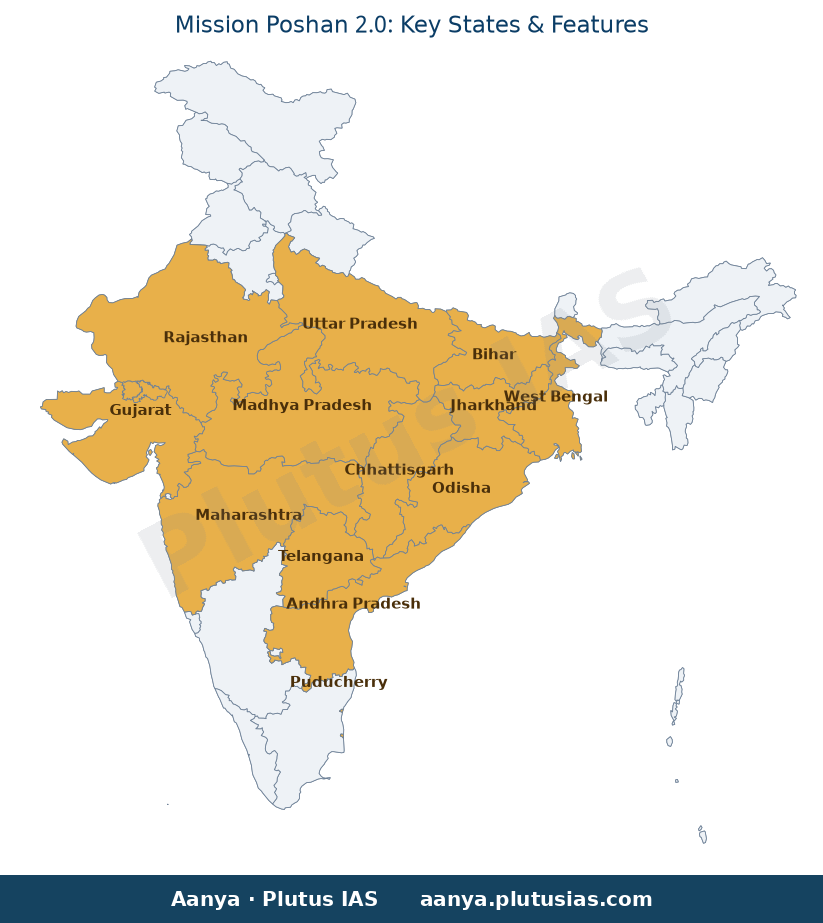
- The World Bank conducted a survey in 2021 across 11 states, including Andhra Pradesh, selected based on high prevalence of stunting in children and anaemia in women, which demonstrated behavioural changes and increased awareness among beneficiaries.
- The Development Monitoring and Evaluation Office (DMEO) of NITI Aayog conducted a result-based evaluation study of Mission Saksham Anganwadi and Poshan 2.0 (Mission Poshan 2.0) in 2025 across 12 states and one Union Territory, reinforcing the need for a strengthened and coordinated approach.
- Malnutrition in India remains a critical public health challenge, with high rates of stunting (35.5% in children under five, NFHS-5 2019-21), wasting (19.3%), and anaemia (57% in women aged 15-49), necessitating sustained and innovative interventions.
What is Mission Poshan 2.0?
- Mission Poshan 2.0 is an upgraded and integrated version of the Poshan Abhiyaan, launched to address malnutrition comprehensively by leveraging the strengths of previous programmes while introducing systemic improvements.
- The initiative adopts a multi-sectoral convergence approach, integrating health, nutrition, sanitation, and early childhood care services to ensure holistic development of children and women.
- It strengthens the delivery of Anganwadi services, including supplementary nutrition, growth monitoring, and counselling, with a focus on improving service utilisation and behavioural outcomes among beneficiaries.
- The programme incorporates digital governance tools such as the Poshan Tracker, a mobile application designed to monitor and review the health and nutrition status of women and children, enabling real-time data-driven decision-making.
- The Poshan Tracker employs facial recognition technology (FRS) to ensure accurate identification of beneficiaries and prevent leakage of entitlements, particularly for take-home rations, thereby enhancing transparency and accountability.
- Aadhaar-based tracking is integrated to prevent data leaks, eliminate fake entries, and ensure that benefits reach only the intended beneficiaries, thereby improving the efficiency of service delivery.
- The programme builds on evidence from evaluations and surveys, such as those conducted by the World Bank and NITI Aayog, which demonstrated significant improvements in nutritional behaviours, including exclusive breastfeeding rates and awareness among women.
- Mission Poshan 2.0 aims to address the root causes of malnutrition through a lifecycle approach, targeting pregnant women, lactating mothers, infants, and young children, with a focus on reducing stunting, wasting, and anaemia.
Key Features
| Feature | Significance |
|---|---|
| Integrated Approach | Combines multiple nutrition programmes (e.g., Supplementary Nutrition, Growth Monitoring, Counselling) under a single framework to address malnutrition holistically. |
| Digital Tracking via ‘Poshan Tracker’ | Uses ICT-based governance tool for real-time monitoring of service delivery, beneficiary identification, and data integrity through Aadhaar linkage. |
| Facial Recognition System (FRS) | Ensures targeted delivery of take-home rations by authenticating beneficiaries at the last mile, reducing leakages and fraud. |
| Behaviour Change Communication | Leverages nutrition messaging to improve maternal and child feeding practices, evidenced by 80%+ reach and 81% exclusive breastfeeding rates. |
| Multi-Stakeholder Coordination | Involves central ministries (MWCD), state governments, and development partners (e.g., World Bank) for evidence-based programme design and evaluation. |
Why it Matters
Public Health
- Directly targets Sustainable Development Goal 2 (Zero Hunger) by reducing stunting, wasting, and anaemia through evidence-based interventions.
- Improves maternal and child health outcomes by promoting exclusive breastfeeding, complementary feeding, and micronutrient supplementation.
- Reduces intergenerational malnutrition cycles by addressing nutritional deficits in early childhood and adolescence.
Governance & Technology
- Demonstrates India’s commitment to leveraging digital public infrastructure (DPI) for social sector delivery, aligning with the ‘Techade’ vision.
- Enhances transparency and accountability in welfare schemes through real-time data tracking and Aadhaar-based authentication.
- Facilitates data-driven policymaking by integrating third-party evaluations (e.g., NITI Aayog, World Bank) and outcome-based assessments.
Socio-Economic Impact
- Contributes to human capital formation by improving cognitive and physical development in children, thereby enhancing future productivity.
- Reduces healthcare costs associated with malnutrition-related diseases (e.g., diarrhoea, anaemia, stunting-related complications).
- Supports gender equity by targeting women’s nutritional status (e.g., anaemia reduction) and empowering them through counselling services.
Challenges
1. Last-Mile Delivery Gaps
- Incomplete coverage of Anganwadi services in remote and tribal areas due to logistical and infrastructure constraints.
- Variations in service quality across states and districts, leading to inconsistent outcomes.
- Dependence on frontline workers (e.g., Anganwadi workers) for data entry and service delivery, which may suffer from high attrition or low motivation.
UPSC Link: GS2: Welfare Schemes
2. Data Integrity & Digital Divide
- Risk of digital exclusion for marginalised populations without access to smartphones or Aadhaar-linked devices.
- Potential for data manipulation or errors in the ‘Poshan Tracker’ due to manual entry or system vulnerabilities.
- Limited digital literacy among beneficiaries and grassroots workers may hinder effective utilisation of ICT tools.
UPSC Link: GS2: E-Governance
3. Behavioural & Cultural Barriers
- Deep-rooted dietary taboos and gender norms may impede adoption of recommended nutrition practices (e.g., exclusive breastfeeding).
- Low awareness about the long-term consequences of malnutrition among rural and tribal communities.
- Resistance to change in traditional feeding practices, particularly in regions with high prevalence of undernutrition.
UPSC Link: GS1: Social Issues
4. Resource Constraints
- Inadequate funding for supplementary nutrition and infrastructure (e.g., Anganwadi centres) in fiscally constrained states.
- Shortage of trained personnel, including nutritionists, paediatricians, and counsellors, to support programme implementation.
- Delays in fund disbursement and procurement of essential commodities (e.g., fortified foods) due to bureaucratic bottlenecks.
UPSC Link: GS3: Resource Mobilisation
5. Monitoring & Evaluation Challenges
- Lack of standardised metrics for measuring behavioural change and nutritional outcomes across states.
- Over-reliance on third-party evaluations, which may not capture real-time ground realities.
- Insufficient integration of nutrition data with broader health information systems (e.g., HMIS) for holistic tracking.
UPSC Link: GS2: Government Policies
Challenges — UPSC Perspective
| Issue | Concern |
|---|---|
| State Disparities | Variations in programme implementation and outcomes due to differential state capacities and priorities. |
| Frontline Worker Burnout | High workload and low incentives for Anganwadi workers leading to suboptimal service delivery. |
| Nutrition Messaging Overload | Risk of information fatigue among beneficiaries due to excessive or conflicting nutrition advice. |
| Supply Chain Disruptions | Delays or shortages in the procurement and distribution of supplementary nutrition products. |
| Caste & Tribal Exclusion | Marginalised communities (e.g., SC/ST) may face systemic barriers in accessing programme benefits. |
| Climate Vulnerability | Extreme weather events (e.g., droughts, floods) disrupt agricultural production and food security, exacerbating malnutrition. |
Government Initiatives — Must-Memorise for Prelims
- Mission Poshan 2.0
- Integrated Child Development Services (ICDS) Scheme
- Saksham Anganwadi and Poshan 2.0
Way Forward
- Strengthen last-mile delivery by expanding digital infrastructure (e.g., mobile vans, community resource centres) in remote and tribal areas.
- Enhance capacity-building programmes for Anganwadi workers and frontline staff to improve service quality and data accuracy.
- Integrate ‘Poshan Tracker’ with other health and nutrition databases (e.g., HMIS, NFSA portals) for seamless data sharing and analytics.
- Launch targeted behaviour change communication campaigns in high-burden districts, leveraging local influencers and community leaders.
- Ensure adequate and timely funding for supplementary nutrition, fortified foods, and Anganwadi infrastructure through multi-year budgeting.
- Promote public-private partnerships to improve supply chain efficiency and innovation in nutrition products (e.g., ready-to-use therapeutic foods).
- Conduct regular third-party audits and citizen feedback mechanisms to identify gaps and address implementation challenges proactively.
- Expand the scope of FRS to include other welfare schemes (e.g., PMMVY, Ujjwala Yojana) to reduce duplication and enhance beneficiary authentication.
UPSC Value Addition
Keywords for Mains Answer-Writing
Mission Poshan 2.0 · Malnutrition eradication · Child development · Poshan Tracker · Anganwadi Services · Nutrition monitoring · ICT-based governance · Facial Recognition System · Complementary Nutrition · Stunting reduction · Anemia in women · Policy Commission evaluation
Constitutional & Policy Linkages
- Article 47: Duty of the State to improve public health and nutrition (Directive Principles of State Policy).
- Article 21: Right to Life includes the right to a dignified life with adequate nutrition and health.
Concept Flow
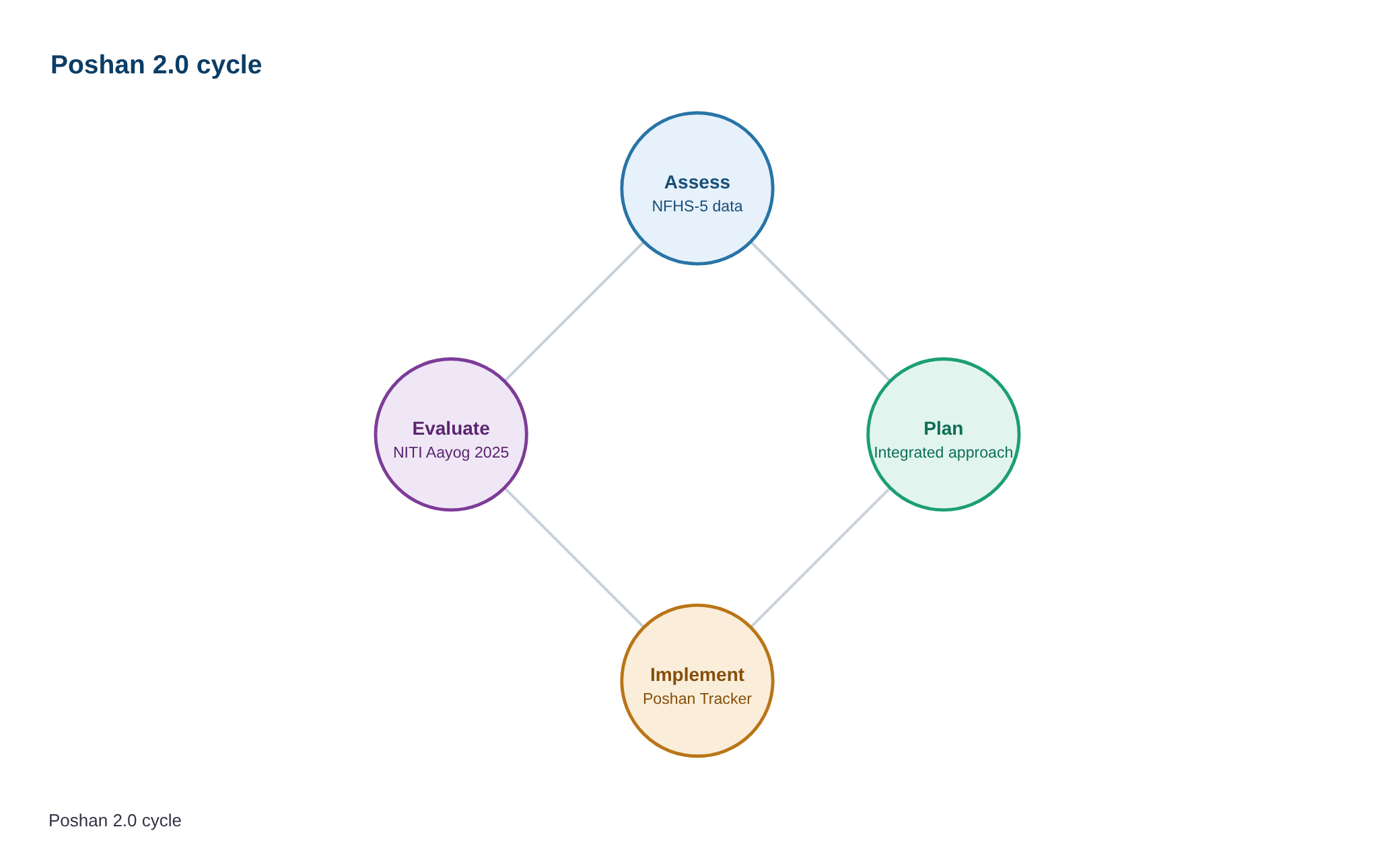
High prevalence of child stunting and anaemia → Government launches Poshan Abhiyaan (2018) → Third-party evaluation (2020) identifies gaps → World Bank survey (2021) validates impact → Mission Poshan 2.0 (2025) integrates services → Digital tools (Poshan Tracker, FRS) enhance delivery → Behaviour change communication improves nutrition practices → Long-term outcomes: reduced malnutrition, improved child development.
Prelims Practice Questions
Q1. Consider the following statements regarding Mission Poshan 2.0:
1. It is an ICT-based governance initiative launched by the Ministry of Women and Child Development.
2. The Poshan Tracker application includes a Facial Recognition System to ensure targeted delivery of take-home rations.
3. The program was evaluated by the World Bank in 2021 across 11 states, including Andhra Pradesh.
How many of the above statements are correct?
- Only one
- Only two
- All three
- None
Answer: All three — Statements 1 and 2 are correct. Statement 3 is incorrect as the World Bank survey was conducted in 2021, but it was not an evaluation of Mission Poshan 2.0, which was launched later. The survey focused on the Poshan Abhiyaan.
Q2. Which of the following is NOT a component of the services provided under Mission Poshan 2.0?
- Supplementary Nutrition
- Development Monitoring
- Counseling
- Universal Basic Income for pregnant women
- Prenatal and Postnatal Care
Answer: Prenatal and Postnatal Care — Universal Basic Income for pregnant women is not a component of Mission Poshan 2.0. The program focuses on supplementary nutrition, development monitoring, and counseling through Anganwadi services.
Q3. Assertion (A): The Poshan Tracker application uses Aadhaar-based tracking to prevent data leaks and fake entries.
Reason (R): Aadhaar-based tracking ensures accurate identification of beneficiaries and enhances transparency in service delivery.
Options:
A. Both A and R are true, and R is the correct explanation of A.
B. Both A and R are true, but R is NOT the correct explanation of A.
C. A is true, but R is false.
D. A is false, but R is true.
Answer: ? — Both Assertion (A) and Reason (R) are true, and Reason (R) correctly explains Assertion (A). Aadhaar-based tracking in the Poshan Tracker application ensures accurate beneficiary identification, prevents data leaks, and eliminates fake entries, thereby enhancing transparency.
Mains Practice Question
✍ Critically examine the design and implementation of Mission Poshan 2.0 as a comprehensive strategy to address malnutrition in India. How does the integration of ICT tools like the Poshan Tracker and Facial Recognition System enhance the effectiveness of the program? (15 Marks)
Approach: MODEL-ANSWER SKELETON:
1. **Introduction (2 Marks)**
– Define Mission Poshan 2.0 and its objectives: holistic approach to combat malnutrition, promote child development, and integrate previous programs like Poshan Abhiyaan.
– Context: High prevalence of stunting, wasting, and anemia in India, as highlighted by NFHS-5 data.
2. **Design of Mission Poshan 2.0 (5 Marks)**
– **Convergence and Coordination**: Integration of multiple ministries (WCD, Health, Rural Development) and schemes (ICDS, PMMVY, NHM).
– **Targeted Services**: Supplementary nutrition, growth monitoring, counseling, and early childhood care through Anganwadi centers.
– **Evidence-Based Approach**: Leveraging evaluations from Policy Commission (2020) and World Bank (2021) to refine interventions.
– **ICT Integration**: Poshan Tracker for real-time monitoring, data analytics, and beneficiary tracking.
3. **Implementation Challenges (4 Marks)**
– **Last-Mile Delivery**: Ensuring last-mile connectivity in rural and tribal areas for effective service delivery.
– **Behavioral Change**: Sustaining nutrition-related behavioral changes among communities, particularly in high-burden states.
– **Data Privacy and Security**: Addressing concerns related to Aadhaar-based tracking and facial recognition in the Poshan Tracker.
– **Inter-State Disparities**: Variability in implementation across states due to administrative and resource constraints.
4. **Role of ICT Tools (4 Marks)**
– **Poshan Tracker**: Real-time data collection, beneficiary identification, and monitoring of service delivery. Use of Aadhaar to prevent duplication and ensure transparency.
– **Facial Recognition System (FRS)**: Ensures targeted delivery of take-home rations by authenticating beneficiaries, reducing leakages and pilferage.
– **Digital Literacy**: Training Anganwadi workers and beneficiaries to use ICT tools effectively.
– **Accountability and Governance**: Enhances transparency, reduces corruption, and enables evidence-based policy adjustments.
5. **Conclusion (2 Marks)**
– Mission Poshan 2.0 represents a paradigm shift in India’s approach to malnutrition by combining convergence, technology, and community engagement.
– While the program holds significant promise, its success depends on addressing implementation gaps, ensuring equitable service delivery, and sustaining behavioral change. The integration of ICT tools like the Poshan Tracker and FRS is a critical enabler but must be complemented by robust ground-level monitoring and community participation.
Source: PIB (Press Information Bureau)
Generated by AanyaAi for educational purpose.

- वस्त्र मंत्रालय ने शुरू किया ‘स्वच्छता ही सेवा 2026’ अभियान: जाने प्रमुख पहल - September 24, 2026
- Swachhata Hi Seva 2026: Textile Ministry’s Nationwide Cleanliness & Green Initiatives - September 24, 2026
- आरबीआई ने क्लेम एक्सिवा फाइनेंस पर लगाया 2.70 लाख रुपये का जुर्माना - September 24, 2026

No Comments